I need help with d) please help thank you
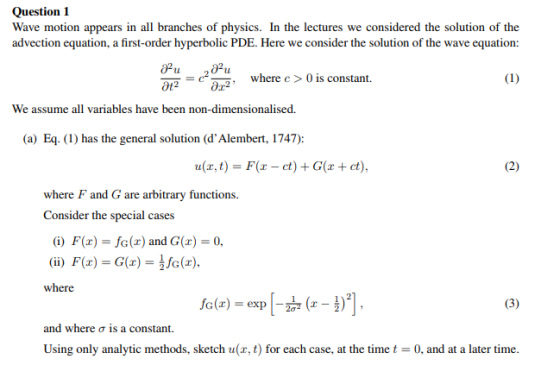
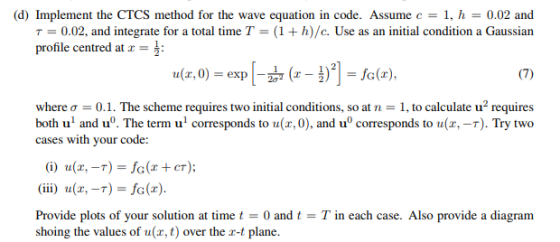
d) Implement the CTCS method for the wave equation in code. Assume c1, h0.02 and τ = 0.02, and integrate for a total time T = (1 + 1)/c. Use as an initial condition a Gaussian profile centred at where σ = 0.1·The scheme requires two initial conditions, so at n = 1, to calculate u2 requires both ui and uo. The term ui corresponds to u (z,0), and uo corresponds to u (z,-r). Try two cases with your code: (i) u(z,-r) = fe(r+CT): (iii) u(z.-r)-fe(r). Provide plots of your solution at time t = 0 and t = T in each case. Also provide a diagram shoing the values of u(x, t) over the r-t plane.
Homework Answers

Add Answer to:
I need help with d) please help thank you Question 1 Wave motion appears in all branches of physics. In the lectures we...
1. Let u be a solution of the wave equation u 0. Let the points A, B, C, D be the vertices of the...
 1. Let u be a solution of the wave equation u 0. Let the points A, B, C, D be the vertices of the paralleogram formed by the two pairs of characteristic lines r-ctC1,x- ct-2,+ ct- di,r +ct- d2 Show that u (A)+u (C)-u (B) + u (D Use this to find u satisfying For which (x, t) can you determine u (x, t) uniquely this way? 2. Suppose u satisfies the wave equation utt -curr0 in the strip 0...
1. Let u be a solution of the wave equation u0. Let the points A, B, C, D be the vertices of the ...
 1. Let u be a solution of the wave equation u0. Let the points A, B, C, D be the vertices of the paralleogram formed by the two pairs of characteristic lines z--d-q,z-ct-c2, z + ct = di, z + ct d2. Show that u(A) u (C) u(B) +u(D) Use this to find u satisfying till- tLzz =0, u( s,s)-s, u(8,8)-82 for s > 0. For which (r, t) can you determine u (x, t) uniquely this way?
1. Let...
1. Let u be a solution of the wave equation u0. Let the points A, B, C, D be the vertices of the paralleogram formed by the two pairs of characteristic lines z--d-q,z-ct-c2, z + ct = di, z + ct d2. Show that u(A) u (C) u(B) +u(D) Use this to find u satisfying till- tLzz =0, u( s,s)-s, u(8,8)-82 for s > 0. For which (r, t) can you determine u (x, t) uniquely this way?
1. Let...
d1= 3 & d2= 2 Question 2 Find the solution 11(x, 1) for the 1-D wave equation aT = (a) 25-for -o <x < oo with initial conditions it (x,0) = A (x) , where A(x) is presented in the diagram bel...
 d1= 3 & d2= 2
Question 2 Find the solution 11(x, 1) for the 1-D wave equation aT = (a) 25-for -o <x < oo with initial conditions it (x,0) = A (x) , where A(x) is presented in the diagram below, and zero initial velocity. For full marks u(x,t) needs to be expressed as an equation involving x and 1, somewhat similar to fex) on page 8s of the Notes Part 2. 2 d2+5 r-0 di+10 di+15 di+20 3...
d1= 3 & d2= 2
Question 2 Find the solution 11(x, 1) for the 1-D wave equation aT = (a) 25-for -o <x < oo with initial conditions it (x,0) = A (x) , where A(x) is presented in the diagram below, and zero initial velocity. For full marks u(x,t) needs to be expressed as an equation involving x and 1, somewhat similar to fex) on page 8s of the Notes Part 2. 2 d2+5 r-0 di+10 di+15 di+20 3...
Question 2 ul lu (a) Find the solution u(x,t) for the 1-D wave equationfor -oo < x < oo with initial conditions u (x,0)-A(x) , where A(x) s presented in the diagram below, and zero initial velo...
 Question 2 ul lu (a) Find the solution u(x,t) for the 1-D wave equationfor -oo < x < oo with initial conditions u (x,0)-A(x) , where A(x) s presented in the diagram below, and zero initial velocity. For full marks u(x,t) needs to be expressed as an equation involving x and t, somewhat similar to f(x) on page 85 of the Notes Part 2. di+10 dı+15di+20 (b) Check for the wave equation in (a) that if f(xtct) (use appropriate value...
d1=8 d2=9 lu for Find the solution u(x,t) for the l-D wave equation-=- Qx2 25 at2 (a) oo < x < oo with initial conditions u(x,0)-A(x) , where A(x) Is presented in the diagram below, and zero in...
 d1=8
d2=9
lu for Find the solution u(x,t) for the l-D wave equation-=- Qx2 25 at2 (a) oo < x < oo with initial conditions u(x,0)-A(x) , where A(x) Is presented in the diagram below, and zero initial velocity. For full marks u(x,t) needs to be expressed as an equation involving x and t, somewhat similar to f(x) on page 85 of the Notes Part 2. d2+5 di+10 di+15dı+20 (b) Check for the wave equation in (a) that if (x...
d1=8
d2=9
lu for Find the solution u(x,t) for the l-D wave equation-=- Qx2 25 at2 (a) oo < x < oo with initial conditions u(x,0)-A(x) , where A(x) Is presented in the diagram below, and zero initial velocity. For full marks u(x,t) needs to be expressed as an equation involving x and t, somewhat similar to f(x) on page 85 of the Notes Part 2. d2+5 di+10 di+15dı+20 (b) Check for the wave equation in (a) that if (x...
Please answer question b. 4.3 In the derivation in Sect.4.1, suppose we include the effect of...
 Please answer question b.
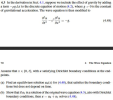
4.3 In the derivation in Sect.4.1, suppose we include the effect of gravity by adding a term-Pg Ar to the discrete equation of motion (4.2), where g>O is the constant of gravitational acceleration. The wave equation is then modified to (4.48) 012 r2 = -8. 70 4 The Wave Equation Assume that x € (0,), with u satisfying Dirichlet boundary conditions at the end points. (a) Find an equilibrium solution uo(x) for (4.48), that satisfies the...
Please answer question b.
4.3 In the derivation in Sect.4.1, suppose we include the effect of gravity by adding a term-Pg Ar to the discrete equation of motion (4.2), where g>O is the constant of gravitational acceleration. The wave equation is then modified to (4.48) 012 r2 = -8. 70 4 The Wave Equation Assume that x € (0,), with u satisfying Dirichlet boundary conditions at the end points. (a) Find an equilibrium solution uo(x) for (4.48), that satisfies the...
PROBLEM 4.3. The one-dimensional wave equation is ə?u - 20u = 0, ət2 or where c>...
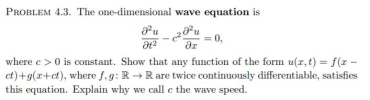 PROBLEM 4.3. The one-dimensional wave equation is ə?u - 20u = 0, ət2 or where c> 0 is constant. Show that any function of the form u(x, t) = f(x - ct)+9(2+ct), where f,g: RR are twice continuously differentiable, satisfies this equation. Explain why we call c the wave speed.
all parts, please For this problem, we'll solve the 3D wave equation in a box. The...
 all parts, please
For this problem, we'll solve the 3D wave equation in a box. The Laplacian in 3 dimensions is a2 vu= a2 a2 ou + ay? U= and the wave equation is 22 a2 at24 = 1 (a) (3 Points) Use separation of variables with ur,y,z,t) = S(x, y, z)T(t) to get a spatial PDE and a temporal ODE for this problem, call the separation constant A. Show all your work! (b) (3 Points) The spatial equation should...
all parts, please
For this problem, we'll solve the 3D wave equation in a box. The Laplacian in 3 dimensions is a2 vu= a2 a2 ou + ay? U= and the wave equation is 22 a2 at24 = 1 (a) (3 Points) Use separation of variables with ur,y,z,t) = S(x, y, z)T(t) to get a spatial PDE and a temporal ODE for this problem, call the separation constant A. Show all your work! (b) (3 Points) The spatial equation should...
need help with this problem. please explain, thank you. 8. Consider a particle encountering a barrier...
 need help with this problem. please explain, thank you.
8. Consider a particle encountering a barrier with potential U = U, >0 between x = -a and x = a with incoming energy E > U. a) Write the symbolic wave functions before and after passing through the barrier (i.e., for xs-a and x>a; regions I and III). UN b) Write down the Schrodinger equation for the wave function in the middle (region II) where the potential is non-zero i.e.,...
need help with this problem. please explain, thank you.
8. Consider a particle encountering a barrier with potential U = U, >0 between x = -a and x = a with incoming energy E > U. a) Write the symbolic wave functions before and after passing through the barrier (i.e., for xs-a and x>a; regions I and III). UN b) Write down the Schrodinger equation for the wave function in the middle (region II) where the potential is non-zero i.e.,...
*Please, answer all the literals and be detailed with the answer (do all the procedure and calculations) *Do it with a clear letter Homework (scattering) 1. Consider the time dependent Schrödinger eq...
 *Please, answer all the literals and be detailed with the answer
(do all the procedure and calculations)
*Do it with a clear letter
Homework (scattering) 1. Consider the time dependent Schrödinger equation written in the form where 0 2mo As it is well known the temporal evolution of a wave function ψ( t) known at a specific time t is uniquely determined for all future times t, > t as well as for all past times t' < t. Moreover,...
*Please, answer all the literals and be detailed with the answer
(do all the procedure and calculations)
*Do it with a clear letter
Homework (scattering) 1. Consider the time dependent Schrödinger equation written in the form where 0 2mo As it is well known the temporal evolution of a wave function ψ( t) known at a specific time t is uniquely determined for all future times t, > t as well as for all past times t' < t. Moreover,...
 1. Let u be a solution of the wave equation u 0. Let the points A, B, C, D be the vertices of the paralleogram formed by the two pairs of characteristic lines r-ctC1,x- ct-2,+ ct- di,r +ct- d2 Show that u (A)+u (C)-u (B) + u (D Use this to find u satisfying For which (x, t) can you determine u (x, t) uniquely this way? 2. Suppose u satisfies the wave equation utt -curr0 in the strip 0...
 1. Let u be a solution of the wave equation u0. Let the points A, B, C, D be the vertices of the paralleogram formed by the two pairs of characteristic lines z--d-q,z-ct-c2, z + ct = di, z + ct d2. Show that u(A) u (C) u(B) +u(D) Use this to find u satisfying till- tLzz =0, u( s,s)-s, u(8,8)-82 for s > 0. For which (r, t) can you determine u (x, t) uniquely this way?
1. Let...
1. Let u be a solution of the wave equation u0. Let the points A, B, C, D be the vertices of the paralleogram formed by the two pairs of characteristic lines z--d-q,z-ct-c2, z + ct = di, z + ct d2. Show that u(A) u (C) u(B) +u(D) Use this to find u satisfying till- tLzz =0, u( s,s)-s, u(8,8)-82 for s > 0. For which (r, t) can you determine u (x, t) uniquely this way?
1. Let...
 d1= 3 & d2= 2
Question 2 Find the solution 11(x, 1) for the 1-D wave equation aT = (a) 25-for -o <x < oo with initial conditions it (x,0) = A (x) , where A(x) is presented in the diagram below, and zero initial velocity. For full marks u(x,t) needs to be expressed as an equation involving x and 1, somewhat similar to fex) on page 8s of the Notes Part 2. 2 d2+5 r-0 di+10 di+15 di+20 3...
d1= 3 & d2= 2
Question 2 Find the solution 11(x, 1) for the 1-D wave equation aT = (a) 25-for -o <x < oo with initial conditions it (x,0) = A (x) , where A(x) is presented in the diagram below, and zero initial velocity. For full marks u(x,t) needs to be expressed as an equation involving x and 1, somewhat similar to fex) on page 8s of the Notes Part 2. 2 d2+5 r-0 di+10 di+15 di+20 3...
 Question 2 ul lu (a) Find the solution u(x,t) for the 1-D wave equationfor -oo < x < oo with initial conditions u (x,0)-A(x) , where A(x) s presented in the diagram below, and zero initial velocity. For full marks u(x,t) needs to be expressed as an equation involving x and t, somewhat similar to f(x) on page 85 of the Notes Part 2. di+10 dı+15di+20 (b) Check for the wave equation in (a) that if f(xtct) (use appropriate value...
 d1=8
d2=9
lu for Find the solution u(x,t) for the l-D wave equation-=- Qx2 25 at2 (a) oo < x < oo with initial conditions u(x,0)-A(x) , where A(x) Is presented in the diagram below, and zero initial velocity. For full marks u(x,t) needs to be expressed as an equation involving x and t, somewhat similar to f(x) on page 85 of the Notes Part 2. d2+5 di+10 di+15dı+20 (b) Check for the wave equation in (a) that if (x...
d1=8
d2=9
lu for Find the solution u(x,t) for the l-D wave equation-=- Qx2 25 at2 (a) oo < x < oo with initial conditions u(x,0)-A(x) , where A(x) Is presented in the diagram below, and zero initial velocity. For full marks u(x,t) needs to be expressed as an equation involving x and t, somewhat similar to f(x) on page 85 of the Notes Part 2. d2+5 di+10 di+15dı+20 (b) Check for the wave equation in (a) that if (x...
 Please answer question b.
4.3 In the derivation in Sect.4.1, suppose we include the effect of gravity by adding a term-Pg Ar to the discrete equation of motion (4.2), where g>O is the constant of gravitational acceleration. The wave equation is then modified to (4.48) 012 r2 = -8. 70 4 The Wave Equation Assume that x € (0,), with u satisfying Dirichlet boundary conditions at the end points. (a) Find an equilibrium solution uo(x) for (4.48), that satisfies the...
Please answer question b.
4.3 In the derivation in Sect.4.1, suppose we include the effect of gravity by adding a term-Pg Ar to the discrete equation of motion (4.2), where g>O is the constant of gravitational acceleration. The wave equation is then modified to (4.48) 012 r2 = -8. 70 4 The Wave Equation Assume that x € (0,), with u satisfying Dirichlet boundary conditions at the end points. (a) Find an equilibrium solution uo(x) for (4.48), that satisfies the...
 PROBLEM 4.3. The one-dimensional wave equation is ə?u - 20u = 0, ət2 or where c> 0 is constant. Show that any function of the form u(x, t) = f(x - ct)+9(2+ct), where f,g: RR are twice continuously differentiable, satisfies this equation. Explain why we call c the wave speed.
 all parts, please
For this problem, we'll solve the 3D wave equation in a box. The Laplacian in 3 dimensions is a2 vu= a2 a2 ou + ay? U= and the wave equation is 22 a2 at24 = 1 (a) (3 Points) Use separation of variables with ur,y,z,t) = S(x, y, z)T(t) to get a spatial PDE and a temporal ODE for this problem, call the separation constant A. Show all your work! (b) (3 Points) The spatial equation should...
all parts, please
For this problem, we'll solve the 3D wave equation in a box. The Laplacian in 3 dimensions is a2 vu= a2 a2 ou + ay? U= and the wave equation is 22 a2 at24 = 1 (a) (3 Points) Use separation of variables with ur,y,z,t) = S(x, y, z)T(t) to get a spatial PDE and a temporal ODE for this problem, call the separation constant A. Show all your work! (b) (3 Points) The spatial equation should...
 need help with this problem. please explain, thank you.
8. Consider a particle encountering a barrier with potential U = U, >0 between x = -a and x = a with incoming energy E > U. a) Write the symbolic wave functions before and after passing through the barrier (i.e., for xs-a and x>a; regions I and III). UN b) Write down the Schrodinger equation for the wave function in the middle (region II) where the potential is non-zero i.e.,...
need help with this problem. please explain, thank you.
8. Consider a particle encountering a barrier with potential U = U, >0 between x = -a and x = a with incoming energy E > U. a) Write the symbolic wave functions before and after passing through the barrier (i.e., for xs-a and x>a; regions I and III). UN b) Write down the Schrodinger equation for the wave function in the middle (region II) where the potential is non-zero i.e.,...
 *Please, answer all the literals and be detailed with the answer
(do all the procedure and calculations)
*Do it with a clear letter
Homework (scattering) 1. Consider the time dependent Schrödinger equation written in the form where 0 2mo As it is well known the temporal evolution of a wave function ψ( t) known at a specific time t is uniquely determined for all future times t, > t as well as for all past times t' < t. Moreover,...
*Please, answer all the literals and be detailed with the answer
(do all the procedure and calculations)
*Do it with a clear letter
Homework (scattering) 1. Consider the time dependent Schrödinger equation written in the form where 0 2mo As it is well known the temporal evolution of a wave function ψ( t) known at a specific time t is uniquely determined for all future times t, > t as well as for all past times t' < t. Moreover,...
Most questions answered within 3 hours.
-
Where is the error in this code sequence?
String s1 = "Hello";
String s2 = "ello";...
asked 10 months ago -
Financial data for Joel de Paris, Inc., for last year
follow:
Joel de Paris, Inc.
Balance...
asked 10 months ago -
Consider this reaction:
Al2(SO4)3 (aq)+ BaCl3
(aq) Al2Cl6 (aq)- +
3BaSO4(s) . What is the...
asked 10 months ago -
Suppose that Savneet is considering increasing her
recent random sample from 20 car rentals to 40...
asked 10 months ago -
Trucks arrive at an unloading terminal at an average rate of 120
per hour.
Trucks arrive...
asked 10 months ago -
Why are methanol and ethanol completely soluble in water while
octanol is not very little soluble....
asked 10 months ago -
A facilities manager at a university reads in a research report
that the mean amount of...
asked 10 months ago -
When the CuSO4 is rehydrated by adding water to the anhydrous
compound, is this an endothermic...
asked 10 months ago -
A ray of sunlight is passing from diamond into crown glass; the
angle of incidence is...
asked 10 months ago -
A block of mass 0.249 kg is placed on top of a light, vertical
spring of...
asked 10 months ago -
how do the kidneys compensate in the presences of acidosis
a) trigger hyperventilate
b) reserve acid...
asked 10 months ago -
Question 501 pts
The rental rate of capital to the firm increases. Which of the
following...
asked 10 months ago