How is cumulative translation adjustment calculated? And how are net assets calculated that plays a part in this?
How is cumulative translation adjustment calculated? And how are net assets calculated that plays a part in this?
Homework Answers
A cumulative translation adjustment (CTA) is calculated in accumulated other comprehensive income section of a translated balance sheet summarizing the gains and losses resulting from change in exchange rates over time. A CTA representation is required under the Financial Accounting Standards Board (FASB) as part of Statement 52 for the purpose of reporting to investors to enable them to differentiate between actual operating gains and losses and those generated through currency translation.
How are net assets calculated
The translation of financial statements begins with translating the income statement. FASB ASC Topic 830, Foreign Currency Matters, requires that all income transactions be translated at the rate that existed when the transaction occurred. In most cases the use of an average rate is acceptable where transactions occur uniformly throughout the year. In our case, we will use an average rate based on the average annual rate, but businesses that are seasonal or transact business in currencies that fluctuate widely may want to translate using rates based on monthly weighted averages.Calculation of cumulative translation adjustment could be understood from the given example.
For example, if a U.S.-based company wishes to operate in United Kingdom, it must convert some of its U.S. dollars to GBP for purposes of purchasing or renting property, paying employees, paying HMRC (tax authority in UK) taxes, etc. In addition, UK citizens or businesses that work with this U.S.-based company will pay with GBPs. The company will report its financial statements in one currency, the dollar. It must convert the value of its business activities conducted in Uk with the GBPs back to dollars via an exchange rate.
Add Answer to:
How is cumulative translation adjustment calculated? And how are net assets calculated that plays a part in this?
Question #1: What is the annual change in the translation adjustment for Year 1? Question #2: What is the cumulative tr...
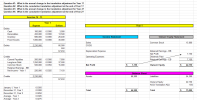 Question #1: What is the annual change in the translation adjustment for Year 1? Question #2: What is the cumulative translation adjustment at the end of Year 1? Question #3: What is the annual change in the translation adjustment for Year 2? Question #4: What is the cumulative translation adjustment at the end of Year 2? Exercise 12-13 Year 1 Rupees Dollars Year 1 Debits Cash Receivables Inventory Fixed Assets 100,000 450,000 680,000 1,000,000 0.0300 0.0300 0.0300 0.0300 3,000 13,500...
Which method, current or temporal (translation versus remeasurement), or neither, are the following statements describing? a. A translation adjustment can affect consolidated net income b. Intang...
Which method, current or temporal (translation versus remeasurement), or neither, are the following statements describing? a. A translation adjustment can affect consolidated net income b. Intangible assets are translated at the historical exchange rate at the date of acquisition. c. A translation adjustment is created by the change in the relative value of a subsidiary's net assets caused by exchange rate fluctuations. d. A translation adjustment is created by the change in the relative value of a subsidiary's monetary assets...
Problem II. Translation/Remeasurement Adjustment Anna Co. started 2018 with two assets: Cash of $20,000 (Stickles) and...
 Problem II. Translation/Remeasurement Adjustment Anna Co. started 2018 with two assets: Cash of $20,000 (Stickles) and Land that originally cost $72,000 when acquired on April 4, 2015. On May 1, 2018, the company rendered services to a customer for $36,000, an amount immediately paid in cash. On October 1, 2018, the company incurred an operating expense of $22,000 that was immediately paid. No other transactions occurred during the year so an average exchange rate is not necessary. Currency exchange rates...
1. What are net assets employed and how are they calculated? Please explain thoroughly.
1. What are net assets employed and how are they calculated? Please explain thoroughly.
How is the book value of plant assets calculated? What is the net book value of...
How is the book value of plant assets calculated? What is the net book value of McDonald'sMcDonald's plant assets as of December 31, 20152015? (Enter any amounts in millions, to the nearest tenth of a million, X.X, as shown in the financial statements.) Book value of plant assets is equal to The net book value of the company's plant assets as of December 31, 2015 is $ (in millions).
If the adjustment for depreciation is not recorded a. assets are understated. O b. net income...
 If the adjustment for depreciation is not recorded a. assets are understated. O b. net income is overstated. c. net income is correctly stated. O d. revenues are overstated.
how we get 0.7 after adjustment, what is this adjustment, what numbers we calculated to get...
 how we get 0.7 after adjustment, what is this adjustment, what
numbers we calculated to get it ? ( clearlyful ...How we get 0.7 ?
where'd how exactly it came from ?
Refrence
Deegan. (2016). Financial Accounting . McGraw-Hill
Education, Australia
Prepare the journal entries under both the cost and the equity method of accounting for the investment in Pa Ltd for the year ending 30 June 2020 (that is, two years after acquisition). LO 32.7 20. On 1 July...
how we get 0.7 after adjustment, what is this adjustment, what
numbers we calculated to get it ? ( clearlyful ...How we get 0.7 ?
where'd how exactly it came from ?
Refrence
Deegan. (2016). Financial Accounting . McGraw-Hill
Education, Australia
Prepare the journal entries under both the cost and the equity method of accounting for the investment in Pa Ltd for the year ending 30 June 2020 (that is, two years after acquisition). LO 32.7 20. On 1 July...
Please calculate the re-measurement(a.) and the translation adjustment (b.) below. The following account balances are for...
 Please calculate the re-measurement(a.) and the translation
adjustment (b.) below.
The following account balances are for the Agee Company as of January 1, 2017, and December 31, 2017. All amounts are denominated in kroner (Kr) January 1, 2017 31, 2017 Accounts payable Accounts receivable Accumulated depreciation-buildings Accumulated depreciation-equipment Bonds payable-due 2020 Buildings Cash Common stock Depreciation expense Dividends (10/1/17) Equipment Gain on sale of building Rent expense Retained earnings Salary expense Sales Utilities expense (14,000) 40,000 (22,000) 90,000 36,000) (6,100)...
Please calculate the re-measurement(a.) and the translation
adjustment (b.) below.
The following account balances are for the Agee Company as of January 1, 2017, and December 31, 2017. All amounts are denominated in kroner (Kr) January 1, 2017 31, 2017 Accounts payable Accounts receivable Accumulated depreciation-buildings Accumulated depreciation-equipment Bonds payable-due 2020 Buildings Cash Common stock Depreciation expense Dividends (10/1/17) Equipment Gain on sale of building Rent expense Retained earnings Salary expense Sales Utilities expense (14,000) 40,000 (22,000) 90,000 36,000) (6,100)...
Exercise 13-4 On January 1, 2014, Trenten Systems, a U.S.-based company, purchased a controlling interest in...
 Exercise 13-4
On January 1, 2014, Trenten Systems, a U.S.-based company,
purchased a controlling interest in Grant Management Consultants
located in Zurich, Switzerland. The acquisition was treated as a
purchase transaction. The 2014 financial statements stated in Swiss
francs are given below.
GRANT MANAGEMENT CONSULTANTS
Comparative Balance Sheets
January 1 and December 31, 2014
Jan. 1
Dec. 31
Cash and Receivables
19,600
54,000
Net Property, Plant, and Equipment
40,000
36,600
Totals
59,600
90,600
Accounts and Notes Payable
30,100
32,100
Common...
Exercise 13-4
On January 1, 2014, Trenten Systems, a U.S.-based company,
purchased a controlling interest in Grant Management Consultants
located in Zurich, Switzerland. The acquisition was treated as a
purchase transaction. The 2014 financial statements stated in Swiss
francs are given below.
GRANT MANAGEMENT CONSULTANTS
Comparative Balance Sheets
January 1 and December 31, 2014
Jan. 1
Dec. 31
Cash and Receivables
19,600
54,000
Net Property, Plant, and Equipment
40,000
36,600
Totals
59,600
90,600
Accounts and Notes Payable
30,100
32,100
Common...
1) How is the current ratio calculated? a. current assets minus current liabilities b. total assets...
1) How is the current ratio calculated? a. current assets minus current liabilities b. total assets divided by total liabilities c. total assets minus total liabilities d. current assets divided by current liabilities 2) The common size income statement reports each income statement item as a percentage of a. net sales b. net income c. gross sales d. total assets
 Question #1: What is the annual change in the translation adjustment for Year 1? Question #2: What is the cumulative translation adjustment at the end of Year 1? Question #3: What is the annual change in the translation adjustment for Year 2? Question #4: What is the cumulative translation adjustment at the end of Year 2? Exercise 12-13 Year 1 Rupees Dollars Year 1 Debits Cash Receivables Inventory Fixed Assets 100,000 450,000 680,000 1,000,000 0.0300 0.0300 0.0300 0.0300 3,000 13,500...
 Problem II. Translation/Remeasurement Adjustment Anna Co. started 2018 with two assets: Cash of $20,000 (Stickles) and Land that originally cost $72,000 when acquired on April 4, 2015. On May 1, 2018, the company rendered services to a customer for $36,000, an amount immediately paid in cash. On October 1, 2018, the company incurred an operating expense of $22,000 that was immediately paid. No other transactions occurred during the year so an average exchange rate is not necessary. Currency exchange rates...
 If the adjustment for depreciation is not recorded a. assets are understated. O b. net income is overstated. c. net income is correctly stated. O d. revenues are overstated.
 how we get 0.7 after adjustment, what is this adjustment, what
numbers we calculated to get it ? ( clearlyful ...How we get 0.7 ?
where'd how exactly it came from ?
Refrence
Deegan. (2016). Financial Accounting . McGraw-Hill
Education, Australia
Prepare the journal entries under both the cost and the equity method of accounting for the investment in Pa Ltd for the year ending 30 June 2020 (that is, two years after acquisition). LO 32.7 20. On 1 July...
how we get 0.7 after adjustment, what is this adjustment, what
numbers we calculated to get it ? ( clearlyful ...How we get 0.7 ?
where'd how exactly it came from ?
Refrence
Deegan. (2016). Financial Accounting . McGraw-Hill
Education, Australia
Prepare the journal entries under both the cost and the equity method of accounting for the investment in Pa Ltd for the year ending 30 June 2020 (that is, two years after acquisition). LO 32.7 20. On 1 July...
 Please calculate the re-measurement(a.) and the translation
adjustment (b.) below.
The following account balances are for the Agee Company as of January 1, 2017, and December 31, 2017. All amounts are denominated in kroner (Kr) January 1, 2017 31, 2017 Accounts payable Accounts receivable Accumulated depreciation-buildings Accumulated depreciation-equipment Bonds payable-due 2020 Buildings Cash Common stock Depreciation expense Dividends (10/1/17) Equipment Gain on sale of building Rent expense Retained earnings Salary expense Sales Utilities expense (14,000) 40,000 (22,000) 90,000 36,000) (6,100)...
Please calculate the re-measurement(a.) and the translation
adjustment (b.) below.
The following account balances are for the Agee Company as of January 1, 2017, and December 31, 2017. All amounts are denominated in kroner (Kr) January 1, 2017 31, 2017 Accounts payable Accounts receivable Accumulated depreciation-buildings Accumulated depreciation-equipment Bonds payable-due 2020 Buildings Cash Common stock Depreciation expense Dividends (10/1/17) Equipment Gain on sale of building Rent expense Retained earnings Salary expense Sales Utilities expense (14,000) 40,000 (22,000) 90,000 36,000) (6,100)...
 Exercise 13-4
On January 1, 2014, Trenten Systems, a U.S.-based company,
purchased a controlling interest in Grant Management Consultants
located in Zurich, Switzerland. The acquisition was treated as a
purchase transaction. The 2014 financial statements stated in Swiss
francs are given below.
GRANT MANAGEMENT CONSULTANTS
Comparative Balance Sheets
January 1 and December 31, 2014
Jan. 1
Dec. 31
Cash and Receivables
19,600
54,000
Net Property, Plant, and Equipment
40,000
36,600
Totals
59,600
90,600
Accounts and Notes Payable
30,100
32,100
Common...
Exercise 13-4
On January 1, 2014, Trenten Systems, a U.S.-based company,
purchased a controlling interest in Grant Management Consultants
located in Zurich, Switzerland. The acquisition was treated as a
purchase transaction. The 2014 financial statements stated in Swiss
francs are given below.
GRANT MANAGEMENT CONSULTANTS
Comparative Balance Sheets
January 1 and December 31, 2014
Jan. 1
Dec. 31
Cash and Receivables
19,600
54,000
Net Property, Plant, and Equipment
40,000
36,600
Totals
59,600
90,600
Accounts and Notes Payable
30,100
32,100
Common...
Most questions answered within 3 hours.
-
Where is the error in this code sequence?
String s1 = "Hello";
String s2 = "ello";...
asked 10 months ago -
Financial data for Joel de Paris, Inc., for last year
follow:
Joel de Paris, Inc.
Balance...
asked 10 months ago -
Consider this reaction:
Al2(SO4)3 (aq)+ BaCl3
(aq) Al2Cl6 (aq)- +
3BaSO4(s) . What is the...
asked 10 months ago -
Suppose that Savneet is considering increasing her
recent random sample from 20 car rentals to 40...
asked 10 months ago -
Trucks arrive at an unloading terminal at an average rate of 120
per hour.
Trucks arrive...
asked 10 months ago -
Why are methanol and ethanol completely soluble in water while
octanol is not very little soluble....
asked 10 months ago -
A facilities manager at a university reads in a research report
that the mean amount of...
asked 10 months ago -
When the CuSO4 is rehydrated by adding water to the anhydrous
compound, is this an endothermic...
asked 10 months ago -
A ray of sunlight is passing from diamond into crown glass; the
angle of incidence is...
asked 10 months ago -
A block of mass 0.249 kg is placed on top of a light, vertical
spring of...
asked 10 months ago -
how do the kidneys compensate in the presences of acidosis
a) trigger hyperventilate
b) reserve acid...
asked 10 months ago -
Question 501 pts
The rental rate of capital to the firm increases. Which of the
following...
asked 10 months ago