Draw an MO diagram for the [FeH6]2- complex. Sketch the group orbitals of the 6 H ligands and show how they overlap wi...
Homework Answers
![page-t Mo diagram of [Fe Ho] ? Energy Antibonding Mos 1 Sto Cond 3d 1. 41 the (t2g)-N Rodney idya (oduz i ( tul - 4 4 4 for t](http://img.homeworklib.com/questions/09b340a0-0de3-11ea-91ce-71476423e982.png?x-oss-process=image/resize,w_560)
Add Answer to:
Draw an MO diagram for the [FeH6]2- complex. Sketch the group orbitals of the 6 H ligands and show how they overlap wi...
We have covered the MO diagram for a general ML6 (On point group) complex with o...
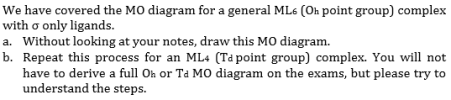 We have covered the MO diagram for a general ML6 (On point group) complex with o only ligands. a. Without looking at your notes, draw this MO diagram. b. Repeat this process for an ML4 (Ta point group) complex. You will not have to derive a full Oh or Ta MO diagram on the exams, but please try to understand the steps.
4. A low oxidation state organometallic complex contains -acceptor ligands and the metal center tends to...
4. A low oxidation state organometallic complex contains -acceptor ligands and the metal center tends to acquire 18 electrons in its valence shell, thus filling the valence orbitals. This is known as the 18-electron rule. Show that Mo(CO)6 obeys the 18-electron rule.
[Co(NH3)6]3+ion 4. Construct the MO diagram. Label all atomic, group and molecular orbitals with...
[Co(NH3)6]3+ion4. Construct the MO diagram. Label all atomic, group and molecular orbitals with symmetry labels. Fill in the diagram with the appropriate number of electrons. Assume that this complex is a strong field, low spin complex.5. a) What set of orbitals is the HOMO (highest occupied molecular orbitals).b) Is this set of orbitals classified as bonding, antibonding or non-bonding (no symmetry match)?6. What set of orbitals is the LUMO (lowest unoccupied molecular orbitals)?
13. (14 pts) MO Theory Draw the complete (core and valence) molecular orbital energy level diagram...
 13. (14 pts) MO Theory Draw the complete (core and valence) molecular orbital energy level diagram for the homonuclear diatomic molecule Be2. Use standard MO symbols to label the energy levels (That is: o, o, , or n*, as needed, with subscripts indicating which atomic orbitals formed them.) a. Sketch the molecular orbital formed when two 2p orbitals, one each on each Be atom, overlap to form a o antibonding MO b. Using your MO energy level diagram in (a),...
Assuming that only the valence orbitals are involved in bonding, draw an approximate MO energy-level diagram...
Assuming that only the valence orbitals are involved in bonding, draw an approximate MO energy-level diagram describing the relative energies of these eight molecular orbitals in N2. What is the apparent bond order for N2? Are there any unpaired electrons in this molecule? If so, how many? (Have all small details sigma,pi etc)
Draw just the homonuclear diatomic MO diagram through the d - orbitals. Then draw in the...
Draw just the homonuclear diatomic MO diagram through the d - orbitals. Then draw in the electrons for KK(4s)2(3d)2
Sketch the MO diagram of CO using only the 2s and 2p orbitals for i) no...
 Sketch the MO diagram of CO using only the 2s and 2p orbitals for i) no sp-mixing, ii) strong sp-mixing. Assign the correct representations to each MO. How many peaks with vibrational fine structure do you expect in an experimental photoelectron spectrum? 1 7 5 3
Q1. a) Draw a molecular orbital energy level diagram for the NH3 molecule. b) Sketch the...
Q1. a) Draw a molecular orbital energy level diagram for the NH3 molecule. b) Sketch the form of the bonding and non-bonding molecular orbitals. c) On the basis of your MO diagram, predict whether NH3 will act as a Lewis acid or a Lewis base. d) How does this bonding model compare with a valence bond description of NH3?
i can't solve this question of coordination chemistry, could someone hlep me please Exercise 1: 1. What kind(s) o...
 i
can't solve this question of coordination chemistry, could someone
hlep me please
Exercise 1: 1. What kind(s) of interaction between the ligand and the metal ion is(are) considered in the crystal field approach? 2. Give and justify the degeneracy lifting for a tetrahedral complex. Would it be the same for an octahedral complex? 3. Let us consider hexaaquacopper(II) ion. Justify the elongation of two opposite Cu-O bonds (along z for example) compared to the other four Cu-O bonds using...
i
can't solve this question of coordination chemistry, could someone
hlep me please
Exercise 1: 1. What kind(s) of interaction between the ligand and the metal ion is(are) considered in the crystal field approach? 2. Give and justify the degeneracy lifting for a tetrahedral complex. Would it be the same for an octahedral complex? 3. Let us consider hexaaquacopper(II) ion. Justify the elongation of two opposite Cu-O bonds (along z for example) compared to the other four Cu-O bonds using...
In addition to interacting with s and p orbitals of ligands such as NH,, CN, etc.,...
 In addition to interacting with s and p orbitals of ligands such as NH,, CN, etc., d orbitals can also interact with other d-orbitals, resulting in the formation of metal-metal bonds. Thus, for a simple metal dimer (i.e., ignoring any other ligands), we can envision the following interactions: M1M2 ? bond bond 8 bond where the o bond represents a face-to-face interaction between the two d orbitals. Considering only the d orbitals on each metal and taking the metal-metal bond...
 We have covered the MO diagram for a general ML6 (On point group) complex with o only ligands. a. Without looking at your notes, draw this MO diagram. b. Repeat this process for an ML4 (Ta point group) complex. You will not have to derive a full Oh or Ta MO diagram on the exams, but please try to understand the steps.
 13. (14 pts) MO Theory Draw the complete (core and valence) molecular orbital energy level diagram for the homonuclear diatomic molecule Be2. Use standard MO symbols to label the energy levels (That is: o, o, , or n*, as needed, with subscripts indicating which atomic orbitals formed them.) a. Sketch the molecular orbital formed when two 2p orbitals, one each on each Be atom, overlap to form a o antibonding MO b. Using your MO energy level diagram in (a),...
 Sketch the MO diagram of CO using only the 2s and 2p orbitals for i) no sp-mixing, ii) strong sp-mixing. Assign the correct representations to each MO. How many peaks with vibrational fine structure do you expect in an experimental photoelectron spectrum? 1 7 5 3
 i
can't solve this question of coordination chemistry, could someone
hlep me please
Exercise 1: 1. What kind(s) of interaction between the ligand and the metal ion is(are) considered in the crystal field approach? 2. Give and justify the degeneracy lifting for a tetrahedral complex. Would it be the same for an octahedral complex? 3. Let us consider hexaaquacopper(II) ion. Justify the elongation of two opposite Cu-O bonds (along z for example) compared to the other four Cu-O bonds using...
i
can't solve this question of coordination chemistry, could someone
hlep me please
Exercise 1: 1. What kind(s) of interaction between the ligand and the metal ion is(are) considered in the crystal field approach? 2. Give and justify the degeneracy lifting for a tetrahedral complex. Would it be the same for an octahedral complex? 3. Let us consider hexaaquacopper(II) ion. Justify the elongation of two opposite Cu-O bonds (along z for example) compared to the other four Cu-O bonds using...
 In addition to interacting with s and p orbitals of ligands such as NH,, CN, etc., d orbitals can also interact with other d-orbitals, resulting in the formation of metal-metal bonds. Thus, for a simple metal dimer (i.e., ignoring any other ligands), we can envision the following interactions: M1M2 ? bond bond 8 bond where the o bond represents a face-to-face interaction between the two d orbitals. Considering only the d orbitals on each metal and taking the metal-metal bond...
Most questions answered within 3 hours.
-
Where is the error in this code sequence?
String s1 = "Hello";
String s2 = "ello";...
asked 10 months ago -
Financial data for Joel de Paris, Inc., for last year
follow:
Joel de Paris, Inc.
Balance...
asked 10 months ago -
Consider this reaction:
Al2(SO4)3 (aq)+ BaCl3
(aq) Al2Cl6 (aq)- +
3BaSO4(s) . What is the...
asked 10 months ago -
Suppose that Savneet is considering increasing her
recent random sample from 20 car rentals to 40...
asked 10 months ago -
Trucks arrive at an unloading terminal at an average rate of 120
per hour.
Trucks arrive...
asked 10 months ago -
Why are methanol and ethanol completely soluble in water while
octanol is not very little soluble....
asked 10 months ago -
A facilities manager at a university reads in a research report
that the mean amount of...
asked 10 months ago -
When the CuSO4 is rehydrated by adding water to the anhydrous
compound, is this an endothermic...
asked 10 months ago -
A ray of sunlight is passing from diamond into crown glass; the
angle of incidence is...
asked 10 months ago -
A block of mass 0.249 kg is placed on top of a light, vertical
spring of...
asked 10 months ago -
how do the kidneys compensate in the presences of acidosis
a) trigger hyperventilate
b) reserve acid...
asked 10 months ago -
Question 501 pts
The rental rate of capital to the firm increases. Which of the
following...
asked 10 months ago