
Homework Answers
![a Lewis symbols or structures cst - ce - elehonic configuration - [Xe] 68² lewin dot diagram - •cs a wnfiguration [Xe]6s1 [xe](http://img.homeworklib.com/questions/b72b7ff0-0deb-11ea-88ad-f1f5dd785612.png?x-oss-process=image/resize,w_560)


Add Answer to:
3. Draw Lewis symbols or structures for the following atoms, ions, or compounds. (a) Cs (b) MgCl2 (c) Se (d) CN- (e)...
1. Identify polar covalent bonds or ionic bonds formed in the binary compounds below. (a) C...
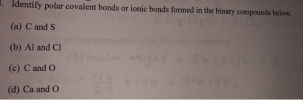 1. Identify polar covalent bonds or ionic bonds formed in the binary compounds below. (a) C and S (b) Al and Ci position of the tokaular weight 2x230 (c) C and o (d) Ca and o
1. Write the Lewis symbols of the ions in each of the following ionic compounds and...
 1. Write the Lewis symbols of the ions in each of the following ionic compounds and the Lewis symbols of the atom from which they are formed: Example of the answer for MgS: Gazo Li3N KCI AIP 2. Write Lewis structures for the following compounds or ions (hint: do not forget about charges when counting electrons): Example of the answer for OH ::H HTeO; HI H2SICO HNOH Page 1 of 3
Draw Lewis structures for covalent compounds with single and multiple central atoms, including compounds with...
Draw Lewis structures for covalent compounds with single and multiple central atoms, including compounds with charges, multiple bonds, incomplete octets, and expanded octets
5. Draw the Lewis structures of the following compounds/ions. a) OF2 b) SO32- c) BH d)...
 5. Draw the Lewis structures of the following compounds/ions. a) OF2 b) SO32- c) BH d) CO
19. Which of the following statements regarding ionic compounds is correct? A) Ions are held together...
 19. Which of the following statements regarding ionic compounds is correct? A) Ions are held together in an ionic lattice by covalent bonds. B) The crystal structure of a given compound does not depend on the sizes and number of ions in a formula unit of the compound. C) Ionic compounds tend to have low melting points. D) Ionic compounds are formed when two metals react. E) In forming an ionic compound from its elements, one element transfers one or...
Procedure: For Part 1, write the Lewis Dot (or Electron Dot) structure for each atom, followed...
Procedure: For Part 1, write the Lewis Dot (or Electron Dot) structure for each atom, followed by the ions that each element would form, the compound that would be formed from the combination of the two elements and finally the Lewis Dot structure for the compound. For Part 2, show the Lewis Dot structure for each molecules, its AXE designation and finally its Electron Pair/ Geometric Shape geometries. Also indicate any partial charges that may exist on that molecule. PART...
2. Predict the formula of the ionic compounds formed from the following pairs of elements using L...
 2. Predict the formula of the ionic compounds formed from the following pairs of elements using Lewis symbols. Name the compounds. a. Al and I b. Rb andS 3. Rank the following in order of increasing bond length and bond strength. a. Si-F Si-C; Si-o 4. Calculate the amount of energy necessary to break all the bonds in formaldehyde CH20. What type of process is this? -O 5. Predict which pairs give ionic, polar covalent, or nonpolar covalent compounds by...
1. Please give the Lewis structure for the following compounds, please include any resonance structures, formal...
1. Please give the Lewis structure for the following compounds, please include any resonance structures, formal charges, and indicate whether the bonds are ionic or covalent. a. AgNO3 b. Na2SO4 c. K2CO3 d. KNO2 e. NaN3 2. Please give the Lewis structure for the following compounds, please include any resonance structures, formal charges, and indicate whether the bonds are ionic or covalent. a. Calcium phosphate b. Strontium sulfite c. Sodium hypochlorite d. Rubidium bromite e. Potassium acetate 3. Please draw...
Compoumas at mignt result from the combination of these metals and nonmetals. Name these compounds. Name...
 Compoumas at mignt result from the combination of these metals and nonmetals. Name these compounds. Name one ionic compound that contains only nonmetallic elements. Name one ionic compound that contains a polyatomic cation and a polyatomic anion (see Table 2.3). 9.9 9.10 An ionic bond is formed between a cation A and an anion B". How would the 9.15 energy of the ionic bond [see Equation (9.2)] be affected by the following changes? (a) doubling the radius of A*, (b)...
b) CI d) He 2. Predict which of the following compounds are ionic and which are covalent, based on the location of...
 b) CI d) He 2. Predict which of the following compounds are ionic and which are covalent, based on the location of their constituent atoms in the periodic table: (a) C1,CO (b) Mno (c) NCI, (d) CoBr (e) CaF (2) HI 3. Identify the more polar bond in each of the following pairs of bonds: (a) HF or HCI (b) NO or CO (C) SH or OH (d) PCI or SCI (e) CH or NH (1) SO or PO What...
 1. Identify polar covalent bonds or ionic bonds formed in the binary compounds below. (a) C and S (b) Al and Ci position of the tokaular weight 2x230 (c) C and o (d) Ca and o
 1. Write the Lewis symbols of the ions in each of the following ionic compounds and the Lewis symbols of the atom from which they are formed: Example of the answer for MgS: Gazo Li3N KCI AIP 2. Write Lewis structures for the following compounds or ions (hint: do not forget about charges when counting electrons): Example of the answer for OH ::H HTeO; HI H2SICO HNOH Page 1 of 3
 5. Draw the Lewis structures of the following compounds/ions. a) OF2 b) SO32- c) BH d) CO
 19. Which of the following statements regarding ionic compounds is correct? A) Ions are held together in an ionic lattice by covalent bonds. B) The crystal structure of a given compound does not depend on the sizes and number of ions in a formula unit of the compound. C) Ionic compounds tend to have low melting points. D) Ionic compounds are formed when two metals react. E) In forming an ionic compound from its elements, one element transfers one or...
 2. Predict the formula of the ionic compounds formed from the following pairs of elements using Lewis symbols. Name the compounds. a. Al and I b. Rb andS 3. Rank the following in order of increasing bond length and bond strength. a. Si-F Si-C; Si-o 4. Calculate the amount of energy necessary to break all the bonds in formaldehyde CH20. What type of process is this? -O 5. Predict which pairs give ionic, polar covalent, or nonpolar covalent compounds by...
 Compoumas at mignt result from the combination of these metals and nonmetals. Name these compounds. Name one ionic compound that contains only nonmetallic elements. Name one ionic compound that contains a polyatomic cation and a polyatomic anion (see Table 2.3). 9.9 9.10 An ionic bond is formed between a cation A and an anion B". How would the 9.15 energy of the ionic bond [see Equation (9.2)] be affected by the following changes? (a) doubling the radius of A*, (b)...
 b) CI d) He 2. Predict which of the following compounds are ionic and which are covalent, based on the location of their constituent atoms in the periodic table: (a) C1,CO (b) Mno (c) NCI, (d) CoBr (e) CaF (2) HI 3. Identify the more polar bond in each of the following pairs of bonds: (a) HF or HCI (b) NO or CO (C) SH or OH (d) PCI or SCI (e) CH or NH (1) SO or PO What...
Most questions answered within 3 hours.
-
Where is the error in this code sequence?
String s1 = "Hello";
String s2 = "ello";...
asked 10 months ago -
Financial data for Joel de Paris, Inc., for last year
follow:
Joel de Paris, Inc.
Balance...
asked 10 months ago -
Consider this reaction:
Al2(SO4)3 (aq)+ BaCl3
(aq) Al2Cl6 (aq)- +
3BaSO4(s) . What is the...
asked 10 months ago -
Suppose that Savneet is considering increasing her
recent random sample from 20 car rentals to 40...
asked 10 months ago -
Trucks arrive at an unloading terminal at an average rate of 120
per hour.
Trucks arrive...
asked 10 months ago -
Why are methanol and ethanol completely soluble in water while
octanol is not very little soluble....
asked 10 months ago -
A facilities manager at a university reads in a research report
that the mean amount of...
asked 10 months ago -
When the CuSO4 is rehydrated by adding water to the anhydrous
compound, is this an endothermic...
asked 10 months ago -
A ray of sunlight is passing from diamond into crown glass; the
angle of incidence is...
asked 10 months ago -
A block of mass 0.249 kg is placed on top of a light, vertical
spring of...
asked 10 months ago -
how do the kidneys compensate in the presences of acidosis
a) trigger hyperventilate
b) reserve acid...
asked 10 months ago -
Question 501 pts
The rental rate of capital to the firm increases. Which of the
following...
asked 10 months ago