Let X1, X2, X3 be independent Binomial(3,p) random variables. Define Y1 = X1 + X3 and Y2 = X2 + X3. Define Z1 = 1 if Y1...
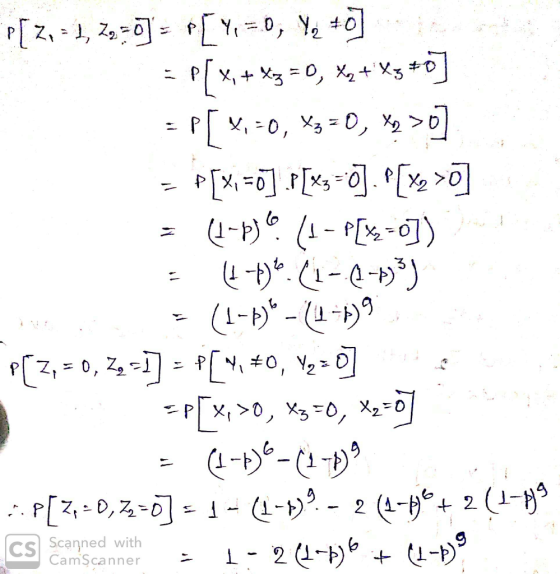
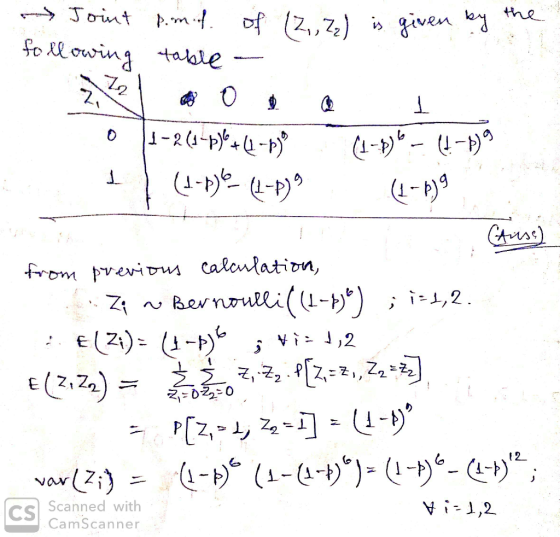
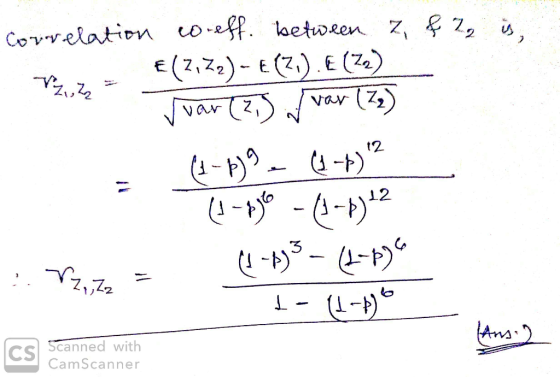
Let X1, X2, X3 be independent Binomial(3,p) random variables. Define Y1 = X1 + X3 and Y2 = X2 + X3. Define Z1 = 1 if Y1 = 0; and 0 otherwise. Define Z2 = 1 if Y2 = 0; and 0 otherwise. As Z1 and Z3 both contain X3, are Z1 and Z3 independent? What is the marginal PMF of Z1 and Z2 and joint PMF of (Z1, Z2) and what is the correlation coefficient between Z1 and Z2?
Homework Answers


Add Answer to:
Let X1, X2, X3 be independent Binomial(3,p) random variables. Define Y1 = X1 + X3 and Y2 = X2 + X3. Define Z1 = 1 if Y1...
Q2 Suppose X1, X2, X3 are independent Bernoulli random variables with p = 0.5. Let Y;...
 Q2 Suppose X1, X2, X3 are independent Bernoulli random variables with p = 0.5. Let Y; be the partial sums, i.e., Y1 = X1, Y2 = X1 + X2, Y3 = X1 + X2 + X3. 1. What is the distubution for each Yį, i = 1, 2, 3? 2. What is the expected value for Y1 + Y2 +Yz? 3. Are Yį and Y2 independent? Explain it by computing their joint P.M.F. 4. What is the variance of Y1...
Let Y1, Y2, and Y3 be independent, N(0, 1)-distributed random variables, and set X1 = Y1...
Let Y1, Y2, and Y3 be independent, N(0, 1)-distributed random variables, and set X1 = Y1 − Y3, X2 = 2Y1 + Y2 − 2Y3, X3 = −2Y1 + 3Y3.Determine the conditional distribution of X2 given that X1 + X3 = x.
Let (X1, Y1) and (X2, Y2) be independent and identically distributed continuous bivariate random variables with joint pr...
Let (X1, Y1) and (X2, Y2) be independent and identically distributed continuous bivariate random variables with joint probability density function: fX,Y (x,y) = e-y, 0 <x<y< ; =0 , elsewhere. Evaluate P( X2>X1, Y2>Y1) + P (X2 <X1, Y2<Y1) .
2. Let Z1 and Zo be independent standard normal random variables. Let! X= 221 +372 +12...
 2. Let Z1 and Zo be independent standard normal random variables. Let! X= 221 +372 +12 X2 = 321 - 22 +11. (a) Find the joint density function of (X1, X2). (b) Find the covariance of X1 and X2. Now let Y1 = X1 + 4X2 +3 Y, = -2X2 +6X2 +5 (a) Find the joint density function of (Y1, Y). (b) Find the covariance of Yi and Y2.
3. (25 pts.) Let X1, X2, X3 be independent random variables such that Xi~ Poisson (A), i 1,2,3. Let N = X1 + X2+X3. (a)...
 3. (25 pts.) Let X1, X2, X3 be independent random variables such that Xi~ Poisson (A), i 1,2,3. Let N = X1 + X2+X3. (a) What is the distribution of N? (b) Find the conditional distribution of (X1, X2, X3) | N. (c) Now let N, X1, X2, X3, be random variables such that N~ Poisson(A), (X1, X2, X3) | N Trinomial(N; pi,p2.ps) where pi+p2+p3 = 1. Find the unconditional distribution of (X1, X2, X3).
3. (25 pts.) Let X1,...
3. (25 pts.) Let X1, X2, X3 be independent random variables such that Xi~ Poisson (A), i 1,2,3. Let N = X1 + X2+X3. (a) What is the distribution of N? (b) Find the conditional distribution of (X1, X2, X3) | N. (c) Now let N, X1, X2, X3, be random variables such that N~ Poisson(A), (X1, X2, X3) | N Trinomial(N; pi,p2.ps) where pi+p2+p3 = 1. Find the unconditional distribution of (X1, X2, X3).
3. (25 pts.) Let X1,...
Let X1, X2, X3 be independent random variables with E(X1) = 1, E(X2) = 2 and...
Let X1, X2, X3 be independent random variables with E(X1) = 1, E(X2) = 2 and E(X3) = 3. Let Y = 3X1 − 2X2 + X3. Find E(Y ), Var(Y ) in the following examples. X1, X2, X3 are Poisson. [Recall that the variance of Poisson(λ) is λ.] X1, X2, X3 are normal, with respective variances σ12 = 1, σ2 = 3, σ32 = 5. Find P(0 ≤ Y ≤ 5). [Recall that any linear combination of independent normal...
Let Y1<Y2<...<Yn be the order statistics of a random sample of size n from the distribution...
 Let Y1<Y2<...<Yn be the
order statistics of a random sample of size n from the distribution
having p.d.f f(x) = e-y , 0<y<, zero elsewhere. Answer the following
questions.
(a) decide whether Z1 = Y2
and Z2=Y4-Y2 are
stochastically independent or not. (hint. first find the joint
p.d.f. of Y2 and Y4)
(b) show that
Z1 = nY1, Z2=
(n-1)(Y2-Y1),
Z3=(n-2)(Y3-Y2), ....,
Zn=Yn-Yn-1
are stocahstically
independent and that each Zi has the exponential
distribution.(hint use change of variable technique)
Let Y1<Y2<...<Yn be the
order statistics of a random sample of size n from the distribution
having p.d.f f(x) = e-y , 0<y<, zero elsewhere. Answer the following
questions.
(a) decide whether Z1 = Y2
and Z2=Y4-Y2 are
stochastically independent or not. (hint. first find the joint
p.d.f. of Y2 and Y4)
(b) show that
Z1 = nY1, Z2=
(n-1)(Y2-Y1),
Z3=(n-2)(Y3-Y2), ....,
Zn=Yn-Yn-1
are stocahstically
independent and that each Zi has the exponential
distribution.(hint use change of variable technique)
Problem 2. (Conditional Distribution of MVN) Let Z1, Z2, Z3 be i.i.d. N(0,1) dis- tributed random...
 Problem 2. (Conditional Distribution of MVN) Let Z1, Z2, Z3 be i.i.d. N(0,1) dis- tributed random variables, and set X1 = 21 – Z3 X2 = 2Z1 + Z2 – 223 X3 = -221 +3Z3 1) What distribution does X = (X1, X2, X3)T follow? Specific the parameters. 2) Find out P(X2 > 0|X1 + X3 = 0).
2. Let X1 and Xbe independent random variables, each with density ſcexp(-1) 0<=<1 lo otherwise a....
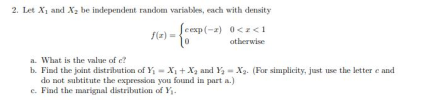 2. Let X1 and Xbe independent random variables, each with density ſcexp(-1) 0<=<1 lo otherwise a. What is the value of c? b. Find the joint distribution of Y1 = X1 + X2 and Y2 = X2. (For simplicity, just use the letter c and do not subtitute the expression you found in part a.) c. Find the marignal distribution of Yı.
(2) Given two independent variables X1 and X2 having Bernoulli distribution with parameter p=1/3, let Y1...
 (2) Given two independent variables X1 and X2 having Bernoulli distribution with parameter p=1/3, let Y1 = 2X1 and Y2 = 2X2. Then A E[Y1 · Y2] = 2/9 BE[Y1 · Y2] = 4/9 C P[Y1 · Y2 = 0) = 1/9 D P[Y1 · Y2 = 0) = 2/9 (3) Let X and Y be two independent random variables having gaussian (normal) distribution with mean 0 and variance equal 2. Then: A P[X +Y > 2] > 0.5 B...
 Q2 Suppose X1, X2, X3 are independent Bernoulli random variables with p = 0.5. Let Y; be the partial sums, i.e., Y1 = X1, Y2 = X1 + X2, Y3 = X1 + X2 + X3. 1. What is the distubution for each Yį, i = 1, 2, 3? 2. What is the expected value for Y1 + Y2 +Yz? 3. Are Yį and Y2 independent? Explain it by computing their joint P.M.F. 4. What is the variance of Y1...
 2. Let Z1 and Zo be independent standard normal random variables. Let! X= 221 +372 +12 X2 = 321 - 22 +11. (a) Find the joint density function of (X1, X2). (b) Find the covariance of X1 and X2. Now let Y1 = X1 + 4X2 +3 Y, = -2X2 +6X2 +5 (a) Find the joint density function of (Y1, Y). (b) Find the covariance of Yi and Y2.
 3. (25 pts.) Let X1, X2, X3 be independent random variables such that Xi~ Poisson (A), i 1,2,3. Let N = X1 + X2+X3. (a) What is the distribution of N? (b) Find the conditional distribution of (X1, X2, X3) | N. (c) Now let N, X1, X2, X3, be random variables such that N~ Poisson(A), (X1, X2, X3) | N Trinomial(N; pi,p2.ps) where pi+p2+p3 = 1. Find the unconditional distribution of (X1, X2, X3).
3. (25 pts.) Let X1,...
3. (25 pts.) Let X1, X2, X3 be independent random variables such that Xi~ Poisson (A), i 1,2,3. Let N = X1 + X2+X3. (a) What is the distribution of N? (b) Find the conditional distribution of (X1, X2, X3) | N. (c) Now let N, X1, X2, X3, be random variables such that N~ Poisson(A), (X1, X2, X3) | N Trinomial(N; pi,p2.ps) where pi+p2+p3 = 1. Find the unconditional distribution of (X1, X2, X3).
3. (25 pts.) Let X1,...
 Let Y1<Y2<...<Yn be the
order statistics of a random sample of size n from the distribution
having p.d.f f(x) = e-y , 0<y<, zero elsewhere. Answer the following
questions.
(a) decide whether Z1 = Y2
and Z2=Y4-Y2 are
stochastically independent or not. (hint. first find the joint
p.d.f. of Y2 and Y4)
(b) show that
Z1 = nY1, Z2=
(n-1)(Y2-Y1),
Z3=(n-2)(Y3-Y2), ....,
Zn=Yn-Yn-1
are stocahstically
independent and that each Zi has the exponential
distribution.(hint use change of variable technique)
Let Y1<Y2<...<Yn be the
order statistics of a random sample of size n from the distribution
having p.d.f f(x) = e-y , 0<y<, zero elsewhere. Answer the following
questions.
(a) decide whether Z1 = Y2
and Z2=Y4-Y2 are
stochastically independent or not. (hint. first find the joint
p.d.f. of Y2 and Y4)
(b) show that
Z1 = nY1, Z2=
(n-1)(Y2-Y1),
Z3=(n-2)(Y3-Y2), ....,
Zn=Yn-Yn-1
are stocahstically
independent and that each Zi has the exponential
distribution.(hint use change of variable technique)
 Problem 2. (Conditional Distribution of MVN) Let Z1, Z2, Z3 be i.i.d. N(0,1) dis- tributed random variables, and set X1 = 21 – Z3 X2 = 2Z1 + Z2 – 223 X3 = -221 +3Z3 1) What distribution does X = (X1, X2, X3)T follow? Specific the parameters. 2) Find out P(X2 > 0|X1 + X3 = 0).
 2. Let X1 and Xbe independent random variables, each with density ſcexp(-1) 0<=<1 lo otherwise a. What is the value of c? b. Find the joint distribution of Y1 = X1 + X2 and Y2 = X2. (For simplicity, just use the letter c and do not subtitute the expression you found in part a.) c. Find the marignal distribution of Yı.
 (2) Given two independent variables X1 and X2 having Bernoulli distribution with parameter p=1/3, let Y1 = 2X1 and Y2 = 2X2. Then A E[Y1 · Y2] = 2/9 BE[Y1 · Y2] = 4/9 C P[Y1 · Y2 = 0) = 1/9 D P[Y1 · Y2 = 0) = 2/9 (3) Let X and Y be two independent random variables having gaussian (normal) distribution with mean 0 and variance equal 2. Then: A P[X +Y > 2] > 0.5 B...
Most questions answered within 3 hours.
-
Where is the error in this code sequence?
String s1 = "Hello";
String s2 = "ello";...
asked 10 months ago -
Financial data for Joel de Paris, Inc., for last year
follow:
Joel de Paris, Inc.
Balance...
asked 10 months ago -
Consider this reaction:
Al2(SO4)3 (aq)+ BaCl3
(aq) Al2Cl6 (aq)- +
3BaSO4(s) . What is the...
asked 10 months ago -
Suppose that Savneet is considering increasing her
recent random sample from 20 car rentals to 40...
asked 10 months ago -
Trucks arrive at an unloading terminal at an average rate of 120
per hour.
Trucks arrive...
asked 10 months ago -
Why are methanol and ethanol completely soluble in water while
octanol is not very little soluble....
asked 10 months ago -
A facilities manager at a university reads in a research report
that the mean amount of...
asked 10 months ago -
When the CuSO4 is rehydrated by adding water to the anhydrous
compound, is this an endothermic...
asked 10 months ago -
A ray of sunlight is passing from diamond into crown glass; the
angle of incidence is...
asked 10 months ago -
A block of mass 0.249 kg is placed on top of a light, vertical
spring of...
asked 10 months ago -
how do the kidneys compensate in the presences of acidosis
a) trigger hyperventilate
b) reserve acid...
asked 10 months ago -
Question 501 pts
The rental rate of capital to the firm increases. Which of the
following...
asked 10 months ago