


Homework Answers
Question 1.
(i) Moles of HCl react with the carbonate = {(50/1000) L * 0.185 mol/L} - {(24.7/1000) L * 0.098 mol/L} = 0.0068294 mol
(ii) The identity of the cation (X): Molar mass of XnCO3 = 0.6739 g/(0.0068294 mol) = 98.676 g/mol; Cation (X) = Ca
Note: The molar mass of CaCO3 = 100 g/mol
Add Answer to:
A 0.6739 g sample of a pure carbonate, X,CO,(s), was dissolved in 50.0 mL of 0.1850 M HCl(aq). The excess HCl(aq)...
A standardized solution that is 0.0100 M in Na+ is necessary for a Hame photometric determination...
 A standardized solution that is 0.0100 M in Na+ is necessary for a Hame photometric determination of the element. How many grams of primary-standard-grade sodium carbonate are necessary to prepare 700.0 mL of this solution? Calculate the number of moles of solute in 79.21 mL of 0.1355 M K, Cr, o, (aq). moles of solute: mol
please help! A 0. 563 g sample of a pure carbonate, X_nCO_3(s) was dissolved in 50....
 please help!
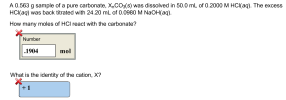
A 0. 563 g sample of a pure carbonate, X_nCO_3(s) was dissolved in 50. 0 mL of 0. 2000 M HCl(aq). The excess HCl(aq) was back titrated with 24. 20 mL of 0. 0980 M NaOH(aq). How many moles of HCl react with the carbonate? What is the identity of the cation, X?
please help!
A 0. 563 g sample of a pure carbonate, X_nCO_3(s) was dissolved in 50. 0 mL of 0. 2000 M HCl(aq). The excess HCl(aq) was back titrated with 24. 20 mL of 0. 0980 M NaOH(aq). How many moles of HCl react with the carbonate? What is the identity of the cation, X?
A 0.450 g sample of impure CaCO3(s) is dissolved in 50.0 mL of 0.150 M HCl(aq)...
A 0.450 g sample of impure CaCO3(s) is dissolved in 50.0 mL of 0.150 M HCl(aq) . The equation for the reaction is CaCO3(s)+2HCl(aq)⟶CaCl2(aq)+H2O(l)+CO2(g) The excess HCl(aq) is titrated by 9.05 mL of 0.125 M NaOH(aq) . Calculate the mass percentage of CaCO3(s) in the sample.
A 0.450 g sample of impure CaCO, (s) is dissolved in 50.0 mL of 0.150 M...
 A 0.450 g sample of impure CaCO, (s) is dissolved in 50.0 mL of 0.150 M HCl(aq). The equation for the reaction is CaCO,(s) + 2 HCl(aq) — CaCl, (aq) + H, 0(1) + CO2(g) The excess HCl(aq) is titrated by 4.85 mL of 0.125 M NaOH(aq) Calculate the mass percentage of Caco, (s) in the sample. mass percentage: The zinc content of a 1.03 g ore sample was determined by dissolving the ore in HCl, which reacts with the...
A 0.450 gram sample of impure CaCO3(s) is dissolved in 50.0 mL of 0.150 M HCl(aq). The equation for the reaction is Ca...
A 0.450 gram sample of impure CaCO3(s) is dissolved in 50.0 mL of 0.150 M HCl(aq). The equation for the reaction is CaCO3(s) + 2HCl(aq) arrow CaCl2(aq) +H2O(l) +CO2(g) The excess HCL (aq) is titrated by 6.45 mL of 0.125 M NaOH(aq). Calculate the mass percentaageof CaCO3(s) in the sample. Please show steps.
A 50.0 mL sample of 0.0639 M AgNO3(aq) is added to 50.0 mL of 0.100 M...
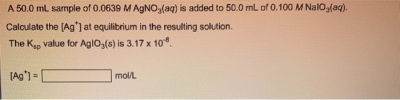 A 50.0 mL sample of 0.0639 M AgNO3(aq) is added to 50.0 mL of 0.100 M Naloz(aq). Calculate the (Ag") at equilibrium in the resulting solution. The Kp value for AglO3(s) is 3.17 x 10⁻⁸ (Ag"]= [ mol/l
If 50.0 g of CH3OH (MM = 32.04 g/mol) are dissolved in 500.0 mL of solvent
If 50.0 g of CH3OH (MM = 32.04 g/mol) are dissolved in 500.0 mL of solvent, what is the concentration of CH3OH in the resulting solution? How many moles of CH3OH are there in 50.0 mL of 0.400 M CH3OH? How many mL of 0.300 M NaCI solution are required to produce 0.150 moles of NaCI?
A 50.0-mL sample of 0.15 M butanoic acid, CH3CH2CH2COOH, is titrated with 0.30 M NaOH(aq). Ka...
A 50.0-mL sample of 0.15 M butanoic acid, CH3CH2CH2COOH, is titrated with 0.30 M NaOH(aq). Ka for butanoic acid is 1.52 x 10⁻⁵ a) How many mL of NaOH(aq) are required to reach the equivalence point? b)What is the pH of the solution after 27.0 mL of NaOH(aq) have been added?
A 4.36-g sample of an unknown alkali metal hydroxide is dissolved in 100.0 mL of water....
A 4.36-g sample of an unknown alkali metal hydroxide is dissolved in 100.0 mL of water. An acid-base indicator is added and the resulting solution is titrated with 2.50 M HCl(aq)solution. The indicator changes color signaling that the equivalence point has been reached after 17.0 mL of the hydrochloric acid solution has been added. A) What is the molar mass of the metal hydroxide? Express your answer with the appropriate units. B)What is the identity of the alkali metal cation:...
A 0.1983 g sample of Na2CO3 was dissolved in 100.00 ml H20. That solution was titrated with 0.1531 M HCL as titrant. The...
A 0.1983 g sample of Na2CO3 was dissolved in 100.00 ml H20. That solution was titrated with 0.1531 M HCL as titrant. The PKa1 and PKa2 of carbonic acid (the conjugate acid of the carbonate ion) are 6.351 and 10.329, respectively. 1.) What is the initial pH of the sodium carbonate solution. 2.) What is the first equivalence point (in ml HCL)? What is the pH at 1st eq.? 3.) What is the second equivalence point (in ml HCL)? What...
 A standardized solution that is 0.0100 M in Na+ is necessary for a Hame photometric determination of the element. How many grams of primary-standard-grade sodium carbonate are necessary to prepare 700.0 mL of this solution? Calculate the number of moles of solute in 79.21 mL of 0.1355 M K, Cr, o, (aq). moles of solute: mol
 please help!
A 0. 563 g sample of a pure carbonate, X_nCO_3(s) was dissolved in 50. 0 mL of 0. 2000 M HCl(aq). The excess HCl(aq) was back titrated with 24. 20 mL of 0. 0980 M NaOH(aq). How many moles of HCl react with the carbonate? What is the identity of the cation, X?
please help!
A 0. 563 g sample of a pure carbonate, X_nCO_3(s) was dissolved in 50. 0 mL of 0. 2000 M HCl(aq). The excess HCl(aq) was back titrated with 24. 20 mL of 0. 0980 M NaOH(aq). How many moles of HCl react with the carbonate? What is the identity of the cation, X?
 A 0.450 g sample of impure CaCO, (s) is dissolved in 50.0 mL of 0.150 M HCl(aq). The equation for the reaction is CaCO,(s) + 2 HCl(aq) — CaCl, (aq) + H, 0(1) + CO2(g) The excess HCl(aq) is titrated by 4.85 mL of 0.125 M NaOH(aq) Calculate the mass percentage of Caco, (s) in the sample. mass percentage: The zinc content of a 1.03 g ore sample was determined by dissolving the ore in HCl, which reacts with the...
 A 50.0 mL sample of 0.0639 M AgNO3(aq) is added to 50.0 mL of 0.100 M Naloz(aq). Calculate the (Ag") at equilibrium in the resulting solution. The Kp value for AglO3(s) is 3.17 x 10⁻⁸ (Ag"]= [ mol/l
Most questions answered within 3 hours.
-
Where is the error in this code sequence?
String s1 = "Hello";
String s2 = "ello";...
asked 11 months ago -
Financial data for Joel de Paris, Inc., for last year
follow:
Joel de Paris, Inc.
Balance...
asked 11 months ago -
Consider this reaction:
Al2(SO4)3 (aq)+ BaCl3
(aq) Al2Cl6 (aq)- +
3BaSO4(s) . What is the...
asked 11 months ago -
Suppose that Savneet is considering increasing her
recent random sample from 20 car rentals to 40...
asked 11 months ago -
Trucks arrive at an unloading terminal at an average rate of 120
per hour.
Trucks arrive...
asked 11 months ago -
Why are methanol and ethanol completely soluble in water while
octanol is not very little soluble....
asked 11 months ago -
A facilities manager at a university reads in a research report
that the mean amount of...
asked 11 months ago -
When the CuSO4 is rehydrated by adding water to the anhydrous
compound, is this an endothermic...
asked 11 months ago -
A ray of sunlight is passing from diamond into crown glass; the
angle of incidence is...
asked 11 months ago -
A block of mass 0.249 kg is placed on top of a light, vertical
spring of...
asked 11 months ago -
how do the kidneys compensate in the presences of acidosis
a) trigger hyperventilate
b) reserve acid...
asked 11 months ago -
Question 501 pts
The rental rate of capital to the firm increases. Which of the
following...
asked 11 months ago