

Homework Answers

Add Answer to:
soluble blz dissociah. - A student mixed 5.00 mL of 0.0120 M Pb(NO), with 5.00 mL of 0.0300 M KI and observed a ye...
Thank you for the help! 2. A student mixed 5.00 mL of 0.0120 M Pb(NO,), with...
 Thank you for the help!
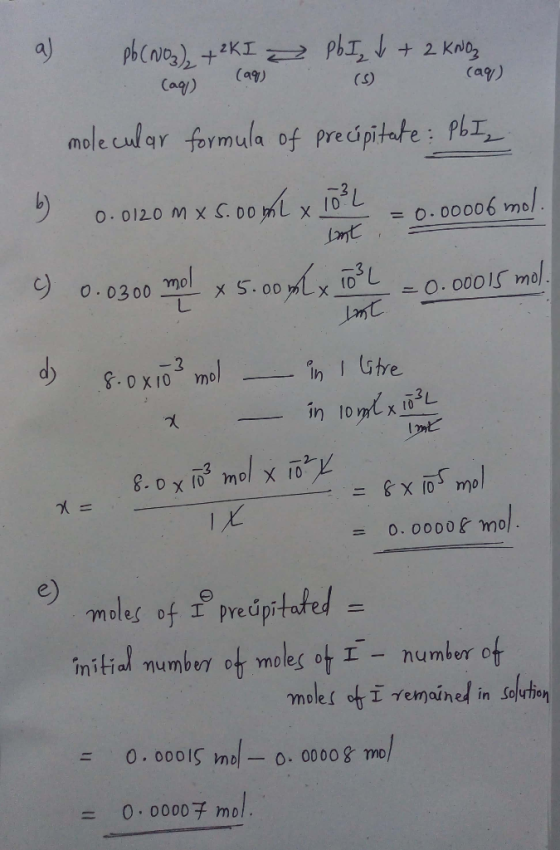
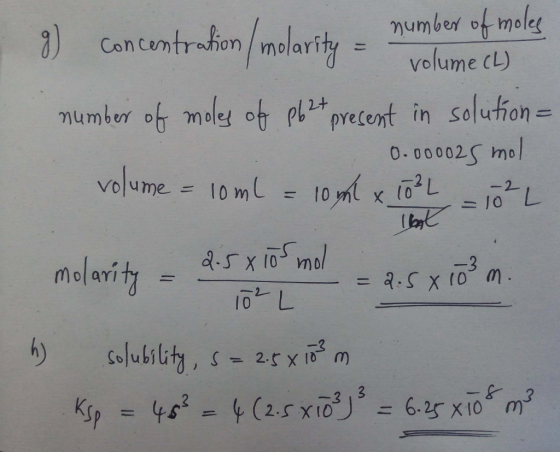
2. A student mixed 5.00 mL of 0.0120 M Pb(NO,), with 4.00 mL of 0.0300 M KI and 1.00 mL of 0.20 M KNO, and observed the formation of a yellow precipitate. Show all calculations for each of the following questions. a. What is the molecular formula of the precipitate? b. How many moles of Pb2+ are present initially? (moles = M.V) c. How many moles of I- are present initially? d. The concentration of...
Thank you for the help!
2. A student mixed 5.00 mL of 0.0120 M Pb(NO,), with 4.00 mL of 0.0300 M KI and 1.00 mL of 0.20 M KNO, and observed the formation of a yellow precipitate. Show all calculations for each of the following questions. a. What is the molecular formula of the precipitate? b. How many moles of Pb2+ are present initially? (moles = M.V) c. How many moles of I- are present initially? d. The concentration of...
A solution composed of 5.00 mL of 0.0120 M Pb(NO3)2, 3.00 mL of 0.0300 M KI,...
 A solution composed of 5.00 mL of 0.0120 M Pb(NO3)2, 3.00 mL of 0.0300 M KI, and 2.00 mL of 0.20 M KNO, is determined Spectroscopically to have [1] -6.25 x 10" M. Show all steps of your calculations. Credit will not be given if work is not shown. a). How many moles of l' is present initially? (2 pt) S+3+2=100L OIL •BM= I 19x10 noles b). How many moles of I should precipitate from the solution? (2 pt)
A solution composed of 5.00 mL of 0.0120 M Pb(NO3)2, 3.00 mL of 0.0300 M KI,...
 A solution composed of 5.00 mL of 0.0120 M Pb(NO3)2, 3.00 mL of 0.0300 M KI, and 2.00 mL of 0.20 M KNO3 is determined spectroscopically to have [1'] = 6.25 x 10 Show all steps of your calculations. Credit will not be given if work is not shown. (2 pt) a). How many moles of l' is present initially? OIL OB S+3+2=10nL M = a. 1o-s b). How many moles of I should precipitate from the solution? " Xo...
Ksp = [Ba²+][10,1 2. 10. mL of 0.10 M Ba(NO), is mixed with 10. mL of...
 Ksp = [Ba²+][10,1 2. 10. mL of 0.10 M Ba(NO), is mixed with 10. mL of 0.10 M KIO,, a precipitate forms. for barium a. Which ion will still be present at appreciable concentration in the equilibrium mixture if K iodate is very small? b. What would that concentration be? 3. Lead chloride, PbCly, is slightly soluble with K equal to 1.7 x 10. a. What is the solubility of lead chloride in pure water? b. What would the solubility...
A student mixes 39.0 mL of 2.88 M Pb(NO3)2(aq) with 20.0 mL of 0.00197 M Na2C2O4(aq)....
 A student mixes 39.0 mL of 2.88
M Pb(NO3)2(aq) with 20.0 mL of 0.00197 M Na2C2O4(aq). How many
moles of PbC2O4(s) precipitate from the resulting solution? What
are the values of [Pb2 ], [C2O42–], [NO3–], and [Na ] after the
solution has reached equilibrium at 25 °C?
A student mixes 39.0 mL of 2.88
M Pb(NO3)2(aq) with 20.0 mL of 0.00197 M Na2C2O4(aq). How many
moles of PbC2O4(s) precipitate from the resulting solution? What
are the values of [Pb2 ], [C2O42–], [NO3–], and [Na ] after the
solution has reached equilibrium at 25 °C?
A student mixes 41.0 mL of 2.84 M Pb(NO3)2(aq) with 20.0 mL of 0.00235 M Nal(aq). How many moles of Pbla(s) precipi...
 A student mixes 41.0 mL of 2.84 M Pb(NO3)2(aq) with 20.0 mL of 0.00235 M Nal(aq). How many moles of Pbla(s) precipitate from the resulting solution? Number K,,[Pb12()] – 9810 mol What are the values of [Pb2+), [1]. [NO3-), and [Na*) after the solution has reached equilibrium at 25 °C? Number Number [Pb?*] = Number Number [no; ]- 0 M [nat)-
4.81 mL of 0.00200 M Fe(NO3)3, 2.85 mL of 0.00200 M KSCN and 2.34 mL of...
4.81 mL of 0.00200 M Fe(NO3)3, 2.85 mL of 0.00200 M KSCN and 2.34 mL of distilled water were mixed. The resulting solution was allowed to attain equilibrium at 24 oC. The absorbance of the equilibrium solution was recorded, and the [FeSCN2+] was determined graphically to be 7.58 x 10⁻⁵ M. Part A: Calculate the number of moles of Fe3+ initially added to the solution. Part B: Calculate the number of moles of FeSCN2+ formed in the solution at equilibrium....
1) A 110 mL solution of 0.340 M HCl(aq) is mixed with a solution of 330...
 1) A 110 mL solution of 0.340 M HCl(aq) is mixed with a solution of 330 mL of 0.150 M HNO3(aq). The solution is then diluted to a final volume of 1.00 L. How many moles of H+ are present in the final solution? 2) When 38.0 mL of 0.1250 M H2SO4 is added to 100 mL of a solution of Pblu, a precipitate of PbSO4 forms. The PbSO4 is then filtered from the solution, dried, and weighed. If the...
A student mixes 5.00 mL 4.00 x 10⁻³ M Fe(NO3)3 with 5.00 mL 4.00 x 10⁻³ M KSCN.
 A student mixes 5.00 mL 4.00 x 10⁻³ M Fe(NO3)3 with 5.00 mL 4.00 x 10⁻³ M KSCN. The student finds that the equilibrium concentration of FeSCN2+ is 5.6 x 10⁻⁴M. a. Set up the Kc expression for the following equation. Fe3+ + SCN- ↔ FeSCN2+b. What is the total volume of the solution? _______ mL c. Fill in the following table for the moles of each species.d. Find the concentration for the above ions. e. Calculate Kc for the reaction.
Answer is C.) 1.38 x 10^-5 but need explanation please Following the same procedure as in...
 Answer is C.) 1.38 x 10^-5 but need explanation please
Following the same procedure as in Experiment 5, a calibration curve (absorbance vs II1) was prepared and determined to have a slope of 68.81 and a y-intercept of 0.004167. Next, 5.00 mL of 0.0120 M Pb(NOs)2, 3.00 mL of 0.0300 M K), and 2.00 mL of 0.200 M KNowere mixed in a centrifuge tube, producing a yellow precipitate of Pbl Again following the same procedure, the supernatant solution was transferred...
Answer is C.) 1.38 x 10^-5 but need explanation please
Following the same procedure as in Experiment 5, a calibration curve (absorbance vs II1) was prepared and determined to have a slope of 68.81 and a y-intercept of 0.004167. Next, 5.00 mL of 0.0120 M Pb(NOs)2, 3.00 mL of 0.0300 M K), and 2.00 mL of 0.200 M KNowere mixed in a centrifuge tube, producing a yellow precipitate of Pbl Again following the same procedure, the supernatant solution was transferred...
 Thank you for the help!
2. A student mixed 5.00 mL of 0.0120 M Pb(NO,), with 4.00 mL of 0.0300 M KI and 1.00 mL of 0.20 M KNO, and observed the formation of a yellow precipitate. Show all calculations for each of the following questions. a. What is the molecular formula of the precipitate? b. How many moles of Pb2+ are present initially? (moles = M.V) c. How many moles of I- are present initially? d. The concentration of...
Thank you for the help!
2. A student mixed 5.00 mL of 0.0120 M Pb(NO,), with 4.00 mL of 0.0300 M KI and 1.00 mL of 0.20 M KNO, and observed the formation of a yellow precipitate. Show all calculations for each of the following questions. a. What is the molecular formula of the precipitate? b. How many moles of Pb2+ are present initially? (moles = M.V) c. How many moles of I- are present initially? d. The concentration of...
 A solution composed of 5.00 mL of 0.0120 M Pb(NO3)2, 3.00 mL of 0.0300 M KI, and 2.00 mL of 0.20 M KNO, is determined Spectroscopically to have [1] -6.25 x 10" M. Show all steps of your calculations. Credit will not be given if work is not shown. a). How many moles of l' is present initially? (2 pt) S+3+2=100L OIL •BM= I 19x10 noles b). How many moles of I should precipitate from the solution? (2 pt)
 A solution composed of 5.00 mL of 0.0120 M Pb(NO3)2, 3.00 mL of 0.0300 M KI, and 2.00 mL of 0.20 M KNO3 is determined spectroscopically to have [1'] = 6.25 x 10 Show all steps of your calculations. Credit will not be given if work is not shown. (2 pt) a). How many moles of l' is present initially? OIL OB S+3+2=10nL M = a. 1o-s b). How many moles of I should precipitate from the solution? " Xo...
 Ksp = [Ba²+][10,1 2. 10. mL of 0.10 M Ba(NO), is mixed with 10. mL of 0.10 M KIO,, a precipitate forms. for barium a. Which ion will still be present at appreciable concentration in the equilibrium mixture if K iodate is very small? b. What would that concentration be? 3. Lead chloride, PbCly, is slightly soluble with K equal to 1.7 x 10. a. What is the solubility of lead chloride in pure water? b. What would the solubility...
 A student mixes 39.0 mL of 2.88
M Pb(NO3)2(aq) with 20.0 mL of 0.00197 M Na2C2O4(aq). How many
moles of PbC2O4(s) precipitate from the resulting solution? What
are the values of [Pb2 ], [C2O42–], [NO3–], and [Na ] after the
solution has reached equilibrium at 25 °C?
A student mixes 39.0 mL of 2.88
M Pb(NO3)2(aq) with 20.0 mL of 0.00197 M Na2C2O4(aq). How many
moles of PbC2O4(s) precipitate from the resulting solution? What
are the values of [Pb2 ], [C2O42–], [NO3–], and [Na ] after the
solution has reached equilibrium at 25 °C?
 A student mixes 41.0 mL of 2.84 M Pb(NO3)2(aq) with 20.0 mL of 0.00235 M Nal(aq). How many moles of Pbla(s) precipitate from the resulting solution? Number K,,[Pb12()] – 9810 mol What are the values of [Pb2+), [1]. [NO3-), and [Na*) after the solution has reached equilibrium at 25 °C? Number Number [Pb?*] = Number Number [no; ]- 0 M [nat)-
 1) A 110 mL solution of 0.340 M HCl(aq) is mixed with a solution of 330 mL of 0.150 M HNO3(aq). The solution is then diluted to a final volume of 1.00 L. How many moles of H+ are present in the final solution? 2) When 38.0 mL of 0.1250 M H2SO4 is added to 100 mL of a solution of Pblu, a precipitate of PbSO4 forms. The PbSO4 is then filtered from the solution, dried, and weighed. If the...
 Answer is C.) 1.38 x 10^-5 but need explanation please
Following the same procedure as in Experiment 5, a calibration curve (absorbance vs II1) was prepared and determined to have a slope of 68.81 and a y-intercept of 0.004167. Next, 5.00 mL of 0.0120 M Pb(NOs)2, 3.00 mL of 0.0300 M K), and 2.00 mL of 0.200 M KNowere mixed in a centrifuge tube, producing a yellow precipitate of Pbl Again following the same procedure, the supernatant solution was transferred...
Answer is C.) 1.38 x 10^-5 but need explanation please
Following the same procedure as in Experiment 5, a calibration curve (absorbance vs II1) was prepared and determined to have a slope of 68.81 and a y-intercept of 0.004167. Next, 5.00 mL of 0.0120 M Pb(NOs)2, 3.00 mL of 0.0300 M K), and 2.00 mL of 0.200 M KNowere mixed in a centrifuge tube, producing a yellow precipitate of Pbl Again following the same procedure, the supernatant solution was transferred...
Most questions answered within 3 hours.
-
Where is the error in this code sequence?
String s1 = "Hello";
String s2 = "ello";...
asked 10 months ago -
Financial data for Joel de Paris, Inc., for last year
follow:
Joel de Paris, Inc.
Balance...
asked 10 months ago -
Consider this reaction:
Al2(SO4)3 (aq)+ BaCl3
(aq) Al2Cl6 (aq)- +
3BaSO4(s) . What is the...
asked 10 months ago -
Suppose that Savneet is considering increasing her
recent random sample from 20 car rentals to 40...
asked 10 months ago -
Trucks arrive at an unloading terminal at an average rate of 120
per hour.
Trucks arrive...
asked 10 months ago -
Why are methanol and ethanol completely soluble in water while
octanol is not very little soluble....
asked 10 months ago -
A facilities manager at a university reads in a research report
that the mean amount of...
asked 10 months ago -
When the CuSO4 is rehydrated by adding water to the anhydrous
compound, is this an endothermic...
asked 10 months ago -
A ray of sunlight is passing from diamond into crown glass; the
angle of incidence is...
asked 10 months ago -
A block of mass 0.249 kg is placed on top of a light, vertical
spring of...
asked 10 months ago -
how do the kidneys compensate in the presences of acidosis
a) trigger hyperventilate
b) reserve acid...
asked 10 months ago -
Question 501 pts
The rental rate of capital to the firm increases. Which of the
following...
asked 10 months ago