what I need for is #2!
#1 is attached for #2.
Please help me! Thanks
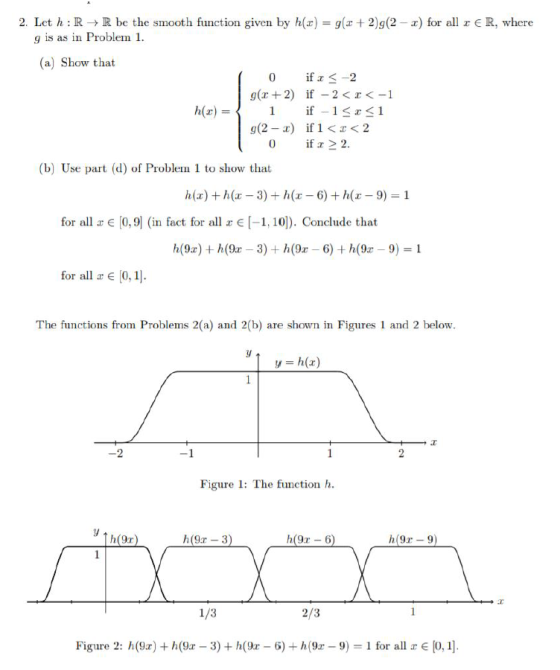
2. Let h : R-+ R be the smooth function given by h(z) g is as in Problem 1 g(z + 2g(2-x) for all r E R, where (a) Show that if a
Homework Answers
 first complete question according to HomeworkLib policy.
Add Answer to:
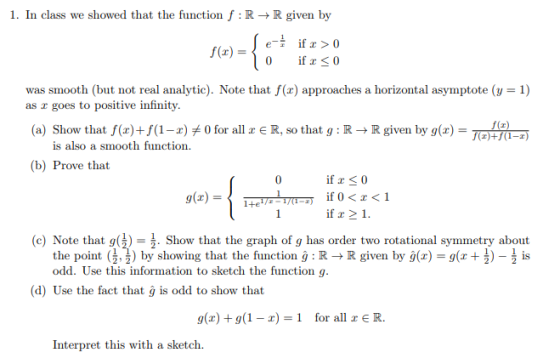
what I need for is #2! #1 is attached for #2. Please help me! Thanks 1. In class we showed that the function f : R → R...
plz help me !! Thanks 1. In class we showed that the function f : R → R given by (if>o 0 if a S0 was smooth (but not...
 plz help me !! Thanks
1. In class we showed that the function f : R → R given by (if>o 0 if a S0 was smooth (but not real analytic). Note that f(x) approaches a horizontal asymptote (y = 1) as a goes to positive infinity. (a) Show that f(x)+f(1-2)メ0 for all x E R, so that g : R → R given by g(x)- 70 is also a smooth function. (b) Prove that if 0 ifx-1. (c) Note...
plz help me !! Thanks
1. In class we showed that the function f : R → R given by (if>o 0 if a S0 was smooth (but not real analytic). Note that f(x) approaches a horizontal asymptote (y = 1) as a goes to positive infinity. (a) Show that f(x)+f(1-2)メ0 for all x E R, so that g : R → R given by g(x)- 70 is also a smooth function. (b) Prove that if 0 ifx-1. (c) Note...
plz help me analysis question! Thanks in advance 2. Let h : R-+ R be the smooth function given by h(z) g is as in Probl...
 plz help me analysis question!
Thanks in advance
2. Let h : R-+ R be the smooth function given by h(z) g is as in Problem 1 g(z + 2g(2-x) for all r E R, where (a) Show that if a < -2 0 g(2) if -2< <-1 h(x) if 2 0 (b) Use part (d) of Proble 1 to show that for all E 0,9 in fact for all ,. Conclude that for all e 0,1 The functions from...
plz help me analysis question!
Thanks in advance
2. Let h : R-+ R be the smooth function given by h(z) g is as in Problem 1 g(z + 2g(2-x) for all r E R, where (a) Show that if a < -2 0 g(2) if -2< <-1 h(x) if 2 0 (b) Use part (d) of Proble 1 to show that for all E 0,9 in fact for all ,. Conclude that for all e 0,1 The functions from...
Implicit Function Theorem in Two Variables: Let g: R2 → R be a smooth function. Set {(z, y) E R2 ...
 Implicit Function Theorem in Two Variables: Let g: R2 → R be a smooth function. Set {(z, y) E R2 | g(z, y) = 0} S Suppose g(a, b)-0 so that (a, b) E S and dg(a, b)メO. Then there exists an open neighborhood of (a, b) say V such that SnV is the image of a smooth parameterized curve. (1) Verify the implicit function theorem using the two examples above. 2) Since dg(a,b) 0, argue that it suffices to...
Please answer this question Implicit Function Theorem in Two Variables: Let g: R2 - R be...
 Please answer this question
Implicit Function Theorem in Two Variables: Let g: R2 - R be a smooth function. Set Suppose g(a, b)-0 so that (a, b) є S and dg(a, b) 0. Then there exists an open neighborhood of (a, b) say V such that SnV is the image of a smooth parameterized curve. (1) Verify the implicit function theorem using the two examples above (2) Since dg(a, b)メ0, argue that it suffices to assume a,b)メ0. (3) Prove the...
Please answer this question
Implicit Function Theorem in Two Variables: Let g: R2 - R be a smooth function. Set Suppose g(a, b)-0 so that (a, b) є S and dg(a, b) 0. Then there exists an open neighborhood of (a, b) say V such that SnV is the image of a smooth parameterized curve. (1) Verify the implicit function theorem using the two examples above (2) Since dg(a, b)メ0, argue that it suffices to assume a,b)メ0. (3) Prove the...
2. 15 Marks (a) Suppose that f : R" R is convex but not necessarily smooth. Prove that h-af is a ...
 need help with all a, b, c
2. 15 Marks (a) Suppose that f : R" R is convex but not necessarily smooth. Prove that h-af is a (b) Suppose that f : R -R is convex and smooth. Also assume that f(x) > 0 for all z (c) Show that the set S = {(x,y) : y > 0} is convex and that the function f(x,y)-x2/v is convex function if a-0. Show with a simple example that this is...
need help with all a, b, c
2. 15 Marks (a) Suppose that f : R" R is convex but not necessarily smooth. Prove that h-af is a (b) Suppose that f : R -R is convex and smooth. Also assume that f(x) > 0 for all z (c) Show that the set S = {(x,y) : y > 0} is convex and that the function f(x,y)-x2/v is convex function if a-0. Show with a simple example that this is...
2) (12) f:R-(3/2)-R-10, (x) 1/(3 2x) g:R--21->R-1o), g (x)1/ (x 2) h:R-(-4/3]-R-(1/3), h(x) (f o g) (x) Verify if h(x) is one to one and onto. If it is, find the inverse function of h(x)....
 2) (12) f:R-(3/2)-R-10, (x) 1/(3 2x) g:R--21->R-1o), g (x)1/ (x 2) h:R-(-4/3]-R-(1/3), h(x) (f o g) (x) Verify if h(x) is one to one and onto. If it is, find the inverse function of h(x).
2) (12) f:R-(3/2)-R-10, (x) 1/(3 2x) g:R--21->R-1o), g (x)1/ (x 2) h:R-(-4/3]-R-(1/3), h(x) (f o g) (x) Verify if h(x) is one to one and onto. If it is, find the inverse function of h(x).
2) (12) f:R-(3/2)-R-10, (x) 1/(3 2x) g:R--21->R-1o), g (x)1/ (x 2) h:R-(-4/3]-R-(1/3), h(x) (f o g) (x) Verify if h(x) is one to one and onto. If it is, find the inverse function of h(x).
Let f: C→C be an entire, one-to-one function. (a) Explain why g()-f() f(0) is an entire 1-1 function (b) Explain why th...
 Let f: C→C be an entire, one-to-one function. (a) Explain why g()-f() f(0) is an entire 1-1 function (b) Explain why there exists0 such that B(O,e) C g(B(O, 1)). Hint: Open Mapping thm.] (c) Explain why Ig(z)2є if 221 . [Hint: g is 1-1.] (d) Since g(0)=0, g(z)=2h(z) for some entire function h(z). Explain why h(z) is never 0 (e) Show that there is a constant C>0 such that 1/h2)l C if21 (f) Deduce that 1/h (z) is a constant...
number 1 and 2 pls Problem 1.1. Suppose that f: R → R and that f...
 number 1 and 2 pls
Problem 1.1. Suppose that f: R → R and that f is differentiable at z = a. 1. Show that, given an angle 6, we can choose 6(0) > 0 small enough so that for all r such that r - al < (0) we have that the graph of f(r) lies inside of the cone with angle e around the tangent line. 2. Can you find explicit formulas for 6(0) for the function f(x)...
number 1 and 2 pls
Problem 1.1. Suppose that f: R → R and that f is differentiable at z = a. 1. Show that, given an angle 6, we can choose 6(0) > 0 small enough so that for all r such that r - al < (0) we have that the graph of f(r) lies inside of the cone with angle e around the tangent line. 2. Can you find explicit formulas for 6(0) for the function f(x)...
3. Show that (a) the function g: R” → R, given by g(x) = ||2||2, is...
 3. Show that (a) the function g: R” → R, given by g(x) = ||2||2, is convex. (b) if f : RM → R is convex, then g:R" + R given by g(x) = f(Ax – b) is also convex. A here is an m x n matrix, and b ERM is a vector. You may use any of the results we covered in class (but the definition of convexity may be an easy way to do this, and gives...
 plz help me !! Thanks
1. In class we showed that the function f : R → R given by (if>o 0 if a S0 was smooth (but not real analytic). Note that f(x) approaches a horizontal asymptote (y = 1) as a goes to positive infinity. (a) Show that f(x)+f(1-2)メ0 for all x E R, so that g : R → R given by g(x)- 70 is also a smooth function. (b) Prove that if 0 ifx-1. (c) Note...
plz help me !! Thanks
1. In class we showed that the function f : R → R given by (if>o 0 if a S0 was smooth (but not real analytic). Note that f(x) approaches a horizontal asymptote (y = 1) as a goes to positive infinity. (a) Show that f(x)+f(1-2)メ0 for all x E R, so that g : R → R given by g(x)- 70 is also a smooth function. (b) Prove that if 0 ifx-1. (c) Note...
 plz help me analysis question!
Thanks in advance
2. Let h : R-+ R be the smooth function given by h(z) g is as in Problem 1 g(z + 2g(2-x) for all r E R, where (a) Show that if a < -2 0 g(2) if -2< <-1 h(x) if 2 0 (b) Use part (d) of Proble 1 to show that for all E 0,9 in fact for all ,. Conclude that for all e 0,1 The functions from...
plz help me analysis question!
Thanks in advance
2. Let h : R-+ R be the smooth function given by h(z) g is as in Problem 1 g(z + 2g(2-x) for all r E R, where (a) Show that if a < -2 0 g(2) if -2< <-1 h(x) if 2 0 (b) Use part (d) of Proble 1 to show that for all E 0,9 in fact for all ,. Conclude that for all e 0,1 The functions from...
 Implicit Function Theorem in Two Variables: Let g: R2 → R be a smooth function. Set {(z, y) E R2 | g(z, y) = 0} S Suppose g(a, b)-0 so that (a, b) E S and dg(a, b)メO. Then there exists an open neighborhood of (a, b) say V such that SnV is the image of a smooth parameterized curve. (1) Verify the implicit function theorem using the two examples above. 2) Since dg(a,b) 0, argue that it suffices to...
 Please answer this question
Implicit Function Theorem in Two Variables: Let g: R2 - R be a smooth function. Set Suppose g(a, b)-0 so that (a, b) є S and dg(a, b) 0. Then there exists an open neighborhood of (a, b) say V such that SnV is the image of a smooth parameterized curve. (1) Verify the implicit function theorem using the two examples above (2) Since dg(a, b)メ0, argue that it suffices to assume a,b)メ0. (3) Prove the...
Please answer this question
Implicit Function Theorem in Two Variables: Let g: R2 - R be a smooth function. Set Suppose g(a, b)-0 so that (a, b) є S and dg(a, b) 0. Then there exists an open neighborhood of (a, b) say V such that SnV is the image of a smooth parameterized curve. (1) Verify the implicit function theorem using the two examples above (2) Since dg(a, b)メ0, argue that it suffices to assume a,b)メ0. (3) Prove the...
 need help with all a, b, c
2. 15 Marks (a) Suppose that f : R" R is convex but not necessarily smooth. Prove that h-af is a (b) Suppose that f : R -R is convex and smooth. Also assume that f(x) > 0 for all z (c) Show that the set S = {(x,y) : y > 0} is convex and that the function f(x,y)-x2/v is convex function if a-0. Show with a simple example that this is...
need help with all a, b, c
2. 15 Marks (a) Suppose that f : R" R is convex but not necessarily smooth. Prove that h-af is a (b) Suppose that f : R -R is convex and smooth. Also assume that f(x) > 0 for all z (c) Show that the set S = {(x,y) : y > 0} is convex and that the function f(x,y)-x2/v is convex function if a-0. Show with a simple example that this is...
 2) (12) f:R-(3/2)-R-10, (x) 1/(3 2x) g:R--21->R-1o), g (x)1/ (x 2) h:R-(-4/3]-R-(1/3), h(x) (f o g) (x) Verify if h(x) is one to one and onto. If it is, find the inverse function of h(x).
2) (12) f:R-(3/2)-R-10, (x) 1/(3 2x) g:R--21->R-1o), g (x)1/ (x 2) h:R-(-4/3]-R-(1/3), h(x) (f o g) (x) Verify if h(x) is one to one and onto. If it is, find the inverse function of h(x).
2) (12) f:R-(3/2)-R-10, (x) 1/(3 2x) g:R--21->R-1o), g (x)1/ (x 2) h:R-(-4/3]-R-(1/3), h(x) (f o g) (x) Verify if h(x) is one to one and onto. If it is, find the inverse function of h(x).
 Let f: C→C be an entire, one-to-one function. (a) Explain why g()-f() f(0) is an entire 1-1 function (b) Explain why there exists0 such that B(O,e) C g(B(O, 1)). Hint: Open Mapping thm.] (c) Explain why Ig(z)2є if 221 . [Hint: g is 1-1.] (d) Since g(0)=0, g(z)=2h(z) for some entire function h(z). Explain why h(z) is never 0 (e) Show that there is a constant C>0 such that 1/h2)l C if21 (f) Deduce that 1/h (z) is a constant...
 number 1 and 2 pls
Problem 1.1. Suppose that f: R → R and that f is differentiable at z = a. 1. Show that, given an angle 6, we can choose 6(0) > 0 small enough so that for all r such that r - al < (0) we have that the graph of f(r) lies inside of the cone with angle e around the tangent line. 2. Can you find explicit formulas for 6(0) for the function f(x)...
number 1 and 2 pls
Problem 1.1. Suppose that f: R → R and that f is differentiable at z = a. 1. Show that, given an angle 6, we can choose 6(0) > 0 small enough so that for all r such that r - al < (0) we have that the graph of f(r) lies inside of the cone with angle e around the tangent line. 2. Can you find explicit formulas for 6(0) for the function f(x)...
 3. Show that (a) the function g: R” → R, given by g(x) = ||2||2, is convex. (b) if f : RM → R is convex, then g:R" + R given by g(x) = f(Ax – b) is also convex. A here is an m x n matrix, and b ERM is a vector. You may use any of the results we covered in class (but the definition of convexity may be an easy way to do this, and gives...
Most questions answered within 3 hours.
-
Where is the error in this code sequence?
String s1 = "Hello";
String s2 = "ello";...
asked 10 months ago -
Financial data for Joel de Paris, Inc., for last year
follow:
Joel de Paris, Inc.
Balance...
asked 10 months ago -
Consider this reaction:
Al2(SO4)3 (aq)+ BaCl3
(aq) Al2Cl6 (aq)- +
3BaSO4(s) . What is the...
asked 10 months ago -
Suppose that Savneet is considering increasing her
recent random sample from 20 car rentals to 40...
asked 10 months ago -
Trucks arrive at an unloading terminal at an average rate of 120
per hour.
Trucks arrive...
asked 10 months ago -
Why are methanol and ethanol completely soluble in water while
octanol is not very little soluble....
asked 10 months ago -
A facilities manager at a university reads in a research report
that the mean amount of...
asked 10 months ago -
When the CuSO4 is rehydrated by adding water to the anhydrous
compound, is this an endothermic...
asked 10 months ago -
A ray of sunlight is passing from diamond into crown glass; the
angle of incidence is...
asked 10 months ago -
A block of mass 0.249 kg is placed on top of a light, vertical
spring of...
asked 10 months ago -
how do the kidneys compensate in the presences of acidosis
a) trigger hyperventilate
b) reserve acid...
asked 10 months ago -
Question 501 pts
The rental rate of capital to the firm increases. Which of the
following...
asked 10 months ago