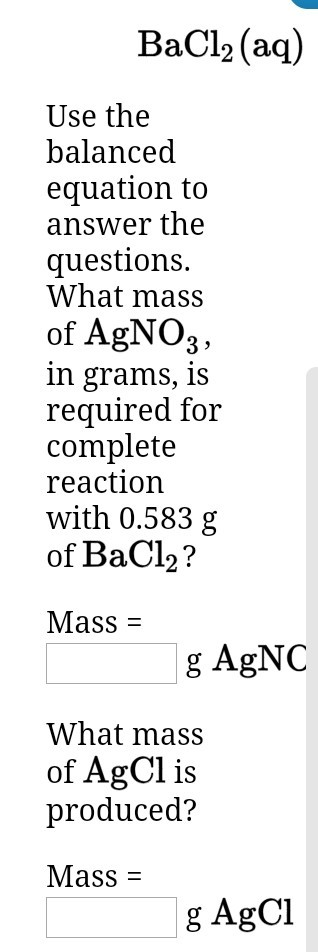
The formation of water-insoluble silver chloride is useful in the
analysis of chloride-containing substances. Consider the following
unbalanced equation:
Homework Answers
Add Answer to:
The formation of water-insoluble silver chloride is useful in the analysis of chloride-containing substances. Consid...
When solutions containing silver ions and chloride ions are mixed, silver chloride precipitates: Ag+(aq)+Cl−(aq)→AgCl(...
When solutions containing silver ions and chloride ions are mixed, silver chloride precipitates: Ag+(aq)+Cl−(aq)→AgCl(s)ΔH=−65.5kJ Calculate ΔH for formation of 0.490 mol of AgCl by this reaction. Calculate ΔH for the formation of 7.50 g of AgCl. Calculate ΔH when 9.23×10⁻⁴ mol of AgCl dissolves in water.
11. Insoluble silver chloride dissolves in the presence of chloride ion. The equation for the overall...
 11. Insoluble silver chloride dissolves in the presence of chloride ion. The equation for the overall reaction is AgCl(s) + Cl(aq) AgCl2 (aq) a) show that the overall reaction is the sum of two others: the ionization of AgCl(s) to give silver(I) and chloride ions, and the formation of AgCl2 (aq) from Ag (aq) and Cl(aq) ions. b) Calculate the equilibrium constant for the overall process from the equilibrium constants for the two steps. (refer back to Complex lon Formation...
When solutions containing silver ions and chloride ions are mixed, silver chloride precipitates: Ag+(aq)+Cl−(aq)→AgCl(s)ΔH=−65.5kJ A.) Calculate...
When solutions containing silver ions and chloride ions are mixed, silver chloride precipitates: Ag+(aq)+Cl−(aq)→AgCl(s)ΔH=−65.5kJ A.) Calculate ΔH for formation of 0.100 mol of AgCl by this reaction. I got A ΔH=-6.55 kJ B.) Calculate ΔH for the formation of 2.80 g of AgCl. C.) Calculate ΔH when 0.110 mmol of AgCl dissolves in water. Need help with B and C.
Silver ions can be precipitated from aqueous solutions by the addition of aqueous chloride: Ag+(aq)+Cl−(aq)→AgCl(s) Silver...
Silver ions can be precipitated from aqueous solutions by the addition of aqueous chloride: Ag+(aq)+Cl−(aq)→AgCl(s) Silver chloride is virtually insoluble in water so that the reaction appears to go to completion. How many grams of solid NaCl must be added to 25.0 mL of 0.149 M AgNO3 solution to completely precipitate the silver?
When solutions of silver nitrate and sodium chloride are mixed, silver chloride precipitates out of solution according t...
When solutions of silver nitrate and sodium chloride are mixed, silver chloride precipitates out of solution according to the equation AgNO3(aq)+NaCl(aq)→AgCl(s)+NaNO3(aq) A.) What mass of silver chloride can be produced from 1.73 L of a 0.278 M solution of silver nitrate? B.)The reaction described in Part A required 3.26 L of sodium chloride. What is the concentration of this sodium chloride solution
5. Given the following balanced chemical reaction, find the mass of silver chloride formed from 8.00...
 5. Given the following balanced chemical reaction, find the mass of silver chloride formed from 8.00 g of silver nitrate using the following steps: AgNO3 (aq) + NaCl (aq) → NaNO3 (aq) + AgCl (s) a. Given 8.00 g of silver nitrate (AgNO3), how many moles are there? b. What is the molar ratio of silver chloride (AgCl) to silver nitrate? C. How many moles of silver chloride are formed from the number of moles of silver nitrate found in...
a When solutions of silver nitrate and sodium chloride are mixed, silver chloride precipitates out of...
a When solutions of silver nitrate and sodium chloride are mixed, silver chloride precipitates out of solution according to the equation AgNO3(aq)+NaCl(aq)→AgCl(s)+NaNO3(aq) Part A What mass of silver chloride can be produced from 1.51 L of a 0.293 M solution of silver nitrate? Express your answer with the appropriate units. b. The reaction described in Part A required 3.54 L of sodium chloride. What is the concentration of this sodium chloride solution? Express your answer with the appropriate units.
Please help asap =) 2. Lead(II)chloride is insoluble in water Kap PbCn 1.7x10-) and silver chloride...
 Please help asap =)
2. Lead(II)chloride is insoluble in water Kap PbCn 1.7x10-) and silver chloride is very insoluble in water (Ksp Agci 1.8x10⁻¹⁰). The reactions when they go into solution are: AgCl(s) ←→ Ag+(aq) + Cl-(aq) PbCl2(s)艹Pb+2(aq) + 2 Cl-(aq) a. What are the expressions for the equilibrium constants, Kop for the above reactions? b. Explain why it is possible to dissolve more lead(I)chloride in solutions in which the concentration of the silver ion is present. c. Explain what...
Please help asap =)
2. Lead(II)chloride is insoluble in water Kap PbCn 1.7x10-) and silver chloride is very insoluble in water (Ksp Agci 1.8x10⁻¹⁰). The reactions when they go into solution are: AgCl(s) ←→ Ag+(aq) + Cl-(aq) PbCl2(s)艹Pb+2(aq) + 2 Cl-(aq) a. What are the expressions for the equilibrium constants, Kop for the above reactions? b. Explain why it is possible to dissolve more lead(I)chloride in solutions in which the concentration of the silver ion is present. c. Explain what...
When solutions containing silver ions and chloride ions are mixed, silver chloride precipitates: Ag' (aq) +...
 When solutions containing silver ions and chloride ions are mixed, silver chloride precipitates: Ag' (aq) + Cl (aq) -> AgCl(s) ?? -65.5kl PartB Calculate ?? for the formation of 9.50 g of AgCl. kJ Submit vious Answers Request Answer X Incorrect, Try Again; 5 attempts remaining Not quite. Check through your calculations; you may have made a rounding error or used the wrong number of significant figures. PartC Calculate ?? when 9.22x10⁻⁴ mol of AgCl dissolves in water ?? Submit...
For the following reaction, 5.09 grams of iron(II) chloride are mixed with excess silver nitrate Assume...
 For the following reaction, 5.09 grams of iron(II) chloride are mixed with excess silver nitrate Assume that the percent yield of iron(II) nitrate is 93.4% Iron(II) chloride(aq) + silver nitrate(aq) iron(II) nitrate(aq) + silver chloride(s) What is the ideal yield of iron(II) nitrate? What is the actual yield of iron(II) nitrate? grams grams Submit ANSWER Retry Entire Group 2 more group attempts remaining The equation for this reaction is: FeCl2(aq) + 2 AgNO3(aq) - Fe(NO3)2(aq) + 2 AgCl(s)
 11. Insoluble silver chloride dissolves in the presence of chloride ion. The equation for the overall reaction is AgCl(s) + Cl(aq) AgCl2 (aq) a) show that the overall reaction is the sum of two others: the ionization of AgCl(s) to give silver(I) and chloride ions, and the formation of AgCl2 (aq) from Ag (aq) and Cl(aq) ions. b) Calculate the equilibrium constant for the overall process from the equilibrium constants for the two steps. (refer back to Complex lon Formation...
 5. Given the following balanced chemical reaction, find the mass of silver chloride formed from 8.00 g of silver nitrate using the following steps: AgNO3 (aq) + NaCl (aq) → NaNO3 (aq) + AgCl (s) a. Given 8.00 g of silver nitrate (AgNO3), how many moles are there? b. What is the molar ratio of silver chloride (AgCl) to silver nitrate? C. How many moles of silver chloride are formed from the number of moles of silver nitrate found in...
 Please help asap =)
2. Lead(II)chloride is insoluble in water Kap PbCn 1.7x10-) and silver chloride is very insoluble in water (Ksp Agci 1.8x10⁻¹⁰). The reactions when they go into solution are: AgCl(s) ←→ Ag+(aq) + Cl-(aq) PbCl2(s)艹Pb+2(aq) + 2 Cl-(aq) a. What are the expressions for the equilibrium constants, Kop for the above reactions? b. Explain why it is possible to dissolve more lead(I)chloride in solutions in which the concentration of the silver ion is present. c. Explain what...
Please help asap =)
2. Lead(II)chloride is insoluble in water Kap PbCn 1.7x10-) and silver chloride is very insoluble in water (Ksp Agci 1.8x10⁻¹⁰). The reactions when they go into solution are: AgCl(s) ←→ Ag+(aq) + Cl-(aq) PbCl2(s)艹Pb+2(aq) + 2 Cl-(aq) a. What are the expressions for the equilibrium constants, Kop for the above reactions? b. Explain why it is possible to dissolve more lead(I)chloride in solutions in which the concentration of the silver ion is present. c. Explain what...
 When solutions containing silver ions and chloride ions are mixed, silver chloride precipitates: Ag' (aq) + Cl (aq) -> AgCl(s) ?? -65.5kl PartB Calculate ?? for the formation of 9.50 g of AgCl. kJ Submit vious Answers Request Answer X Incorrect, Try Again; 5 attempts remaining Not quite. Check through your calculations; you may have made a rounding error or used the wrong number of significant figures. PartC Calculate ?? when 9.22x10⁻⁴ mol of AgCl dissolves in water ?? Submit...
 For the following reaction, 5.09 grams of iron(II) chloride are mixed with excess silver nitrate Assume that the percent yield of iron(II) nitrate is 93.4% Iron(II) chloride(aq) + silver nitrate(aq) iron(II) nitrate(aq) + silver chloride(s) What is the ideal yield of iron(II) nitrate? What is the actual yield of iron(II) nitrate? grams grams Submit ANSWER Retry Entire Group 2 more group attempts remaining The equation for this reaction is: FeCl2(aq) + 2 AgNO3(aq) - Fe(NO3)2(aq) + 2 AgCl(s)
Most questions answered within 3 hours.
-
Where is the error in this code sequence?
String s1 = "Hello";
String s2 = "ello";...
asked 11 months ago -
Financial data for Joel de Paris, Inc., for last year
follow:
Joel de Paris, Inc.
Balance...
asked 11 months ago -
Consider this reaction:
Al2(SO4)3 (aq)+ BaCl3
(aq) Al2Cl6 (aq)- +
3BaSO4(s) . What is the...
asked 11 months ago -
Suppose that Savneet is considering increasing her
recent random sample from 20 car rentals to 40...
asked 11 months ago -
Trucks arrive at an unloading terminal at an average rate of 120
per hour.
Trucks arrive...
asked 11 months ago -
Why are methanol and ethanol completely soluble in water while
octanol is not very little soluble....
asked 11 months ago -
A facilities manager at a university reads in a research report
that the mean amount of...
asked 11 months ago -
When the CuSO4 is rehydrated by adding water to the anhydrous
compound, is this an endothermic...
asked 11 months ago -
A ray of sunlight is passing from diamond into crown glass; the
angle of incidence is...
asked 11 months ago -
A block of mass 0.249 kg is placed on top of a light, vertical
spring of...
asked 11 months ago -
how do the kidneys compensate in the presences of acidosis
a) trigger hyperventilate
b) reserve acid...
asked 11 months ago -
Question 501 pts
The rental rate of capital to the firm increases. Which of the
following...
asked 11 months ago