
Homework Answers
Add Answer to:
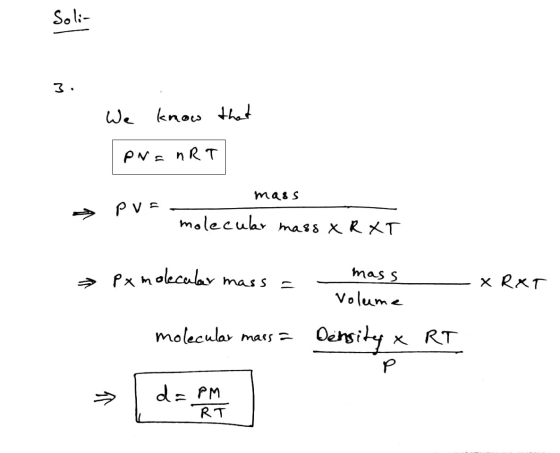
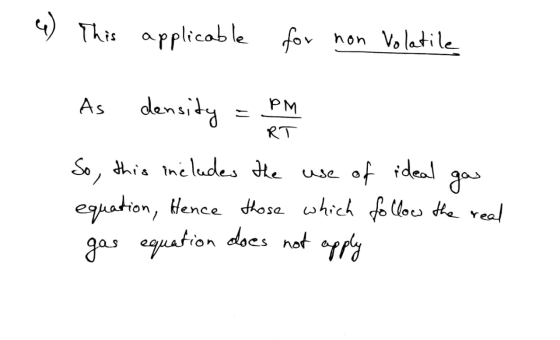
3. The relation that exists between gas density and molecular mass applies to gases. In this experiment, the unknown wa...
Name Section/CRN EXPERIMENT 8 THE IDEAL GAS LAW AND THE MOLECULAR MASS OF GASES PRE-LABORATORY QUESTIONS...
 Name Section/CRN EXPERIMENT 8 THE IDEAL GAS LAW AND THE MOLECULAR MASS OF GASES PRE-LABORATORY QUESTIONS The following preparatory questions should be answered before coming to lab. They are intended to introduce you to several ideas that are important to aspects of the experiment. You must turn in your work to your instructor before you will be allowed to begin the experiment. 1. State the ideal gas law in equation form. What does each symbol in the equation stand for...
DISCUSSION QUESTIONS 1. If the liquid did not completely vaporize in the experiment, would the ap-...
 DISCUSSION QUESTIONS 1. If the liquid did not completely vaporize in the experiment, would the ap- parent molecular weight be larger, smaller, or unchanged compared to that determined if the experiment had been properly performed? Would the error in part (1) have a larger, smaller, or the same effect as the errors that might be made in measuring the temperature of the water in the flask, the barometric pressure, or the volume of the flask? Explain your answer. 2. What...
A student attempted to identify an unknown compound by the method used in this experiment. Her or...
 A student attempted to identify an unknown compound by the method used in this experiment. Her original sample weight was 0.7047 g. When heated in the first step, the mass decreased to 0.4862 g Write the complete, net balanced reaction that would occur in this experiment if - the student's unknown compound was NaHCO3 -the student's unknown compound was KHCO3 Using stoichiometry, predict the theoretical yield of the solid chloride obtained at the end of the student's experiment if -...
Molecular Mass of a Volatile Liquid 1. The atmospheric pressure of a hot summer day in...
 Molecular Mass of a Volatile Liquid 1. The atmospheric pressure of a hot summer day in NYC is 29.94 inHg. Calculate this value in mmile and am 2. The atmospheric pressure of a cold winter day in NYC is 25.94 inHg. Calculate this value in Pa. 3. We set up an experiment utilizing the Dumas method to calculate the molar mass of an unknown chemical. A 4.00 mL pure liquid sample of this chemical is vaporized in an Erlenmeyer flask...
Chame nsead tu age 06-17 Experiment 8: Molar Mass of a Volatile Liquid Purpose To determine...
 Chame nsead tu age 06-17 Experiment 8: Molar Mass of a Volatile Liquid Purpose To determine the molar mass of a pure substance we need to find out (a) the number of moles in a given sample, and (b) the mass of the same sample. Molar mass is then: mass divided by moles Introduction Using the ideal gas equation, PV= nRT, we can determine the number of moles (n) of gas or vapor under measured conditions of pressure (P), volume...
1. Under what conditions do real gases behave most like an ideal gas? 3. A student had an...
1. Under what conditions do real gases behave most like an ideal gas? 3. A student had an unknown liquid and wished to determine its molecular weight. The following data was collected using the procedure of this experiment: Weight of the 125 mL Erlenmeyer flask and cover (Al foil and Cu wire), 75.33 g Weight of cooled flask and cover containing condensed liquid, 87.6 g Temperature of boiling water, 100.5 oC Volume of the 125 mL Erlenmeyer flask, 165.5 mL Atmospheric pressure, 780.3...
i dont understand why the molecular weight i calculated (42.012 g/mol) for my unknown liquid (acetone)...
 i dont understand why the molecular weight i calculated
(42.012 g/mol) for my unknown liquid (acetone) is less than the
actual molecular weight (58.08 g/mol). what errors could i have
made in my lab that would account for the difference.
Molecular Weight of a Volatile Liquid In this experiment, an amount of liquid more than sufficient to fill the flask when vaporized is placed in a flask of measured volume and mass. The flask is then heated in a boiling...
i dont understand why the molecular weight i calculated
(42.012 g/mol) for my unknown liquid (acetone) is less than the
actual molecular weight (58.08 g/mol). what errors could i have
made in my lab that would account for the difference.
Molecular Weight of a Volatile Liquid In this experiment, an amount of liquid more than sufficient to fill the flask when vaporized is placed in a flask of measured volume and mass. The flask is then heated in a boiling...
Can, anyone make sure these answers are correct? 1. If 0.765g of an unknown gas is...
 Can, anyone make sure these answers are correct?
1. If 0.765g of an unknown gas is collected at 741 torr (corrected) and 95°C in a 245 ml container, calculate the molecular weight of this unknown gas? P=741 tona PV=ART -> ideal gas equation n=PU T=95C+243=368K BT mass of the gas = 0.7659 =a41tów 80.245€ R= 62-4L-fowl mol- 624kbar V=245 med 'x 36644 Moler mass of the gos= 0.7659 245L 6 +91-1 60079rmal 2. If in the experiment in Question 1,...
Can, anyone make sure these answers are correct?
1. If 0.765g of an unknown gas is collected at 741 torr (corrected) and 95°C in a 245 ml container, calculate the molecular weight of this unknown gas? P=741 tona PV=ART -> ideal gas equation n=PU T=95C+243=368K BT mass of the gas = 0.7659 =a41tów 80.245€ R= 62-4L-fowl mol- 624kbar V=245 med 'x 36644 Moler mass of the gos= 0.7659 245L 6 +91-1 60079rmal 2. If in the experiment in Question 1,...
Homework 3 t Gas Density and Molar Mass 6 of 14 > ReviewI Constants Periodic Table...
 Homework 3 t Gas Density and Molar Mass 6 of 14 > ReviewI Constants Periodic Table ▼ Part B Pressure and temperature affect the amount of space between gas molecules, which affects the volume and, therefore, the density of the gas since To identify a diatomic gas (X2), a researcher carried out the following experiment: She weighed an empty 4.5-L bulb, then filled it with the gas at 1.30 atm and 24.0 °C and weighed it again. The difference in...
4. Suppose that a student performed the experiment and calculations perfectly as directed except that, unknown...
 4. Suppose that a student performed the experiment and calculations perfectly as directed except that, unknown to the student, the balance was not zeroed but weighed 0.100 g too high throughout the experiment. Would the calculated val- ue for the density of the unknown liquid be correct? That is, would it be equal to, higher than, or lower than the true value. Explain your answer in clear and correct English. 16 LABORATORY EXPERIMENTS IN GENERAL CHEMISTRY ed in question 4...
 Name Section/CRN EXPERIMENT 8 THE IDEAL GAS LAW AND THE MOLECULAR MASS OF GASES PRE-LABORATORY QUESTIONS The following preparatory questions should be answered before coming to lab. They are intended to introduce you to several ideas that are important to aspects of the experiment. You must turn in your work to your instructor before you will be allowed to begin the experiment. 1. State the ideal gas law in equation form. What does each symbol in the equation stand for...
 DISCUSSION QUESTIONS 1. If the liquid did not completely vaporize in the experiment, would the ap- parent molecular weight be larger, smaller, or unchanged compared to that determined if the experiment had been properly performed? Would the error in part (1) have a larger, smaller, or the same effect as the errors that might be made in measuring the temperature of the water in the flask, the barometric pressure, or the volume of the flask? Explain your answer. 2. What...
 A student attempted to identify an unknown compound by the method used in this experiment. Her original sample weight was 0.7047 g. When heated in the first step, the mass decreased to 0.4862 g Write the complete, net balanced reaction that would occur in this experiment if - the student's unknown compound was NaHCO3 -the student's unknown compound was KHCO3 Using stoichiometry, predict the theoretical yield of the solid chloride obtained at the end of the student's experiment if -...
 Molecular Mass of a Volatile Liquid 1. The atmospheric pressure of a hot summer day in NYC is 29.94 inHg. Calculate this value in mmile and am 2. The atmospheric pressure of a cold winter day in NYC is 25.94 inHg. Calculate this value in Pa. 3. We set up an experiment utilizing the Dumas method to calculate the molar mass of an unknown chemical. A 4.00 mL pure liquid sample of this chemical is vaporized in an Erlenmeyer flask...
 Chame nsead tu age 06-17 Experiment 8: Molar Mass of a Volatile Liquid Purpose To determine the molar mass of a pure substance we need to find out (a) the number of moles in a given sample, and (b) the mass of the same sample. Molar mass is then: mass divided by moles Introduction Using the ideal gas equation, PV= nRT, we can determine the number of moles (n) of gas or vapor under measured conditions of pressure (P), volume...
 i dont understand why the molecular weight i calculated
(42.012 g/mol) for my unknown liquid (acetone) is less than the
actual molecular weight (58.08 g/mol). what errors could i have
made in my lab that would account for the difference.
Molecular Weight of a Volatile Liquid In this experiment, an amount of liquid more than sufficient to fill the flask when vaporized is placed in a flask of measured volume and mass. The flask is then heated in a boiling...
i dont understand why the molecular weight i calculated
(42.012 g/mol) for my unknown liquid (acetone) is less than the
actual molecular weight (58.08 g/mol). what errors could i have
made in my lab that would account for the difference.
Molecular Weight of a Volatile Liquid In this experiment, an amount of liquid more than sufficient to fill the flask when vaporized is placed in a flask of measured volume and mass. The flask is then heated in a boiling...
 Can, anyone make sure these answers are correct?
1. If 0.765g of an unknown gas is collected at 741 torr (corrected) and 95°C in a 245 ml container, calculate the molecular weight of this unknown gas? P=741 tona PV=ART -> ideal gas equation n=PU T=95C+243=368K BT mass of the gas = 0.7659 =a41tów 80.245€ R= 62-4L-fowl mol- 624kbar V=245 med 'x 36644 Moler mass of the gos= 0.7659 245L 6 +91-1 60079rmal 2. If in the experiment in Question 1,...
Can, anyone make sure these answers are correct?
1. If 0.765g of an unknown gas is collected at 741 torr (corrected) and 95°C in a 245 ml container, calculate the molecular weight of this unknown gas? P=741 tona PV=ART -> ideal gas equation n=PU T=95C+243=368K BT mass of the gas = 0.7659 =a41tów 80.245€ R= 62-4L-fowl mol- 624kbar V=245 med 'x 36644 Moler mass of the gos= 0.7659 245L 6 +91-1 60079rmal 2. If in the experiment in Question 1,...
 Homework 3 t Gas Density and Molar Mass 6 of 14 > ReviewI Constants Periodic Table ▼ Part B Pressure and temperature affect the amount of space between gas molecules, which affects the volume and, therefore, the density of the gas since To identify a diatomic gas (X2), a researcher carried out the following experiment: She weighed an empty 4.5-L bulb, then filled it with the gas at 1.30 atm and 24.0 °C and weighed it again. The difference in...
 4. Suppose that a student performed the experiment and calculations perfectly as directed except that, unknown to the student, the balance was not zeroed but weighed 0.100 g too high throughout the experiment. Would the calculated val- ue for the density of the unknown liquid be correct? That is, would it be equal to, higher than, or lower than the true value. Explain your answer in clear and correct English. 16 LABORATORY EXPERIMENTS IN GENERAL CHEMISTRY ed in question 4...
Most questions answered within 3 hours.
-
Where is the error in this code sequence?
String s1 = "Hello";
String s2 = "ello";...
asked 10 months ago -
Financial data for Joel de Paris, Inc., for last year
follow:
Joel de Paris, Inc.
Balance...
asked 10 months ago -
Consider this reaction:
Al2(SO4)3 (aq)+ BaCl3
(aq) Al2Cl6 (aq)- +
3BaSO4(s) . What is the...
asked 10 months ago -
Suppose that Savneet is considering increasing her
recent random sample from 20 car rentals to 40...
asked 10 months ago -
Trucks arrive at an unloading terminal at an average rate of 120
per hour.
Trucks arrive...
asked 10 months ago -
Why are methanol and ethanol completely soluble in water while
octanol is not very little soluble....
asked 10 months ago -
A facilities manager at a university reads in a research report
that the mean amount of...
asked 10 months ago -
When the CuSO4 is rehydrated by adding water to the anhydrous
compound, is this an endothermic...
asked 10 months ago -
A ray of sunlight is passing from diamond into crown glass; the
angle of incidence is...
asked 10 months ago -
A block of mass 0.249 kg is placed on top of a light, vertical
spring of...
asked 10 months ago -
how do the kidneys compensate in the presences of acidosis
a) trigger hyperventilate
b) reserve acid...
asked 10 months ago -
Question 501 pts
The rental rate of capital to the firm increases. Which of the
following...
asked 10 months ago