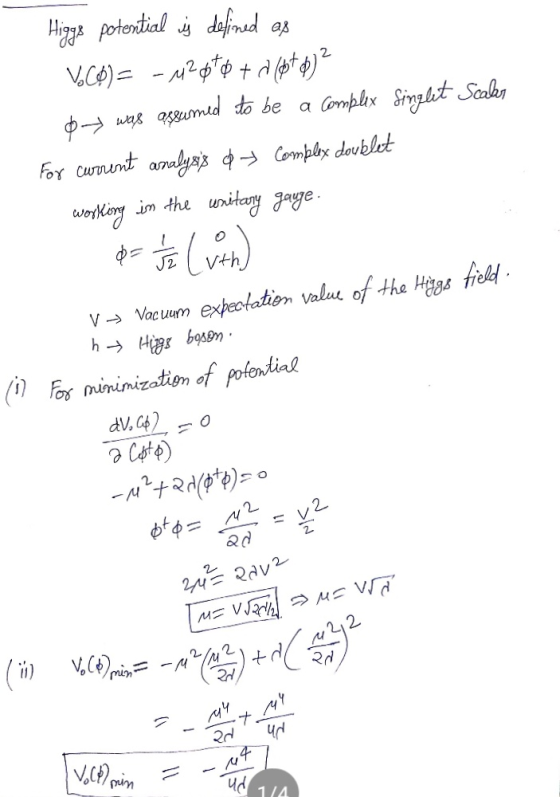
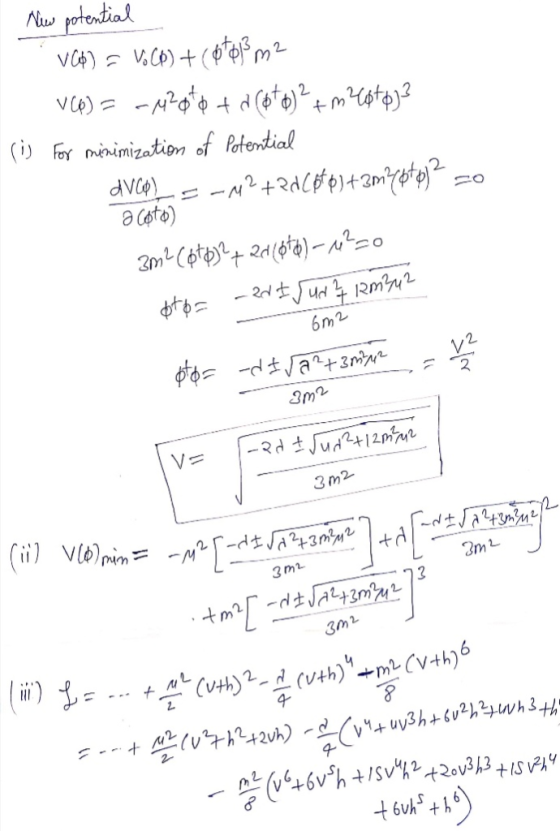
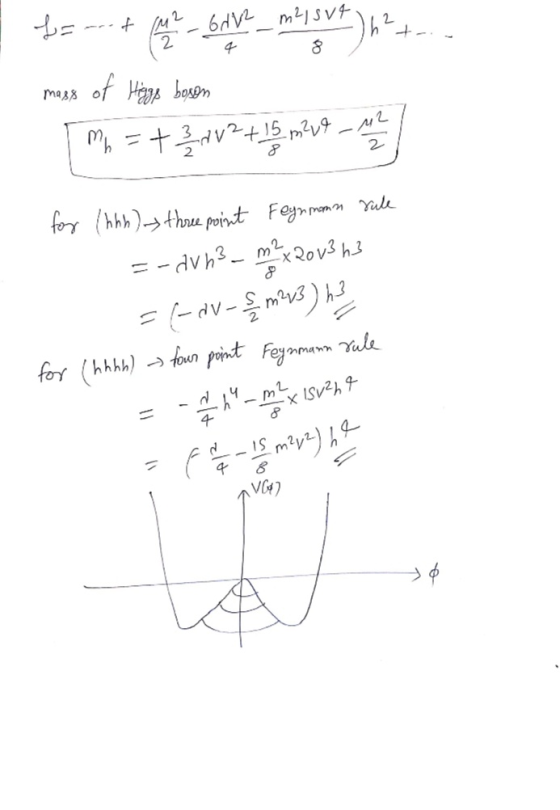
In class we have discussed the Higgs potential V_{o}(\Phi )= -\mu ^{2}\Phi^{\dagger }\Phi+ (\lambda\Phi^{\dagger }\Phi)^...
In class we have discussed the Higgs potential V_{o}(\Phi )= -\mu ^{2}\Phi^{\dagger }\Phi+ (\lambda\Phi^{\dagger }\Phi)^{2} where the Higgs field \Phi was assumed to be a complex singlet scalar for simplicity. For the current analysis consider it to be a complex doublet but for again simplicity arguments let us work in the so-called unitary gauge so that \Phi can be represented as \Phi=\binom{0}{(v+h)/\sqrt2} where all the unphysical degrees \Phi Φ are eliminated. Here v stands for the vacuum expectation value of the Higgs field and h for the Higgs boson. a) i) Do the following: i. Minimize the potential V_0 and eliminate \mu^2 in terms of the other parameters (\lambda,v). ii) Find the value of V_0 at the minimum. iii).Identify the mass term th for the Higgs boson h and express it in terms of parameter (\lambda,v). iv). Drive the Feynman rules for the three-point (hhh) and four-point (hhhh) Higgs interactions. Let us extend the above potential V_0 by adding a non-renormalizable term so that V(\Phi)= V_0(\Phi)+ (\Phi^\dagger \Phi)^3/M^2 b) ) Repeat all the subparts given in part (a) for the potential V(\Phi). Show transcribed image text
Homework Answers

Add Answer to:
In class we have discussed the Higgs potential V_{o}(\Phi )= -\mu ^{2}\Phi^{\dagger }\Phi+ (\lambda\Phi^{\dagger }\Phi)^...
Most questions answered within 3 hours.
-
Where is the error in this code sequence?
String s1 = "Hello";
String s2 = "ello";...
asked 10 months ago -
Financial data for Joel de Paris, Inc., for last year
follow:
Joel de Paris, Inc.
Balance...
asked 10 months ago -
Consider this reaction:
Al2(SO4)3 (aq)+ BaCl3
(aq) Al2Cl6 (aq)- +
3BaSO4(s) . What is the...
asked 10 months ago -
Suppose that Savneet is considering increasing her
recent random sample from 20 car rentals to 40...
asked 10 months ago -
Trucks arrive at an unloading terminal at an average rate of 120
per hour.
Trucks arrive...
asked 10 months ago -
Why are methanol and ethanol completely soluble in water while
octanol is not very little soluble....
asked 10 months ago -
A facilities manager at a university reads in a research report
that the mean amount of...
asked 10 months ago -
When the CuSO4 is rehydrated by adding water to the anhydrous
compound, is this an endothermic...
asked 10 months ago -
A ray of sunlight is passing from diamond into crown glass; the
angle of incidence is...
asked 10 months ago -
A block of mass 0.249 kg is placed on top of a light, vertical
spring of...
asked 10 months ago -
how do the kidneys compensate in the presences of acidosis
a) trigger hyperventilate
b) reserve acid...
asked 10 months ago -
Question 501 pts
The rental rate of capital to the firm increases. Which of the
following...
asked 10 months ago