
Homework Answers
Add Answer to:
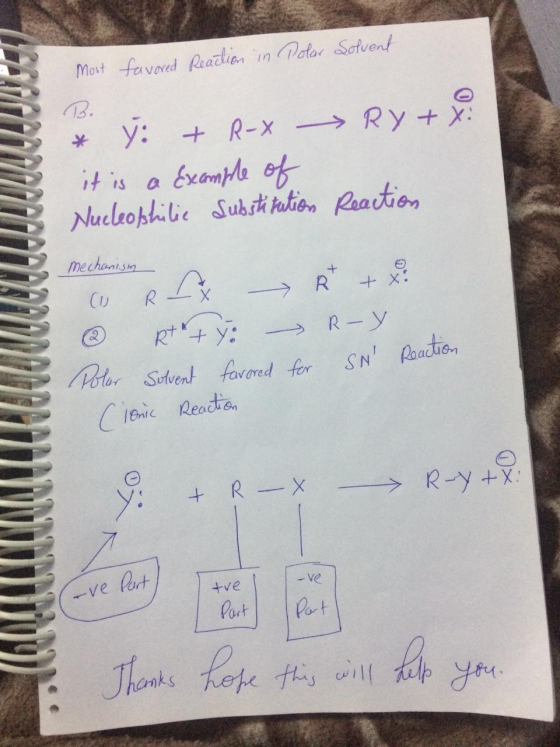
16. Considering the relative solvation of reactants and the transition states of substitution reactions of these re...
We begin with the surmise that the nucleophilic substitution reactions can occur only by one of...
 We begin with the surmise that the nucleophilic substitution reactions can occur only by one of two mechanisms: Sn1 solvolysis: three-step mechanism R-X slow, R® + to R® + ROH fast , ROM R' H. R-O + R'OH fast , ROR' + R- SN2: one-step mechanism R-X + Nuc slow, Nuc-R + x Begin by answering the three questions below. If you don't understand what's up, please ask! 1. Write out the rate law for the above Sn1 reaction and...
2. (16 points) In each of the following pairs of reactions elimination competes with substitution. Write...
 2. (16 points) In each of the following pairs of reactions elimination competes with substitution. Write the starting material and all possible products of the reactions, don't write mechanistic part Write "elimination is favored" for reaction in which elimination products can be obtained in higher yield comparing to the yield of the elimination product/s in the second reaction. Provide the reason for such statement, reason is in reaction conditions. Supplementary session is on 10/31/19 between 5:30 PM an write an...
Consider the SN2 reaction of butyl bromide with hydroxide ion , Assuming no other changes, what...
Consider the SN2 reaction of butyl bromide with hydroxide ion , Assuming no other changes, what effect on the reaction rate would result from simultaneously doubling the concentrations of both butyl bromide and hydroxyl ion No effect (B)It would double the rate (C)it would increase the rate six times (D) It would increase the rate four times. 2. Which alky halide would you expect to undergo SN1 hydrolysis most rapidly? (A) (CH3)3C-I (B) (CH3)3C-Br (C) (CH3)3C-Cl (D) (CH3)3C-F 3....
7. Draw the structures of the products P1 and P2 for the two SN 2 reactions...
 7. Draw the structures of the products P1 and P2 for the two SN 2 reactions shown. Make sure to indicate the stereochemistry in the products correctly! What is the most appropriate description for the role of the polar aprotic solvent (DMSO) in each reaction? KCN NASH → P1 By → P2 DMSO DMSO For questions 7 - 10: to practice for the exam: draw the reaction-energy diagrams for these reactions, writing out the specific rate equations for each of...
Experiment F. Nucleophilic Substitution Reactions. Pre -Lab Report 2. SPECIAL INSTRUCTIONS: a. Work in groups of 2-...
 Experiment F. Nucleophilic Substitution Reactions. Pre -Lab Report
2. SPECIAL INSTRUCTIONS: a. Work in groups of 2-3 students. Each group will complete and turn in one report for grade. You will not complete the lab report in your lab notebook using the usual format. Instead, the entire report is provided in the procedures section of these lab materials. You will complete the report by providing the missing information. Report is due at the end of the lab period. b. While...
Experiment F. Nucleophilic Substitution Reactions. Pre -Lab Report
2. SPECIAL INSTRUCTIONS: a. Work in groups of 2-3 students. Each group will complete and turn in one report for grade. You will not complete the lab report in your lab notebook using the usual format. Instead, the entire report is provided in the procedures section of these lab materials. You will complete the report by providing the missing information. Report is due at the end of the lab period. b. While...
Please completely answer the questions, thank you! For the reactions below, 1. supply the reagents needed...
 Please completely answer the questions, thank you!
For the reactions below, 1. supply the reagents needed to carry out the reaction, by writing them above the reaction arrow. 2. Use choices 1A through 11, 2A through 24, and 3A through 3X, above to answer the questions about reaction types and mechanistic details. 3. For the reactions in column 3, that require you to diagram the mechanism, diagram the mechanism. Column 1 Column 2 Column 3 Type of Reaction The Reason...
Please completely answer the questions, thank you!
For the reactions below, 1. supply the reagents needed to carry out the reaction, by writing them above the reaction arrow. 2. Use choices 1A through 11, 2A through 24, and 3A through 3X, above to answer the questions about reaction types and mechanistic details. 3. For the reactions in column 3, that require you to diagram the mechanism, diagram the mechanism. Column 1 Column 2 Column 3 Type of Reaction The Reason...
For letters h & i : For each of the following reactions, predict the major mechanistic pathway (SN1/SN2/E1/E2...
 For
letters h & i :
For each of the following reactions, predict the major
mechanistic pathway (SN1/SN2/E1/E2) and the major organic
products
1. (cont.) (h) НСОН CHB -CHBr HCOH - (0) CH,CH,CH,CH,Br- NH 2. For each of the following indicate which reaction will occur faster. Explain your reasoning. (No credit will be given for guesses) (a) The reaction of (CH),CBr with 0.001M aqueous NaOH or 0.10M aqueous NaOH (b) The reaction of 2-bromobutane with NaOH in DMSO or NaSH...
For
letters h & i :
For each of the following reactions, predict the major
mechanistic pathway (SN1/SN2/E1/E2) and the major organic
products
1. (cont.) (h) НСОН CHB -CHBr HCOH - (0) CH,CH,CH,CH,Br- NH 2. For each of the following indicate which reaction will occur faster. Explain your reasoning. (No credit will be given for guesses) (a) The reaction of (CH),CBr with 0.001M aqueous NaOH or 0.10M aqueous NaOH (b) The reaction of 2-bromobutane with NaOH in DMSO or NaSH...
250 ChemActivity 29 Electrophilic Aromatic Substitution no ChemActivity 29 Part A: Electrophilic Aromatic Substitution (What products...
 250 ChemActivity 29 Electrophilic Aromatic Substitution no ChemActivity 29 Part A: Electrophilic Aromatic Substitution (What products are formed when a strong electrophile is added to benzene?) Model 1: (review) Electrophilic Addition of HCI Rani o g cyclohexene carbocation intermediate Run 2 U X benzene This product carbocation intermediate DOES NOT Critical Thinking Questions 1 For Rxn I (above) draw curved arrows showing the mechanism of electrophilic addition of HCl. Include an appropriate carbocation intermediate in the box above. Figure 1:...
13. What is the major organic product of the following reaction? ma POCI OH 16-POCIE CIZOPO...
 13. What is the major organic product of the following reaction? ma POCI OH 16-POCIE CIZOPO 14. Which of the following statements about Grignard reagents (R-Mg-X) is true? (i) because of the highly polar nature of the Mg-X and Mg-C bonds in Grignard reagents, water and CH3OH are good solvents for Grignard reactions. (ii) reaction of a Grignard reagent with an aldehyde yields a secondary alcohol; (iii) Grignard reagents are strongly nucleophilic; (a) only () is true (d) only (i)...
Grignard Reaction 1. Draw your complete reaction, including the formation of the Grignard reagent and the...
 Grignard Reaction 1. Draw your complete reaction, including the formation of the Grignard reagent and the reaction with your carbonyl compound. Below each reagent, write its molecular weight and density (if a liquid). Also write how much of each material you will use in ml (if liquid), grams, and moles. Also include the molecular weight and melting point of your final product. 2. How many moles of Grignard reagent are you synthesizing? What mass of water could fully react with...
 We begin with the surmise that the nucleophilic substitution reactions can occur only by one of two mechanisms: Sn1 solvolysis: three-step mechanism R-X slow, R® + to R® + ROH fast , ROM R' H. R-O + R'OH fast , ROR' + R- SN2: one-step mechanism R-X + Nuc slow, Nuc-R + x Begin by answering the three questions below. If you don't understand what's up, please ask! 1. Write out the rate law for the above Sn1 reaction and...
 2. (16 points) In each of the following pairs of reactions elimination competes with substitution. Write the starting material and all possible products of the reactions, don't write mechanistic part Write "elimination is favored" for reaction in which elimination products can be obtained in higher yield comparing to the yield of the elimination product/s in the second reaction. Provide the reason for such statement, reason is in reaction conditions. Supplementary session is on 10/31/19 between 5:30 PM an write an...
 7. Draw the structures of the products P1 and P2 for the two SN 2 reactions shown. Make sure to indicate the stereochemistry in the products correctly! What is the most appropriate description for the role of the polar aprotic solvent (DMSO) in each reaction? KCN NASH → P1 By → P2 DMSO DMSO For questions 7 - 10: to practice for the exam: draw the reaction-energy diagrams for these reactions, writing out the specific rate equations for each of...
 Experiment F. Nucleophilic Substitution Reactions. Pre -Lab Report
2. SPECIAL INSTRUCTIONS: a. Work in groups of 2-3 students. Each group will complete and turn in one report for grade. You will not complete the lab report in your lab notebook using the usual format. Instead, the entire report is provided in the procedures section of these lab materials. You will complete the report by providing the missing information. Report is due at the end of the lab period. b. While...
Experiment F. Nucleophilic Substitution Reactions. Pre -Lab Report
2. SPECIAL INSTRUCTIONS: a. Work in groups of 2-3 students. Each group will complete and turn in one report for grade. You will not complete the lab report in your lab notebook using the usual format. Instead, the entire report is provided in the procedures section of these lab materials. You will complete the report by providing the missing information. Report is due at the end of the lab period. b. While...
 Please completely answer the questions, thank you!
For the reactions below, 1. supply the reagents needed to carry out the reaction, by writing them above the reaction arrow. 2. Use choices 1A through 11, 2A through 24, and 3A through 3X, above to answer the questions about reaction types and mechanistic details. 3. For the reactions in column 3, that require you to diagram the mechanism, diagram the mechanism. Column 1 Column 2 Column 3 Type of Reaction The Reason...
Please completely answer the questions, thank you!
For the reactions below, 1. supply the reagents needed to carry out the reaction, by writing them above the reaction arrow. 2. Use choices 1A through 11, 2A through 24, and 3A through 3X, above to answer the questions about reaction types and mechanistic details. 3. For the reactions in column 3, that require you to diagram the mechanism, diagram the mechanism. Column 1 Column 2 Column 3 Type of Reaction The Reason...
 For
letters h & i :
For each of the following reactions, predict the major
mechanistic pathway (SN1/SN2/E1/E2) and the major organic
products
1. (cont.) (h) НСОН CHB -CHBr HCOH - (0) CH,CH,CH,CH,Br- NH 2. For each of the following indicate which reaction will occur faster. Explain your reasoning. (No credit will be given for guesses) (a) The reaction of (CH),CBr with 0.001M aqueous NaOH or 0.10M aqueous NaOH (b) The reaction of 2-bromobutane with NaOH in DMSO or NaSH...
For
letters h & i :
For each of the following reactions, predict the major
mechanistic pathway (SN1/SN2/E1/E2) and the major organic
products
1. (cont.) (h) НСОН CHB -CHBr HCOH - (0) CH,CH,CH,CH,Br- NH 2. For each of the following indicate which reaction will occur faster. Explain your reasoning. (No credit will be given for guesses) (a) The reaction of (CH),CBr with 0.001M aqueous NaOH or 0.10M aqueous NaOH (b) The reaction of 2-bromobutane with NaOH in DMSO or NaSH...
 250 ChemActivity 29 Electrophilic Aromatic Substitution no ChemActivity 29 Part A: Electrophilic Aromatic Substitution (What products are formed when a strong electrophile is added to benzene?) Model 1: (review) Electrophilic Addition of HCI Rani o g cyclohexene carbocation intermediate Run 2 U X benzene This product carbocation intermediate DOES NOT Critical Thinking Questions 1 For Rxn I (above) draw curved arrows showing the mechanism of electrophilic addition of HCl. Include an appropriate carbocation intermediate in the box above. Figure 1:...
 13. What is the major organic product of the following reaction? ma POCI OH 16-POCIE CIZOPO 14. Which of the following statements about Grignard reagents (R-Mg-X) is true? (i) because of the highly polar nature of the Mg-X and Mg-C bonds in Grignard reagents, water and CH3OH are good solvents for Grignard reactions. (ii) reaction of a Grignard reagent with an aldehyde yields a secondary alcohol; (iii) Grignard reagents are strongly nucleophilic; (a) only () is true (d) only (i)...
 Grignard Reaction 1. Draw your complete reaction, including the formation of the Grignard reagent and the reaction with your carbonyl compound. Below each reagent, write its molecular weight and density (if a liquid). Also write how much of each material you will use in ml (if liquid), grams, and moles. Also include the molecular weight and melting point of your final product. 2. How many moles of Grignard reagent are you synthesizing? What mass of water could fully react with...
Most questions answered within 3 hours.
-
Where is the error in this code sequence?
String s1 = "Hello";
String s2 = "ello";...
asked 10 months ago -
Financial data for Joel de Paris, Inc., for last year
follow:
Joel de Paris, Inc.
Balance...
asked 10 months ago -
Consider this reaction:
Al2(SO4)3 (aq)+ BaCl3
(aq) Al2Cl6 (aq)- +
3BaSO4(s) . What is the...
asked 10 months ago -
Suppose that Savneet is considering increasing her
recent random sample from 20 car rentals to 40...
asked 10 months ago -
Trucks arrive at an unloading terminal at an average rate of 120
per hour.
Trucks arrive...
asked 10 months ago -
Why are methanol and ethanol completely soluble in water while
octanol is not very little soluble....
asked 10 months ago -
A facilities manager at a university reads in a research report
that the mean amount of...
asked 10 months ago -
When the CuSO4 is rehydrated by adding water to the anhydrous
compound, is this an endothermic...
asked 10 months ago -
A ray of sunlight is passing from diamond into crown glass; the
angle of incidence is...
asked 10 months ago -
A block of mass 0.249 kg is placed on top of a light, vertical
spring of...
asked 10 months ago -
how do the kidneys compensate in the presences of acidosis
a) trigger hyperventilate
b) reserve acid...
asked 10 months ago -
Question 501 pts
The rental rate of capital to the firm increases. Which of the
following...
asked 10 months ago