
Homework Answers
The ring opening of 5-methylfuran-2(5H)-one takes place in the presence of methanol. The OCH3 group of methanol attacks the carbonyl carbon of the lactone ring to form the product methyl-4-hydroxypent-2-enoate. When this product is exposed to methanol during the course of reflux, intramolecular reaction takes place when the hydroxy group (nucleophile) attacks the carbonyl carbon to release the -OCH3 group and form the stable lactone ring. It can be explained by the following reactions:
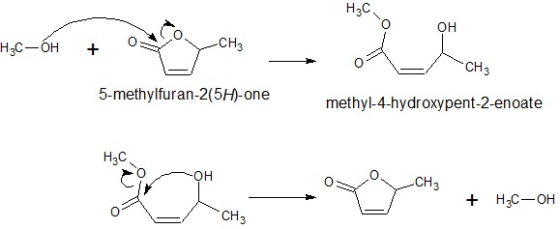
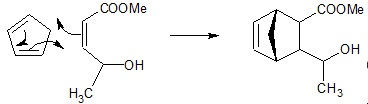
The transesterified product methyl-4-hydroxypent-2-enoate undergoes diels alder reaction with cyclopentadiene.
This can be explained by the following chemical equation:
Add Answer to:
Forward and Retro Diels-Alder Post-Lab Questions: 5-methylfuran-2 (5 H)-one (see below) is an alcohol/water sensiti...
5-methylfuran-2(5H)-one is an alcohol/water sensitive compound. in the presence if an alcohol, it undergoes a process...
 5-methylfuran-2(5H)-one is an alcohol/water sensitive compound.
in the presence if an alcohol, it undergoes a process known as
transesterification. draw the structure of transesterified
5-methylfuran-2(5H)-one. PLEASE HELP WITH QUESTION 1&2!!!
Forward and Retro Diels-Alder Post-Lab Questions: 1. 5-methylfuran-2(5H)-one (see below) is an alcohol/water sensitive compound. In the presence of an alcohol, it undergoes a process known as transesterification. Draw the structure of transesterified 5- methylfuran-2(5H)-one: CH3OH Transesterification 2. If the reaction vessel were exposed to methanol during the course of...
5-methylfuran-2(5H)-one is an alcohol/water sensitive compound.
in the presence if an alcohol, it undergoes a process known as
transesterification. draw the structure of transesterified
5-methylfuran-2(5H)-one. PLEASE HELP WITH QUESTION 1&2!!!
Forward and Retro Diels-Alder Post-Lab Questions: 1. 5-methylfuran-2(5H)-one (see below) is an alcohol/water sensitive compound. In the presence of an alcohol, it undergoes a process known as transesterification. Draw the structure of transesterified 5- methylfuran-2(5H)-one: CH3OH Transesterification 2. If the reaction vessel were exposed to methanol during the course of...
1. S-methylfuran-2(5H)-one (see below) is an alcohol/water sensitive compound. In the presence ofa alcohol, it undergoes...
 1. S-methylfuran-2(5H)-one (see below) is an alcohol/water sensitive compound. In the presence ofa alcohol, it undergoes a process known as transesterification. Draw the structure of transesterified methylfuran-2(5H)-one: CH3OH Transesterification
What is the objective of this experiment? The reaction solvent for this experiment is xylene. What...
 What is the objective of this experiment?
The reaction solvent for this experiment is xylene. What
property of this solvent makes it a better choice than toluene or
benzene?
Draw the orbitals involved in the 4+2 electrocyclization for
this reaction. Draw the structures of the reactants as best you
can. It may be appropriate to abbreviate the structure of
anthracene.
IR is not provided for this reaction product. Why is IR not
useful for monitoring the reaction or characterizing the...
What is the objective of this experiment?
The reaction solvent for this experiment is xylene. What
property of this solvent makes it a better choice than toluene or
benzene?
Draw the orbitals involved in the 4+2 electrocyclization for
this reaction. Draw the structures of the reactants as best you
can. It may be appropriate to abbreviate the structure of
anthracene.
IR is not provided for this reaction product. Why is IR not
useful for monitoring the reaction or characterizing the...
This is from an organic chemistry diels-alder lab using anthracene, maleic anhydride and xylenes. Can anyone...
 This is from an organic chemistry diels-alder lab using
anthracene, maleic anhydride and xylenes. Can anyone tell me the
correct answers to all of these? For question 3 I need a method to
remove xylene and a method to remove acetone. Thank you!
CHM 20L Organic ll Lab Discussion and conclusion Provide responses to each of the following questions." Attach the 'H NMR spectrum for your product to respond to the following (on the spectrum, where appropriate) 1. Use the...
This is from an organic chemistry diels-alder lab using
anthracene, maleic anhydride and xylenes. Can anyone tell me the
correct answers to all of these? For question 3 I need a method to
remove xylene and a method to remove acetone. Thank you!
CHM 20L Organic ll Lab Discussion and conclusion Provide responses to each of the following questions." Attach the 'H NMR spectrum for your product to respond to the following (on the spectrum, where appropriate) 1. Use the...
Pre-lab Questions: Importance A one-step preparation of aspirin from its precursor, salicylic acid, via an ester...
 Pre-lab Questions:
Importance A one-step preparation of aspirin from its precursor, salicylic acid, via an ester formation illustrates one of synthetic organic chemistry's most important uses, making the drugs that treat all types of illnesses. OH HOOH Background Aspirin is a prodrug of salicylic acid, the actual active drug. A compound related to salicylic acid, salicin, was first isolated from willow bark in the mid 1700's, but willow-bark extract was used by the ancient Greeks as a treatment for pain...
Pre-lab Questions:
Importance A one-step preparation of aspirin from its precursor, salicylic acid, via an ester formation illustrates one of synthetic organic chemistry's most important uses, making the drugs that treat all types of illnesses. OH HOOH Background Aspirin is a prodrug of salicylic acid, the actual active drug. A compound related to salicylic acid, salicin, was first isolated from willow bark in the mid 1700's, but willow-bark extract was used by the ancient Greeks as a treatment for pain...
Grignard reagent THE GRIGNARD REAGENT-PREPARATION AND REACTION In this experiment, you will prepa...
 i need help with the postlab questions please
Grignard reagent THE GRIGNARD REAGENT-PREPARATION AND REACTION In this experiment, you will prepare a Grignard reagent, phenyl magnesium bromide, from bromobenzene and magnesium metal. The Grignard reagent will then react with methyl benzoate to form triphenylmethanol. Introduction Grignard reagents, such as organomagnesium halides, were discovered in 1910 by French chemist Victor Grignard. The Grignard reaction is one of the most general methods for carbon- carbon bond formation in all of organic chemistry....
i need help with the postlab questions please
Grignard reagent THE GRIGNARD REAGENT-PREPARATION AND REACTION In this experiment, you will prepare a Grignard reagent, phenyl magnesium bromide, from bromobenzene and magnesium metal. The Grignard reagent will then react with methyl benzoate to form triphenylmethanol. Introduction Grignard reagents, such as organomagnesium halides, were discovered in 1910 by French chemist Victor Grignard. The Grignard reaction is one of the most general methods for carbon- carbon bond formation in all of organic chemistry....
 5-methylfuran-2(5H)-one is an alcohol/water sensitive compound.
in the presence if an alcohol, it undergoes a process known as
transesterification. draw the structure of transesterified
5-methylfuran-2(5H)-one. PLEASE HELP WITH QUESTION 1&2!!!
Forward and Retro Diels-Alder Post-Lab Questions: 1. 5-methylfuran-2(5H)-one (see below) is an alcohol/water sensitive compound. In the presence of an alcohol, it undergoes a process known as transesterification. Draw the structure of transesterified 5- methylfuran-2(5H)-one: CH3OH Transesterification 2. If the reaction vessel were exposed to methanol during the course of...
5-methylfuran-2(5H)-one is an alcohol/water sensitive compound.
in the presence if an alcohol, it undergoes a process known as
transesterification. draw the structure of transesterified
5-methylfuran-2(5H)-one. PLEASE HELP WITH QUESTION 1&2!!!
Forward and Retro Diels-Alder Post-Lab Questions: 1. 5-methylfuran-2(5H)-one (see below) is an alcohol/water sensitive compound. In the presence of an alcohol, it undergoes a process known as transesterification. Draw the structure of transesterified 5- methylfuran-2(5H)-one: CH3OH Transesterification 2. If the reaction vessel were exposed to methanol during the course of...
 1. S-methylfuran-2(5H)-one (see below) is an alcohol/water sensitive compound. In the presence ofa alcohol, it undergoes a process known as transesterification. Draw the structure of transesterified methylfuran-2(5H)-one: CH3OH Transesterification
 What is the objective of this experiment?
The reaction solvent for this experiment is xylene. What
property of this solvent makes it a better choice than toluene or
benzene?
Draw the orbitals involved in the 4+2 electrocyclization for
this reaction. Draw the structures of the reactants as best you
can. It may be appropriate to abbreviate the structure of
anthracene.
IR is not provided for this reaction product. Why is IR not
useful for monitoring the reaction or characterizing the...
What is the objective of this experiment?
The reaction solvent for this experiment is xylene. What
property of this solvent makes it a better choice than toluene or
benzene?
Draw the orbitals involved in the 4+2 electrocyclization for
this reaction. Draw the structures of the reactants as best you
can. It may be appropriate to abbreviate the structure of
anthracene.
IR is not provided for this reaction product. Why is IR not
useful for monitoring the reaction or characterizing the...
 This is from an organic chemistry diels-alder lab using
anthracene, maleic anhydride and xylenes. Can anyone tell me the
correct answers to all of these? For question 3 I need a method to
remove xylene and a method to remove acetone. Thank you!
CHM 20L Organic ll Lab Discussion and conclusion Provide responses to each of the following questions." Attach the 'H NMR spectrum for your product to respond to the following (on the spectrum, where appropriate) 1. Use the...
This is from an organic chemistry diels-alder lab using
anthracene, maleic anhydride and xylenes. Can anyone tell me the
correct answers to all of these? For question 3 I need a method to
remove xylene and a method to remove acetone. Thank you!
CHM 20L Organic ll Lab Discussion and conclusion Provide responses to each of the following questions." Attach the 'H NMR spectrum for your product to respond to the following (on the spectrum, where appropriate) 1. Use the...
 Pre-lab Questions:
Importance A one-step preparation of aspirin from its precursor, salicylic acid, via an ester formation illustrates one of synthetic organic chemistry's most important uses, making the drugs that treat all types of illnesses. OH HOOH Background Aspirin is a prodrug of salicylic acid, the actual active drug. A compound related to salicylic acid, salicin, was first isolated from willow bark in the mid 1700's, but willow-bark extract was used by the ancient Greeks as a treatment for pain...
Pre-lab Questions:
Importance A one-step preparation of aspirin from its precursor, salicylic acid, via an ester formation illustrates one of synthetic organic chemistry's most important uses, making the drugs that treat all types of illnesses. OH HOOH Background Aspirin is a prodrug of salicylic acid, the actual active drug. A compound related to salicylic acid, salicin, was first isolated from willow bark in the mid 1700's, but willow-bark extract was used by the ancient Greeks as a treatment for pain...
 i need help with the postlab questions please
Grignard reagent THE GRIGNARD REAGENT-PREPARATION AND REACTION In this experiment, you will prepare a Grignard reagent, phenyl magnesium bromide, from bromobenzene and magnesium metal. The Grignard reagent will then react with methyl benzoate to form triphenylmethanol. Introduction Grignard reagents, such as organomagnesium halides, were discovered in 1910 by French chemist Victor Grignard. The Grignard reaction is one of the most general methods for carbon- carbon bond formation in all of organic chemistry....
i need help with the postlab questions please
Grignard reagent THE GRIGNARD REAGENT-PREPARATION AND REACTION In this experiment, you will prepare a Grignard reagent, phenyl magnesium bromide, from bromobenzene and magnesium metal. The Grignard reagent will then react with methyl benzoate to form triphenylmethanol. Introduction Grignard reagents, such as organomagnesium halides, were discovered in 1910 by French chemist Victor Grignard. The Grignard reaction is one of the most general methods for carbon- carbon bond formation in all of organic chemistry....
Most questions answered within 3 hours.
-
Where is the error in this code sequence?
String s1 = "Hello";
String s2 = "ello";...
asked 10 months ago -
Financial data for Joel de Paris, Inc., for last year
follow:
Joel de Paris, Inc.
Balance...
asked 10 months ago -
Consider this reaction:
Al2(SO4)3 (aq)+ BaCl3
(aq) Al2Cl6 (aq)- +
3BaSO4(s) . What is the...
asked 10 months ago -
Suppose that Savneet is considering increasing her
recent random sample from 20 car rentals to 40...
asked 10 months ago -
Trucks arrive at an unloading terminal at an average rate of 120
per hour.
Trucks arrive...
asked 10 months ago -
Why are methanol and ethanol completely soluble in water while
octanol is not very little soluble....
asked 10 months ago -
A facilities manager at a university reads in a research report
that the mean amount of...
asked 10 months ago -
When the CuSO4 is rehydrated by adding water to the anhydrous
compound, is this an endothermic...
asked 10 months ago -
A ray of sunlight is passing from diamond into crown glass; the
angle of incidence is...
asked 10 months ago -
A block of mass 0.249 kg is placed on top of a light, vertical
spring of...
asked 10 months ago -
how do the kidneys compensate in the presences of acidosis
a) trigger hyperventilate
b) reserve acid...
asked 10 months ago -
Question 501 pts
The rental rate of capital to the firm increases. Which of the
following...
asked 10 months ago