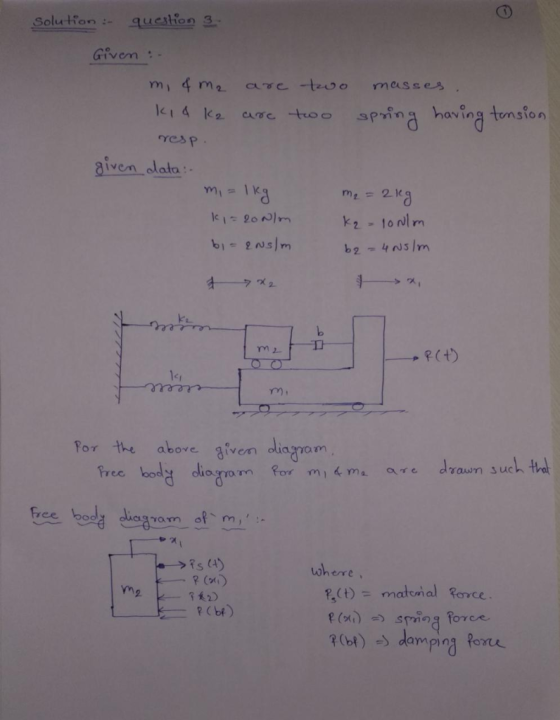
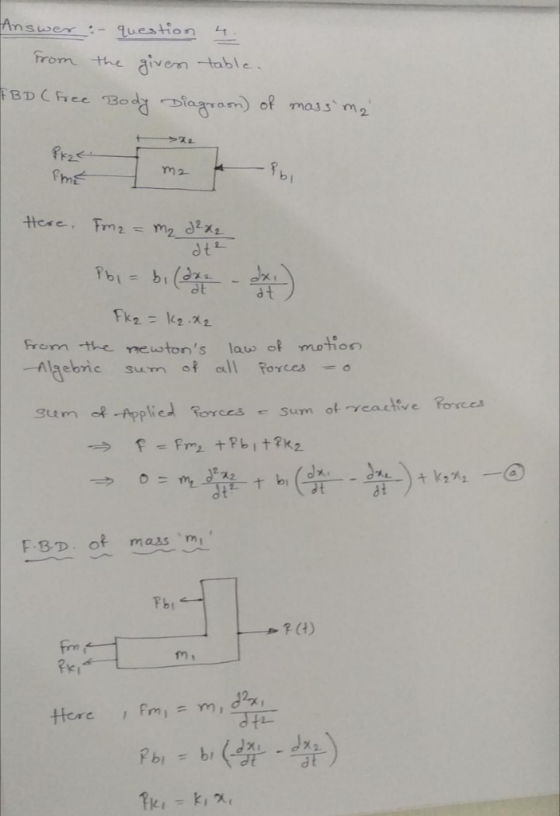
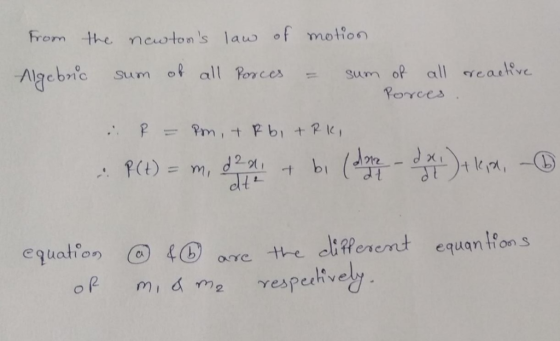
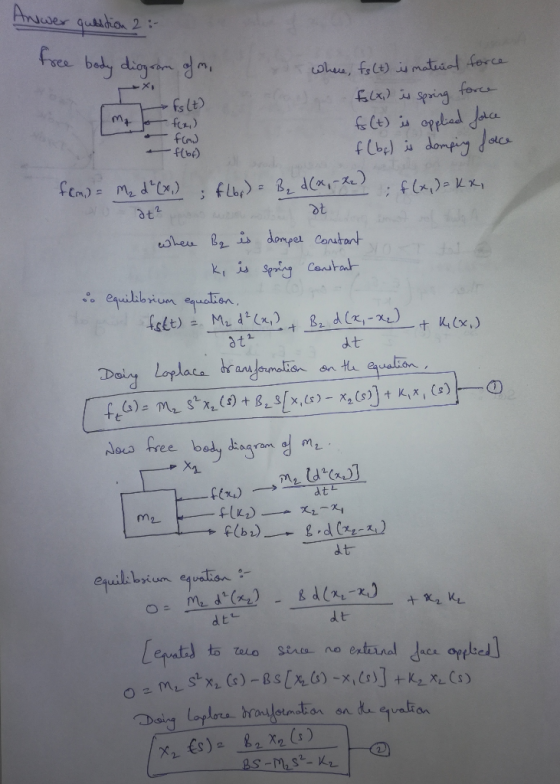
![Question 1-4 is about the following mechanical system: Data: ki-20 [N/m] b-2 [Ns/m] k2# 10 [N/m] m2 At) mi Question 1 X1(s) D](http://img.homeworklib.com/images/5b2d21db-56b1-4a32-a9a1-47ed86dd3c68.png?x-oss-process=image/resize,w_560)
Homework Answers


Add Answer to:
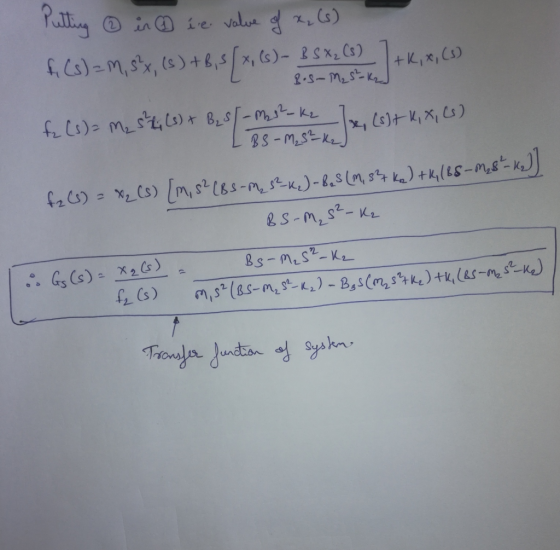
Question 1-4 is about the following mechanical system: Data: ki-20 [N/m] b-2 [Ns/m] k2# 10 [N/m] m2 At) mi Question 1 X...
Problem 4. Consider the control system shown below with plant G(s) that has time con- stants...
 Problem 4. Consider the control system shown below with plant G(s) that has time con- stants T1 = 2, T2 = 10, and gain k = 0.1. 4 673 +1679+1) (1.) Sketch the pole-zero plot for G(s). Is one of the poles more dominant? Using MATLAB, simulate the step response of the plant itself, along with G1(s) and G2(s) as defined by Gl(s) = and G2(s) = sti + 1 ST2+1 (2.) Design a proportional gain C(s) = K so...
3. Consider the following mass-spring-damper system. Let m= 1 kg, b = 10 Ns/m, and k...
 3. Consider the following mass-spring-damper system. Let m= 1 kg, b = 10 Ns/m, and k = 20 N/m. b m F k a) Derive the open-loop transfer function X(S) F(s) Plot the step response using matlab. b) Derive the closed-loop transfer function with P-controller with Kp = 300. Plot the step response using matlab. c) Derive the closed-loop transfer function with PD-controller with Ky and Ka = 10. Plot the step response using matlab. d) Derive the closed-loop transfer...
Mi k2 b yi m2 Figure 5-45 Mechanical system. Assuming that mi 10 kg, m2 5 kg, b 10 N-s/m, k 40 N/...
 mi k2 b yi m2 Figure 5-45 Mechanical system. Assuming that mi 10 kg, m2 5 kg, b 10 N-s/m, k 40 N/m, and k 20 N/m and that input force u is a constant force of 5 N, obtain the response of the sys- tem. Plot the response curves n(t) versus r and y2(t) versus t with MATLAB Problem B-5-23 Consider the system shown in Figure 5-45. The system is at rest for t < 0. The dis placements...
Consider the system. (1) M →1.0) M +0.1 kg, B=0.2 N-s/m Mv(1) + By(t) = 1,01)...
 Consider the system. (1) M →1.0) M +0.1 kg, B=0.2 N-s/m Mv(1) + By(t) = 1,01) Consider a system described by the following differential equation: 0.1"WX2 +0.2v(t) = .0), where y(t) and 4.0) are the output and the input of the system. dt (la) Convert the above differential equation into the form of the typical first-order dynamic system: + ) = ), and explain the physical meaning of the two parameters 7 and v.. (5%) dv(1) (1b) According to the...
7.22 A simple 1-DOF mechanical system has the following transfer function Y(s) 0.25 U(s) s +2s...
 7.22 A simple 1-DOF mechanical system has the following transfer function Y(s) 0.25 U(s) s +2s +9 where the position of the mass y0) is in meters. The system is initially at rest, y(O) (0) 0, and the applied force is a step function u(t0 4N Copyrighto Problems 243 a. Accurately sketch the system response y() and label all important performance criteria on your sketch b. Use MATLAB or Simulink to verify your sketch in part (a). Plot y(o) from...
A linear time invariant system has an impulse response given by h[n] = 2(-0.5)" u[n] –...
 A linear time invariant system has an impulse response given by h[n] = 2(-0.5)" u[n] – 3(0.5)2º u[n] where u[n] is the unit step function. a) Find the z-domain transfer function H(2). b) Draw pole-zero plot of the system and indicate the region of convergence. c) is the system stable? Explain. d) is the system causal? Explain. e) Find the unit step response s[n] of the system, that is, the response to the unit step input. f) Provide a linear...
I want the answer for Part B I have the answer for Part A-Q1 I uploaded it 2 H I F ua 212 < > 0.5% on Y; 4Ω Fig...
 I want the answer for Part B I have the answer for Part
A-Q1 I uploaded it
2 H I F ua 212 < > 0.5% on Y; 4Ω Figure 1 PART A: MATHEMATICAL MODEL AND TIME DOMAIN ANALYSIS (5%) 1) For the circuit of Figure 1, determine the transfer function relating the output voltage (s) to the input voltage V(s). Assuming zero initial condition, obtain the output response vo(t) to an input step with 6V amplitude, that is vi(t)6...
I want the answer for Part B I have the answer for Part
A-Q1 I uploaded it
2 H I F ua 212 < > 0.5% on Y; 4Ω Figure 1 PART A: MATHEMATICAL MODEL AND TIME DOMAIN ANALYSIS (5%) 1) For the circuit of Figure 1, determine the transfer function relating the output voltage (s) to the input voltage V(s). Assuming zero initial condition, obtain the output response vo(t) to an input step with 6V amplitude, that is vi(t)6...
Question: given a differential equation: a. initial conditions for the plan and input are zero, ...
 Question:
given a differential equation:
a. initial conditions for the plan and input are zero, derive
plan's transfer function in Laplace transform
b. using inverse Laplace transform, find the solution for the
differential equation for the plan (find function y(t)).
c. derive state-space model of the plan
d. Assume open-loop system with no controller added to the
plant, analyse the steady-state value of the system using final
value theorem and step input
e. Calculate value of the overshoot, rise time...
Question:
given a differential equation:
a. initial conditions for the plan and input are zero, derive
plan's transfer function in Laplace transform
b. using inverse Laplace transform, find the solution for the
differential equation for the plan (find function y(t)).
c. derive state-space model of the plan
d. Assume open-loop system with no controller added to the
plant, analyse the steady-state value of the system using final
value theorem and step input
e. Calculate value of the overshoot, rise time...
' 1. Review Question a) Name three applications for feedback control systems. b) Functionally, ho...
 ' 1. Review Question a) Name three applications for feedback control systems. b) Functionally, how do closed-loop systems differ from open-loop systems? c) Name the three major design criteria for control systems. d) Name the performance specification for first-order systems. e) Briefly describe how the zeros of the open-loop system affect the root locus and the transient response. What does the Routh-Hurwitz criterion tell us? f) 2. Given the electric network shown in Figure. a) Write the differential equation for...
1. Consider the system shown. Assume B-3 N-s/m and K-7 N/m. Negligible Mass a) Find the...
 1. Consider the system shown. Assume B-3 N-s/m and K-7 N/m. Negligible Mass a) Find the transfer function, H(s)-X(s)Fa(s) b) Using the transfer function, find the unit step response and the unit impulse response. c) Using the transfer function, find the steady-state response when fa(t) 2 sin (4t) d) Find the free response (zero-input response) assuming x(0) 2 m.
 Problem 4. Consider the control system shown below with plant G(s) that has time con- stants T1 = 2, T2 = 10, and gain k = 0.1. 4 673 +1679+1) (1.) Sketch the pole-zero plot for G(s). Is one of the poles more dominant? Using MATLAB, simulate the step response of the plant itself, along with G1(s) and G2(s) as defined by Gl(s) = and G2(s) = sti + 1 ST2+1 (2.) Design a proportional gain C(s) = K so...
 3. Consider the following mass-spring-damper system. Let m= 1 kg, b = 10 Ns/m, and k = 20 N/m. b m F k a) Derive the open-loop transfer function X(S) F(s) Plot the step response using matlab. b) Derive the closed-loop transfer function with P-controller with Kp = 300. Plot the step response using matlab. c) Derive the closed-loop transfer function with PD-controller with Ky and Ka = 10. Plot the step response using matlab. d) Derive the closed-loop transfer...
 mi k2 b yi m2 Figure 5-45 Mechanical system. Assuming that mi 10 kg, m2 5 kg, b 10 N-s/m, k 40 N/m, and k 20 N/m and that input force u is a constant force of 5 N, obtain the response of the sys- tem. Plot the response curves n(t) versus r and y2(t) versus t with MATLAB Problem B-5-23 Consider the system shown in Figure 5-45. The system is at rest for t < 0. The dis placements...
 Consider the system. (1) M →1.0) M +0.1 kg, B=0.2 N-s/m Mv(1) + By(t) = 1,01) Consider a system described by the following differential equation: 0.1"WX2 +0.2v(t) = .0), where y(t) and 4.0) are the output and the input of the system. dt (la) Convert the above differential equation into the form of the typical first-order dynamic system: + ) = ), and explain the physical meaning of the two parameters 7 and v.. (5%) dv(1) (1b) According to the...
 7.22 A simple 1-DOF mechanical system has the following transfer function Y(s) 0.25 U(s) s +2s +9 where the position of the mass y0) is in meters. The system is initially at rest, y(O) (0) 0, and the applied force is a step function u(t0 4N Copyrighto Problems 243 a. Accurately sketch the system response y() and label all important performance criteria on your sketch b. Use MATLAB or Simulink to verify your sketch in part (a). Plot y(o) from...
 A linear time invariant system has an impulse response given by h[n] = 2(-0.5)" u[n] – 3(0.5)2º u[n] where u[n] is the unit step function. a) Find the z-domain transfer function H(2). b) Draw pole-zero plot of the system and indicate the region of convergence. c) is the system stable? Explain. d) is the system causal? Explain. e) Find the unit step response s[n] of the system, that is, the response to the unit step input. f) Provide a linear...
 I want the answer for Part B I have the answer for Part
A-Q1 I uploaded it
2 H I F ua 212 < > 0.5% on Y; 4Ω Figure 1 PART A: MATHEMATICAL MODEL AND TIME DOMAIN ANALYSIS (5%) 1) For the circuit of Figure 1, determine the transfer function relating the output voltage (s) to the input voltage V(s). Assuming zero initial condition, obtain the output response vo(t) to an input step with 6V amplitude, that is vi(t)6...
I want the answer for Part B I have the answer for Part
A-Q1 I uploaded it
2 H I F ua 212 < > 0.5% on Y; 4Ω Figure 1 PART A: MATHEMATICAL MODEL AND TIME DOMAIN ANALYSIS (5%) 1) For the circuit of Figure 1, determine the transfer function relating the output voltage (s) to the input voltage V(s). Assuming zero initial condition, obtain the output response vo(t) to an input step with 6V amplitude, that is vi(t)6...
 Question:
given a differential equation:
a. initial conditions for the plan and input are zero, derive
plan's transfer function in Laplace transform
b. using inverse Laplace transform, find the solution for the
differential equation for the plan (find function y(t)).
c. derive state-space model of the plan
d. Assume open-loop system with no controller added to the
plant, analyse the steady-state value of the system using final
value theorem and step input
e. Calculate value of the overshoot, rise time...
Question:
given a differential equation:
a. initial conditions for the plan and input are zero, derive
plan's transfer function in Laplace transform
b. using inverse Laplace transform, find the solution for the
differential equation for the plan (find function y(t)).
c. derive state-space model of the plan
d. Assume open-loop system with no controller added to the
plant, analyse the steady-state value of the system using final
value theorem and step input
e. Calculate value of the overshoot, rise time...
 ' 1. Review Question a) Name three applications for feedback control systems. b) Functionally, how do closed-loop systems differ from open-loop systems? c) Name the three major design criteria for control systems. d) Name the performance specification for first-order systems. e) Briefly describe how the zeros of the open-loop system affect the root locus and the transient response. What does the Routh-Hurwitz criterion tell us? f) 2. Given the electric network shown in Figure. a) Write the differential equation for...
 1. Consider the system shown. Assume B-3 N-s/m and K-7 N/m. Negligible Mass a) Find the transfer function, H(s)-X(s)Fa(s) b) Using the transfer function, find the unit step response and the unit impulse response. c) Using the transfer function, find the steady-state response when fa(t) 2 sin (4t) d) Find the free response (zero-input response) assuming x(0) 2 m.
Most questions answered within 3 hours.
-
Where is the error in this code sequence?
String s1 = "Hello";
String s2 = "ello";...
asked 10 months ago -
Financial data for Joel de Paris, Inc., for last year
follow:
Joel de Paris, Inc.
Balance...
asked 10 months ago -
Consider this reaction:
Al2(SO4)3 (aq)+ BaCl3
(aq) Al2Cl6 (aq)- +
3BaSO4(s) . What is the...
asked 10 months ago -
Suppose that Savneet is considering increasing her
recent random sample from 20 car rentals to 40...
asked 10 months ago -
Trucks arrive at an unloading terminal at an average rate of 120
per hour.
Trucks arrive...
asked 10 months ago -
Why are methanol and ethanol completely soluble in water while
octanol is not very little soluble....
asked 10 months ago -
A facilities manager at a university reads in a research report
that the mean amount of...
asked 10 months ago -
When the CuSO4 is rehydrated by adding water to the anhydrous
compound, is this an endothermic...
asked 10 months ago -
A ray of sunlight is passing from diamond into crown glass; the
angle of incidence is...
asked 10 months ago -
A block of mass 0.249 kg is placed on top of a light, vertical
spring of...
asked 10 months ago -
how do the kidneys compensate in the presences of acidosis
a) trigger hyperventilate
b) reserve acid...
asked 10 months ago -
Question 501 pts
The rental rate of capital to the firm increases. Which of the
following...
asked 10 months ago