
Homework Answers
Add Answer to:
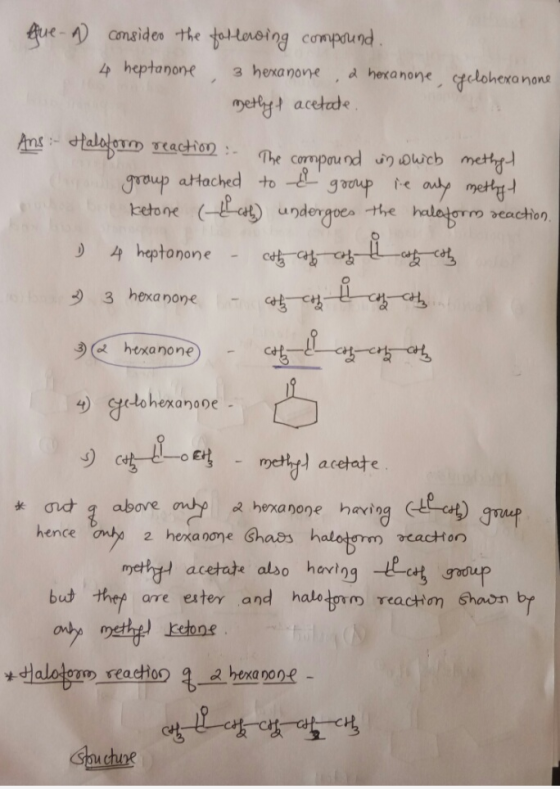
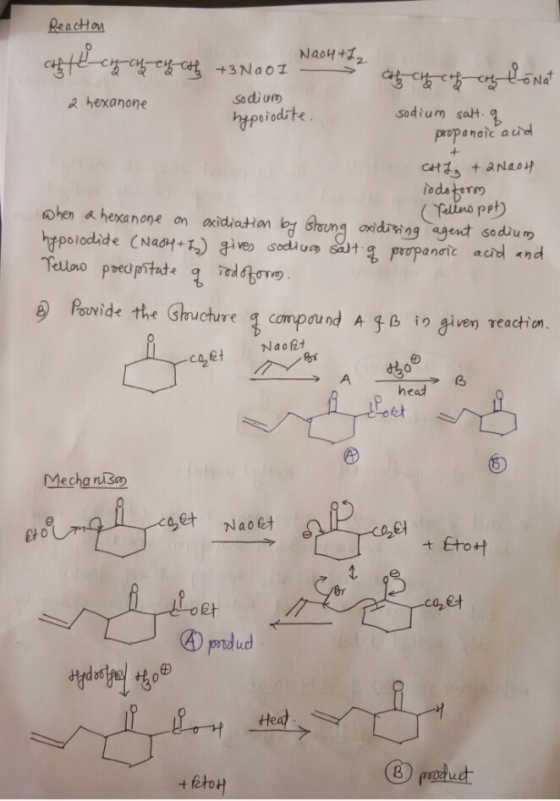
11) (24 pts total) (A) Consider the following compounds: 4-heptanone 3-hexanone 2-hexanone cyclohexanone methyl acetate...
Lumili alle for the following compound? - (CH)CHCH.COCH,CH, a. 2-methyl-4-hexanone c. 2-methyl-3-hexanone b. 5-methyl-3-hexanone d. ethyl...
 Lumili alle for the following compound? - (CH)CHCH.COCH,CH, a. 2-methyl-4-hexanone c. 2-methyl-3-hexanone b. 5-methyl-3-hexanone d. ethyl isopropyl ketonel. 25-Identify the directing effect of the ring substituent in the following reaction: BO, HBO. (a) o.p., activating (b) m-, deactivating (c) o.p., deactivating (d) None of these 26--Ketones are easily reduced to CH3-C-CH3 a-Secondary alcohol b- Primary alcohol c- to acetaldehyde d- to carboxylic acid 27-. What is the structure of the azo group? a-N- b-N-N- C-NEN- d-NEN- 28-What class of organic...
HW 22: Enolates 1. Provide a detailed, stepwise mechanism for the base-catalyzed enolization (keto enol tautomerism) of acetaldehyde. 2. Provide the major organic product of the folowing reactio...
 HW 22: Enolates 1. Provide a detailed, stepwise mechanism for the base-catalyzed enolization (keto enol tautomerism) of acetaldehyde. 2. Provide the major organic product of the folowing reaction. 3. Provide the major organic product of the following reaction LDA 4. Which of the following ketones will give a positive iodoform test? A) 4-heptanone D) cyclohexanone B) 3-hexanone C)2-hexanone 5. Provide the major organic product of the following reaction. 6. Provide the structure of the major organic product which results when...
11) (50 pts total) Consider the following 2 compounds: Yor You I II (a) (6 pts)...
 11) (50 pts total) Consider the following 2 compounds: Yor You I II (a) (6 pts) Provide the IUPAC names for compounds I and II. Compound I: Compound II: (b) (10 pts) Draw the resonance contributors of compounds I and II. Which compound is more stable? Explain in 20 words or less. (c) (6 pts) Which C-N bond below is shorter, A or B ? Explain in 20 words or less. (d) (6 pts) Draw the products obtained when compound...
(12 pts total) 21-23. Mechanisms: Provide a reasonable, detailed, stepwise mechanism for: (4 pts, all, if...
 (12 pts total) 21-23. Mechanisms: Provide a reasonable, detailed, stepwise mechanism for: (4 pts, all, if completely correct, or nothing) 21. ... the base-promoted transesterification of methyl benzoate with sodium ethoxide. (4 pts, all, if completely correct, or nothing) 22. ... the acid-catalyzed enolization of acetaldehyde. (4 pts, all, if completely correct, or nothing) 23. ... the base-promoted enolization of chloropropanone. (16 pts total) 24-25. Multistep Syntheses: propose a reasonable, efficient, effective, elegant, good-yield synthesis, providing the appropriate reagents and/or...
1. Draw the structures of the following compounds: a. 3-ethyl-4-methyl-2-hexene b.2-chloro-butyl acetate c. Ethylbenzene d. 2-methyl-3-pentanol...
 1. Draw the structures of the following compounds: a. 3-ethyl-4-methyl-2-hexene b.2-chloro-butyl acetate c. Ethylbenzene d. 2-methyl-3-pentanol e. 2-methylpropyl methyl ether 2. A) Distinguish between photodissociation and photoionization B) Use energy requirements of these two processes to explain why photodissociation of oxygen is more important than photoionization of oxygen at altitudes below about 90 km.
4. Multiple Choice Place your answer in the space provided. (2 pts. each; 12 pts. total)...
 4. Multiple Choice Place your answer in the space provided. (2 pts. each; 12 pts. total) Which is NOT true of the aldol condensation? A. It accomplishes the formation of a new carbon-carbon bond B. The enolate is favored at equilibrium (assume NaOH as the base) C. The key step is the mechanism is attack of the enolate ion on a carbonyl carbon atom D. Dehydration of the aldol product is often observed and is irreversible. _Which sets of hydrogen...
Provide a skeletal line structure for the following compounds: a. 2-ethyl-3-methyl-1-propylbenzene b. Trans-4-methylpent-2-ene c. 2,4-dimethyl-3-ethylhexane
Provide a skeletal line structure for the following compounds: a. 2-ethyl-3-methyl-1-propylbenzene b. Trans-4-methylpent-2-ene c. 2,4-dimethyl-3-ethylhexane
26) Name the following compound. CH3 H2C=CH-CH2CHCH: A) 1,1-dimethyl-3-butane B) 4-methyl-1-pentene C) hexene D) 2-methyl-4-pentene E)...
 26) Name the following compound. CH3 H2C=CH-CH2CHCH: A) 1,1-dimethyl-3-butane B) 4-methyl-1-pentene C) hexene D) 2-methyl-4-pentene E) 2-methylpentene 27) Name the following compound. CI A) 2,3,5-trichlorobenzene B) trichlorostyrene C) 1,3,4-trichlorobenzene D) 1,3,4-trichlorohexene E) 1,2,4-trichlorobenzene 28) Identify the formula for an alkene. A) CnH2n+4 B) CnH2n+2 C) CnH2n D) CnH2n-4 E) CnH2n-2 29) Name the following compound. A) 1,4-bromocyclohexene B) 1,4-dibromobenzene C) 3,6-dibromobenzene D) 2,5-dibromobenzene E) 2,5-dibromocyclohexene 30) Name the following compound. CECH CH,CH,CHCH A) 2-ethynebutane B) 3-methyl-1-pentyne C) 3-methyl-4-pentyne D) 3-ethyl-1-butyne...
Name: Consider the following compound: a. (4 pts) Write its systematic name: b. (2 pts) How...
 Name: Consider the following compound: a. (4 pts) Write its systematic name: b. (2 pts) How many equivalents of a Grignard reagent would react with it 2. (3 pts) Consider the following compound: a. (3 pts) In the space above, write the names of all the carbonyl-containing functional groups in it. b. (2 pts) On the structure, circle the two carbonyls that are the most electrophilic (no need to decide which is most vs second-most). Consider the following reaction, whose...
Section 4. Total points 26 1. Give one example of each of the following name reactions....
 Section 4. Total points 26 1. Give one example of each of the following name reactions. For each reaction, you MUST INCLUDE: i) IUPAC Name of the reactant ii) IUPAC Name of the product iii) Reagents and reaction conditions (4points X 4 = 16 points) a. H.V.Z reaction b. Crossed aldol reaction between an aldehyde and a ketone 2-Propanone Benzaldehple c. Michael reaction between an a.ß unsaturated aldehyde and a B-diketone. d. Dieckman Condensation to have a cyclic product with...
 Lumili alle for the following compound? - (CH)CHCH.COCH,CH, a. 2-methyl-4-hexanone c. 2-methyl-3-hexanone b. 5-methyl-3-hexanone d. ethyl isopropyl ketonel. 25-Identify the directing effect of the ring substituent in the following reaction: BO, HBO. (a) o.p., activating (b) m-, deactivating (c) o.p., deactivating (d) None of these 26--Ketones are easily reduced to CH3-C-CH3 a-Secondary alcohol b- Primary alcohol c- to acetaldehyde d- to carboxylic acid 27-. What is the structure of the azo group? a-N- b-N-N- C-NEN- d-NEN- 28-What class of organic...
 HW 22: Enolates 1. Provide a detailed, stepwise mechanism for the base-catalyzed enolization (keto enol tautomerism) of acetaldehyde. 2. Provide the major organic product of the folowing reaction. 3. Provide the major organic product of the following reaction LDA 4. Which of the following ketones will give a positive iodoform test? A) 4-heptanone D) cyclohexanone B) 3-hexanone C)2-hexanone 5. Provide the major organic product of the following reaction. 6. Provide the structure of the major organic product which results when...
 11) (50 pts total) Consider the following 2 compounds: Yor You I II (a) (6 pts) Provide the IUPAC names for compounds I and II. Compound I: Compound II: (b) (10 pts) Draw the resonance contributors of compounds I and II. Which compound is more stable? Explain in 20 words or less. (c) (6 pts) Which C-N bond below is shorter, A or B ? Explain in 20 words or less. (d) (6 pts) Draw the products obtained when compound...
 (12 pts total) 21-23. Mechanisms: Provide a reasonable, detailed, stepwise mechanism for: (4 pts, all, if completely correct, or nothing) 21. ... the base-promoted transesterification of methyl benzoate with sodium ethoxide. (4 pts, all, if completely correct, or nothing) 22. ... the acid-catalyzed enolization of acetaldehyde. (4 pts, all, if completely correct, or nothing) 23. ... the base-promoted enolization of chloropropanone. (16 pts total) 24-25. Multistep Syntheses: propose a reasonable, efficient, effective, elegant, good-yield synthesis, providing the appropriate reagents and/or...
 1. Draw the structures of the following compounds: a. 3-ethyl-4-methyl-2-hexene b.2-chloro-butyl acetate c. Ethylbenzene d. 2-methyl-3-pentanol e. 2-methylpropyl methyl ether 2. A) Distinguish between photodissociation and photoionization B) Use energy requirements of these two processes to explain why photodissociation of oxygen is more important than photoionization of oxygen at altitudes below about 90 km.
 4. Multiple Choice Place your answer in the space provided. (2 pts. each; 12 pts. total) Which is NOT true of the aldol condensation? A. It accomplishes the formation of a new carbon-carbon bond B. The enolate is favored at equilibrium (assume NaOH as the base) C. The key step is the mechanism is attack of the enolate ion on a carbonyl carbon atom D. Dehydration of the aldol product is often observed and is irreversible. _Which sets of hydrogen...
 26) Name the following compound. CH3 H2C=CH-CH2CHCH: A) 1,1-dimethyl-3-butane B) 4-methyl-1-pentene C) hexene D) 2-methyl-4-pentene E) 2-methylpentene 27) Name the following compound. CI A) 2,3,5-trichlorobenzene B) trichlorostyrene C) 1,3,4-trichlorobenzene D) 1,3,4-trichlorohexene E) 1,2,4-trichlorobenzene 28) Identify the formula for an alkene. A) CnH2n+4 B) CnH2n+2 C) CnH2n D) CnH2n-4 E) CnH2n-2 29) Name the following compound. A) 1,4-bromocyclohexene B) 1,4-dibromobenzene C) 3,6-dibromobenzene D) 2,5-dibromobenzene E) 2,5-dibromocyclohexene 30) Name the following compound. CECH CH,CH,CHCH A) 2-ethynebutane B) 3-methyl-1-pentyne C) 3-methyl-4-pentyne D) 3-ethyl-1-butyne...
 Name: Consider the following compound: a. (4 pts) Write its systematic name: b. (2 pts) How many equivalents of a Grignard reagent would react with it 2. (3 pts) Consider the following compound: a. (3 pts) In the space above, write the names of all the carbonyl-containing functional groups in it. b. (2 pts) On the structure, circle the two carbonyls that are the most electrophilic (no need to decide which is most vs second-most). Consider the following reaction, whose...
 Section 4. Total points 26 1. Give one example of each of the following name reactions. For each reaction, you MUST INCLUDE: i) IUPAC Name of the reactant ii) IUPAC Name of the product iii) Reagents and reaction conditions (4points X 4 = 16 points) a. H.V.Z reaction b. Crossed aldol reaction between an aldehyde and a ketone 2-Propanone Benzaldehple c. Michael reaction between an a.ß unsaturated aldehyde and a B-diketone. d. Dieckman Condensation to have a cyclic product with...
Most questions answered within 3 hours.
-
Where is the error in this code sequence?
String s1 = "Hello";
String s2 = "ello";...
asked 10 months ago -
Financial data for Joel de Paris, Inc., for last year
follow:
Joel de Paris, Inc.
Balance...
asked 10 months ago -
Consider this reaction:
Al2(SO4)3 (aq)+ BaCl3
(aq) Al2Cl6 (aq)- +
3BaSO4(s) . What is the...
asked 10 months ago -
Suppose that Savneet is considering increasing her
recent random sample from 20 car rentals to 40...
asked 10 months ago -
Trucks arrive at an unloading terminal at an average rate of 120
per hour.
Trucks arrive...
asked 10 months ago -
Why are methanol and ethanol completely soluble in water while
octanol is not very little soluble....
asked 10 months ago -
A facilities manager at a university reads in a research report
that the mean amount of...
asked 10 months ago -
When the CuSO4 is rehydrated by adding water to the anhydrous
compound, is this an endothermic...
asked 10 months ago -
A ray of sunlight is passing from diamond into crown glass; the
angle of incidence is...
asked 10 months ago -
A block of mass 0.249 kg is placed on top of a light, vertical
spring of...
asked 10 months ago -
how do the kidneys compensate in the presences of acidosis
a) trigger hyperventilate
b) reserve acid...
asked 10 months ago -
Question 501 pts
The rental rate of capital to the firm increases. Which of the
following...
asked 10 months ago