
Homework Answers
Add Answer to:
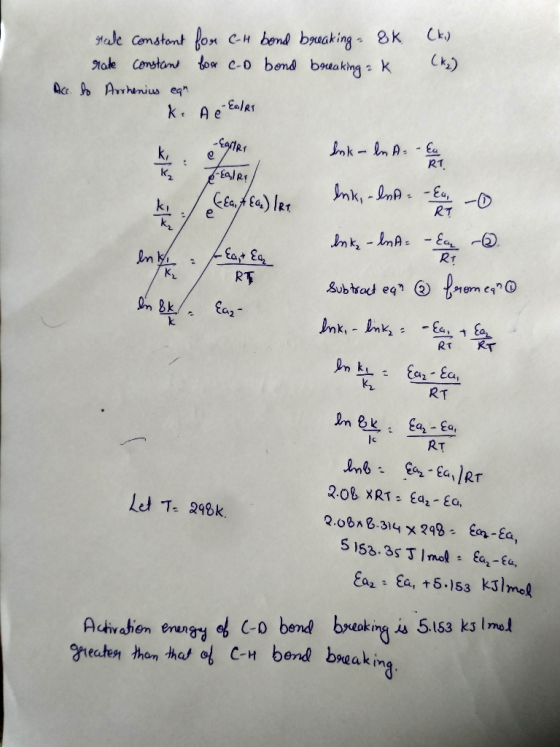
The rate constant for a reaction that breaks a C-H bond in the rate-limiting step is about 8 times that for the same re...
The chemistry of deuterium is nearly identical to that of hydrogen. One area of difference is...
 The chemistry of deuterium is nearly identical to that of
hydrogen. One area of difference is that C-D bonds are about 1.2
kcal/mol stronger than C-H bonds. As a result, reaction rates tend
to be slower if a C-D (as opposed to C-H) bond is broken in a
rate-limiting step. This important fact can lead to great
mechanistic insight and is called the kinetic isotope effect.
a) Propose a mechanism to explain each product in the following
reaction.
b) When...
The chemistry of deuterium is nearly identical to that of
hydrogen. One area of difference is that C-D bonds are about 1.2
kcal/mol stronger than C-H bonds. As a result, reaction rates tend
to be slower if a C-D (as opposed to C-H) bond is broken in a
rate-limiting step. This important fact can lead to great
mechanistic insight and is called the kinetic isotope effect.
a) Propose a mechanism to explain each product in the following
reaction.
b) When...
1. (a) In the first step of an SN1 reaction, the carbon-leaving group bond breaks and...
 1. (a) In the first step of an SN1 reaction, the carbon-leaving group bond breaks and a carbocation forms. In the second step, the carbocation undergoes a nucleophilic attack. The rate limiting step in an SN1 reaction is: The nucleophilic attack. The formation of the product. The formation of the carbocation. Submit Answer Tries 0/1 (b) In an SN2 reaction, the nucleophile attacks while the leaving group leaves in a concerted mechanism. The rate limiting step in an SN2 reaction...
For this question, you can ignore part (5). (10 points each) 3.11. The Cannizzaro reaction is...
 For this question, you can ignore part (5). (10 points each) 3.11. The Cannizzaro reaction is a disproportionation that takes place in strongly basic solution and converts aromatic aldchydes to the corresponding benzyl alcohol and sodium benzoate. Several mechanisms, all of which involve a hydride transfer as a key step, have been postulated. On the basis of the following information, formulate one or more mechanisms that would be consistent with all the data provided. Indicate the significance of each observation...
Atoms can bond to other atoms to make molecules. Atoms sometimes break these bonds and form...
 Atoms can bond to other atoms to make molecules. Atoms sometimes break these bonds and form them in a different way. For example, it is possible to take two molecules of hydrogen (H_2) and one molecule of oxygen (O_2), put them near one another, give them a little spark to help them start a reaction, and you will end up with two molecules of water (H_2O). Do you see what happened? Some of the H-H bonds and the O-O bonds...
1. The reaction 6f propane with oxygen follows the reaction below: Equation1 ) Balance Equation 1...
 1. The reaction 6f propane with oxygen follows the reaction below: Equation1 ) Balance Equation 1 above i) is the above reaction endothermic or exothermic? Enstem i) Classify the reaction above as combination, single displacement, double displacement, decomposition or combustion. comba How much heat was produced in Equation 1 if it can heat 100 g of water from 32 °C? to 40 Is the energy in propane potential or kinetic energy? P。hhi vi) Given that 1 mole of propane produces...
 The chemistry of deuterium is nearly identical to that of
hydrogen. One area of difference is that C-D bonds are about 1.2
kcal/mol stronger than C-H bonds. As a result, reaction rates tend
to be slower if a C-D (as opposed to C-H) bond is broken in a
rate-limiting step. This important fact can lead to great
mechanistic insight and is called the kinetic isotope effect.
a) Propose a mechanism to explain each product in the following
reaction.
b) When...
The chemistry of deuterium is nearly identical to that of
hydrogen. One area of difference is that C-D bonds are about 1.2
kcal/mol stronger than C-H bonds. As a result, reaction rates tend
to be slower if a C-D (as opposed to C-H) bond is broken in a
rate-limiting step. This important fact can lead to great
mechanistic insight and is called the kinetic isotope effect.
a) Propose a mechanism to explain each product in the following
reaction.
b) When...
 1. (a) In the first step of an SN1 reaction, the carbon-leaving group bond breaks and a carbocation forms. In the second step, the carbocation undergoes a nucleophilic attack. The rate limiting step in an SN1 reaction is: The nucleophilic attack. The formation of the product. The formation of the carbocation. Submit Answer Tries 0/1 (b) In an SN2 reaction, the nucleophile attacks while the leaving group leaves in a concerted mechanism. The rate limiting step in an SN2 reaction...
 For this question, you can ignore part (5). (10 points each) 3.11. The Cannizzaro reaction is a disproportionation that takes place in strongly basic solution and converts aromatic aldchydes to the corresponding benzyl alcohol and sodium benzoate. Several mechanisms, all of which involve a hydride transfer as a key step, have been postulated. On the basis of the following information, formulate one or more mechanisms that would be consistent with all the data provided. Indicate the significance of each observation...
 Atoms can bond to other atoms to make molecules. Atoms sometimes break these bonds and form them in a different way. For example, it is possible to take two molecules of hydrogen (H_2) and one molecule of oxygen (O_2), put them near one another, give them a little spark to help them start a reaction, and you will end up with two molecules of water (H_2O). Do you see what happened? Some of the H-H bonds and the O-O bonds...
 1. The reaction 6f propane with oxygen follows the reaction below: Equation1 ) Balance Equation 1 above i) is the above reaction endothermic or exothermic? Enstem i) Classify the reaction above as combination, single displacement, double displacement, decomposition or combustion. comba How much heat was produced in Equation 1 if it can heat 100 g of water from 32 °C? to 40 Is the energy in propane potential or kinetic energy? P。hhi vi) Given that 1 mole of propane produces...
Most questions answered within 3 hours.
-
Where is the error in this code sequence?
String s1 = "Hello";
String s2 = "ello";...
asked 10 months ago -
Financial data for Joel de Paris, Inc., for last year
follow:
Joel de Paris, Inc.
Balance...
asked 10 months ago -
Consider this reaction:
Al2(SO4)3 (aq)+ BaCl3
(aq) Al2Cl6 (aq)- +
3BaSO4(s) . What is the...
asked 10 months ago -
Suppose that Savneet is considering increasing her
recent random sample from 20 car rentals to 40...
asked 10 months ago -
Trucks arrive at an unloading terminal at an average rate of 120
per hour.
Trucks arrive...
asked 10 months ago -
Why are methanol and ethanol completely soluble in water while
octanol is not very little soluble....
asked 10 months ago -
A facilities manager at a university reads in a research report
that the mean amount of...
asked 10 months ago -
When the CuSO4 is rehydrated by adding water to the anhydrous
compound, is this an endothermic...
asked 10 months ago -
A ray of sunlight is passing from diamond into crown glass; the
angle of incidence is...
asked 10 months ago -
A block of mass 0.249 kg is placed on top of a light, vertical
spring of...
asked 10 months ago -
how do the kidneys compensate in the presences of acidosis
a) trigger hyperventilate
b) reserve acid...
asked 10 months ago -
Question 501 pts
The rental rate of capital to the firm increases. Which of the
following...
asked 10 months ago