
Homework Answers
Add Answer to:
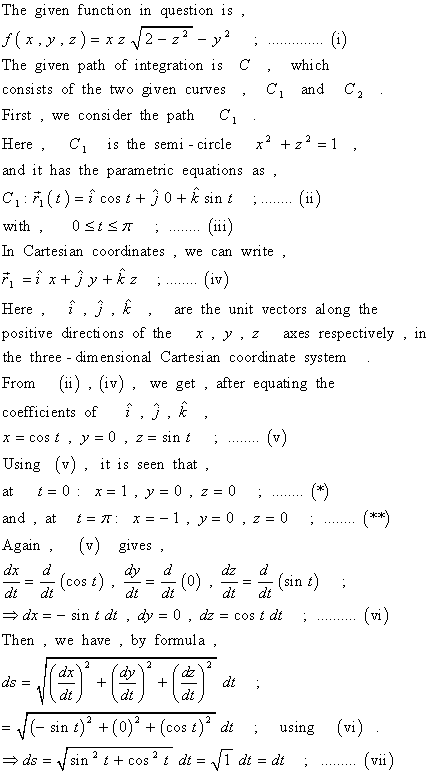
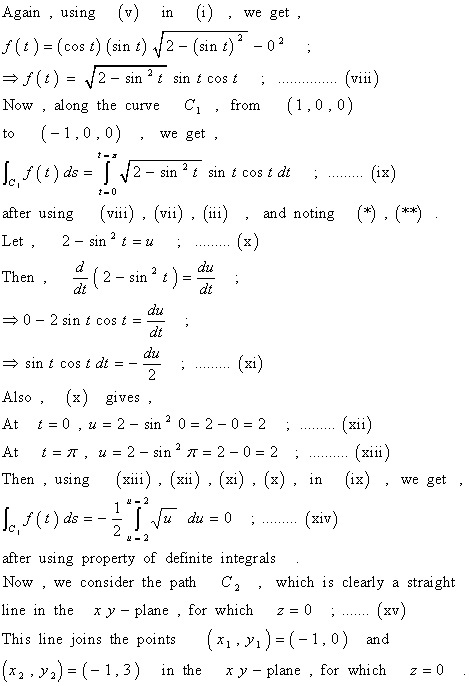
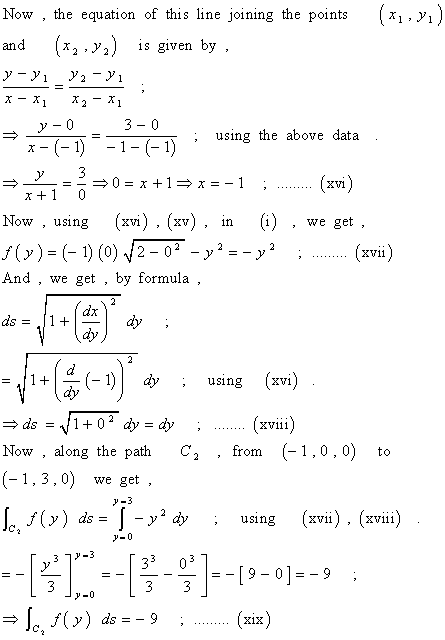
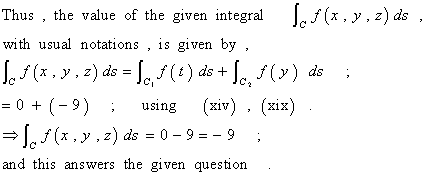
Question 2 (30 points) Integrate f(x, y,2) xzv2-z2 - y2 over the path C, which consists of two curves, C1 and C2 from (...
(1) Integrate f(x, y,z)+Vy - z2 over the straight line segment path from (0,0,0) to (1,1,1) (2) Consider the field F (2xyz+2,x2z, x2y), (a) (b) (c) Show that the field is conservative. Find a pot...
 (1) Integrate f(x, y,z)+Vy - z2 over the straight line segment path from (0,0,0) to (1,1,1) (2) Consider the field F (2xyz+2,x2z, x2y), (a) (b) (c) Show that the field is conservative. Find a potential function for the field. Find the work the field does on an object that follows the path consisting of the line segment from (0,0,0) to (1,2,2), followed by the line segment from (1,2,2) to (2,4,3) Find the work done by the field ß-(x, 3y,-5z) along...
and C2 in the xy-planedefined by the parametric equations Consider trajectories on two curves C1:x=t?, y=t?...
 and C2 in the xy-planedefined by the parametric equations Consider trajectories on two curves C1:x=t?, y=t? - <t<«. C2: x = 3t, y=t?, - <t<mo. These two trajectories are known to *intersect* at exactly two points. The origin (0,0) is one of them. And there is another one, which we'll call P. Find Pand select the choice below which gives the slope of the tangent line to the first curve at the point P. Note that only ONE of the...
1. (2 points) Find F dF if curl(F) 3 in the region defined by the 4 curves and C4 Ci F . d7 where F(x,y,z)-Wi +pz? + Vi> and C consists of the arc of the 2. (2 points) Evaluate curve y = sin(...
 1. (2 points) Find F dF if curl(F) 3 in the region defined by the 4 curves and C4 Ci F . d7 where F(x,y,z)-Wi +pz? + Vi> and C consists of the arc of the 2. (2 points) Evaluate curve y = sin(x) from (0,0) to (π, 0) and the line segment from (π,0) to (0,0). 4 3 3. (2 points) Evaluate F di where F.y,(ry, 2:,3) and C is the curve of intersection of 5 and y29. going...
Integrate the differential one-form ayr dy over the indicated closed curves (a) The circle x2 + y...
 Integrate the differential one-form ayr dy over the indicated closed curves (a) The circle x2 + y2-4 using the parametrization z = 2 cos(t), y 2 sin(t) with 0 < t < 2T. (b) The squarey 1 parametrized by the piecewise linear curve from (1,0) to (0,1) to (-1,0) to (0,-1) back to (1,0). HINT: The first linear curve is given by 1-t, y t 0 t 1, and the second is given by z -t, y 1-twith 0 t...
Question 2. Consider a surface S in the 0 plane with three smooth boundary curves C1, C2, and C3 as shown in the diagram. Each curve is parametrised so that it is traversed in the direction shown by...
 Question 2. Consider a surface S in the 0 plane with three smooth boundary curves C1, C2, and C3 as shown in the diagram. Each curve is parametrised so that it is traversed in the direction shown by the arrows For a smooth vector field A(x, y, z) you are given the following results: Ca Adr =-3 C2 0.5 2.0 1.5 -0.5 (a) What is the value of the surface integral ▽ × A. ds. if we assume by convention...
(1 point) (▽ x F) . ds where M is the hemisphere z2 + y2 + z2-25, z > 0, Use Stoke's Theorem to evaluate with the normal in the direction of the positive x direction, and F--(z3,0, y Begin...
 (1 point) (▽ x F) . ds where M is the hemisphere z2 + y2 + z2-25, z > 0, Use Stoke's Theorem to evaluate with the normal in the direction of the positive x direction, and F--(z3,0, y Begin by writing down the "standard" parametrization of aM as a function of the angle 0 (denoted by "t" in your answer) (use "t" for theta). The value of the integral is
(1 point) (▽ x F) . ds where M...
(1 point) (▽ x F) . ds where M is the hemisphere z2 + y2 + z2-25, z > 0, Use Stoke's Theorem to evaluate with the normal in the direction of the positive x direction, and F--(z3,0, y Begin by writing down the "standard" parametrization of aM as a function of the angle 0 (denoted by "t" in your answer) (use "t" for theta). The value of the integral is
(1 point) (▽ x F) . ds where M...
→ (1 point) Let Vf-6xe-r sin(5y) +1 5e* cos(Sy) j. Find the change inf between (0,0) and (1, n/2) in two ways. (a) First, find the change by computing the line integral c Vf di, where C is a curve co...
 → (1 point) Let Vf-6xe-r sin(5y) +1 5e* cos(Sy) j. Find the change inf between (0,0) and (1, n/2) in two ways. (a) First, find the change by computing the line integral c Vf di, where C is a curve connecting (0,0) and (1, π/2) The simplest curve is the line segment joining these points. Parameterize it: with 0 t 1, K) = dt Note that this isn't a very pleasant integral to evaluate by hand (though we could easily...
Evaluate the surface integral f(x,y,z) dS using a parametric description of the surface. f(xyz) = 4x,...
 Evaluate the surface integral f(x,y,z) dS using a parametric description of the surface. f(xyz) = 4x, where S is the cylinder X + z2-25, 0 ys2 The value of the surface integral is (Type exact answers, using T as needed.) Find the area of the following surface using the given explicit description of the surface. The cone z2 = (x2 +y2) , for Oszs8 Set up the surface integral for the given function over the given surface S as a...
(1 point) Let Vf =-8xe-r sin(5y) 20e-x. cos(Sy) j. Find the change inf between (0,0) and (1, π/2) in two ways vf . dr, where C is a curve connecting (0,0) and (1.d2). (a) First, find the change by co...
 (1 point) Let Vf =-8xe-r sin(5y) 20e-x. cos(Sy) j. Find the change inf between (0,0) and (1, π/2) in two ways vf . dr, where C is a curve connecting (0,0) and (1.d2). (a) First, find the change by computing the line integral The simplest curve is the line segment joining these points. Parameterize it: with 03t s 1, r(t)- so that Icvf . di- Note that this isn't a very pleasant integral to evaluate by hand (though we could...
13. (10 points) (a): Find the line integral of f(x, y, z) = x+y+z over the...
 13. (10 points) (a): Find the line integral of f(x, y, z) = x+y+z over the straight-line segment from (1,2,3) to 0,-1,1). (b): Find the work done by F over the curve in the direction of increasing t, where F=< x2 + y, y2 +1, ze>>, r(t) =< cost, sint,t/27 >, 0<t<27.
 (1) Integrate f(x, y,z)+Vy - z2 over the straight line segment path from (0,0,0) to (1,1,1) (2) Consider the field F (2xyz+2,x2z, x2y), (a) (b) (c) Show that the field is conservative. Find a potential function for the field. Find the work the field does on an object that follows the path consisting of the line segment from (0,0,0) to (1,2,2), followed by the line segment from (1,2,2) to (2,4,3) Find the work done by the field ß-(x, 3y,-5z) along...
 and C2 in the xy-planedefined by the parametric equations Consider trajectories on two curves C1:x=t?, y=t? - <t<«. C2: x = 3t, y=t?, - <t<mo. These two trajectories are known to *intersect* at exactly two points. The origin (0,0) is one of them. And there is another one, which we'll call P. Find Pand select the choice below which gives the slope of the tangent line to the first curve at the point P. Note that only ONE of the...
 1. (2 points) Find F dF if curl(F) 3 in the region defined by the 4 curves and C4 Ci F . d7 where F(x,y,z)-Wi +pz? + Vi> and C consists of the arc of the 2. (2 points) Evaluate curve y = sin(x) from (0,0) to (π, 0) and the line segment from (π,0) to (0,0). 4 3 3. (2 points) Evaluate F di where F.y,(ry, 2:,3) and C is the curve of intersection of 5 and y29. going...
 Integrate the differential one-form ayr dy over the indicated closed curves (a) The circle x2 + y2-4 using the parametrization z = 2 cos(t), y 2 sin(t) with 0 < t < 2T. (b) The squarey 1 parametrized by the piecewise linear curve from (1,0) to (0,1) to (-1,0) to (0,-1) back to (1,0). HINT: The first linear curve is given by 1-t, y t 0 t 1, and the second is given by z -t, y 1-twith 0 t...
 Question 2. Consider a surface S in the 0 plane with three smooth boundary curves C1, C2, and C3 as shown in the diagram. Each curve is parametrised so that it is traversed in the direction shown by the arrows For a smooth vector field A(x, y, z) you are given the following results: Ca Adr =-3 C2 0.5 2.0 1.5 -0.5 (a) What is the value of the surface integral ▽ × A. ds. if we assume by convention...
 (1 point) (▽ x F) . ds where M is the hemisphere z2 + y2 + z2-25, z > 0, Use Stoke's Theorem to evaluate with the normal in the direction of the positive x direction, and F--(z3,0, y Begin by writing down the "standard" parametrization of aM as a function of the angle 0 (denoted by "t" in your answer) (use "t" for theta). The value of the integral is
(1 point) (▽ x F) . ds where M...
(1 point) (▽ x F) . ds where M is the hemisphere z2 + y2 + z2-25, z > 0, Use Stoke's Theorem to evaluate with the normal in the direction of the positive x direction, and F--(z3,0, y Begin by writing down the "standard" parametrization of aM as a function of the angle 0 (denoted by "t" in your answer) (use "t" for theta). The value of the integral is
(1 point) (▽ x F) . ds where M...
 → (1 point) Let Vf-6xe-r sin(5y) +1 5e* cos(Sy) j. Find the change inf between (0,0) and (1, n/2) in two ways. (a) First, find the change by computing the line integral c Vf di, where C is a curve connecting (0,0) and (1, π/2) The simplest curve is the line segment joining these points. Parameterize it: with 0 t 1, K) = dt Note that this isn't a very pleasant integral to evaluate by hand (though we could easily...
 Evaluate the surface integral f(x,y,z) dS using a parametric description of the surface. f(xyz) = 4x, where S is the cylinder X + z2-25, 0 ys2 The value of the surface integral is (Type exact answers, using T as needed.) Find the area of the following surface using the given explicit description of the surface. The cone z2 = (x2 +y2) , for Oszs8 Set up the surface integral for the given function over the given surface S as a...
 (1 point) Let Vf =-8xe-r sin(5y) 20e-x. cos(Sy) j. Find the change inf between (0,0) and (1, π/2) in two ways vf . dr, where C is a curve connecting (0,0) and (1.d2). (a) First, find the change by computing the line integral The simplest curve is the line segment joining these points. Parameterize it: with 03t s 1, r(t)- so that Icvf . di- Note that this isn't a very pleasant integral to evaluate by hand (though we could...
 13. (10 points) (a): Find the line integral of f(x, y, z) = x+y+z over the straight-line segment from (1,2,3) to 0,-1,1). (b): Find the work done by F over the curve in the direction of increasing t, where F=< x2 + y, y2 +1, ze>>, r(t) =< cost, sint,t/27 >, 0<t<27.
Most questions answered within 3 hours.
-
Where is the error in this code sequence?
String s1 = "Hello";
String s2 = "ello";...
asked 10 months ago -
Financial data for Joel de Paris, Inc., for last year
follow:
Joel de Paris, Inc.
Balance...
asked 10 months ago -
Consider this reaction:
Al2(SO4)3 (aq)+ BaCl3
(aq) Al2Cl6 (aq)- +
3BaSO4(s) . What is the...
asked 10 months ago -
Suppose that Savneet is considering increasing her
recent random sample from 20 car rentals to 40...
asked 10 months ago -
Trucks arrive at an unloading terminal at an average rate of 120
per hour.
Trucks arrive...
asked 10 months ago -
Why are methanol and ethanol completely soluble in water while
octanol is not very little soluble....
asked 10 months ago -
A facilities manager at a university reads in a research report
that the mean amount of...
asked 10 months ago -
When the CuSO4 is rehydrated by adding water to the anhydrous
compound, is this an endothermic...
asked 10 months ago -
A ray of sunlight is passing from diamond into crown glass; the
angle of incidence is...
asked 10 months ago -
A block of mass 0.249 kg is placed on top of a light, vertical
spring of...
asked 10 months ago -
how do the kidneys compensate in the presences of acidosis
a) trigger hyperventilate
b) reserve acid...
asked 10 months ago -
Question 501 pts
The rental rate of capital to the firm increases. Which of the
following...
asked 10 months ago