 Organic chemistry
Homework Answers
Add Answer to:
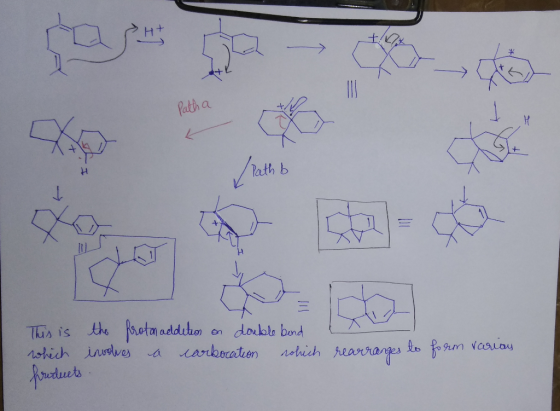
Organic chemistry 2 This problem involves the rearrangement of a carbocation skeleton formed from a sesquiterpene. Prov...
Chemistry 2401 Experiment 7 Acid Catalyzed Dehydration of 3.3-Dimethyl-2-Butanol with Rearrangement Experiment 7 Pre-lab Assignment Dehydration...
 Chemistry 2401 Experiment 7 Acid Catalyzed Dehydration of 3.3-Dimethyl-2-Butanol with Rearrangement Experiment 7 Pre-lab Assignment Dehydration of 3,3-Dimethyl-2-Butanol 1. Draw the structures of all the expected products from the following reactions: a) 3-methyl-3-pentanol + H = b)2-methylcyclohexanol + H - c) 2-methyl-2-butanol + H - d) 2,2-dimethylcyclohexanol + H = This reaction will give a complex mixture of products, since rearrangements can occur. Show the full mechanism for this reaction and how the possible products can form from the carbocation...
For the dehydration shown, use curved arrows to show the formation of the carbocation intermediate in...
 For the dehydration shown, use curved arrows to show the formation of the carbocation intermediate in the presence of sulfuric acid H, SO4, then draw the structure of the major product of the elimination. ОН H2SO4 - product Step 1: Use curved arrows to complete the protonation mechanism of the alcohol. Step 2: Use a curved arrow to show the formation the carbocation intermediate. Note: HSOZ is formed from step 1, but not shown. Select Draw Rings More Erase Select...
Draw a structural formula for the more stable carbocation intermediate formed in the reaction shown CH3...
 Draw a structural formula for the more stable carbocation intermediate formed in the reaction shown CH3 H,C-CHCH CHCHH You do not have to consider stereochemistry. Do not include anionic counter-ions, e.g., I, in your answer. For cases in which carbocations of the same or similar stability are expected, draw all of the structures. Draw one structure per sketcher. Add additional sketchers using the drop-down menu in the bottom right corner. Separate structures with + signs from the drop-down menu. ....
Klein, Organic Chemistry, 3e Help System Announcements Integrated Problem 07.89 Propose a mechanism for the follow...
 Klein, Organic Chemistry, 3e Help System Announcements Integrated Problem 07.89 Propose a mechanism for the following transformation: OH Step 1 Correct. Step 1 of the mechanism is a proton transfer step. Draw step 1 of the mechanism for the formation of this product. Include lone pairs ar the mechanism. OH HC Сн, en.wileyplus.com Joint Commission Amazon.com - Priceline.com TripAdvisor imported From Youtube to MP3 M Mathway trgono S Klein, Organic Chemistry, 3e Help System Announcements PRINTER VERSION BACK NEXT Step...
Help on all parts of question 3 would be greatly appreciated! 3. Treating alkene "A" below...
 Help on all parts of question 3 would be greatly
appreciated!
3. Treating alkene "A" below with HBr can lead to a number of products. "A" + H-Br A bunch of products. For real, hella products. 3.A. Label the stereocenters in compound "A" as R or S and label the alkene as E or Z. 3.B. Draw the curved arrow mechanism leading to the most stabilized carbo- cation intermediate. (don't do any rearrangements, just acid/base with the alkene) H-Br most...
Help on all parts of question 3 would be greatly
appreciated!
3. Treating alkene "A" below with HBr can lead to a number of products. "A" + H-Br A bunch of products. For real, hella products. 3.A. Label the stereocenters in compound "A" as R or S and label the alkene as E or Z. 3.B. Draw the curved arrow mechanism leading to the most stabilized carbo- cation intermediate. (don't do any rearrangements, just acid/base with the alkene) H-Br most...
1. (4 pts) Rank each of the following carbocations in order of stability (1 most stable...
 1. (4 pts) Rank each of the following carbocations in order of stability (1 most stable and 4 least stable). н н сH н Н,с Н,с" H сH; CH3 Hас- H 2. (6 pts total; 2 pts each) Complete the following transformations by indicating the reactant structure or the major organic product(s). Place your answer(s) in the space provided. Be certain to indicate stereochemistry where applicable. Cl2 Он cat. H2SO H-о Br Br conc. HBra) сн сна 3. (10 pts...
Organic chemistry mechanisms i need help with systheses questions 6,7,8,9 2-hydroxybenzoic (3 pts) 5. Provide an...
 Organic chemistry mechanisms
i need help with systheses questions 6,7,8,9
2-hydroxybenzoic (3 pts) 5. Provide an appropriate structure for: 3,3-dimethylcyclobutanecarbonitrile. (4 pts each, unless otherwise noted, 12 pts total) 6-8. Syntheses: draw / provide the likely organic product(s) generated in each of the reactions (or reaction sequences) below. As appropriate, pay attention to regiospecificity (new bond formation and location in the product formed) and stereochemistry (direction in space of new bond(s) formed). Indicate ALL likely products: where one product does...
Organic chemistry mechanisms
i need help with systheses questions 6,7,8,9
2-hydroxybenzoic (3 pts) 5. Provide an appropriate structure for: 3,3-dimethylcyclobutanecarbonitrile. (4 pts each, unless otherwise noted, 12 pts total) 6-8. Syntheses: draw / provide the likely organic product(s) generated in each of the reactions (or reaction sequences) below. As appropriate, pay attention to regiospecificity (new bond formation and location in the product formed) and stereochemistry (direction in space of new bond(s) formed). Indicate ALL likely products: where one product does...
References TReview Topics Draw a structural formula for the more stable carbocation intermediate formed in the...
 References TReview Topics Draw a structural formula for the more stable carbocation intermediate formed in the reaction shown Hас С— СHCH,CH,CH3 Hас НCl + You do not have to consider stereochemistry Do not include anionic counter-ions, e.g., I, in your answer For cases in which carbocations of the same or similar stability are expected, draw all of the structures .Draw one structure per sketcher. Add additional sketchers using the drop-down menu in the bottom right con Separate structures with +...
Organic chemistry Provide a forward synthesis of A from formaldehyde, 1-bromo-2-methylpropane and any other reagent contributing...
 Organic chemistry
Provide a forward synthesis of A from formaldehyde, 1-bromo-2-methylpropane and any other reagent contributing 6 or fewer carbons to the product. Though you are very likely to need to use mechanistic analysis along the way, please do not write curved arrow mechanisms in the space below. CH3 Ck Br
Organic chemistry
Provide a forward synthesis of A from formaldehyde, 1-bromo-2-methylpropane and any other reagent contributing 6 or fewer carbons to the product. Though you are very likely to need to use mechanistic analysis along the way, please do not write curved arrow mechanisms in the space below. CH3 Ck Br
SOLVED PROBLEM 7-3 When the following compound is heated in methanol, several different products are formed....
 SOLVED PROBLEM 7-3 When the following compound is heated in methanol, several different products are formed. Propose mechanisms to account for the four products shown. CH-Br CH heat CH,OH -OCH; + -OCH PARTIAL SOLUTION With no strong base and a good ionizing solvent, we would expect a first-order reaction. But this is a primary alkyl halide, so ionization is difficult unless it rearranges. It might rearrange as it forms, but we'll imagine the cation forming then rearranging. H. Br: CH...
 Chemistry 2401 Experiment 7 Acid Catalyzed Dehydration of 3.3-Dimethyl-2-Butanol with Rearrangement Experiment 7 Pre-lab Assignment Dehydration of 3,3-Dimethyl-2-Butanol 1. Draw the structures of all the expected products from the following reactions: a) 3-methyl-3-pentanol + H = b)2-methylcyclohexanol + H - c) 2-methyl-2-butanol + H - d) 2,2-dimethylcyclohexanol + H = This reaction will give a complex mixture of products, since rearrangements can occur. Show the full mechanism for this reaction and how the possible products can form from the carbocation...
 For the dehydration shown, use curved arrows to show the formation of the carbocation intermediate in the presence of sulfuric acid H, SO4, then draw the structure of the major product of the elimination. ОН H2SO4 - product Step 1: Use curved arrows to complete the protonation mechanism of the alcohol. Step 2: Use a curved arrow to show the formation the carbocation intermediate. Note: HSOZ is formed from step 1, but not shown. Select Draw Rings More Erase Select...
 Draw a structural formula for the more stable carbocation intermediate formed in the reaction shown CH3 H,C-CHCH CHCHH You do not have to consider stereochemistry. Do not include anionic counter-ions, e.g., I, in your answer. For cases in which carbocations of the same or similar stability are expected, draw all of the structures. Draw one structure per sketcher. Add additional sketchers using the drop-down menu in the bottom right corner. Separate structures with + signs from the drop-down menu. ....
 Klein, Organic Chemistry, 3e Help System Announcements Integrated Problem 07.89 Propose a mechanism for the following transformation: OH Step 1 Correct. Step 1 of the mechanism is a proton transfer step. Draw step 1 of the mechanism for the formation of this product. Include lone pairs ar the mechanism. OH HC Сн, en.wileyplus.com Joint Commission Amazon.com - Priceline.com TripAdvisor imported From Youtube to MP3 M Mathway trgono S Klein, Organic Chemistry, 3e Help System Announcements PRINTER VERSION BACK NEXT Step...
 Help on all parts of question 3 would be greatly
appreciated!
3. Treating alkene "A" below with HBr can lead to a number of products. "A" + H-Br A bunch of products. For real, hella products. 3.A. Label the stereocenters in compound "A" as R or S and label the alkene as E or Z. 3.B. Draw the curved arrow mechanism leading to the most stabilized carbo- cation intermediate. (don't do any rearrangements, just acid/base with the alkene) H-Br most...
Help on all parts of question 3 would be greatly
appreciated!
3. Treating alkene "A" below with HBr can lead to a number of products. "A" + H-Br A bunch of products. For real, hella products. 3.A. Label the stereocenters in compound "A" as R or S and label the alkene as E or Z. 3.B. Draw the curved arrow mechanism leading to the most stabilized carbo- cation intermediate. (don't do any rearrangements, just acid/base with the alkene) H-Br most...
 1. (4 pts) Rank each of the following carbocations in order of stability (1 most stable and 4 least stable). н н сH н Н,с Н,с" H сH; CH3 Hас- H 2. (6 pts total; 2 pts each) Complete the following transformations by indicating the reactant structure or the major organic product(s). Place your answer(s) in the space provided. Be certain to indicate stereochemistry where applicable. Cl2 Он cat. H2SO H-о Br Br conc. HBra) сн сна 3. (10 pts...
 Organic chemistry mechanisms
i need help with systheses questions 6,7,8,9
2-hydroxybenzoic (3 pts) 5. Provide an appropriate structure for: 3,3-dimethylcyclobutanecarbonitrile. (4 pts each, unless otherwise noted, 12 pts total) 6-8. Syntheses: draw / provide the likely organic product(s) generated in each of the reactions (or reaction sequences) below. As appropriate, pay attention to regiospecificity (new bond formation and location in the product formed) and stereochemistry (direction in space of new bond(s) formed). Indicate ALL likely products: where one product does...
Organic chemistry mechanisms
i need help with systheses questions 6,7,8,9
2-hydroxybenzoic (3 pts) 5. Provide an appropriate structure for: 3,3-dimethylcyclobutanecarbonitrile. (4 pts each, unless otherwise noted, 12 pts total) 6-8. Syntheses: draw / provide the likely organic product(s) generated in each of the reactions (or reaction sequences) below. As appropriate, pay attention to regiospecificity (new bond formation and location in the product formed) and stereochemistry (direction in space of new bond(s) formed). Indicate ALL likely products: where one product does...
 References TReview Topics Draw a structural formula for the more stable carbocation intermediate formed in the reaction shown Hас С— СHCH,CH,CH3 Hас НCl + You do not have to consider stereochemistry Do not include anionic counter-ions, e.g., I, in your answer For cases in which carbocations of the same or similar stability are expected, draw all of the structures .Draw one structure per sketcher. Add additional sketchers using the drop-down menu in the bottom right con Separate structures with +...
 Organic chemistry
Provide a forward synthesis of A from formaldehyde, 1-bromo-2-methylpropane and any other reagent contributing 6 or fewer carbons to the product. Though you are very likely to need to use mechanistic analysis along the way, please do not write curved arrow mechanisms in the space below. CH3 Ck Br
Organic chemistry
Provide a forward synthesis of A from formaldehyde, 1-bromo-2-methylpropane and any other reagent contributing 6 or fewer carbons to the product. Though you are very likely to need to use mechanistic analysis along the way, please do not write curved arrow mechanisms in the space below. CH3 Ck Br
 SOLVED PROBLEM 7-3 When the following compound is heated in methanol, several different products are formed. Propose mechanisms to account for the four products shown. CH-Br CH heat CH,OH -OCH; + -OCH PARTIAL SOLUTION With no strong base and a good ionizing solvent, we would expect a first-order reaction. But this is a primary alkyl halide, so ionization is difficult unless it rearranges. It might rearrange as it forms, but we'll imagine the cation forming then rearranging. H. Br: CH...
Most questions answered within 3 hours.
-
Where is the error in this code sequence?
String s1 = "Hello";
String s2 = "ello";...
asked 10 months ago -
Financial data for Joel de Paris, Inc., for last year
follow:
Joel de Paris, Inc.
Balance...
asked 10 months ago -
Consider this reaction:
Al2(SO4)3 (aq)+ BaCl3
(aq) Al2Cl6 (aq)- +
3BaSO4(s) . What is the...
asked 10 months ago -
Suppose that Savneet is considering increasing her
recent random sample from 20 car rentals to 40...
asked 10 months ago -
Trucks arrive at an unloading terminal at an average rate of 120
per hour.
Trucks arrive...
asked 10 months ago -
Why are methanol and ethanol completely soluble in water while
octanol is not very little soluble....
asked 10 months ago -
A facilities manager at a university reads in a research report
that the mean amount of...
asked 10 months ago -
When the CuSO4 is rehydrated by adding water to the anhydrous
compound, is this an endothermic...
asked 10 months ago -
A ray of sunlight is passing from diamond into crown glass; the
angle of incidence is...
asked 10 months ago -
A block of mass 0.249 kg is placed on top of a light, vertical
spring of...
asked 10 months ago -
how do the kidneys compensate in the presences of acidosis
a) trigger hyperventilate
b) reserve acid...
asked 10 months ago -
Question 501 pts
The rental rate of capital to the firm increases. Which of the
following...
asked 10 months ago