
Homework Answers
Shear strain is the change in angle that occurs between two line segments that are initially perpendicular. Shear strain is denoted by  and measured in radians.
Shear stress can be calculated using known values of shear modulus and shear strain.
Normal strain is a measure of longitudinal deformation that is elongation or contraction in the body. Normal strain is denoted by  .
.
Normal stress can be calculated using known values of Young’s modulus and normal strain.
Both the normal stress and shear stress are used in various real time applications.
The shear strain is calculated as follows:

ABCD represents initial position of the block and AECD represents final position of the block.
From the figure,

For small values of  ,
,  .
.

The angle  is called shear strain.

The relation between shear stress and shear strain is as follows:

Here, G is shear modulus.
The normal strain is calculated as follows:

From the figure, initial length is  and the final length is
  .
.
The normal strain is,

7-98P
Draw the deformed diagram of the rectangular plastic piece.

Draw the deformed diagram of the triangle  .
.

From the geometry of the triangle,

Convert the units degree to radians as follows:

Draw the deformed diagram of the triangle  .
.

From the geometry of the triangle ,

Convert the units from degrees to radians.

Write the relation to calculate the shear strain at corner C.

Substitute  for
for  and
and  for
for  .
.

Draw the deformed diagram of corner D and triangle 

Calculate the shear strain at corner D.

Substitute for  and for
  .
.

7-99P
Figure shows original and deformed rectangle piece:

Calculate the diagonal length from the figure of AC and BD.

Here,  and
and  are sides of the rectangle.
Substitute 400 mm for , and 300 mm for .

Consider the triangle  to find the deformed length of the diagonal
 .
.

Here,  is deformed length of the AD,
  is deformed length of DC.
Substitute  for , and
  for .
for .

Find the normal strain along the diagonal .
.

Substitute  for
for  and
and  for
for  .
.

Consider the triangle  .
.

Consider the triangle, use Pythagoras theorem to calculate the length of  .
.

Substitute  for
for  and
and  for
for  .
.

Calculate the normal strain along using the equation.

Substitute  for
for  and 500 mm for
  .
.

The shear strain at corner C and D are  and
and  respectively.
Add Answer to:
Question
7-98
7-99
The piece of plastic is originally rectangular. Determine the shear strain gamma xy at corners D...
7. The piece of plastic is originally rectangular. If the plastic distorts as shown by the...
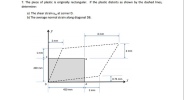 7. The piece of plastic is originally rectangular. If the plastic distorts as shown by the dashed lines, determine a) The shear strain Vay at corner D. b) The average normal strain along diagonal DB. 6 mm 2 mm 4 mm 1 mm 200 mm 0.75 mm 450 mm 2 mm
Problem #3: The piece of rubber is originally rectangular. Determine the average shear strain Yxy at...
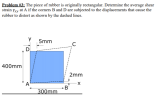 Problem #3: The piece of rubber is originally rectangular. Determine the average shear strain Yxy at A if the corners B and D are subjected to the displacements that cause the rubber to distort as shown by the dashed lines. 5mm 400mm 2mm B 300mm
2-11. Determine the shear strain yy at corners D and Cif the plastic distorts as shown...
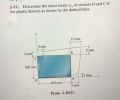 2-11. Determine the shear strain yy at corners D and Cif the plastic distorts as shown by the dashed lines. y 12 mm 4 mm 8 mm B 3 mm 300 mm 12 mm x A 400 mm 5 mm Probs. 2-10/11
The rectangular plate deforms as shown by the dashed lines. Determine the shear strain ?xy at...
 The rectangular plate deforms as shown by the dashed lines.
Determine the shear strain ?xy at Point A.
Determine the shear strain ??′y′ atPointA.
T 0.01 in 5 in X 0.02 in.- ---0.02 in -5 in. A -5 in
The rectangular plate deforms as shown by the dashed lines.
Determine the shear strain ?xy at Point A.
Determine the shear strain ??′y′ atPointA.
T 0.01 in 5 in X 0.02 in.- ---0.02 in -5 in. A -5 in
Part A) Determine the average normal strain along diagonal AC. Part B) determine the average shear...
 Part A) Determine the average normal strain along diagonal
AC.
Part B) determine the average shear strain at corner A.
The rectangular plate is deformed into the shape shown by the dashed lines. Suppose that a =250 mm and b= 410 mm (Figure 1) Figure 1 of 1 6 mm h 2 2 mm mm 6 mm 2 mm B 3 mm
Part A) Determine the average normal strain along diagonal
AC.
Part B) determine the average shear strain at corner A.
The rectangular plate is deformed into the shape shown by the dashed lines. Suppose that a =250 mm and b= 410 mm (Figure 1) Figure 1 of 1 6 mm h 2 2 mm mm 6 mm 2 mm B 3 mm
A rectangle deforms into the position shown by the dashed lines. 1. Determine the average normal strain along AD. 2. De...
 A rectangle deforms into the position shown by the dashed lines. 1. Determine the average normal strain along AD. 2. Determine the average normal strain along diagonal DB. 3. Determine the average normal strain along AB. Using the Law of Cosines, determine the shear str A. 3.5mm 4mm 3mm D' 1.5mm C B 1mm 3mm B A 400mm 300mm
A rectangle deforms into the position shown by the dashed lines. 1. Determine the average normal strain along AD. 2. Determine...
A rectangle deforms into the position shown by the dashed lines. 1. Determine the average normal strain along AD. 2. Determine the average normal strain along diagonal DB. 3. Determine the average normal strain along AB. Using the Law of Cosines, determine the shear str A. 3.5mm 4mm 3mm D' 1.5mm C B 1mm 3mm B A 400mm 300mm
A rectangle deforms into the position shown by the dashed lines. 1. Determine the average normal strain along AD. 2. Determine...
Part A: Average normal strain along AC Determine the average normal strain (ϵAC)avg along AC after...
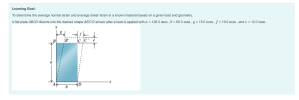 Part A: Average normal strain along
AC
Determine the average normal strain
(ϵAC)avg along AC after the load has
been applied.
Part B: Average shear strain at A
Determine the average shear strain γxy at A
relative to the x and y axes.
Part C: Average shear strain at point
C
Determine the average shear strain γxy at point
C relative to the x and y axes after
deformation.
Learning Goal: To determine the average normal strain and average shear...
Part A: Average normal strain along
AC
Determine the average normal strain
(ϵAC)avg along AC after the load has
been applied.
Part B: Average shear strain at A
Determine the average shear strain γxy at A
relative to the x and y axes.
Part C: Average shear strain at point
C
Determine the average shear strain γxy at point
C relative to the x and y axes after
deformation.
Learning Goal: To determine the average normal strain and average shear...
Show your work please : Problem 2.29 The rectangular plate is deformed into the shape shown by the dashed lines. Su...
 Show your work please :
Problem 2.29 The rectangular plate is deformed into the shape shown by the dashed lines. Suppose that a = 330 mm and b= 420 mm . (Figure 1) Figure 1 B of 1 Part A Determine the average normal strain along diagonal AC. Express your answer using three significant figures. Part B Determine the average shear strain at corner A. Express your answer to three significant figures and include the appropriate units.
Show your work please :
Problem 2.29 The rectangular plate is deformed into the shape shown by the dashed lines. Suppose that a = 330 mm and b= 420 mm . (Figure 1) Figure 1 B of 1 Part A Determine the average normal strain along diagonal AC. Express your answer using three significant figures. Part B Determine the average shear strain at corner A. Express your answer to three significant figures and include the appropriate units.
 7. The piece of plastic is originally rectangular. If the plastic distorts as shown by the dashed lines, determine a) The shear strain Vay at corner D. b) The average normal strain along diagonal DB. 6 mm 2 mm 4 mm 1 mm 200 mm 0.75 mm 450 mm 2 mm
 Problem #3: The piece of rubber is originally rectangular. Determine the average shear strain Yxy at A if the corners B and D are subjected to the displacements that cause the rubber to distort as shown by the dashed lines. 5mm 400mm 2mm B 300mm
 2-11. Determine the shear strain yy at corners D and Cif the plastic distorts as shown by the dashed lines. y 12 mm 4 mm 8 mm B 3 mm 300 mm 12 mm x A 400 mm 5 mm Probs. 2-10/11
 The rectangular plate deforms as shown by the dashed lines.
Determine the shear strain ?xy at Point A.
Determine the shear strain ??′y′ atPointA.
T 0.01 in 5 in X 0.02 in.- ---0.02 in -5 in. A -5 in
The rectangular plate deforms as shown by the dashed lines.
Determine the shear strain ?xy at Point A.
Determine the shear strain ??′y′ atPointA.
T 0.01 in 5 in X 0.02 in.- ---0.02 in -5 in. A -5 in
 Part A) Determine the average normal strain along diagonal
AC.
Part B) determine the average shear strain at corner A.
The rectangular plate is deformed into the shape shown by the dashed lines. Suppose that a =250 mm and b= 410 mm (Figure 1) Figure 1 of 1 6 mm h 2 2 mm mm 6 mm 2 mm B 3 mm
Part A) Determine the average normal strain along diagonal
AC.
Part B) determine the average shear strain at corner A.
The rectangular plate is deformed into the shape shown by the dashed lines. Suppose that a =250 mm and b= 410 mm (Figure 1) Figure 1 of 1 6 mm h 2 2 mm mm 6 mm 2 mm B 3 mm
 A rectangle deforms into the position shown by the dashed lines. 1. Determine the average normal strain along AD. 2. Determine the average normal strain along diagonal DB. 3. Determine the average normal strain along AB. Using the Law of Cosines, determine the shear str A. 3.5mm 4mm 3mm D' 1.5mm C B 1mm 3mm B A 400mm 300mm
A rectangle deforms into the position shown by the dashed lines. 1. Determine the average normal strain along AD. 2. Determine...
A rectangle deforms into the position shown by the dashed lines. 1. Determine the average normal strain along AD. 2. Determine the average normal strain along diagonal DB. 3. Determine the average normal strain along AB. Using the Law of Cosines, determine the shear str A. 3.5mm 4mm 3mm D' 1.5mm C B 1mm 3mm B A 400mm 300mm
A rectangle deforms into the position shown by the dashed lines. 1. Determine the average normal strain along AD. 2. Determine...
 Part A: Average normal strain along
AC
Determine the average normal strain
(ϵAC)avg along AC after the load has
been applied.
Part B: Average shear strain at A
Determine the average shear strain γxy at A
relative to the x and y axes.
Part C: Average shear strain at point
C
Determine the average shear strain γxy at point
C relative to the x and y axes after
deformation.
Learning Goal: To determine the average normal strain and average shear...
Part A: Average normal strain along
AC
Determine the average normal strain
(ϵAC)avg along AC after the load has
been applied.
Part B: Average shear strain at A
Determine the average shear strain γxy at A
relative to the x and y axes.
Part C: Average shear strain at point
C
Determine the average shear strain γxy at point
C relative to the x and y axes after
deformation.
Learning Goal: To determine the average normal strain and average shear...
 Show your work please :
Problem 2.29 The rectangular plate is deformed into the shape shown by the dashed lines. Suppose that a = 330 mm and b= 420 mm . (Figure 1) Figure 1 B of 1 Part A Determine the average normal strain along diagonal AC. Express your answer using three significant figures. Part B Determine the average shear strain at corner A. Express your answer to three significant figures and include the appropriate units.
Show your work please :
Problem 2.29 The rectangular plate is deformed into the shape shown by the dashed lines. Suppose that a = 330 mm and b= 420 mm . (Figure 1) Figure 1 B of 1 Part A Determine the average normal strain along diagonal AC. Express your answer using three significant figures. Part B Determine the average shear strain at corner A. Express your answer to three significant figures and include the appropriate units.
Most questions answered within 3 hours.
-
Where is the error in this code sequence?
String s1 = "Hello";
String s2 = "ello";...
asked 11 months ago -
Financial data for Joel de Paris, Inc., for last year
follow:
Joel de Paris, Inc.
Balance...
asked 11 months ago -
Consider this reaction:
Al2(SO4)3 (aq)+ BaCl3
(aq) Al2Cl6 (aq)- +
3BaSO4(s) . What is the...
asked 11 months ago -
Suppose that Savneet is considering increasing her
recent random sample from 20 car rentals to 40...
asked 11 months ago -
Trucks arrive at an unloading terminal at an average rate of 120
per hour.
Trucks arrive...
asked 11 months ago -
Why are methanol and ethanol completely soluble in water while
octanol is not very little soluble....
asked 11 months ago -
A facilities manager at a university reads in a research report
that the mean amount of...
asked 11 months ago -
When the CuSO4 is rehydrated by adding water to the anhydrous
compound, is this an endothermic...
asked 11 months ago -
A ray of sunlight is passing from diamond into crown glass; the
angle of incidence is...
asked 11 months ago -
A block of mass 0.249 kg is placed on top of a light, vertical
spring of...
asked 11 months ago -
how do the kidneys compensate in the presences of acidosis
a) trigger hyperventilate
b) reserve acid...
asked 11 months ago -
Question 501 pts
The rental rate of capital to the firm increases. Which of the
following...
asked 11 months ago