How to prove that the independence axiom must be true for a set of preferences that can be represented by expected utili...
How to prove that the independence axiom must be true for a set of preferences that can be represented by expected utility function?
Homework Answers
Expected utility theorem states that the value associated with a person's gamble is the statistical value that a person attaches to the result expected out of that trail. In order for a person's decision to be compliant with Expected utility Theorem, four axioms must hold true, namely: Completeness, Transitivity, Independence and Continuity.
Independence axiom states that the two gambling scenarios when combined with a third gambling scenario which is irrelevant to the preference, then the preference order remains same as that without the presence of third gambling option.
Add Answer to:
How to prove that the independence axiom must be true for a set of preferences that can be represented by expected utili...
Cobb-Douglas Preferences: Cobb-Douglas preferences on the consump- tion set R2+ can be represented by a utility...
Cobb-Douglas Preferences: Cobb-Douglas preferences on the consump- tion set R2+ can be represented by a utility function of the form U (q1,q2) = Aq1αq2β, where A > 0, α ∈ (0,1), and β ∈ (0,1) are fixed parameters. 1. If we assume that preferences are ordinal, explain why these precise preferences are also represented by the utility function U(q ,q )=qγq1−γ, 1212 whereγ= α .Isγ∈(0,1)? (α+β) 2. If we assume that preferences are ordinal and restrict attention to the consumption...
The Independence Axiom of expected utility states that the preference relation is such that: L a...
The Independence Axiom of expected utility states that the preference relation is such that: L a L b ⇐⇒ αLa + (1 − α)L c αLb + (1 − α)L c . Note that ⇐⇒ means “is equivalent to.” What does is mean in the language of economics and finance?
ots) Mark has preferences that can be represented by the following utility function: U(x,y)= (18+x)(+1). Sarah's...
 ots) Mark has preferences that can be represented by the following utility function: U(x,y)= (18+x)(+1). Sarah's utility function is v) 6x +60 y - 4x + 2xy - 24 y +29: Do Mark and Sarah have the same preferences? You must prove your answer. U (x, y) = 6x+60 y - 4x + 2
Suppose that a decision-maker’s preferences over the set A={a, b, c} are represented by the payoff...
Suppose that a decision-maker’s preferences over the set A={a, b, c} are represented by the payoff function u for which u(a) = 0, u(b) = 1, and u(c) = 4. (a) Give another example of a function f:A→R that represents the decision-maker’s preferences. (b) Is there a function that represents the decision-maker’s preferences and assigns negative numbers to all elements of A?
Suppose that a decision-maker’s preferences over the set A={a, b, c} are represented by the payoff...
Suppose that a decision-maker’s preferences over the set A={a, b, c} are represented by the payoff function u for which u(a) = 0, u(b) = 1, and u(c) = 4. (a) Give another example of a function f:A→R that represents the decision-maker’s preferences. (b) Is there a function that represents the decision-maker’s preferences and assigns negative numbers to all elements of A?
please show all steps 10. A consumer's preferences over bundles of two goods can be represented...
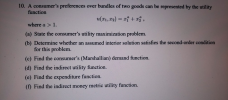 please show all steps
10. A consumer's preferences over bundles of two goods can be represented by the utility function where a >1. (a) State the consumer's utility maximization problem (b) Determine whether an assumed interior solution satisfies the second-order condition for this problem. (c) Find the consumer's (Marshallian) demand function. (d) Find the indirect utility function. (e) Find the expenditure function. (f) Find the indirect money metric utility function.
please show all steps
10. A consumer's preferences over bundles of two goods can be represented by the utility function where a >1. (a) State the consumer's utility maximization problem (b) Determine whether an assumed interior solution satisfies the second-order condition for this problem. (c) Find the consumer's (Marshallian) demand function. (d) Find the indirect utility function. (e) Find the expenditure function. (f) Find the indirect money metric utility function.
3. Suppose an individual has perfect-complements preferences that can be represented by the utility function U(x,y)=...
 3. Suppose an individual has perfect-complements preferences that can be represented by the utility function U(x,y)= min[3x,2y]. Furthermore, suppose that she faces a standard linear budget constraint, with income denoted by m and prices denoted by px and p,, respectively. a) Derive the demand functions for x and y. b) How does demand for the two goods depend on the prices, p, and p, ? Explain.
Suppose a consumer's preferences can be represented by the utility function: U(X,Y)=X3/5Y1/4 a. Derive the function...
Suppose a consumer's preferences can be represented by the utility function: U(X,Y)=X3/5Y1/4 a. Derive the function for the marginal rate of substitution holding utility constant: U X Y b. Derive the demand curves for the two goods, X and Y. c. Confirm that both demand curves slope downward. d. Calculate the price elasticity for each of the goods. e. Calculate the income elasticity for each of the goods.
Suppose there are two consumption goods and preferences of a consumer can be represented by the following utility functi...
 Suppose there are two consumption goods and preferences of a
consumer can be represented by the following utility function:
;
a) Derive the Marshallian demand function of this consumer.
b) Calculate and intuitively interpret the elasticity of
substitution.
d/11027(0 - 1) + 10) = (2x Iz)n (0<a <1:0 +p<1)
Suppose there are two consumption goods and preferences of a
consumer can be represented by the following utility function:
;
a) Derive the Marshallian demand function of this consumer.
b) Calculate and intuitively interpret the elasticity of
substitution.
d/11027(0 - 1) + 10) = (2x Iz)n (0<a <1:0 +p<1)
Exercise 2: Expenditure minimization We assume an individual whose preferences can be represented by the utility...
 Exercise 2: Expenditure minimization We assume an individual whose preferences can be represented by the utility functions | Ưới a) = 8 * @a An expenditure-minimizing consumer would try to minimize the amount they spend on both and rach that their utility is at least as high as some set level of utility U. Mathematically, we thus have minha + P such that Ul. 22) 20 1. Please write the Lagrangan formula corresponding to this particular optimization set up oynundo...
 ots) Mark has preferences that can be represented by the following utility function: U(x,y)= (18+x)(+1). Sarah's utility function is v) 6x +60 y - 4x + 2xy - 24 y +29: Do Mark and Sarah have the same preferences? You must prove your answer. U (x, y) = 6x+60 y - 4x + 2
 please show all steps
10. A consumer's preferences over bundles of two goods can be represented by the utility function where a >1. (a) State the consumer's utility maximization problem (b) Determine whether an assumed interior solution satisfies the second-order condition for this problem. (c) Find the consumer's (Marshallian) demand function. (d) Find the indirect utility function. (e) Find the expenditure function. (f) Find the indirect money metric utility function.
please show all steps
10. A consumer's preferences over bundles of two goods can be represented by the utility function where a >1. (a) State the consumer's utility maximization problem (b) Determine whether an assumed interior solution satisfies the second-order condition for this problem. (c) Find the consumer's (Marshallian) demand function. (d) Find the indirect utility function. (e) Find the expenditure function. (f) Find the indirect money metric utility function.
 3. Suppose an individual has perfect-complements preferences that can be represented by the utility function U(x,y)= min[3x,2y]. Furthermore, suppose that she faces a standard linear budget constraint, with income denoted by m and prices denoted by px and p,, respectively. a) Derive the demand functions for x and y. b) How does demand for the two goods depend on the prices, p, and p, ? Explain.
 Suppose there are two consumption goods and preferences of a
consumer can be represented by the following utility function:
;
a) Derive the Marshallian demand function of this consumer.
b) Calculate and intuitively interpret the elasticity of
substitution.
d/11027(0 - 1) + 10) = (2x Iz)n (0<a <1:0 +p<1)
Suppose there are two consumption goods and preferences of a
consumer can be represented by the following utility function:
;
a) Derive the Marshallian demand function of this consumer.
b) Calculate and intuitively interpret the elasticity of
substitution.
d/11027(0 - 1) + 10) = (2x Iz)n (0<a <1:0 +p<1)
 Exercise 2: Expenditure minimization We assume an individual whose preferences can be represented by the utility functions | Ưới a) = 8 * @a An expenditure-minimizing consumer would try to minimize the amount they spend on both and rach that their utility is at least as high as some set level of utility U. Mathematically, we thus have minha + P such that Ul. 22) 20 1. Please write the Lagrangan formula corresponding to this particular optimization set up oynundo...
Most questions answered within 3 hours.
-
Where is the error in this code sequence?
String s1 = "Hello";
String s2 = "ello";...
asked 11 months ago -
Financial data for Joel de Paris, Inc., for last year
follow:
Joel de Paris, Inc.
Balance...
asked 11 months ago -
Consider this reaction:
Al2(SO4)3 (aq)+ BaCl3
(aq) Al2Cl6 (aq)- +
3BaSO4(s) . What is the...
asked 11 months ago -
Suppose that Savneet is considering increasing her
recent random sample from 20 car rentals to 40...
asked 11 months ago -
Trucks arrive at an unloading terminal at an average rate of 120
per hour.
Trucks arrive...
asked 11 months ago -
Why are methanol and ethanol completely soluble in water while
octanol is not very little soluble....
asked 11 months ago -
A facilities manager at a university reads in a research report
that the mean amount of...
asked 11 months ago -
When the CuSO4 is rehydrated by adding water to the anhydrous
compound, is this an endothermic...
asked 11 months ago -
A ray of sunlight is passing from diamond into crown glass; the
angle of incidence is...
asked 11 months ago -
A block of mass 0.249 kg is placed on top of a light, vertical
spring of...
asked 11 months ago -
how do the kidneys compensate in the presences of acidosis
a) trigger hyperventilate
b) reserve acid...
asked 11 months ago -
Question 501 pts
The rental rate of capital to the firm increases. Which of the
following...
asked 11 months ago