![function [n,alpha]-bisect (a,b,eps) alpha-(a+b)/2 n-1i fval-f (alpha); while (b-alpha> eps) & (fval0) fa-f (a) if fa*fval< 0](http://img.homeworklib.com/images/e21201d4-1082-4dd8-a398-f5fdc6a9f04f.png?x-oss-process=image/resize,w_560)

![function [n,alpha ] newton (x0,eps, maxits) alpha-x0; [fval,deriv]-func (alpha); n 0; while ( abs ( fval ) > eps ) & ( n <= m](http://img.homeworklib.com/images/e69ccddb-4b2e-48a5-8937-a84d294fee22.png?x-oss-process=image/resize,w_560)
![function [f,fdash]=func (W) f=cos (w)-w ; fdash--sin(w)-1; end](http://img.homeworklib.com/images/170d446e-2c44-44cd-98e7-041aa0548bd9.png?x-oss-process=image/resize,w_560)
function [n,alpha]-bisect (a,b,eps) alpha-(a+b)/2 n-1i fval-f (alpha); while (b-alpha> eps) & (fval0) fa-f (a) if fa*fval eps ) & ( n
Homework Answers
CODE:
Bisect
function [n,alpha]=bisect(a,b,eps)
alpha=(a+b)/2;
n=1;
fval=f(alpha);
while (b-alpha> eps) & (fval ~= 0)
fa=f(a);
if fa*fval< 0
b=alpha;
else
a=alpha;
end
alpha=(a+b)/2;
n=n+1;
fval=f(alpha);
end
end
newton
function [n,alpha]=newton(x0,eps,maxits)
alpha=x0;
[fval,deriv]=func(alpha);
n=0;
while (abs(fval) > eps) & (n <= maxits)
alpha=alpha-fval/deriv;
n=n+1;
[fval,deriv]=func(alpha);
end
end
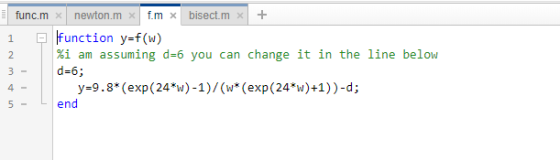
f
function y=f(w)
%i am assuming d=6 you can change it in the line below
d=6;
y=9.8*(exp(24*w)-1)/(w*(exp(24*w)+1))-d;
end
func
function [f,fdash]=func(w)
d=6;
f=9.8*(exp(24*w)-1)/(w*(exp(24*w)+1))-d;
fdash=9.8*(24*(exp(24*w)*(w*(exp(24*w)+1)))-(exp(24*w)-1)*((exp(24*w)+1)+w*(exp(24*w)*24)))/((w*(exp(24*w)+1))^2);
end
![>> format long [n,ans]-bisect(-2,1,10 (-8)) n- 29 ans 1.633333338424563](http://img.homeworklib.com/images/58ee87dd-05eb-4b48-9074-4c561a9f40ec.png?x-oss-process=image/resize,w_560)
![[n, ans]-newton(- .5,104-8,500e) >> n- fi ans 1.633333333220014](http://img.homeworklib.com/images/6c3da974-7a2c-4d73-b601-76b2099bb4eb.png?x-oss-process=image/resize,w_560)
![function [n,alpha]-newton(xe, eps,maxits) alpha-xe; [fval, deriv-func (alpha); n=0 ; while (abs(fval) > eps) & (n <= alpha-al](http://img.homeworklib.com/images/9452d301-f592-4bfc-9ddb-aacf2c54d5c8.png?x-oss-process=image/resize,w_560)

![function [n,alpha]-bisect (a,b,eps) alpha-(a+b)/2; 1 n=1; fval-f (alpha); while (b-alpha» fa-f(a); & (fva1 5-[ eps) e) ~= if](http://img.homeworklib.com/images/44c08a30-b5d4-4a29-b1f3-673eb52012e6.png?x-oss-process=image/resize,w_560)
Add Answer to:
last digit is 5 bisect f.m newton.m func.m 2(a) Let d be the last digit of your student ID number. But if d0, t...
Hi, we recently had an assignment and I ended up skipping this question because I didn't understand the question nor...
 Hi, we recently had an assignment and I ended up skipping this
question because I didn't understand the question nor how to even
start it. Obviously for Matlab! Coding is not my strong point so
this was a stitch up. The data we were meant to use is below!
For (a)
function [n,alpha]=bisect(a,b,eps)
alpha=(a+b)/2
n=1;
fval=f(alpha);
while (b-alpha> eps) & (fval ~= 0)
fa=f(a);
if fa*fval< 0
b=alpha;
else
a=alpha;
end
alpha=(a+b)/2
n=n+1;
fval=f(alpha);
end
end
Sample f.m
function y=f(w)...
Hi, we recently had an assignment and I ended up skipping this
question because I didn't understand the question nor how to even
start it. Obviously for Matlab! Coding is not my strong point so
this was a stitch up. The data we were meant to use is below!
For (a)
function [n,alpha]=bisect(a,b,eps)
alpha=(a+b)/2
n=1;
fval=f(alpha);
while (b-alpha> eps) & (fval ~= 0)
fa=f(a);
if fa*fval< 0
b=alpha;
else
a=alpha;
end
alpha=(a+b)/2
n=n+1;
fval=f(alpha);
end
end
Sample f.m
function y=f(w)...
in matlab -Consider the equation f(x) = x-2-sin x = 0 on the interval x E [0.1,4 π] Use a plot to approximately locate the roots of f. To which roots do the fol- owing initial guesses converge wh...
 in
matlab
-Consider the equation f(x) = x-2-sin x = 0 on the interval x E [0.1,4 π] Use a plot to approximately locate the roots of f. To which roots do the fol- owing initial guesses converge when using Function 4.3.1? Is the root obtained the one that is closest to that guess? )xo = 1.5, (b) x0 = 2, (c) x.-3.2, (d) xo = 4, (e) xo = 5, (f) xo = 27. Function 4.3.1 (newton) Newton's method...
in
matlab
-Consider the equation f(x) = x-2-sin x = 0 on the interval x E [0.1,4 π] Use a plot to approximately locate the roots of f. To which roots do the fol- owing initial guesses converge when using Function 4.3.1? Is the root obtained the one that is closest to that guess? )xo = 1.5, (b) x0 = 2, (c) x.-3.2, (d) xo = 4, (e) xo = 5, (f) xo = 27. Function 4.3.1 (newton) Newton's method...
____________ % This function is a modified versio of the newtmult function obtained % from % “Ap...
 ____________
% This function is a modified versio of the newtmult function
obtained
% from
% “Applied Numerical Methods with MATLAB, Chapra,
% 3rd edition, 2012, McGraw-Hill.”
function [x,f,ea,iter]=newtmult(func,x0,es,maxit,varargin)
% newtmult: Newton-Raphson root zeroes nonlinear systems
% [x,f,ea,iter]=newtmult(f,J,x0,es,maxit,p1,p2,...):
% uses the Newton-Raphson method to find the roots of
% a system of nonlinear equations
% input:
% f = the passed function
% J = the passed jacobian
% x0 = initial guess
% es = desired percent relative error...
____________
% This function is a modified versio of the newtmult function
obtained
% from
% “Applied Numerical Methods with MATLAB, Chapra,
% 3rd edition, 2012, McGraw-Hill.”
function [x,f,ea,iter]=newtmult(func,x0,es,maxit,varargin)
% newtmult: Newton-Raphson root zeroes nonlinear systems
% [x,f,ea,iter]=newtmult(f,J,x0,es,maxit,p1,p2,...):
% uses the Newton-Raphson method to find the roots of
% a system of nonlinear equations
% input:
% f = the passed function
% J = the passed jacobian
% x0 = initial guess
% es = desired percent relative error...
This is Matlab Problem and I'll attach problem1 and its answer for reference. We were unable...
 This is Matlab Problem and I'll attach problem1 and its answer
for reference.
We were unable to transcribe this imageNewton's Method We have already seen the bisection method, which is an iterative root-finding method. The Newton Rhapson method (Newton's method) is another iterative root-finding method. The method is geometrically motivated and uses the derivative to find roots. It has the advantage that it is very fast (generally faster than bisection) and works on problems with double (repeated) roots, where the...
This is Matlab Problem and I'll attach problem1 and its answer
for reference.
We were unable to transcribe this imageNewton's Method We have already seen the bisection method, which is an iterative root-finding method. The Newton Rhapson method (Newton's method) is another iterative root-finding method. The method is geometrically motivated and uses the derivative to find roots. It has the advantage that it is very fast (generally faster than bisection) and works on problems with double (repeated) roots, where the...
Newton's Method in MATLAB During this module, we are going to use Newton's method to compute...
 Newton's Method in MATLAB During this module, we are going to use Newton's method to compute the root(s) of the function f(x) = x° + 3x² – 2x – 4 Since we need an initial approximation ('guess') of each root to use in Newton's method, let's plot the function f(x) to see many roots there are, and approximately where they lie. Exercise 1 Use MATLAB to create a plot of the function f(x) that clearly shows the locations of its...
 Hi, we recently had an assignment and I ended up skipping this
question because I didn't understand the question nor how to even
start it. Obviously for Matlab! Coding is not my strong point so
this was a stitch up. The data we were meant to use is below!
For (a)
function [n,alpha]=bisect(a,b,eps)
alpha=(a+b)/2
n=1;
fval=f(alpha);
while (b-alpha> eps) & (fval ~= 0)
fa=f(a);
if fa*fval< 0
b=alpha;
else
a=alpha;
end
alpha=(a+b)/2
n=n+1;
fval=f(alpha);
end
end
Sample f.m
function y=f(w)...
Hi, we recently had an assignment and I ended up skipping this
question because I didn't understand the question nor how to even
start it. Obviously for Matlab! Coding is not my strong point so
this was a stitch up. The data we were meant to use is below!
For (a)
function [n,alpha]=bisect(a,b,eps)
alpha=(a+b)/2
n=1;
fval=f(alpha);
while (b-alpha> eps) & (fval ~= 0)
fa=f(a);
if fa*fval< 0
b=alpha;
else
a=alpha;
end
alpha=(a+b)/2
n=n+1;
fval=f(alpha);
end
end
Sample f.m
function y=f(w)...
 in
matlab
-Consider the equation f(x) = x-2-sin x = 0 on the interval x E [0.1,4 π] Use a plot to approximately locate the roots of f. To which roots do the fol- owing initial guesses converge when using Function 4.3.1? Is the root obtained the one that is closest to that guess? )xo = 1.5, (b) x0 = 2, (c) x.-3.2, (d) xo = 4, (e) xo = 5, (f) xo = 27. Function 4.3.1 (newton) Newton's method...
in
matlab
-Consider the equation f(x) = x-2-sin x = 0 on the interval x E [0.1,4 π] Use a plot to approximately locate the roots of f. To which roots do the fol- owing initial guesses converge when using Function 4.3.1? Is the root obtained the one that is closest to that guess? )xo = 1.5, (b) x0 = 2, (c) x.-3.2, (d) xo = 4, (e) xo = 5, (f) xo = 27. Function 4.3.1 (newton) Newton's method...
 ____________
% This function is a modified versio of the newtmult function
obtained
% from
% “Applied Numerical Methods with MATLAB, Chapra,
% 3rd edition, 2012, McGraw-Hill.”
function [x,f,ea,iter]=newtmult(func,x0,es,maxit,varargin)
% newtmult: Newton-Raphson root zeroes nonlinear systems
% [x,f,ea,iter]=newtmult(f,J,x0,es,maxit,p1,p2,...):
% uses the Newton-Raphson method to find the roots of
% a system of nonlinear equations
% input:
% f = the passed function
% J = the passed jacobian
% x0 = initial guess
% es = desired percent relative error...
____________
% This function is a modified versio of the newtmult function
obtained
% from
% “Applied Numerical Methods with MATLAB, Chapra,
% 3rd edition, 2012, McGraw-Hill.”
function [x,f,ea,iter]=newtmult(func,x0,es,maxit,varargin)
% newtmult: Newton-Raphson root zeroes nonlinear systems
% [x,f,ea,iter]=newtmult(f,J,x0,es,maxit,p1,p2,...):
% uses the Newton-Raphson method to find the roots of
% a system of nonlinear equations
% input:
% f = the passed function
% J = the passed jacobian
% x0 = initial guess
% es = desired percent relative error...
 This is Matlab Problem and I'll attach problem1 and its answer
for reference.
We were unable to transcribe this imageNewton's Method We have already seen the bisection method, which is an iterative root-finding method. The Newton Rhapson method (Newton's method) is another iterative root-finding method. The method is geometrically motivated and uses the derivative to find roots. It has the advantage that it is very fast (generally faster than bisection) and works on problems with double (repeated) roots, where the...
This is Matlab Problem and I'll attach problem1 and its answer
for reference.
We were unable to transcribe this imageNewton's Method We have already seen the bisection method, which is an iterative root-finding method. The Newton Rhapson method (Newton's method) is another iterative root-finding method. The method is geometrically motivated and uses the derivative to find roots. It has the advantage that it is very fast (generally faster than bisection) and works on problems with double (repeated) roots, where the...
 Newton's Method in MATLAB During this module, we are going to use Newton's method to compute the root(s) of the function f(x) = x° + 3x² – 2x – 4 Since we need an initial approximation ('guess') of each root to use in Newton's method, let's plot the function f(x) to see many roots there are, and approximately where they lie. Exercise 1 Use MATLAB to create a plot of the function f(x) that clearly shows the locations of its...
Most questions answered within 3 hours.
-
Where is the error in this code sequence?
String s1 = "Hello";
String s2 = "ello";...
asked 10 months ago -
Financial data for Joel de Paris, Inc., for last year
follow:
Joel de Paris, Inc.
Balance...
asked 10 months ago -
Consider this reaction:
Al2(SO4)3 (aq)+ BaCl3
(aq) Al2Cl6 (aq)- +
3BaSO4(s) . What is the...
asked 10 months ago -
Suppose that Savneet is considering increasing her
recent random sample from 20 car rentals to 40...
asked 10 months ago -
Trucks arrive at an unloading terminal at an average rate of 120
per hour.
Trucks arrive...
asked 10 months ago -
Why are methanol and ethanol completely soluble in water while
octanol is not very little soluble....
asked 10 months ago -
A facilities manager at a university reads in a research report
that the mean amount of...
asked 10 months ago -
When the CuSO4 is rehydrated by adding water to the anhydrous
compound, is this an endothermic...
asked 10 months ago -
A ray of sunlight is passing from diamond into crown glass; the
angle of incidence is...
asked 10 months ago -
A block of mass 0.249 kg is placed on top of a light, vertical
spring of...
asked 10 months ago -
how do the kidneys compensate in the presences of acidosis
a) trigger hyperventilate
b) reserve acid...
asked 10 months ago -
Question 501 pts
The rental rate of capital to the firm increases. Which of the
following...
asked 10 months ago