

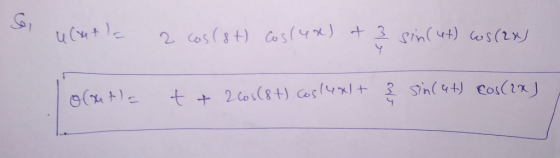
se that the initial angular displacement and angular velocity are 0(z,0)-2cos(dz), ele,o)-1 + 3 cos(2x), 0
Homework Answers
Any doubt in this then comment below...

Add Answer to:
where θ(z, t) is the angular displacement (angle of twist) along the shaft, z is the distance fr supported by fric...
where θ(z, t) is the angular displacement (angle of twist) along the shaft z is the distance from supported by fri...
 where θ(z, t) is the angular displacement (angle of twist) along the shaft z is the distance from supported by frictionless bearings at each end, the boundary conditions are the end of the shatt and t is time. For a shaft of length 3π that s Suppose that the initial angular displacement and angular velocity are respectively You may use the result that the eigenvalues of the boundary-value problem are 上一题11试题菜单^ 退出并保存 itii, 提交试卷 14:09 2019/6/1 MacBook Pro Suppose that...
where (x, t) is the angular displacement (ang le of twist) along the shaft, x is the distance from the end of the shaf...
 where (x, t) is the angular displacement (ang le of twist) along the shaft, x is the distance from the end of the shaft and t is time. For a shaft of length 4m that is supported by frictionless bearings at each end, the boundary conditions are t 0. Өx (0, г) — Өx(4л, t) — 0, Suppose that the initial angular displacement and angular velocity are Of(x, 0) = 2 cos(3x) = 6 cos(4x), ex, 0) 0 x< 4...
governed by the wave equation, Torsional vibration of a shaft at2 ax2 where x, t) is the angular displacement (angle of...
 governed by the wave equation, Torsional vibration of a shaft at2 ax2 where x, t) is the angular displacement (angle of twist) along the shaft, x is the distance from the end of the shaft and t is time. For a shaft of length 4T that is supported by frictionless bearings at each end, the boundary conditions are t > 0 ex(0, t) 0x(47, t) = 0, Suppose that the initial angular displacement and angular velocity are e(x,0) = 3...
Torsional vibration of a shaft is governed by the wave equation, = 16 where (x,t) is the angular displacement (angle of...
 Torsional vibration of a shaft is governed by the wave equation, = 16 where (x,t) is the angular displacement (angle of twist) along the shaft, ar is the distance from the end of the shaft and t is time. For a shaft of length 2T that supported by frictionless b end, the boundary conditions are 0r(0,t) = 0x(2T, t) = 0, t> 0. Suppose that the initial angular displacement and angular velocity are (x,0) = 6 cos(x), Ot(x,0) =3+2 cos(42),...
0.0/10,0 Torsional vibration of a shaft is governed by the wave equation, 4 where e(z,t) is...
 0.0/10,0 Torsional vibration of a shaft is governed by the wave equation, 4 where e(z,t) is the angular displacement (angle of twist) along the shaft, r is the distance from the end of the shaft and t is time. For a by frictionless bearings at each end, the boundary conditions are x(0,)0(2w,t) 0, t> 0. Suppose that the initial angular displacement and angular velocity are (r,0)2 cos (4z), e(z,0) 3+3cos(4r), 0< z < 2x, respectively You may use the result...
Torsional vibration of a shafti govemed by the wave equation a-2 where (z,t) is the angular...
 Torsional vibration of a shafti govemed by the wave equation a-2 where (z,t) is the angular displacement (angle of twist) along the shaft, z is the distance from the end of the shaft and t is time. For a shaft of length 2 that is supported by frictionless bearings at each end the boundary conditions are r(0.t)-r(2r.t) =0. t>0. Suppose that the initial angular displacement and angular velocity are (,0) cos(3r), 0,(z,0)- 6+6cos(2r), 0<r< 2x, respectively. the eigenvalues of the...
Torsional vibration of a shaft is govened by e wave equation where e(z,t) is the anqular...
 Torsional vibration of a shaft is govened by e wave equation where e(z,t) is the anqular displacement (angle of twist) along the shaft, z is the distance from the end of the shaft and t is time. For a shaft of length that is supported by frictionless bearings at each end, boundary conditions are 0(0,t) 0(4x,t) 0, t> 0. Suppose that the initial angular displacement and angular velocity are e(z,0) 3cos(2r), 0(z,0)= 4+cos(2r), 0<z< 4m, respectively You may use the...
Torsional vibration of a shaft is govened by e wave equation where e(z,t) is the anqular...
 Torsional vibration of a shaft is govened by e wave equation where e(z,t) is the anqular displacement (angle of twist) along the shaft, z is the distance from the end of the shaft and t is time. For a shaft of length that is supported by frictionless bearings at each end, boundary conditions are 0(0,t) 0(4x,t) 0, t> 0. Suppose that the initial angular displacement and angular velocity are e(z,0) 3cos(2r), 0(z,0)= 4+cos(2r), 0<z< 4m, respectively You may use the...
Torsional vibration of a shaft is governed by the wave equation, = 4 where ex, ) is the angular displacement (angle...
 Torsional vibration of a shaft is governed by the wave equation, = 4 where ex, ) is the angular displacement (angle of twist) along the shaft, x is the distance from the endc the shaft and is time. For a shaft of length 4x that is supported by frictionless bearings at each end, the boundary conditions are Ox(O.t) = 0x(4r, f) = 0, 1>0. Suppose that the initial angular displacement and angular velocity are Ox, 0) = 6 cos(x), 0x,...
(a) You are given that two solutions of the homogeneous Euler-Cauchy equation, da2 are y,-z-6 and y2 2 Confirm the linear independence of your two solutions (for z >0) by computing their Wron...
 (a) You are given that two solutions of the homogeneous Euler-Cauchy equation, da2 are y,-z-6 and y2 2 Confirm the linear independence of your two solutions (for z >0) by computing their Wronskian, (b) Use variation of parameters to find a particular solution of the inhomogeneous Euler-Cauchy equation, d r (O) First, enter your expression foru(as defined in lectures) below da 上一题 退出并保存 提交试卷 (b) Use variation of parameters to find a particular solution of the inhomogeneous Euler-Cauchy equation, d...
 where θ(z, t) is the angular displacement (angle of twist) along the shaft z is the distance from supported by frictionless bearings at each end, the boundary conditions are the end of the shatt and t is time. For a shaft of length 3π that s Suppose that the initial angular displacement and angular velocity are respectively You may use the result that the eigenvalues of the boundary-value problem are 上一题11试题菜单^ 退出并保存 itii, 提交试卷 14:09 2019/6/1 MacBook Pro Suppose that...
 where (x, t) is the angular displacement (ang le of twist) along the shaft, x is the distance from the end of the shaft and t is time. For a shaft of length 4m that is supported by frictionless bearings at each end, the boundary conditions are t 0. Өx (0, г) — Өx(4л, t) — 0, Suppose that the initial angular displacement and angular velocity are Of(x, 0) = 2 cos(3x) = 6 cos(4x), ex, 0) 0 x< 4...
 governed by the wave equation, Torsional vibration of a shaft at2 ax2 where x, t) is the angular displacement (angle of twist) along the shaft, x is the distance from the end of the shaft and t is time. For a shaft of length 4T that is supported by frictionless bearings at each end, the boundary conditions are t > 0 ex(0, t) 0x(47, t) = 0, Suppose that the initial angular displacement and angular velocity are e(x,0) = 3...
 Torsional vibration of a shaft is governed by the wave equation, = 16 where (x,t) is the angular displacement (angle of twist) along the shaft, ar is the distance from the end of the shaft and t is time. For a shaft of length 2T that supported by frictionless b end, the boundary conditions are 0r(0,t) = 0x(2T, t) = 0, t> 0. Suppose that the initial angular displacement and angular velocity are (x,0) = 6 cos(x), Ot(x,0) =3+2 cos(42),...
 0.0/10,0 Torsional vibration of a shaft is governed by the wave equation, 4 where e(z,t) is the angular displacement (angle of twist) along the shaft, r is the distance from the end of the shaft and t is time. For a by frictionless bearings at each end, the boundary conditions are x(0,)0(2w,t) 0, t> 0. Suppose that the initial angular displacement and angular velocity are (r,0)2 cos (4z), e(z,0) 3+3cos(4r), 0< z < 2x, respectively You may use the result...
 Torsional vibration of a shafti govemed by the wave equation a-2 where (z,t) is the angular displacement (angle of twist) along the shaft, z is the distance from the end of the shaft and t is time. For a shaft of length 2 that is supported by frictionless bearings at each end the boundary conditions are r(0.t)-r(2r.t) =0. t>0. Suppose that the initial angular displacement and angular velocity are (,0) cos(3r), 0,(z,0)- 6+6cos(2r), 0<r< 2x, respectively. the eigenvalues of the...
 Torsional vibration of a shaft is govened by e wave equation where e(z,t) is the anqular displacement (angle of twist) along the shaft, z is the distance from the end of the shaft and t is time. For a shaft of length that is supported by frictionless bearings at each end, boundary conditions are 0(0,t) 0(4x,t) 0, t> 0. Suppose that the initial angular displacement and angular velocity are e(z,0) 3cos(2r), 0(z,0)= 4+cos(2r), 0<z< 4m, respectively You may use the...
 Torsional vibration of a shaft is govened by e wave equation where e(z,t) is the anqular displacement (angle of twist) along the shaft, z is the distance from the end of the shaft and t is time. For a shaft of length that is supported by frictionless bearings at each end, boundary conditions are 0(0,t) 0(4x,t) 0, t> 0. Suppose that the initial angular displacement and angular velocity are e(z,0) 3cos(2r), 0(z,0)= 4+cos(2r), 0<z< 4m, respectively You may use the...
 Torsional vibration of a shaft is governed by the wave equation, = 4 where ex, ) is the angular displacement (angle of twist) along the shaft, x is the distance from the endc the shaft and is time. For a shaft of length 4x that is supported by frictionless bearings at each end, the boundary conditions are Ox(O.t) = 0x(4r, f) = 0, 1>0. Suppose that the initial angular displacement and angular velocity are Ox, 0) = 6 cos(x), 0x,...
 (a) You are given that two solutions of the homogeneous Euler-Cauchy equation, da2 are y,-z-6 and y2 2 Confirm the linear independence of your two solutions (for z >0) by computing their Wronskian, (b) Use variation of parameters to find a particular solution of the inhomogeneous Euler-Cauchy equation, d r (O) First, enter your expression foru(as defined in lectures) below da 上一题 退出并保存 提交试卷 (b) Use variation of parameters to find a particular solution of the inhomogeneous Euler-Cauchy equation, d...
Most questions answered within 3 hours.
-
Where is the error in this code sequence?
String s1 = "Hello";
String s2 = "ello";...
asked 10 months ago -
Financial data for Joel de Paris, Inc., for last year
follow:
Joel de Paris, Inc.
Balance...
asked 10 months ago -
Consider this reaction:
Al2(SO4)3 (aq)+ BaCl3
(aq) Al2Cl6 (aq)- +
3BaSO4(s) . What is the...
asked 10 months ago -
Suppose that Savneet is considering increasing her
recent random sample from 20 car rentals to 40...
asked 10 months ago -
Trucks arrive at an unloading terminal at an average rate of 120
per hour.
Trucks arrive...
asked 10 months ago -
Why are methanol and ethanol completely soluble in water while
octanol is not very little soluble....
asked 10 months ago -
A facilities manager at a university reads in a research report
that the mean amount of...
asked 10 months ago -
When the CuSO4 is rehydrated by adding water to the anhydrous
compound, is this an endothermic...
asked 10 months ago -
A ray of sunlight is passing from diamond into crown glass; the
angle of incidence is...
asked 10 months ago -
A block of mass 0.249 kg is placed on top of a light, vertical
spring of...
asked 10 months ago -
how do the kidneys compensate in the presences of acidosis
a) trigger hyperventilate
b) reserve acid...
asked 10 months ago -
Question 501 pts
The rental rate of capital to the firm increases. Which of the
following...
asked 10 months ago