If you deposit $10,000 today in an account that earns 14.5% compounded...
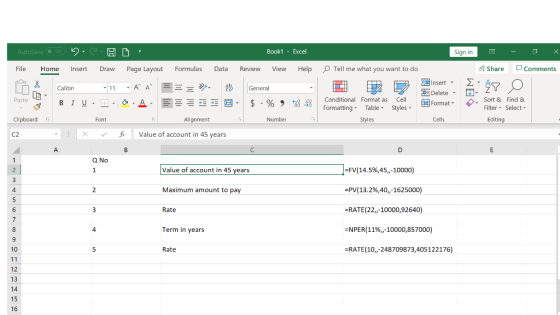
- If you deposit $10,000 today in an account that earns 14.5% compounded annually, how much will the account be worth in 45 years?
- You have the opportunity to purchase an investment that will pay $1,625,000 at the end of 40 years. If your required rate of return on this investment is 13.2%, what is the maximum amount you should be willing to pay for it?
- Your grandparents deposited a $10,000 birthday check for you when you were born 22 years ago. Today, the account (to which no other deposits have been made) is worth $92,640. What annually compounded rate of return has the account earned?
- In going through some old papers, you find an account statement that shows a current balance of $857,000. The papers also show that the account has earned an annually compounded rate of return of 11%, and you know that the account was originally opened with a deposit of $10,000. Assuming that no other deposits have been made to the account since the original deposit, how long ago (in years) was the account opened?
- The estimated population of the United States from the 1990 census was 248,709,873. The total population estimate from the 2000 census was 405,122,176. What was the annual population growth rate during this period?
Homework Answers
| Q No | ||
| 1 | Value of account in 45 years | $4,428,400.59 |
| 2 | Maximum amount to pay | $11,402.40 |
| 3 | Rate | 10.65% |
| 4 | Term in years | 42.65 |
| 5 | Rate | 5.00% |
Workings
Add Answer to:
If you deposit $10,000 today in an account that earns 14.5% compounded...
Pei's savings account balance is $12,000 today. Pei opened the account exactly 7 years ago with...
Pei's savings account balance is $12,000 today. Pei opened the account exactly 7 years ago with a $10,000 deposit. Pei has made no other deposits or withdrawals. What annual interest rate (compounded annually) has the account earned? (Enter your answers as a decimal rounded to 4 decimal places, not a percentage. For example, enter 0.0843 instead of 8.43%)
an account has been established 4 years ago with an initial deposit. today the account is...
an account has been established 4 years ago with an initial deposit. today the account is credited with annual interest of 291. the interest rate is 7.6 compounded annually. no other deposits or withdrawals have been made. how much is the end of the day balance
If you deposit $2,800 today into an account earning an annual rate of return of 8...
If you deposit $2,800 today into an account earning an annual rate of return of 8 percent, what would your account be worth in 35 years (assuming no further deposits)? In 40 years? a. If you deposit $2,800 today into an account earning an annual rate of return of 8 percent, what would your account be worth in 35 years? __________________ (Round to the nearest cent.) b. If you deposit $2,800 today into an account earning an annual rate of...
1. An account was established 4 years ago with an initial deposit. Today the account is...
 1. An account was established 4 years ago with an initial deposit. Today the account is credited with annual interest of $291. The interest rate is 7.6% compounded annually. No other deposits or withdrawals have been made. How much is the end-of-day balance? 1. Construct the timelines. 2. Find the balance at the end of year 3. 3. Find the balance at the end of year 4.
If you deposit $2,900 today into an account earning an annual rate of return of 11...
If you deposit $2,900 today into an account earning an annual rate of return of 11 percent, what would your account be worth in 35 years (assuming no further deposits)? In 40 years? a. If you deposit $2,900 today into an account earning an annual rate of return of 11 percent, what would your account be worth in 35 years? $ ___(Round to the nearest cent.)
(Future value) If you deposit $2,200 today into an account earning an annual rate of return...
(Future value) If you deposit $2,200 today into an account earning an annual rate of return of 8 percent, what would your account be worth in 35 years (assuming no further deposits)? In 40 years? a. If you deposit $2,200 today into an account earning an annual rate of return of 8 percent, what would your account be worth in 35 years? $nothing (Round to the nearest cent.)
(Related to Checkpoint 5.2) (Future value) If you deposit $3,500 today into an account earning an...
 (Related to Checkpoint 5.2) (Future value) If you deposit $3,500 today into an account earning an annual rate of return of 11 percent, what would your account be worth in 35 years (assuming no further deposits)? In 40 years? a. If you deposit $3,500 today into an account earning an annual rate of return of 11 percent, what would your account be worth in 35 years? $ (Round to the nearest cent.)
(Related to Checkpoint 5.2) (Future value) If you deposit $2,700 today into an account earning an...
 (Related to Checkpoint 5.2) (Future value) If you deposit $2,700 today into an account earning an annual rate of return of 9 percent, what would your account be worth in 25 years (assuming no further deposits)? In 30 years? a. If you deposit $2,700 today into an account earning an annual rate of return of 9 percent, what would your account be worth in 25 years? (Round to the nearest cent.)
You are able to deposit $5290 annually into a bank account that is paying 4% annually....
You are able to deposit $5290 annually into a bank account that is paying 4% annually. How much will you be able to accumulate after 4 years? How much should you deposit into a bank account annually in order to buy a property that you expect to cost $349000 in 17 years if the account pays 11% annual interest? What should you pay for a property which pays you $968 monthly if you expect to earn 15% annually for 24years...
Assume that you deposit $10,000 today into an account paying 6% annual interest and leave it...
Assume that you deposit $10,000 today into an account paying 6% annual interest and leave it on deposit for exactly 8 years. a. How much will be in the account at the end of 8 years in interest is compounded: 1. annually? 2. semiannually? 3. monthly? 4. continuously? b. Calculate the effective annual rate (EAR) for a (1) through a (4) above. c. Based on your findings in parts a and b, what is the general...
 1. An account was established 4 years ago with an initial deposit. Today the account is credited with annual interest of $291. The interest rate is 7.6% compounded annually. No other deposits or withdrawals have been made. How much is the end-of-day balance? 1. Construct the timelines. 2. Find the balance at the end of year 3. 3. Find the balance at the end of year 4.
 (Related to Checkpoint 5.2) (Future value) If you deposit $3,500 today into an account earning an annual rate of return of 11 percent, what would your account be worth in 35 years (assuming no further deposits)? In 40 years? a. If you deposit $3,500 today into an account earning an annual rate of return of 11 percent, what would your account be worth in 35 years? $ (Round to the nearest cent.)
 (Related to Checkpoint 5.2) (Future value) If you deposit $2,700 today into an account earning an annual rate of return of 9 percent, what would your account be worth in 25 years (assuming no further deposits)? In 30 years? a. If you deposit $2,700 today into an account earning an annual rate of return of 9 percent, what would your account be worth in 25 years? (Round to the nearest cent.)
Most questions answered within 3 hours.
-
Where is the error in this code sequence?
String s1 = "Hello";
String s2 = "ello";...
asked 11 months ago -
Financial data for Joel de Paris, Inc., for last year
follow:
Joel de Paris, Inc.
Balance...
asked 11 months ago -
Consider this reaction:
Al2(SO4)3 (aq)+ BaCl3
(aq) Al2Cl6 (aq)- +
3BaSO4(s) . What is the...
asked 11 months ago -
Suppose that Savneet is considering increasing her
recent random sample from 20 car rentals to 40...
asked 11 months ago -
Trucks arrive at an unloading terminal at an average rate of 120
per hour.
Trucks arrive...
asked 11 months ago -
Why are methanol and ethanol completely soluble in water while
octanol is not very little soluble....
asked 11 months ago -
A facilities manager at a university reads in a research report
that the mean amount of...
asked 11 months ago -
When the CuSO4 is rehydrated by adding water to the anhydrous
compound, is this an endothermic...
asked 11 months ago -
A ray of sunlight is passing from diamond into crown glass; the
angle of incidence is...
asked 11 months ago -
A block of mass 0.249 kg is placed on top of a light, vertical
spring of...
asked 11 months ago -
how do the kidneys compensate in the presences of acidosis
a) trigger hyperventilate
b) reserve acid...
asked 11 months ago -
Question 501 pts
The rental rate of capital to the firm increases. Which of the
following...
asked 11 months ago