
Homework Answers
Add Answer to:
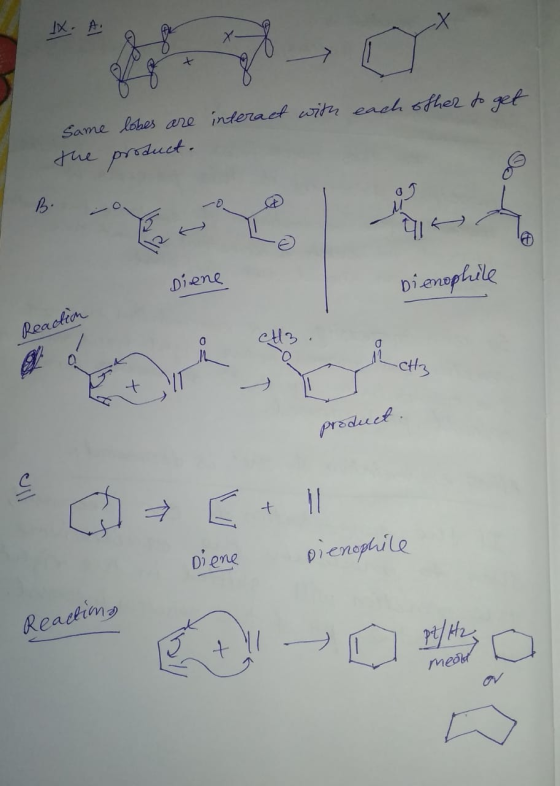
1x. A. Fill in the appropriate basis orbitals leading to Diels-Alder reaction 88 X- B. With curved arrows, lone pairs a...
Complete the mechanism of the following Diels-Alder reaction by drawing the curved arrows for the concerted...
Complete the mechanism of the following Diels-Alder reaction by drawing the curved arrows for the concerted reaction and the final product formed. (Note that the COOH group is a carboxylic acid group, which is electron withdrawing.) Interactive 3D display mode Draw all missing reactants and/or products in the appropriate boxes by placing atoms on the grid and connecting them with bonds, including charges where needed. Indicate the mechanism by drawing the electron-flow arrows on the molecules. Arrows should start on...
tion 5 continued) c. Anthracene is known to act as the diene in Diels-Alder read as...
 tion 5 continued) c. Anthracene is known to act as the diene in Diels-Alder read as maleic anhydride as shown below. Draw the str reaction and draw a reasonable mechanism illustrating its comma explanation for the observed regioselectivity. he diene in Diels-Alder reactions with dienophiles such s shown below. Draw the structure of the major product of this nechanism illustrating its formation. Give a brief [4 marks) Propose a detailed mechanism for the following two transformations. Use curved arrows to...
The Diels-Alder reaction involves the coupling between a diene and a dienophile. In the box below...
 The Diels-Alder reaction involves the coupling between a diene and a dienophile. In the box below draw the structure of the bicyclic product obtained from the Diels-Alder reaction of the following compound with cyclopentadiene. • You do not have to consider stereochemistry. • In cases where there is more than one answer, just draw one.
Draw Products of a Reaction Shown with Curved Arrows: Lone Pairs Included Draw the products of...
 Draw Products of a Reaction Shown with Curved Arrows: Lone Pairs
Included
Draw the products of the reaction shown. Electron flow is indicated with curved arrows :OCH3 H3C CH3 :Br: Include all valence lone pairs in your answer. Include counter-ions, e.g., Na, I, in your submission, but draw them in their own separate sketcher. Draw one structure per sketcher. Add additional sketchers using the dropdown menu in the bottom right corner. . Separate multiple products using the + sign from...
Draw Products of a Reaction Shown with Curved Arrows: Lone Pairs
Included
Draw the products of the reaction shown. Electron flow is indicated with curved arrows :OCH3 H3C CH3 :Br: Include all valence lone pairs in your answer. Include counter-ions, e.g., Na, I, in your submission, but draw them in their own separate sketcher. Draw one structure per sketcher. Add additional sketchers using the dropdown menu in the bottom right corner. . Separate multiple products using the + sign from...
Show lone pairs on all appropriate atoms and the proper flow of electrons. (1) Mechanism #1:...
 Show lone pairs on all appropriate atoms and the proper flow of electrons. (1) Mechanism #1: • Predict the products of the following reaction under different temperature conditions. • Show the mechanism for how the two products are formed at different temperatures (include resonance structures if appropriate). • Label the kinetic product and the thermodynamic product. (5 points) -80 °C + HBr 40 °C (2) Predict the product and show the complete mechanism for the following reaction. • Make sure...
2. Complete the following propagation steps. Add all lone pairs, show curved arrows and give the ...
 2. Complete the following propagation steps. Add all lone pairs, show curved arrows and give the product(s). Notice how the pattern of the arrow is the same. Br CH3 c. HC H CI Which is more energetically favorable, example 2. c. or 2. d. above? d s more favorable bccase bond List all intermediates shown in #2.
2. Complete the following propagation steps. Add all lone pairs, show curved arrows and give the product(s). Notice how the pattern of the...
2. Complete the following propagation steps. Add all lone pairs, show curved arrows and give the product(s). Notice how the pattern of the arrow is the same. Br CH3 c. HC H CI Which is more energetically favorable, example 2. c. or 2. d. above? d s more favorable bccase bond List all intermediates shown in #2.
2. Complete the following propagation steps. Add all lone pairs, show curved arrows and give the product(s). Notice how the pattern of the...
1) Draw a rational mechanism for the reaction shown below. Use curved arrows appropriately. Show all...
 1) Draw a rational mechanism for the reaction shown below. Use curved arrows appropriately. Show all relevant intermediate(s) and lone pairs of electrons and formal charges where appropriate. HO H2SO4 Ome
(a) Complete the mechanism for the keto-enol tautomerization below using bonds, charges, nonbonding electron pairs, and curved arrows (forward reaction only). Do not remove any pre-drawn bonds/lone pairs. (b) The tautomer that predominates in aqueous solu
 (a) Complete the mechanism for the keto-enol tautomerization below using bonds, charges, nonbonding electron pairs, and curved arrows (forward reaction only). Do not remove any pre-drawn bonds/lone pairs. (b) The tautomer that predominates in aqueous solution is the:
Consider the Diels-Alder cycloaddition reaction below and complete parts (a)-(b) below.
 Consider the Diels-Alder cycloaddition reaction below and complete parts (a)-(b) below. D = deuterium = 2H (a) Draw the major regioisomer (or in other words, constitutional isomer) expected to form. Also, draw appropriate resonance structures to explain why only one constitutional isomer is expected to form. Discuss the interactions between the diene and dienophile that govern this constitutional isomer being the only one expected. (b) Redraw the regioisomer from part (a) and show the appropriate stereochemistry using correct dash/wedge notation expected for the...
Please help with both questions with all work shown (lone pairs, charges, arrows). Thank you so...
 Please help with both questions with all work shown
(lone pairs, charges, arrows). Thank you so much!
(4pts) Draw the appropriate substrate and nucleophile needed to make the following compounds via S2 in the highest yield. SH (3pts) Identify the a carbon and B carbon(s) on the structures below. Provide the product(s) of an E2 reaction between the structure shown below and OC(CHs)a а. Cl oc(CHa) b. Br oC (CHs)s C. Br -OC cCH
Please help with both questions with all work shown
(lone pairs, charges, arrows). Thank you so much!
(4pts) Draw the appropriate substrate and nucleophile needed to make the following compounds via S2 in the highest yield. SH (3pts) Identify the a carbon and B carbon(s) on the structures below. Provide the product(s) of an E2 reaction between the structure shown below and OC(CHs)a а. Cl oc(CHa) b. Br oC (CHs)s C. Br -OC cCH
 tion 5 continued) c. Anthracene is known to act as the diene in Diels-Alder read as maleic anhydride as shown below. Draw the str reaction and draw a reasonable mechanism illustrating its comma explanation for the observed regioselectivity. he diene in Diels-Alder reactions with dienophiles such s shown below. Draw the structure of the major product of this nechanism illustrating its formation. Give a brief [4 marks) Propose a detailed mechanism for the following two transformations. Use curved arrows to...
 The Diels-Alder reaction involves the coupling between a diene and a dienophile. In the box below draw the structure of the bicyclic product obtained from the Diels-Alder reaction of the following compound with cyclopentadiene. • You do not have to consider stereochemistry. • In cases where there is more than one answer, just draw one.
 Draw Products of a Reaction Shown with Curved Arrows: Lone Pairs
Included
Draw the products of the reaction shown. Electron flow is indicated with curved arrows :OCH3 H3C CH3 :Br: Include all valence lone pairs in your answer. Include counter-ions, e.g., Na, I, in your submission, but draw them in their own separate sketcher. Draw one structure per sketcher. Add additional sketchers using the dropdown menu in the bottom right corner. . Separate multiple products using the + sign from...
Draw Products of a Reaction Shown with Curved Arrows: Lone Pairs
Included
Draw the products of the reaction shown. Electron flow is indicated with curved arrows :OCH3 H3C CH3 :Br: Include all valence lone pairs in your answer. Include counter-ions, e.g., Na, I, in your submission, but draw them in their own separate sketcher. Draw one structure per sketcher. Add additional sketchers using the dropdown menu in the bottom right corner. . Separate multiple products using the + sign from...
 Show lone pairs on all appropriate atoms and the proper flow of electrons. (1) Mechanism #1: • Predict the products of the following reaction under different temperature conditions. • Show the mechanism for how the two products are formed at different temperatures (include resonance structures if appropriate). • Label the kinetic product and the thermodynamic product. (5 points) -80 °C + HBr 40 °C (2) Predict the product and show the complete mechanism for the following reaction. • Make sure...
 2. Complete the following propagation steps. Add all lone pairs, show curved arrows and give the product(s). Notice how the pattern of the arrow is the same. Br CH3 c. HC H CI Which is more energetically favorable, example 2. c. or 2. d. above? d s more favorable bccase bond List all intermediates shown in #2.
2. Complete the following propagation steps. Add all lone pairs, show curved arrows and give the product(s). Notice how the pattern of the...
2. Complete the following propagation steps. Add all lone pairs, show curved arrows and give the product(s). Notice how the pattern of the arrow is the same. Br CH3 c. HC H CI Which is more energetically favorable, example 2. c. or 2. d. above? d s more favorable bccase bond List all intermediates shown in #2.
2. Complete the following propagation steps. Add all lone pairs, show curved arrows and give the product(s). Notice how the pattern of the...
 1) Draw a rational mechanism for the reaction shown below. Use curved arrows appropriately. Show all relevant intermediate(s) and lone pairs of electrons and formal charges where appropriate. HO H2SO4 Ome
 Please help with both questions with all work shown
(lone pairs, charges, arrows). Thank you so much!
(4pts) Draw the appropriate substrate and nucleophile needed to make the following compounds via S2 in the highest yield. SH (3pts) Identify the a carbon and B carbon(s) on the structures below. Provide the product(s) of an E2 reaction between the structure shown below and OC(CHs)a а. Cl oc(CHa) b. Br oC (CHs)s C. Br -OC cCH
Please help with both questions with all work shown
(lone pairs, charges, arrows). Thank you so much!
(4pts) Draw the appropriate substrate and nucleophile needed to make the following compounds via S2 in the highest yield. SH (3pts) Identify the a carbon and B carbon(s) on the structures below. Provide the product(s) of an E2 reaction between the structure shown below and OC(CHs)a а. Cl oc(CHa) b. Br oC (CHs)s C. Br -OC cCH
Most questions answered within 3 hours.
-
Where is the error in this code sequence?
String s1 = "Hello";
String s2 = "ello";...
asked 10 months ago -
Financial data for Joel de Paris, Inc., for last year
follow:
Joel de Paris, Inc.
Balance...
asked 10 months ago -
Consider this reaction:
Al2(SO4)3 (aq)+ BaCl3
(aq) Al2Cl6 (aq)- +
3BaSO4(s) . What is the...
asked 10 months ago -
Suppose that Savneet is considering increasing her
recent random sample from 20 car rentals to 40...
asked 10 months ago -
Trucks arrive at an unloading terminal at an average rate of 120
per hour.
Trucks arrive...
asked 10 months ago -
Why are methanol and ethanol completely soluble in water while
octanol is not very little soluble....
asked 10 months ago -
A facilities manager at a university reads in a research report
that the mean amount of...
asked 10 months ago -
When the CuSO4 is rehydrated by adding water to the anhydrous
compound, is this an endothermic...
asked 10 months ago -
A ray of sunlight is passing from diamond into crown glass; the
angle of incidence is...
asked 10 months ago -
A block of mass 0.249 kg is placed on top of a light, vertical
spring of...
asked 10 months ago -
how do the kidneys compensate in the presences of acidosis
a) trigger hyperventilate
b) reserve acid...
asked 10 months ago -
Question 501 pts
The rental rate of capital to the firm increases. Which of the
following...
asked 10 months ago