
Homework Answers

c
 thank
you very much
thank
you very much
Add Answer to:
the way of sharing electrons? (equally dinerelle 2. How is an ionic bond or a covalent bond formed? How do you tell...
If the bond is formed by sharing electrons unequally between two atoms, the bond is called...
 If the bond is formed by sharing electrons unequally between two atoms, the bond is called ionic bond A polar covalent bond hydrogen bond nonpolar covalent bond
what type of chemical bond results from sharing valance electrons between two nonmetals of similar electronegativity...
what type of chemical bond results from sharing valance electrons between two nonmetals of similar electronegativity polar covalent bond ionic bond nonmetallic bond non polar covalent metallic
What type of bond involves the unequal sharing of electrons? Nonpolar covalent Polar covalent ionic Hydrogen
 What type of bond involves the unequal sharing of electrons? Nonpolar covalent Polar covalent ionic Hydrogen
Part A Review Constants Periodic Table Learning Goal: Consider the following element combinations. Classify the bonds...
 Part A Review Constants Periodic Table Learning Goal: Consider the following element combinations. Classify the bonds formed between each pair as ionic, polar covalent, or nonpolar covalent qualitatively based solely on each element's position on the periodic table. To use electronegativity or metal versus nonmetal classifications to distinguish covalent polar covalent, and ionic bonds. not conduct calculations. Drag the appropriate items to their respective bins. When two bonded atoms attract electrons with View Available Hint(s) equal strength, the result is...
6. How do you know the number of covalent bonds between two nonmetals? (based on the...
 6. How do you know the number of covalent bonds between two nonmetals? (based on the number of electrons they need to meet the octet. For example: nitrogen has 5 valence electrons, it needs another three valence electrons to become 8. Two Natoms share three pairs of electrons and they form triple bond. O2: double bond, halogen: single bond.) 7. How many valence electrons that an element need to form a negative ion? (to see how many valence electrons to...
Ionic & Covalent Virtual Lab Pre-Virtual Lab Questions: Answer these before going to the website to...
 Ionic & Covalent Virtual Lab Pre-Virtual Lab Questions: Answer these before going to the website to begin the virtual lab. 1. Where are metal atoms located on the periodic table? Where are non metal atoms located on the periodic table? 2. What subatomic particles) participate in chemical bonding? 3. In your own words, define valence electrons. 4. How can you determine the number of valence electrons in an atom using the periodic table? 5. Draw a Lewis Dot Structure for...
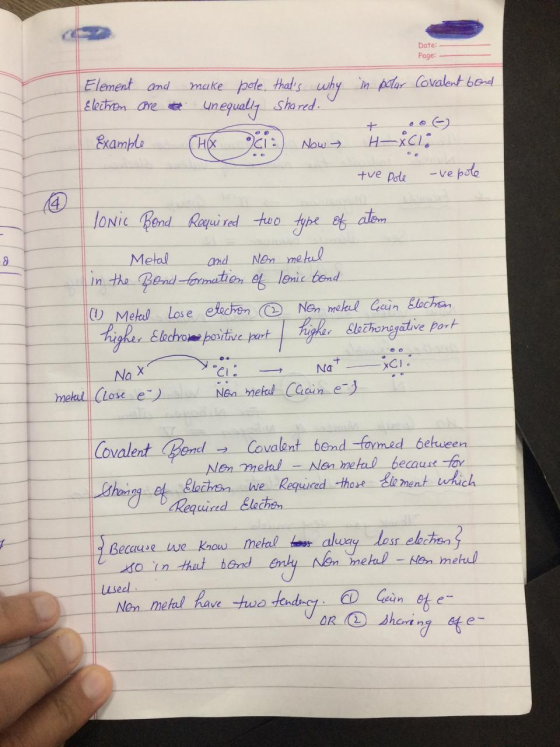
A covalent bond is a bond in which electrons are shared between atoms of elements
 A covalent bond is a
bond in which electrons are shared between atoms of elements. A
covalent bond can be polar or nonpolar. In a nonpolar covalent
bond, the bond is between two identical atoms and the electrons are
evenly shared between the atoms.In contrast, in a
polar covalent bond, the bond is between two nonidentical atoms and
the electrons are unevenly shared between the atoms. The uneven
sharing of electrons takes place because of the difference in the
electronegativity...
A covalent bond is a
bond in which electrons are shared between atoms of elements. A
covalent bond can be polar or nonpolar. In a nonpolar covalent
bond, the bond is between two identical atoms and the electrons are
evenly shared between the atoms.In contrast, in a
polar covalent bond, the bond is between two nonidentical atoms and
the electrons are unevenly shared between the atoms. The uneven
sharing of electrons takes place because of the difference in the
electronegativity...
10. If you pour water in a glass cylinder, you see upper and lower meniscus. If...
10. If you pour water in a glass cylinder, you see upper and lower meniscus. If you use a plastic cylinder, the surface appears flat. Which of the following properties of water is responsible for the formation of the meniscus? High heat of vaporization Cohesion and Adhesion Excellent solubility maintenance of pH 17. If you were to make 200 mL of 3% sugar solution, how much sugar would you have to weigh? 2 g 12 g 6 g 1.5 g...
A stable molecule can be formed using 1 magnesium, 2 oxygens and 2 hydrogens. Looking at...
 A stable molecule can be formed using 1 magnesium, 2 oxygens and 2 hydrogens. Looking at the number of electrons in the outer shell of each of these elements, can you determine how these elements can share electrons (covalent bonds) or transfer an electron (ionic bond) to form a stable molecule with the formula MgO2H2. Note: ionic bonds and covalent bonds can both be present in the same molecule. Draw a molecule that could be made using these elements and...
Critical thinking questions 1) Determne the average electronegativity between EN1 and EN2 for eac...
 Critical thinking questions
1) Determne the average electronegativity between EN1 and EN2
for each bond in the table above. Based on the data on table 1,
what combination of ΔEN given and average EN
values leads to ionic bonding?
2) Based on the data in table 1, what combination of
ΔEN and average EN values leads to non polar
covalent bonding?
3) Based on the data in table 1, what combination of
ΔEN and average EN values leads to polar...
Critical thinking questions
1) Determne the average electronegativity between EN1 and EN2
for each bond in the table above. Based on the data on table 1,
what combination of ΔEN given and average EN
values leads to ionic bonding?
2) Based on the data in table 1, what combination of
ΔEN and average EN values leads to non polar
covalent bonding?
3) Based on the data in table 1, what combination of
ΔEN and average EN values leads to polar...
 If the bond is formed by sharing electrons unequally between two atoms, the bond is called ionic bond A polar covalent bond hydrogen bond nonpolar covalent bond
 What type of bond involves the unequal sharing of electrons? Nonpolar covalent Polar covalent ionic Hydrogen
 Part A Review Constants Periodic Table Learning Goal: Consider the following element combinations. Classify the bonds formed between each pair as ionic, polar covalent, or nonpolar covalent qualitatively based solely on each element's position on the periodic table. To use electronegativity or metal versus nonmetal classifications to distinguish covalent polar covalent, and ionic bonds. not conduct calculations. Drag the appropriate items to their respective bins. When two bonded atoms attract electrons with View Available Hint(s) equal strength, the result is...
 6. How do you know the number of covalent bonds between two nonmetals? (based on the number of electrons they need to meet the octet. For example: nitrogen has 5 valence electrons, it needs another three valence electrons to become 8. Two Natoms share three pairs of electrons and they form triple bond. O2: double bond, halogen: single bond.) 7. How many valence electrons that an element need to form a negative ion? (to see how many valence electrons to...
 Ionic & Covalent Virtual Lab Pre-Virtual Lab Questions: Answer these before going to the website to begin the virtual lab. 1. Where are metal atoms located on the periodic table? Where are non metal atoms located on the periodic table? 2. What subatomic particles) participate in chemical bonding? 3. In your own words, define valence electrons. 4. How can you determine the number of valence electrons in an atom using the periodic table? 5. Draw a Lewis Dot Structure for...
 A covalent bond is a
bond in which electrons are shared between atoms of elements. A
covalent bond can be polar or nonpolar. In a nonpolar covalent
bond, the bond is between two identical atoms and the electrons are
evenly shared between the atoms.In contrast, in a
polar covalent bond, the bond is between two nonidentical atoms and
the electrons are unevenly shared between the atoms. The uneven
sharing of electrons takes place because of the difference in the
electronegativity...
A covalent bond is a
bond in which electrons are shared between atoms of elements. A
covalent bond can be polar or nonpolar. In a nonpolar covalent
bond, the bond is between two identical atoms and the electrons are
evenly shared between the atoms.In contrast, in a
polar covalent bond, the bond is between two nonidentical atoms and
the electrons are unevenly shared between the atoms. The uneven
sharing of electrons takes place because of the difference in the
electronegativity...
 A stable molecule can be formed using 1 magnesium, 2 oxygens and 2 hydrogens. Looking at the number of electrons in the outer shell of each of these elements, can you determine how these elements can share electrons (covalent bonds) or transfer an electron (ionic bond) to form a stable molecule with the formula MgO2H2. Note: ionic bonds and covalent bonds can both be present in the same molecule. Draw a molecule that could be made using these elements and...
 Critical thinking questions
1) Determne the average electronegativity between EN1 and EN2
for each bond in the table above. Based on the data on table 1,
what combination of ΔEN given and average EN
values leads to ionic bonding?
2) Based on the data in table 1, what combination of
ΔEN and average EN values leads to non polar
covalent bonding?
3) Based on the data in table 1, what combination of
ΔEN and average EN values leads to polar...
Critical thinking questions
1) Determne the average electronegativity between EN1 and EN2
for each bond in the table above. Based on the data on table 1,
what combination of ΔEN given and average EN
values leads to ionic bonding?
2) Based on the data in table 1, what combination of
ΔEN and average EN values leads to non polar
covalent bonding?
3) Based on the data in table 1, what combination of
ΔEN and average EN values leads to polar...
Most questions answered within 3 hours.
-
Where is the error in this code sequence?
String s1 = "Hello";
String s2 = "ello";...
asked 11 months ago -
Financial data for Joel de Paris, Inc., for last year
follow:
Joel de Paris, Inc.
Balance...
asked 11 months ago -
Consider this reaction:
Al2(SO4)3 (aq)+ BaCl3
(aq) Al2Cl6 (aq)- +
3BaSO4(s) . What is the...
asked 11 months ago -
Suppose that Savneet is considering increasing her
recent random sample from 20 car rentals to 40...
asked 11 months ago -
Trucks arrive at an unloading terminal at an average rate of 120
per hour.
Trucks arrive...
asked 11 months ago -
Why are methanol and ethanol completely soluble in water while
octanol is not very little soluble....
asked 11 months ago -
A facilities manager at a university reads in a research report
that the mean amount of...
asked 11 months ago -
When the CuSO4 is rehydrated by adding water to the anhydrous
compound, is this an endothermic...
asked 11 months ago -
A ray of sunlight is passing from diamond into crown glass; the
angle of incidence is...
asked 11 months ago -
A block of mass 0.249 kg is placed on top of a light, vertical
spring of...
asked 11 months ago -
how do the kidneys compensate in the presences of acidosis
a) trigger hyperventilate
b) reserve acid...
asked 11 months ago -
Question 501 pts
The rental rate of capital to the firm increases. Which of the
following...
asked 11 months ago