What is its role of trityl tetrafluoroborate in the below experiment and what would be the byproduct of the reaction?
![CH2Cl2 [Mo(CO)3(C:Ho] + [PhC][BF4] → [Mo(CO)3(C7H7)][BF4] +](http://img.homeworklib.com/images/a2abdcb3-9bbe-49ec-977c-6dcfc411b557.png?x-oss-process=image/resize,w_560)
Homework Answers
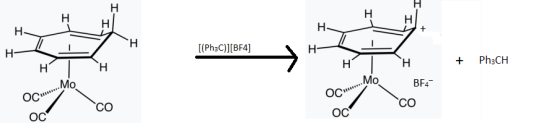
trityl tetrafluoroborate will abstract hydride (H-) from cycloheptatriene unit to convert to stable aromatic tropylium cation unit as shown in above scheme, since trityl tetrafluoroborate abstact proton it will be converted to Ph3CH, therefore biproduct is triphenylmethane
Add Answer to:
What is its role of trityl tetrafluoroborate in the below experiment and what would be the byproduct of the reaction? C...
2. What are the roles of nitrosonium tetrafluoroborate and hydrazine in this reaction? cis-mer-...
 see picture 2 for reaction
2. What are the roles of nitrosonium tetrafluoroborate and hydrazine in this reaction? cis-mer-MnBr(Co(POPh)ppm)] CH,C trans-mer-MnBr(Co) (POPh) dppm)(e) (3) CH2Cl2 INOJIBFl hydrazine
2. What are the roles of nitrosonium tetrafluoroborate and hydrazine in this reaction?
cis-mer-MnBr(Co(POPh)ppm)] CH,C trans-mer-MnBr(Co) (POPh) dppm)(e) (3) CH2Cl2 INOJIBFl hydrazine
see picture 2 for reaction
2. What are the roles of nitrosonium tetrafluoroborate and hydrazine in this reaction? cis-mer-MnBr(Co(POPh)ppm)] CH,C trans-mer-MnBr(Co) (POPh) dppm)(e) (3) CH2Cl2 INOJIBFl hydrazine
2. What are the roles of nitrosonium tetrafluoroborate and hydrazine in this reaction?
cis-mer-MnBr(Co(POPh)ppm)] CH,C trans-mer-MnBr(Co) (POPh) dppm)(e) (3) CH2Cl2 INOJIBFl hydrazine
Post-Experiment Questions: 8. What would a more acidic pH indicate about the fermentation reaction? Think about...
 Post-Experiment Questions: 8. What would a more acidic pH indicate about the fermentation reaction? Think about what produces acid as a metabolic byproduct 9. Based on lecture material what could be done to isolate the wine mixture from the yeast culture? What method would be most the most logical for preserving the wine mixture? 10. If the lead acetate paper turns a dark color this indicates the production of hydrogen sulfide gas during primary fermentation. Given its chemical formula. what...
What is the reaction center in each photosystem? What is its role in electron flow?
What is the reaction center in each photosystem? What is its role in electron flow?
2. Draw the structure of the byproduct that would be formed if the reaction mixture were...
 2. Draw the structure of the byproduct that would be formed if the reaction mixture were not kept in an ice bath during the azo coupling reaction. [2 pts) Methyl orange can be synthesized using an azo coupling reaction, which is an example of an electrophilic aromatic substitution (EAS). In an azo coupling, the electrophile is an aryldiazonium salt, and the nucleophile is another electron-rich aromatic compound (typically an aniline or phenol). In this experiment, sulfanilic acid will be converted...
what is the role of CsOAc? 0 1. The following reaction was recently reported along with...
 what is the role of CsOAc?
0 1. The following reaction was recently reported along with a proposed catalytic cycle below: co Pd(PPhg) (1 mol %) CsOAC (1.0 equiv) THF, 60 °C, 16 h Na 32 examples up to 99% yields , co PdLI NHR ACOH CO2 COAC NHRC
what is the role of CsOAc?
0 1. The following reaction was recently reported along with a proposed catalytic cycle below: co Pd(PPhg) (1 mol %) CsOAC (1.0 equiv) THF, 60 °C, 16 h Na 32 examples up to 99% yields , co PdLI NHR ACOH CO2 COAC NHRC
often conducted at reflux? What would be the result of reaction in a round-bottom flask or...
 often conducted at reflux? What would be the result of reaction in a round-bottom flask or Erlenmeyer flask with- 1. Define the term "reflux." 2. Why are reactions often conducted at reflux simply boiling this reaction in a round-bottom flask out a reflux condenser? 3. Why must the n-butyl acetate product be rigorously dried prior to in analyor the role of the sodium iodide in today's experiment? Why is only a tiny amount needed? 5. Propose mechanisms for the formation...
The data in the table below were obtained for the reaction: A+B C Experiment Number [A]...
 The data in the table below were obtained for the reaction: A+B C Experiment Number [A] (M) [B] (M) 10.451 0.885 | 0.451 1.77 1.35 0.885 Initial Rate (M/s) 1.13 1.13 10.17 What is the order of the reaction in A? A) 1 B) 2 C) 3 D) 4 E) 0
Discuss the polycondensation reaction. Why would water interfere with it? In case experiment failed-explanation is expected....
Discuss the polycondensation reaction. Why would water interfere with it? In case experiment failed-explanation is expected. Why it failed? What could be improved. Explain molecular structure vs signal relationship . In your discussion consider the following concepts: polycondensation, functional groups, fibril formation and stabilization (interchain molecular itneractions) , reaction yield and the role of NaOH solution used in the reaction Can you answer these questions based on the Synthesis of Nylon-6,6 using adipoyl chloride and 1,6-hexanediamine
3. The second part of the experiment uses Hess's Law, to determine a heat of reaction...
 3. The second part of the experiment uses Hess's Law, to determine a heat of reaction that would be difficult to measure directly, the heat of combustion of either calcium or magnesium metal. Show how the equation for the combustion reaction (4) may be obtained by combining equations 1 - 3 below algebraically. (M signifies either calcium or magnesium.) Note: Since M is a general symbol the actual heat cannot be determined. You only need to show how the equations...
What is the role of NO(g) in the reaction mechanism below? NO(g) + O3(g) --> NO2(g)...
What is the role of NO(g) in the reaction mechanism below? NO(g) + O3(g) --> NO2(g) + O2(g) O(g) + NO2(g) --> NO(g) + O2(g)
 see picture 2 for reaction
2. What are the roles of nitrosonium tetrafluoroborate and hydrazine in this reaction? cis-mer-MnBr(Co(POPh)ppm)] CH,C trans-mer-MnBr(Co) (POPh) dppm)(e) (3) CH2Cl2 INOJIBFl hydrazine
2. What are the roles of nitrosonium tetrafluoroborate and hydrazine in this reaction?
cis-mer-MnBr(Co(POPh)ppm)] CH,C trans-mer-MnBr(Co) (POPh) dppm)(e) (3) CH2Cl2 INOJIBFl hydrazine
see picture 2 for reaction
2. What are the roles of nitrosonium tetrafluoroborate and hydrazine in this reaction? cis-mer-MnBr(Co(POPh)ppm)] CH,C trans-mer-MnBr(Co) (POPh) dppm)(e) (3) CH2Cl2 INOJIBFl hydrazine
2. What are the roles of nitrosonium tetrafluoroborate and hydrazine in this reaction?
cis-mer-MnBr(Co(POPh)ppm)] CH,C trans-mer-MnBr(Co) (POPh) dppm)(e) (3) CH2Cl2 INOJIBFl hydrazine
 Post-Experiment Questions: 8. What would a more acidic pH indicate about the fermentation reaction? Think about what produces acid as a metabolic byproduct 9. Based on lecture material what could be done to isolate the wine mixture from the yeast culture? What method would be most the most logical for preserving the wine mixture? 10. If the lead acetate paper turns a dark color this indicates the production of hydrogen sulfide gas during primary fermentation. Given its chemical formula. what...
 2. Draw the structure of the byproduct that would be formed if the reaction mixture were not kept in an ice bath during the azo coupling reaction. [2 pts) Methyl orange can be synthesized using an azo coupling reaction, which is an example of an electrophilic aromatic substitution (EAS). In an azo coupling, the electrophile is an aryldiazonium salt, and the nucleophile is another electron-rich aromatic compound (typically an aniline or phenol). In this experiment, sulfanilic acid will be converted...
 what is the role of CsOAc?
0 1. The following reaction was recently reported along with a proposed catalytic cycle below: co Pd(PPhg) (1 mol %) CsOAC (1.0 equiv) THF, 60 °C, 16 h Na 32 examples up to 99% yields , co PdLI NHR ACOH CO2 COAC NHRC
what is the role of CsOAc?
0 1. The following reaction was recently reported along with a proposed catalytic cycle below: co Pd(PPhg) (1 mol %) CsOAC (1.0 equiv) THF, 60 °C, 16 h Na 32 examples up to 99% yields , co PdLI NHR ACOH CO2 COAC NHRC
 often conducted at reflux? What would be the result of reaction in a round-bottom flask or Erlenmeyer flask with- 1. Define the term "reflux." 2. Why are reactions often conducted at reflux simply boiling this reaction in a round-bottom flask out a reflux condenser? 3. Why must the n-butyl acetate product be rigorously dried prior to in analyor the role of the sodium iodide in today's experiment? Why is only a tiny amount needed? 5. Propose mechanisms for the formation...
 The data in the table below were obtained for the reaction: A+B C Experiment Number [A] (M) [B] (M) 10.451 0.885 | 0.451 1.77 1.35 0.885 Initial Rate (M/s) 1.13 1.13 10.17 What is the order of the reaction in A? A) 1 B) 2 C) 3 D) 4 E) 0
 3. The second part of the experiment uses Hess's Law, to determine a heat of reaction that would be difficult to measure directly, the heat of combustion of either calcium or magnesium metal. Show how the equation for the combustion reaction (4) may be obtained by combining equations 1 - 3 below algebraically. (M signifies either calcium or magnesium.) Note: Since M is a general symbol the actual heat cannot be determined. You only need to show how the equations...
Most questions answered within 3 hours.
-
Where is the error in this code sequence?
String s1 = "Hello";
String s2 = "ello";...
asked 11 months ago -
Financial data for Joel de Paris, Inc., for last year
follow:
Joel de Paris, Inc.
Balance...
asked 11 months ago -
Consider this reaction:
Al2(SO4)3 (aq)+ BaCl3
(aq) Al2Cl6 (aq)- +
3BaSO4(s) . What is the...
asked 11 months ago -
Suppose that Savneet is considering increasing her
recent random sample from 20 car rentals to 40...
asked 11 months ago -
Trucks arrive at an unloading terminal at an average rate of 120
per hour.
Trucks arrive...
asked 11 months ago -
Why are methanol and ethanol completely soluble in water while
octanol is not very little soluble....
asked 11 months ago -
A facilities manager at a university reads in a research report
that the mean amount of...
asked 11 months ago -
When the CuSO4 is rehydrated by adding water to the anhydrous
compound, is this an endothermic...
asked 11 months ago -
A ray of sunlight is passing from diamond into crown glass; the
angle of incidence is...
asked 11 months ago -
A block of mass 0.249 kg is placed on top of a light, vertical
spring of...
asked 11 months ago -
how do the kidneys compensate in the presences of acidosis
a) trigger hyperventilate
b) reserve acid...
asked 11 months ago -
Question 501 pts
The rental rate of capital to the firm increases. Which of the
following...
asked 11 months ago