
Homework Answers
Add Answer to:
Question 1 (1 mark) Attempt 1 Consider the boundary value problem Q Find the functions g, Φ 1 and Φ 2 so that u-3-a...
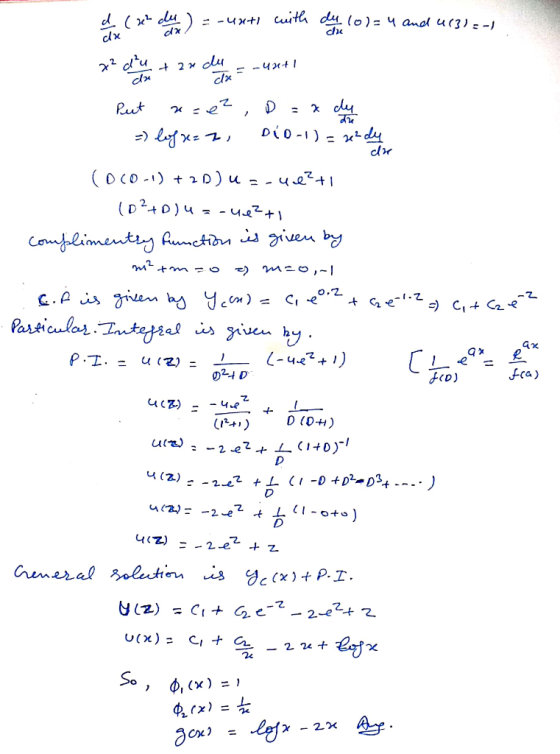
Consider the boundary value problem (12")=-45+4 with (2)=5 and u(6)=-1 Find the functions g., and ,...
 Consider the boundary value problem (12")=-45+4 with (2)=5 and u(6)=-1 Find the functions g., and , so that y = 9+Q81+ay, is the approximate quadratic solution that satisfies the essential boundary condition. Your answer should consist of three expressions, the first representing the term g, the second representing the term , and the third representing the term og. All three expressions should be expressed in terms of the independent variable x. Your answers should be expressed as a function of...
Question 1 (1 mark) Attempt 1 Consider the boundary value problem1, 2<8 with uç2)-3 and uB)-s...
 Question 1 (1 mark) Attempt 1 Consider the boundary value problem1, 2<8 with uç2)-3 and uB)-s Find functions g and фі such that u gtal +1 is a quadratic approximation that satisfies the boundary condos. Your answer should consist of two expressions, the frst representing the term g and the second representing the term ti. Both shouild be expressed in terms of tho independent varatbie Your answers should be expressed as a function of x using the correct syntax For...
Question Question 1 (1 mark) Attempt 1 Consider the boundary value problem: du+ U=1, 2<c<13 with...
 Question Question 1 (1 mark) Attempt 1 Consider the boundary value problem: du+ U=1, 2<c<13 with u(2) = 4 and u(13) = 5 Find functions g and , such that u=gta, is a quadratic approximation that satisfies the boundary conditions. Your answer should consist of two expressions, the first representing the term g and the second representing the term ,. Both should be expressed in terms of the independent variable x. Your answers should be expressed as a function of...
Question 3 (1 mark) Special Attempt 1 When solving a particular boundary value problem using the...
 Question 3 (1 mark) Special Attempt 1 When solving a particular boundary value problem using the approximate solution u(x)=C–1+Q1 (32-40) the residual is R(*)= 3+20–42+Q7 (22+50+1). Use the collocation method with the collocation point x = 2 to find the value of a Your answer should consist of the single (exact) value of Qy. For example -911/203 Qq = Skipped
please solve, previous ones all wrong! Question 11 1 mark) Attempt 2 What is the Inverse Fourier transform of F(u)- 10-5? Reflection: F-1[F(-u)]=f(-t) Your answer should be expressed as a function of...
 please solve, previous ones all wrong!
Question 11 1 mark) Attempt 2 What is the Inverse Fourier transform of F(u)- 10-5? Reflection: F-1[F(-u)]=f(-t) Your answer should be expressed as a function of t using the correct syntax. Inverse F.T. is f(t) Question 12 (T mark) Attempt 2 What is the Inverse Fourier transform of: 7 16+iw-4)2 Reflection: F--) Your answer should be expressed as a function of t using the correct syntax. Inverse F.T. is f(t) Question 13 (2 marks)...
please solve, previous ones all wrong!
Question 11 1 mark) Attempt 2 What is the Inverse Fourier transform of F(u)- 10-5? Reflection: F-1[F(-u)]=f(-t) Your answer should be expressed as a function of t using the correct syntax. Inverse F.T. is f(t) Question 12 (T mark) Attempt 2 What is the Inverse Fourier transform of: 7 16+iw-4)2 Reflection: F--) Your answer should be expressed as a function of t using the correct syntax. Inverse F.T. is f(t) Question 13 (2 marks)...
Question Question 17 (2 marks) Attempt 1 f(t) satisfies the integral equation: Find the solution of the integral equation using Fourier transforms Your answer should be expressed as a function of t u...
 Question Question 17 (2 marks) Attempt 1 f(t) satisfies the integral equation: Find the solution of the integral equation using Fourier transforms Your answer should be expressed as a function of t using the correct syntax. f(t)- Skipped
Question Question 17 (2 marks) Attempt 1 f(t) satisfies the integral equation: Find the solution of the integral equation using Fourier transforms Your answer should be expressed as a function of t using the correct syntax. f(t)- Skipped
Question Question 17 (2 marks) Attempt 1 f(t) satisfies the integral equation: Find the solution of the integral equation using Fourier transforms Your answer should be expressed as a function of t using the correct syntax. f(t)- Skipped
Question 12 (2 marks) Attempt 1 A space curve is defined by C:u)2i+u+3u2k, for u20 Find the Cartesian form of the equat...
 Question 12 (2 marks) Attempt 1 A space curve is defined by C:u)2i+u+3u2k, for u20 Find the Cartesian form of the equation for the plane that is perpendicular to the space curve C at the point where u 1 Your answer should be an equation, expressed in terms of the Cartesian variables x, y and z using the correct syntax. For example: 3*x-2y+5'z-2, or, 2 (x-1)+4 (y-2)+z-1-0, or 3'x+ 6'z-12-y, or y-x+35 (2-256)-20 Do not use decimal approximations all numbers...
thank you for the help :) Question Question 17 (2 marks) Attempt 1 f(t) satisfies the integral equation: f(t)-5 | f(t-u) e-liu H(u) du=12 sgn(t-2) Find the solution of the integral equation using...
 thank you for the help :)
Question Question 17 (2 marks) Attempt 1 f(t) satisfies the integral equation: f(t)-5 | f(t-u) e-liu H(u) du=12 sgn(t-2) Find the solution of the integral equation using Fourier transforms. Your answer should be expressed as a function of t using the correct syntax f() Skipped
Question Question 17 (2 marks) Attempt 1 f(t) satisfies the integral equation: f(t)-5 | f(t-u) e-liu H(u) du=12 sgn(t-2) Find the solution of the integral equation using Fourier transforms....
thank you for the help :)
Question Question 17 (2 marks) Attempt 1 f(t) satisfies the integral equation: f(t)-5 | f(t-u) e-liu H(u) du=12 sgn(t-2) Find the solution of the integral equation using Fourier transforms. Your answer should be expressed as a function of t using the correct syntax f() Skipped
Question Question 17 (2 marks) Attempt 1 f(t) satisfies the integral equation: f(t)-5 | f(t-u) e-liu H(u) du=12 sgn(t-2) Find the solution of the integral equation using Fourier transforms....
Question 13 (2 marks) Attempt 1 ,2/144-aw Find the Inverse Fourier transform of: Te-v F(u)--3 Your answer should be expressed as a function of t using the correct syntax. Inverse F.T. is f(t)- Skippe...
 Question 13 (2 marks) Attempt 1 ,2/144-aw Find the Inverse Fourier transform of: Te-v F(u)--3 Your answer should be expressed as a function of t using the correct syntax. Inverse F.T. is f(t)- Skipped a Screen Shot 2019-05-17 at 2.07.40 AM Search Question 14 (2 marks) Attempt 1 Find the inverse Fourier transform of: F(w-5 π w sgn(w) e-Tw Your answer should be expressed as a function of t using the correct syntax. Inverse F.T. is f(t)- Skipped Question 15...
Question 5 (1 mark) Attempt 1 Consider the initial value problem: y'= 4.0(1+42), y(1 Using one...
 Question 5 (1 mark) Attempt 1 Consider the initial value problem: y'= 4.0(1+42), y(1 Using one step of the following explict third order Runge-Kutta scheme ki = hf (Toniyn), k2 = hf(son+zh,yn+şkı), k3 = hf(antih,yn+şka), Yn+1 = yn+(k1+3kz), obtain an approximate solution to the initial value problem at x = 1.03. Maintain at least eight decimal digit accuracy throughout all your calculations. You may express your answer as a single five decimal digit number, for example 17.18263. YOU DO NOT...
 Consider the boundary value problem (12")=-45+4 with (2)=5 and u(6)=-1 Find the functions g., and , so that y = 9+Q81+ay, is the approximate quadratic solution that satisfies the essential boundary condition. Your answer should consist of three expressions, the first representing the term g, the second representing the term , and the third representing the term og. All three expressions should be expressed in terms of the independent variable x. Your answers should be expressed as a function of...
 Question 1 (1 mark) Attempt 1 Consider the boundary value problem1, 2<8 with uç2)-3 and uB)-s Find functions g and фі such that u gtal +1 is a quadratic approximation that satisfies the boundary condos. Your answer should consist of two expressions, the frst representing the term g and the second representing the term ti. Both shouild be expressed in terms of tho independent varatbie Your answers should be expressed as a function of x using the correct syntax For...
 Question Question 1 (1 mark) Attempt 1 Consider the boundary value problem: du+ U=1, 2<c<13 with u(2) = 4 and u(13) = 5 Find functions g and , such that u=gta, is a quadratic approximation that satisfies the boundary conditions. Your answer should consist of two expressions, the first representing the term g and the second representing the term ,. Both should be expressed in terms of the independent variable x. Your answers should be expressed as a function of...
 Question 3 (1 mark) Special Attempt 1 When solving a particular boundary value problem using the approximate solution u(x)=C–1+Q1 (32-40) the residual is R(*)= 3+20–42+Q7 (22+50+1). Use the collocation method with the collocation point x = 2 to find the value of a Your answer should consist of the single (exact) value of Qy. For example -911/203 Qq = Skipped
 please solve, previous ones all wrong!
Question 11 1 mark) Attempt 2 What is the Inverse Fourier transform of F(u)- 10-5? Reflection: F-1[F(-u)]=f(-t) Your answer should be expressed as a function of t using the correct syntax. Inverse F.T. is f(t) Question 12 (T mark) Attempt 2 What is the Inverse Fourier transform of: 7 16+iw-4)2 Reflection: F--) Your answer should be expressed as a function of t using the correct syntax. Inverse F.T. is f(t) Question 13 (2 marks)...
please solve, previous ones all wrong!
Question 11 1 mark) Attempt 2 What is the Inverse Fourier transform of F(u)- 10-5? Reflection: F-1[F(-u)]=f(-t) Your answer should be expressed as a function of t using the correct syntax. Inverse F.T. is f(t) Question 12 (T mark) Attempt 2 What is the Inverse Fourier transform of: 7 16+iw-4)2 Reflection: F--) Your answer should be expressed as a function of t using the correct syntax. Inverse F.T. is f(t) Question 13 (2 marks)...
 Question Question 17 (2 marks) Attempt 1 f(t) satisfies the integral equation: Find the solution of the integral equation using Fourier transforms Your answer should be expressed as a function of t using the correct syntax. f(t)- Skipped
Question Question 17 (2 marks) Attempt 1 f(t) satisfies the integral equation: Find the solution of the integral equation using Fourier transforms Your answer should be expressed as a function of t using the correct syntax. f(t)- Skipped
Question Question 17 (2 marks) Attempt 1 f(t) satisfies the integral equation: Find the solution of the integral equation using Fourier transforms Your answer should be expressed as a function of t using the correct syntax. f(t)- Skipped
 Question 12 (2 marks) Attempt 1 A space curve is defined by C:u)2i+u+3u2k, for u20 Find the Cartesian form of the equation for the plane that is perpendicular to the space curve C at the point where u 1 Your answer should be an equation, expressed in terms of the Cartesian variables x, y and z using the correct syntax. For example: 3*x-2y+5'z-2, or, 2 (x-1)+4 (y-2)+z-1-0, or 3'x+ 6'z-12-y, or y-x+35 (2-256)-20 Do not use decimal approximations all numbers...
 thank you for the help :)
Question Question 17 (2 marks) Attempt 1 f(t) satisfies the integral equation: f(t)-5 | f(t-u) e-liu H(u) du=12 sgn(t-2) Find the solution of the integral equation using Fourier transforms. Your answer should be expressed as a function of t using the correct syntax f() Skipped
Question Question 17 (2 marks) Attempt 1 f(t) satisfies the integral equation: f(t)-5 | f(t-u) e-liu H(u) du=12 sgn(t-2) Find the solution of the integral equation using Fourier transforms....
thank you for the help :)
Question Question 17 (2 marks) Attempt 1 f(t) satisfies the integral equation: f(t)-5 | f(t-u) e-liu H(u) du=12 sgn(t-2) Find the solution of the integral equation using Fourier transforms. Your answer should be expressed as a function of t using the correct syntax f() Skipped
Question Question 17 (2 marks) Attempt 1 f(t) satisfies the integral equation: f(t)-5 | f(t-u) e-liu H(u) du=12 sgn(t-2) Find the solution of the integral equation using Fourier transforms....
 Question 13 (2 marks) Attempt 1 ,2/144-aw Find the Inverse Fourier transform of: Te-v F(u)--3 Your answer should be expressed as a function of t using the correct syntax. Inverse F.T. is f(t)- Skipped a Screen Shot 2019-05-17 at 2.07.40 AM Search Question 14 (2 marks) Attempt 1 Find the inverse Fourier transform of: F(w-5 π w sgn(w) e-Tw Your answer should be expressed as a function of t using the correct syntax. Inverse F.T. is f(t)- Skipped Question 15...
 Question 5 (1 mark) Attempt 1 Consider the initial value problem: y'= 4.0(1+42), y(1 Using one step of the following explict third order Runge-Kutta scheme ki = hf (Toniyn), k2 = hf(son+zh,yn+şkı), k3 = hf(antih,yn+şka), Yn+1 = yn+(k1+3kz), obtain an approximate solution to the initial value problem at x = 1.03. Maintain at least eight decimal digit accuracy throughout all your calculations. You may express your answer as a single five decimal digit number, for example 17.18263. YOU DO NOT...
Most questions answered within 3 hours.
-
Where is the error in this code sequence?
String s1 = "Hello";
String s2 = "ello";...
asked 10 months ago -
Financial data for Joel de Paris, Inc., for last year
follow:
Joel de Paris, Inc.
Balance...
asked 10 months ago -
Consider this reaction:
Al2(SO4)3 (aq)+ BaCl3
(aq) Al2Cl6 (aq)- +
3BaSO4(s) . What is the...
asked 10 months ago -
Suppose that Savneet is considering increasing her
recent random sample from 20 car rentals to 40...
asked 10 months ago -
Trucks arrive at an unloading terminal at an average rate of 120
per hour.
Trucks arrive...
asked 10 months ago -
Why are methanol and ethanol completely soluble in water while
octanol is not very little soluble....
asked 10 months ago -
A facilities manager at a university reads in a research report
that the mean amount of...
asked 10 months ago -
When the CuSO4 is rehydrated by adding water to the anhydrous
compound, is this an endothermic...
asked 10 months ago -
A ray of sunlight is passing from diamond into crown glass; the
angle of incidence is...
asked 10 months ago -
A block of mass 0.249 kg is placed on top of a light, vertical
spring of...
asked 10 months ago -
how do the kidneys compensate in the presences of acidosis
a) trigger hyperventilate
b) reserve acid...
asked 10 months ago -
Question 501 pts
The rental rate of capital to the firm increases. Which of the
following...
asked 10 months ago