
Homework Answers
Add Answer to:
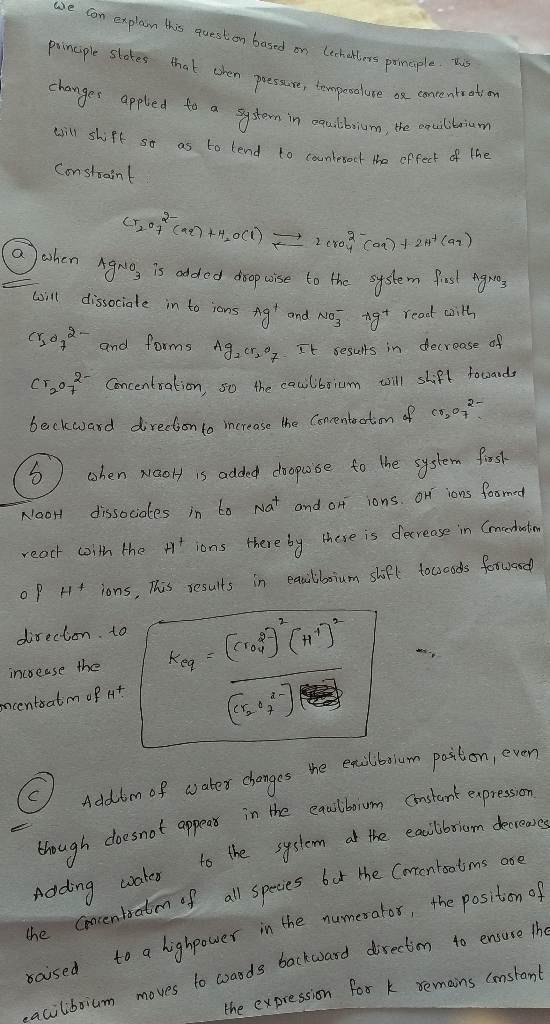
1. Consider the following equilibrium: Cr OP(aq)+H20(1) 5 2Cro2 (aq) + 2H'(aq) a. Predict the shift in system at eq...
2. Consider the following equilibrium: Mg(OH)2(8) 5 Mg?'(aq) + 2OH(aq) redict the shift in system at equilibrium if...
 2. Consider the following equilibrium: Mg(OH)2(8) 5 Mg?'(aq) + 2OH(aq) redict the shift in system at equilibrium if a solution of HCI is added dropwise to the system at equilibrium. Briefly explain. 0. Predict the change in equilibrium if a solution of NaOH is added dropwise to the system at equilibrium. Briefly explain. c. Predict the change in equilibrium if the system at equilibrium is diluted by distilled water. Briefly explain
CHEM 2A Class Pack FIB 8. Consider the equilibrium system: HCN (aq) + H20 (1) H,O*...
 CHEM 2A Class Pack FIB 8. Consider the equilibrium system: HCN (aq) + H20 (1) H,O* (aq) + CN' (a) a) write an equilibrium expression for this reaction b) Predict the direction the position of equilibrium will shift as a result of the following disturbances, 1. (HCN) increases ii. KCN is added iii. KCl is added iv. pH decreases V. KOH is added 9. Consider the equilibrium system: C(s) + CO2(g) + heat 2 CO (9) 1. write an equilibrium...
2. Consider the following equilibrium represent by the reversible equation below: Cu2+(aq) + 4 NH4OH(aq) =...
 2. Consider the following equilibrium represent by the reversible equation below: Cu2+(aq) + 4 NH4OH(aq) = [Cu(NH3)4]2+(aq) + 4 H20() Blue Colorless Navy blue Predict the shift (explain why) and indicate the color of the solution when c. Water is added to the mixture at equilibrium.
G. C. 2-7 Studying the Effect of Changes in Conditions on an Equilibrium System 57 System...
 G. C. 2-7 Studying the Effect of Changes in Conditions on an Equilibrium System 57 System No. 4: [Co(H0).J? + 4C 5 [CoCLIC + 6H,0 Solutions Observations Dissolved CoCl-6H,0 - Pink solution Solution plus HCI Blue Solution Heated solution Blue Solution Cooled solution Pink Solutam 9. According to the equilibrium equation, which ion(s) do you have after the solid was diluted? Explain how you know the identity of the ion(s) present. 10. Explain what happened when HCl was added to...
2. Consider the following equilibrium represent by the reversible equation below: Cu2+(aq) + 4 NH4OH(aq) =...
 2. Consider the following equilibrium represent by the reversible equation below: Cu2+(aq) + 4 NH4OH(aq) = [Cu(NH3)4]2+(aq) + 4 H2O(1) Blue Colorless Navy blue Predict the shift (explain why) and indicate the color of the solution when a. Drops of strong acid is added b. H2S gas is bubbled in the solution. Note: H2S reacts with transition metal cations. c. Water is added to the mixture at equilibrium.
2. Consider the following equilibrium represent by the reversible equation below: Cu2+(aq) + 4 NH4OH(aq) =...
 2. Consider the following equilibrium represent by the reversible equation below: Cu2+(aq) + 4 NH4OH(aq) = [Cu(NH3)4]2+(aq) + 4 H2O(1) Blue Colorless Navy blue Predict the shift (explain why) and indicate the color of the solution when a. Drops of strong acid is added b. H2S gas is bubbled in the solution. Note: H2S reacts with transition metal cations. c. Water is added to the mixture at equilibrium.
2. Consider the following equilibrium represent by the reversible equation below: Cu2+(aq) + 4 NH4OH(aq) =...
 2. Consider the following equilibrium represent by the reversible equation below: Cu2+(aq) + 4 NH4OH(aq) = [Cu(NH3)4]2+(aq) + 4 H20() Blue Colorless Navy blue Predict the shift (explain why) and indicate the color of the solution when a. Drops of strong acid is added
2. Consider the following equilibrium represent by the reversible equation below: Cu?"(aq) + 4 NH OH(aq)...
 2. Consider the following equilibrium represent by the reversible equation below: Cu?"(aq) + 4 NH OH(aq) = [Cu(NH3)4]?" (aq) + 4 H2O(1) Blue Colorless Navy blue Predict the shift (explain why) and indicate the color of the solution when a. Drops of strong acid is added b. H2S gas is bubbled in the solution. Note: H2S reacts with transition metal cations. c. Water is added to the mixture at equilibrium.
You are given the equilibrium system BiCl_3 (aq) bismuth (III) chloride(colorless) + H_2, O(l) BiOCl (s)...
 You are given the equilibrium system BiCl_3 (aq) bismuth (III) chloride(colorless) + H_2, O(l) BiOCl (s) bismuth(III) oxychloride (white) + 2HCl (aq) at a point at which the solution is colorless and no BiOCl (s) is observed. a. which way should the equilibrium shift, to the left or to the right, when water is added until a change is observed? What would be observed? Explain the shift in terms of lessthanorequalto Chatelier's principle. b. Which way should the equilibrium shift...
EXPERIMENT 8 Post-Lab Questions Section Name: 1 Consider the following system at equilibrium in a closed...
 EXPERIMENT 8 Post-Lab Questions Section Name: 1 Consider the following system at equilibrium in a closed container (pressure at 1 atm): NaOH(s) CO,(0) NaliCO. (s) Ar 0 Concentration of CO: gas present at equilibrium can be decreased by True or False (T or F) adding Na gas to double the pressure adding more NaOH increasing the volume of the container lowering the temperature (10 pts) 2. 2Cro (aq. yellow) 2H,0-(aq) Cr o (aq, orange) + 3H20D (AH-ve) a. What would...
 2. Consider the following equilibrium: Mg(OH)2(8) 5 Mg?'(aq) + 2OH(aq) redict the shift in system at equilibrium if a solution of HCI is added dropwise to the system at equilibrium. Briefly explain. 0. Predict the change in equilibrium if a solution of NaOH is added dropwise to the system at equilibrium. Briefly explain. c. Predict the change in equilibrium if the system at equilibrium is diluted by distilled water. Briefly explain
 CHEM 2A Class Pack FIB 8. Consider the equilibrium system: HCN (aq) + H20 (1) H,O* (aq) + CN' (a) a) write an equilibrium expression for this reaction b) Predict the direction the position of equilibrium will shift as a result of the following disturbances, 1. (HCN) increases ii. KCN is added iii. KCl is added iv. pH decreases V. KOH is added 9. Consider the equilibrium system: C(s) + CO2(g) + heat 2 CO (9) 1. write an equilibrium...
 2. Consider the following equilibrium represent by the reversible equation below: Cu2+(aq) + 4 NH4OH(aq) = [Cu(NH3)4]2+(aq) + 4 H20() Blue Colorless Navy blue Predict the shift (explain why) and indicate the color of the solution when c. Water is added to the mixture at equilibrium.
 G. C. 2-7 Studying the Effect of Changes in Conditions on an Equilibrium System 57 System No. 4: [Co(H0).J? + 4C 5 [CoCLIC + 6H,0 Solutions Observations Dissolved CoCl-6H,0 - Pink solution Solution plus HCI Blue Solution Heated solution Blue Solution Cooled solution Pink Solutam 9. According to the equilibrium equation, which ion(s) do you have after the solid was diluted? Explain how you know the identity of the ion(s) present. 10. Explain what happened when HCl was added to...
 2. Consider the following equilibrium represent by the reversible equation below: Cu2+(aq) + 4 NH4OH(aq) = [Cu(NH3)4]2+(aq) + 4 H2O(1) Blue Colorless Navy blue Predict the shift (explain why) and indicate the color of the solution when a. Drops of strong acid is added b. H2S gas is bubbled in the solution. Note: H2S reacts with transition metal cations. c. Water is added to the mixture at equilibrium.
 2. Consider the following equilibrium represent by the reversible equation below: Cu2+(aq) + 4 NH4OH(aq) = [Cu(NH3)4]2+(aq) + 4 H2O(1) Blue Colorless Navy blue Predict the shift (explain why) and indicate the color of the solution when a. Drops of strong acid is added b. H2S gas is bubbled in the solution. Note: H2S reacts with transition metal cations. c. Water is added to the mixture at equilibrium.
 2. Consider the following equilibrium represent by the reversible equation below: Cu2+(aq) + 4 NH4OH(aq) = [Cu(NH3)4]2+(aq) + 4 H20() Blue Colorless Navy blue Predict the shift (explain why) and indicate the color of the solution when a. Drops of strong acid is added
 2. Consider the following equilibrium represent by the reversible equation below: Cu?"(aq) + 4 NH OH(aq) = [Cu(NH3)4]?" (aq) + 4 H2O(1) Blue Colorless Navy blue Predict the shift (explain why) and indicate the color of the solution when a. Drops of strong acid is added b. H2S gas is bubbled in the solution. Note: H2S reacts with transition metal cations. c. Water is added to the mixture at equilibrium.
 You are given the equilibrium system BiCl_3 (aq) bismuth (III) chloride(colorless) + H_2, O(l) BiOCl (s) bismuth(III) oxychloride (white) + 2HCl (aq) at a point at which the solution is colorless and no BiOCl (s) is observed. a. which way should the equilibrium shift, to the left or to the right, when water is added until a change is observed? What would be observed? Explain the shift in terms of lessthanorequalto Chatelier's principle. b. Which way should the equilibrium shift...
 EXPERIMENT 8 Post-Lab Questions Section Name: 1 Consider the following system at equilibrium in a closed container (pressure at 1 atm): NaOH(s) CO,(0) NaliCO. (s) Ar 0 Concentration of CO: gas present at equilibrium can be decreased by True or False (T or F) adding Na gas to double the pressure adding more NaOH increasing the volume of the container lowering the temperature (10 pts) 2. 2Cro (aq. yellow) 2H,0-(aq) Cr o (aq, orange) + 3H20D (AH-ve) a. What would...
Most questions answered within 3 hours.
-
Where is the error in this code sequence?
String s1 = "Hello";
String s2 = "ello";...
asked 10 months ago -
Financial data for Joel de Paris, Inc., for last year
follow:
Joel de Paris, Inc.
Balance...
asked 10 months ago -
Consider this reaction:
Al2(SO4)3 (aq)+ BaCl3
(aq) Al2Cl6 (aq)- +
3BaSO4(s) . What is the...
asked 10 months ago -
Suppose that Savneet is considering increasing her
recent random sample from 20 car rentals to 40...
asked 10 months ago -
Trucks arrive at an unloading terminal at an average rate of 120
per hour.
Trucks arrive...
asked 10 months ago -
Why are methanol and ethanol completely soluble in water while
octanol is not very little soluble....
asked 10 months ago -
A facilities manager at a university reads in a research report
that the mean amount of...
asked 10 months ago -
When the CuSO4 is rehydrated by adding water to the anhydrous
compound, is this an endothermic...
asked 10 months ago -
A ray of sunlight is passing from diamond into crown glass; the
angle of incidence is...
asked 10 months ago -
A block of mass 0.249 kg is placed on top of a light, vertical
spring of...
asked 10 months ago -
how do the kidneys compensate in the presences of acidosis
a) trigger hyperventilate
b) reserve acid...
asked 10 months ago -
Question 501 pts
The rental rate of capital to the firm increases. Which of the
following...
asked 10 months ago