
Homework Answers
Add Answer to:
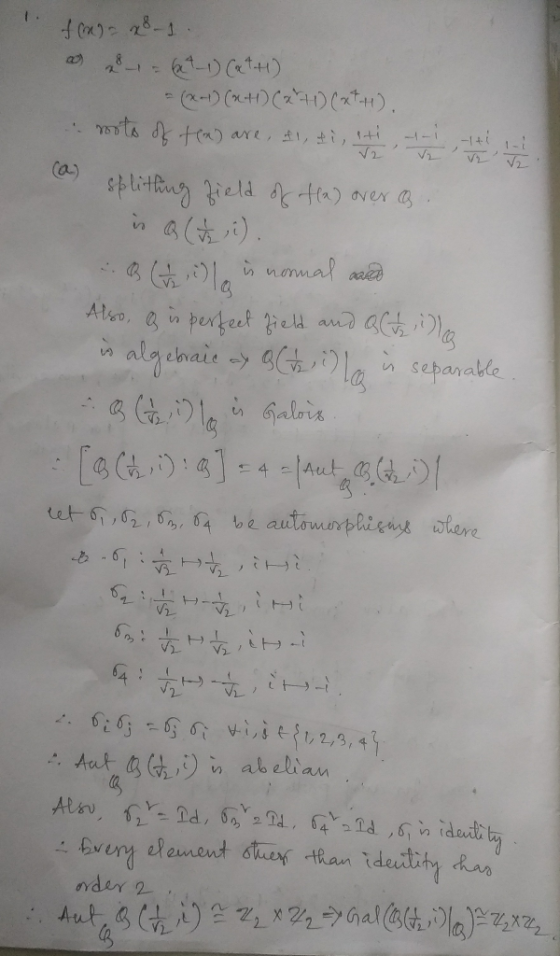
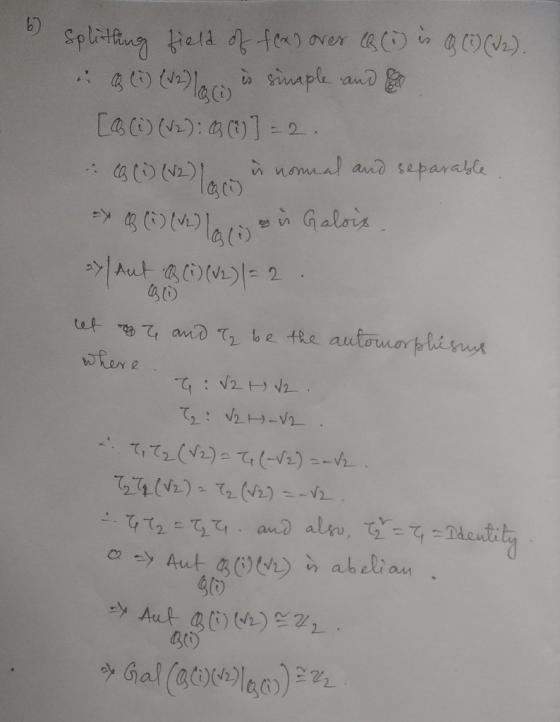
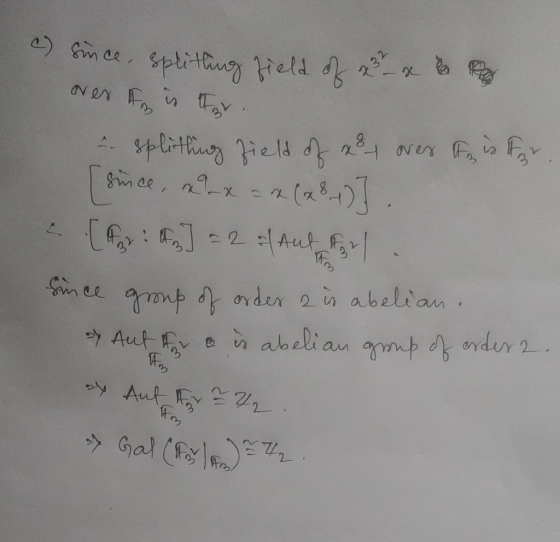
1. Let f(x) group, and explicitly how each element of the group acts on the splitting field. Justify your claim a) (5&#...
Determine the Galois group (up to isomorphism) of each of the following polynomials over Q (that is, find the Galois group of the splitting field othe polynomial over Q) Also, draw the complete latti...
Determine the Galois group (up to isomorphism) of each of the following polynomials over Q (that is, find the Galois group of the splitting field othe polynomial over Q) Also, draw the complete lattice of subfeilds of the splitting field. Determine the Galois group (up to isomorphism) of each of the following polynomials over Q (that is, find the Galois group of the splitting field othe polynomial over Q) Also, draw the complete lattice of subfeilds of the splitting field.
10. Let p(x) +1. Let E be the splitting field for p(x) over Q. a. Find the resolvent cubic R(z). ...
 Part D,E,F,G
10. Let p(x) +1. Let E be the splitting field for p(x) over Q. a. Find the resolvent cubic R(z). b. Prove that R(x) is irreducible over Q. c. Prove that (E:Q) 12 or 24. d. Prove: Gal(E/Q) A4 or S4 e. If p(x) (2+ az+ b)(a2 + cr + d), verify the calculations on page 100 which show that a2 is a root of the cubic polynomial r(x)3-4. 1. f. Prove: r(x) -4z 1 is irreducible in...
Part D,E,F,G
10. Let p(x) +1. Let E be the splitting field for p(x) over Q. a. Find the resolvent cubic R(z). b. Prove that R(x) is irreducible over Q. c. Prove that (E:Q) 12 or 24. d. Prove: Gal(E/Q) A4 or S4 e. If p(x) (2+ az+ b)(a2 + cr + d), verify the calculations on page 100 which show that a2 is a root of the cubic polynomial r(x)3-4. 1. f. Prove: r(x) -4z 1 is irreducible in...
5. Let F be a field, and let p(x) ∈ F [x] be a separable, irreducible polynomial of degree 3. Let K be the splitting fi...
5. Let F be a field, and let p(x) ∈ F [x] be a separable, irreducible polynomial of degree 3. Let K be the splitting field of p(x), and denote the roots of p(x) in K by α1, α2, α3. a) (10’) If char(F ) does not equal 2, 3, prove that K = F (α1 − α2).
Exercise 1 Let E, FCC and let E 2F be a field. (a) Without using the primitive element theorem, s...
 Exercise 1 Let E, FCC and let E 2F be a field. (a) Without using the primitive element theorem, show that [E : FI < oo if and only if (Hint: Tower law → [F(01, , , , a.) : F1 < oo. For the other direction, use induction on IE、F) (b) Suppose that E F(a Show that E is normal if and only if for every E Flai, . . . , α.) for some on. . . ....
2u-5 8. Let w be a root of f(x) = r +2r - 6 over the...
 2u-5 8. Let w be a root of f(x) = r +2r - 6 over the field Q. Consider z E Q(w). Find a, b, c, d e Q us + w-2 such that : a + bu + cu2 + du 9. Let E be an extension field of a field F. (1) What does it mean for an element z E E being algebraic over F? (2) What does it mean for an element z EF being transcendental...
8. Let n be a positive integer. The n-th cyclotomic polynomial Ф,a(z) E Z[2] is defined recursively in the following way: 1. Ф1(x)-x-1. 2. If n > 1, then Фп(x)- , (where in the product in the...
 8. Let n be a positive integer. The n-th cyclotomic polynomial Ф,a(z) E Z[2] is defined recursively in the following way: 1. Ф1(x)-x-1. 2. If n > 1, then Фп(x)- , (where in the product in the denomina- tor, d runs through all divisors of n less than n). . A. Calculate Ф2(x), Ф4(x) and Ф8(z): . B. n(x) is the minimal polynomial for the primitive n-th root of unity over Q. Let f(x) = "8-1 E Q[a] and ω...
9. Let E be an extension field of a field F. (1) What does it mean...
 9. Let E be an extension field of a field F. (1) What does it mean for an element z EE being algebraic over F? (2) What does it mean for an element z E E being transcendental over F? (3) Can you find any element r e C such that r is transcendental over Q? (4) Can you prove that if a E E is algebraic over F then (F(a): F] is finite? (5) Can you prove that if...
Let F be a finite field with q elements. a) S -1 for every a*0 in F. how that a-1 either f* 0 or ...
 Let F be a finite field with q elements. a) S -1 for every a*0 in F. how that a-1 either f* 0 or deg(f*)<q, and f* induces the same function on F as f does. function on F, then f=g. b) Let j(X)E F[X]. Show that there exists a polynomial /*(X)EF[X] such that c) Show that if two polynomials f and g, each of degree <g, induce the same
Let F be a finite field with q elements. a)...
Let F be a finite field with q elements. a) S -1 for every a*0 in F. how that a-1 either f* 0 or deg(f*)<q, and f* induces the same function on F as f does. function on F, then f=g. b) Let j(X)E F[X]. Show that there exists a polynomial /*(X)EF[X] such that c) Show that if two polynomials f and g, each of degree <g, induce the same
Let F be a finite field with q elements. a)...
Homework 19. Due April 5. Consider the polynomial p(z) = r3 + 21+1. Let F denote the field Q modu...
 Homework 19. Due April 5. Consider the polynomial p(z) = r3 + 21+1. Let F denote the field Q modulo p(x) and Fs denote the field Zs[r] modulo p(x). (i) Prove that p(x) is irreducible over Q and also irreducible over Zs, so that in fact, F and Fs are fields (ii) Calculate 1+2r2-2r + in HF. (iii) Find the multiplicative inverse of 1 +2r2 in F. (iv) Repeat (ii) and (iii) for Fs. (v) How many elements are in...
 Part D,E,F,G
10. Let p(x) +1. Let E be the splitting field for p(x) over Q. a. Find the resolvent cubic R(z). b. Prove that R(x) is irreducible over Q. c. Prove that (E:Q) 12 or 24. d. Prove: Gal(E/Q) A4 or S4 e. If p(x) (2+ az+ b)(a2 + cr + d), verify the calculations on page 100 which show that a2 is a root of the cubic polynomial r(x)3-4. 1. f. Prove: r(x) -4z 1 is irreducible in...
Part D,E,F,G
10. Let p(x) +1. Let E be the splitting field for p(x) over Q. a. Find the resolvent cubic R(z). b. Prove that R(x) is irreducible over Q. c. Prove that (E:Q) 12 or 24. d. Prove: Gal(E/Q) A4 or S4 e. If p(x) (2+ az+ b)(a2 + cr + d), verify the calculations on page 100 which show that a2 is a root of the cubic polynomial r(x)3-4. 1. f. Prove: r(x) -4z 1 is irreducible in...
 Exercise 1 Let E, FCC and let E 2F be a field. (a) Without using the primitive element theorem, show that [E : FI < oo if and only if (Hint: Tower law → [F(01, , , , a.) : F1 < oo. For the other direction, use induction on IE、F) (b) Suppose that E F(a Show that E is normal if and only if for every E Flai, . . . , α.) for some on. . . ....
 2u-5 8. Let w be a root of f(x) = r +2r - 6 over the field Q. Consider z E Q(w). Find a, b, c, d e Q us + w-2 such that : a + bu + cu2 + du 9. Let E be an extension field of a field F. (1) What does it mean for an element z E E being algebraic over F? (2) What does it mean for an element z EF being transcendental...
 8. Let n be a positive integer. The n-th cyclotomic polynomial Ф,a(z) E Z[2] is defined recursively in the following way: 1. Ф1(x)-x-1. 2. If n > 1, then Фп(x)- , (where in the product in the denomina- tor, d runs through all divisors of n less than n). . A. Calculate Ф2(x), Ф4(x) and Ф8(z): . B. n(x) is the minimal polynomial for the primitive n-th root of unity over Q. Let f(x) = "8-1 E Q[a] and ω...
 9. Let E be an extension field of a field F. (1) What does it mean for an element z EE being algebraic over F? (2) What does it mean for an element z E E being transcendental over F? (3) Can you find any element r e C such that r is transcendental over Q? (4) Can you prove that if a E E is algebraic over F then (F(a): F] is finite? (5) Can you prove that if...
 Let F be a finite field with q elements. a) S -1 for every a*0 in F. how that a-1 either f* 0 or deg(f*)<q, and f* induces the same function on F as f does. function on F, then f=g. b) Let j(X)E F[X]. Show that there exists a polynomial /*(X)EF[X] such that c) Show that if two polynomials f and g, each of degree <g, induce the same
Let F be a finite field with q elements. a)...
Let F be a finite field with q elements. a) S -1 for every a*0 in F. how that a-1 either f* 0 or deg(f*)<q, and f* induces the same function on F as f does. function on F, then f=g. b) Let j(X)E F[X]. Show that there exists a polynomial /*(X)EF[X] such that c) Show that if two polynomials f and g, each of degree <g, induce the same
Let F be a finite field with q elements. a)...
 Homework 19. Due April 5. Consider the polynomial p(z) = r3 + 21+1. Let F denote the field Q modulo p(x) and Fs denote the field Zs[r] modulo p(x). (i) Prove that p(x) is irreducible over Q and also irreducible over Zs, so that in fact, F and Fs are fields (ii) Calculate 1+2r2-2r + in HF. (iii) Find the multiplicative inverse of 1 +2r2 in F. (iv) Repeat (ii) and (iii) for Fs. (v) How many elements are in...
Most questions answered within 3 hours.
-
Where is the error in this code sequence?
String s1 = "Hello";
String s2 = "ello";...
asked 10 months ago -
Financial data for Joel de Paris, Inc., for last year
follow:
Joel de Paris, Inc.
Balance...
asked 10 months ago -
Consider this reaction:
Al2(SO4)3 (aq)+ BaCl3
(aq) Al2Cl6 (aq)- +
3BaSO4(s) . What is the...
asked 10 months ago -
Suppose that Savneet is considering increasing her
recent random sample from 20 car rentals to 40...
asked 10 months ago -
Trucks arrive at an unloading terminal at an average rate of 120
per hour.
Trucks arrive...
asked 10 months ago -
Why are methanol and ethanol completely soluble in water while
octanol is not very little soluble....
asked 10 months ago -
A facilities manager at a university reads in a research report
that the mean amount of...
asked 10 months ago -
When the CuSO4 is rehydrated by adding water to the anhydrous
compound, is this an endothermic...
asked 10 months ago -
A ray of sunlight is passing from diamond into crown glass; the
angle of incidence is...
asked 10 months ago -
A block of mass 0.249 kg is placed on top of a light, vertical
spring of...
asked 10 months ago -
how do the kidneys compensate in the presences of acidosis
a) trigger hyperventilate
b) reserve acid...
asked 10 months ago -
Question 501 pts
The rental rate of capital to the firm increases. Which of the
following...
asked 10 months ago