
Homework Answers
Add Answer to:
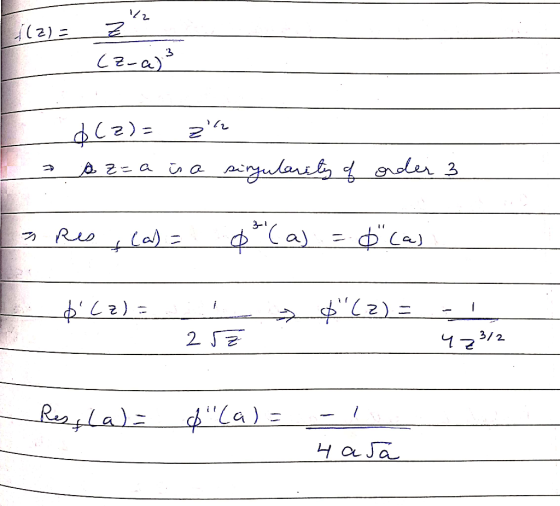
,1/2 wi Problem (2) For the usual (branch) choice, namely -r < 0 < r let f(z) = positive. Compute Res/(a) a real...
Problem 5: Let f(z) = zi = eiLog?, [2] > 0, -T < Arg z <a...
 Problem 5: Let f(z) = zi = eiLog?, [2] > 0, -T < Arg z <a denote the principal branch of the function z', and let C be any contour from –2 to 1 that, except for its endpoints, lies above the real axis. (a) Find an antiderivative of the function f(z); (b) Compute the integralf(z)dz; SOLUTION:
5. Let f(x) = e-} Log(z) (that is, f is the principal branch of z-1/2). Compute...
 5. Let f(x) = e-} Log(z) (that is, f is the principal branch of z-1/2). Compute [flade, where (a) (2 points) y is the upper half of the unit circle C(0) from +1 to -1; (b) (2 points) y is the lower half of the unit circle C1(0) from +1 to -1.
2. Let a be a positive real number, let r be a real number satisfying r...
 2. Let a be a positive real number, let r be a real number satisfying r >1, let N be an integer greater than one, and let tR -R be the integrable simple function defined such that tr,N(r) = 0 whenver x < a or z > ar*, tr,N(a) = a-2 and tr,N(z) = (ar)-2 whenever arj-ıく < ar] for some integer j satisfying 1 < j < N. Determine the value of JR trN(x) dz.
Let k 21 be a positive integer, and let r R be a non-zero real number. For any real number e, we ...
 Let k 21 be a positive integer, and let r R be a non-zero real number. For any real number e, we would like to show that for all 0 SjSk-, the function satisfies the advancement operator equation (A -r)f0 (a) Show that this is true whenever J-0. You can use the fact that f(n) = crn satisfies (A-r)f = 0. (b) Suppose fm n) satisfies the equation when m s k-2 for every choice of c. Show that )...
(1) Consider Z with the addition and multiplication mod 3 as usual. Let R=ZgxZg. Define (a, b)+ (...
 (1) Consider Z with the addition and multiplication mod 3 as usual. Let R=ZgxZg. Define (a, b)+ (a',b) (aab+and(a,b)((aa-bab +a'b) (a) Show that (R, +) is a commutative ring. b) Show that (1,0) is the identity element for the multiplication. c) Show that the equation 22 hs exactly two solutions in R Bonus Problem) Show that (R, +,.) is a field. (Hint: To find multiplicative inverse, first show that a2 + b2メ0 if (a, b)メ(0.0). Then compute (a, b).(a,-b).)
(1)...
(1) Consider Z with the addition and multiplication mod 3 as usual. Let R=ZgxZg. Define (a, b)+ (a',b) (aab+and(a,b)((aa-bab +a'b) (a) Show that (R, +) is a commutative ring. b) Show that (1,0) is the identity element for the multiplication. c) Show that the equation 22 hs exactly two solutions in R Bonus Problem) Show that (R, +,.) is a field. (Hint: To find multiplicative inverse, first show that a2 + b2メ0 if (a, b)メ(0.0). Then compute (a, b).(a,-b).)
(1)...
Problem statement: Prove the following: Theorem: Let n, r, s be positive integers, and let v1, . . . , vr E Rn and wi,...
 Problem statement: Prove the following: Theorem: Let n, r, s be positive integers, and let v1, . . . , vr E Rn and wi, . . . , w, є Rn. If wi є span {v1, . . . , vr} for each i = 1, . . . , s, then spanfVi, . .., v-) -spanfvi, . .., Vr, W,...,w,) Suggestiorn: To see how the proof should go, first try the case s - 1, r 2..]
Problem...
Problem statement: Prove the following: Theorem: Let n, r, s be positive integers, and let v1, . . . , vr E Rn and wi, . . . , w, є Rn. If wi є span {v1, . . . , vr} for each i = 1, . . . , s, then spanfVi, . .., v-) -spanfvi, . .., Vr, W,...,w,) Suggestiorn: To see how the proof should go, first try the case s - 1, r 2..]
Problem...
Let f(z) = V3z sin(#) and P(z) =r-x-1. 1. Find f(e) 2. Find the real solution(s) to Px) 0. Hint: ...
 This is a MATLAB question so please answer them with MATLAB
steps.
Let f(z) = V3z sin(#) and P(z) =r-x-1. 1. Find f(e) 2. Find the real solution(s) to Px) 0. Hint: use the roots command. 3. Find the global minimum for f(x). Hint: plot f over [0,2] 4. Solve f()P. Hint: plot f and P over [0,21. 5. Find lim,→0+ f(x). Hint: make a vector hi make a table [x + h; f(x + h)]". 6. Find '(In 2)....
This is a MATLAB question so please answer them with MATLAB
steps.
Let f(z) = V3z sin(#) and P(z) =r-x-1. 1. Find f(e) 2. Find the real solution(s) to Px) 0. Hint: use the roots command. 3. Find the global minimum for f(x). Hint: plot f over [0,2] 4. Solve f()P. Hint: plot f and P over [0,21. 5. Find lim,→0+ f(x). Hint: make a vector hi make a table [x + h; f(x + h)]". 6. Find '(In 2)....
[3] Let p(z) be the principal branch of 21-1. Let D* = C\(-0,0] be all the...
 [3] Let p(z) be the principal branch of 21-1. Let D* = C\(-0,0] be all the complex numbers except for the non-positive real numbers. (a) Find a function which is an antiderivative of p(z) on D*. (b)Let I be a contour such that (i) T is contained in D* and (ii) the initial point of is 1 and the terminal point of I is i. Compute J, Plzydz. Justify your answers. [9] Let f(z) be the function 2 3 f(x)...
2. Let 6 marks (a) Find f(x),f"(x), and f"(x). (b) Find the second order Taylor expansion of f at 1, namely f(r) = ao + ala-1 ) + a2(z-1)2 + R2(x), where Ra is the remainder. You s...
 2. Let 6 marks (a) Find f(x),f"(x), and f"(x). (b) Find the second order Taylor expansion of f at 1, namely f(r) = ao + ala-1 ) + a2(z-1)2 + R2(x), where Ra is the remainder. You should find ao, a, a2, and R(p). 8 marks that the error in this estimation (i.e., R2(0.9)1) is at most 10-3. 6 marks (c) Use the Taylor expansion found above to estimate the value of f(0.9). Show Find f(x), f"(), and f" (b)...
2. Let f(z) be the principal branch of i.е., f(z) exp@ Log(z)}. Co mpute (e)dz where...
 2. Let f(z) be the principal branch of i.е., f(z) exp@ Log(z)}. Co mpute (e)dz where C is the semicircle {et : 0 < θ < π
 Problem 5: Let f(z) = zi = eiLog?, [2] > 0, -T < Arg z <a denote the principal branch of the function z', and let C be any contour from –2 to 1 that, except for its endpoints, lies above the real axis. (a) Find an antiderivative of the function f(z); (b) Compute the integralf(z)dz; SOLUTION:
 5. Let f(x) = e-} Log(z) (that is, f is the principal branch of z-1/2). Compute [flade, where (a) (2 points) y is the upper half of the unit circle C(0) from +1 to -1; (b) (2 points) y is the lower half of the unit circle C1(0) from +1 to -1.
 2. Let a be a positive real number, let r be a real number satisfying r >1, let N be an integer greater than one, and let tR -R be the integrable simple function defined such that tr,N(r) = 0 whenver x < a or z > ar*, tr,N(a) = a-2 and tr,N(z) = (ar)-2 whenever arj-ıく < ar] for some integer j satisfying 1 < j < N. Determine the value of JR trN(x) dz.
 Let k 21 be a positive integer, and let r R be a non-zero real number. For any real number e, we would like to show that for all 0 SjSk-, the function satisfies the advancement operator equation (A -r)f0 (a) Show that this is true whenever J-0. You can use the fact that f(n) = crn satisfies (A-r)f = 0. (b) Suppose fm n) satisfies the equation when m s k-2 for every choice of c. Show that )...
 (1) Consider Z with the addition and multiplication mod 3 as usual. Let R=ZgxZg. Define (a, b)+ (a',b) (aab+and(a,b)((aa-bab +a'b) (a) Show that (R, +) is a commutative ring. b) Show that (1,0) is the identity element for the multiplication. c) Show that the equation 22 hs exactly two solutions in R Bonus Problem) Show that (R, +,.) is a field. (Hint: To find multiplicative inverse, first show that a2 + b2メ0 if (a, b)メ(0.0). Then compute (a, b).(a,-b).)
(1)...
(1) Consider Z with the addition and multiplication mod 3 as usual. Let R=ZgxZg. Define (a, b)+ (a',b) (aab+and(a,b)((aa-bab +a'b) (a) Show that (R, +) is a commutative ring. b) Show that (1,0) is the identity element for the multiplication. c) Show that the equation 22 hs exactly two solutions in R Bonus Problem) Show that (R, +,.) is a field. (Hint: To find multiplicative inverse, first show that a2 + b2メ0 if (a, b)メ(0.0). Then compute (a, b).(a,-b).)
(1)...
 Problem statement: Prove the following: Theorem: Let n, r, s be positive integers, and let v1, . . . , vr E Rn and wi, . . . , w, є Rn. If wi є span {v1, . . . , vr} for each i = 1, . . . , s, then spanfVi, . .., v-) -spanfvi, . .., Vr, W,...,w,) Suggestiorn: To see how the proof should go, first try the case s - 1, r 2..]
Problem...
Problem statement: Prove the following: Theorem: Let n, r, s be positive integers, and let v1, . . . , vr E Rn and wi, . . . , w, є Rn. If wi є span {v1, . . . , vr} for each i = 1, . . . , s, then spanfVi, . .., v-) -spanfvi, . .., Vr, W,...,w,) Suggestiorn: To see how the proof should go, first try the case s - 1, r 2..]
Problem...
 This is a MATLAB question so please answer them with MATLAB
steps.
Let f(z) = V3z sin(#) and P(z) =r-x-1. 1. Find f(e) 2. Find the real solution(s) to Px) 0. Hint: use the roots command. 3. Find the global minimum for f(x). Hint: plot f over [0,2] 4. Solve f()P. Hint: plot f and P over [0,21. 5. Find lim,→0+ f(x). Hint: make a vector hi make a table [x + h; f(x + h)]". 6. Find '(In 2)....
This is a MATLAB question so please answer them with MATLAB
steps.
Let f(z) = V3z sin(#) and P(z) =r-x-1. 1. Find f(e) 2. Find the real solution(s) to Px) 0. Hint: use the roots command. 3. Find the global minimum for f(x). Hint: plot f over [0,2] 4. Solve f()P. Hint: plot f and P over [0,21. 5. Find lim,→0+ f(x). Hint: make a vector hi make a table [x + h; f(x + h)]". 6. Find '(In 2)....
 [3] Let p(z) be the principal branch of 21-1. Let D* = C\(-0,0] be all the complex numbers except for the non-positive real numbers. (a) Find a function which is an antiderivative of p(z) on D*. (b)Let I be a contour such that (i) T is contained in D* and (ii) the initial point of is 1 and the terminal point of I is i. Compute J, Plzydz. Justify your answers. [9] Let f(z) be the function 2 3 f(x)...
 2. Let 6 marks (a) Find f(x),f"(x), and f"(x). (b) Find the second order Taylor expansion of f at 1, namely f(r) = ao + ala-1 ) + a2(z-1)2 + R2(x), where Ra is the remainder. You should find ao, a, a2, and R(p). 8 marks that the error in this estimation (i.e., R2(0.9)1) is at most 10-3. 6 marks (c) Use the Taylor expansion found above to estimate the value of f(0.9). Show Find f(x), f"(), and f" (b)...
 2. Let f(z) be the principal branch of i.е., f(z) exp@ Log(z)}. Co mpute (e)dz where C is the semicircle {et : 0 < θ < π
Most questions answered within 3 hours.
-
Where is the error in this code sequence?
String s1 = "Hello";
String s2 = "ello";...
asked 10 months ago -
Financial data for Joel de Paris, Inc., for last year
follow:
Joel de Paris, Inc.
Balance...
asked 10 months ago -
Consider this reaction:
Al2(SO4)3 (aq)+ BaCl3
(aq) Al2Cl6 (aq)- +
3BaSO4(s) . What is the...
asked 10 months ago -
Suppose that Savneet is considering increasing her
recent random sample from 20 car rentals to 40...
asked 10 months ago -
Trucks arrive at an unloading terminal at an average rate of 120
per hour.
Trucks arrive...
asked 10 months ago -
Why are methanol and ethanol completely soluble in water while
octanol is not very little soluble....
asked 10 months ago -
A facilities manager at a university reads in a research report
that the mean amount of...
asked 10 months ago -
When the CuSO4 is rehydrated by adding water to the anhydrous
compound, is this an endothermic...
asked 10 months ago -
A ray of sunlight is passing from diamond into crown glass; the
angle of incidence is...
asked 10 months ago -
A block of mass 0.249 kg is placed on top of a light, vertical
spring of...
asked 10 months ago -
how do the kidneys compensate in the presences of acidosis
a) trigger hyperventilate
b) reserve acid...
asked 10 months ago -
Question 501 pts
The rental rate of capital to the firm increases. Which of the
following...
asked 10 months ago