
Homework Answers
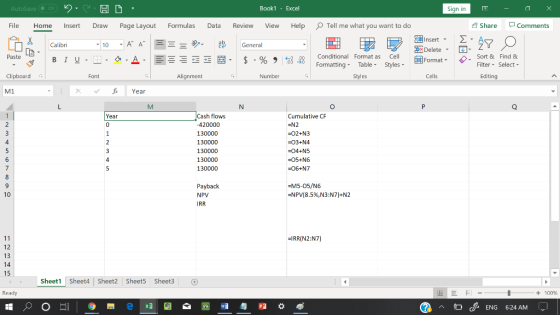
| Payback | 3.23 |
| NPV | $92,283.47 |
| IRR | 16.58% |
Accept the project since NPV is positive
Workings
Payback = Year in which Cumulative CF is last negative -(Last
negative cumulative CF/ CF of next year
| Year | Cash flows | Cumulative CF |
| 0 | -420000 | -420000 |
| 1 | 130000 | -290000 |
| 2 | 130000 | -160000 |
| 3 | 130000 | -30000 |
| 4 | 130000 | 100000 |
| 5 | 130000 | 230000 |
Add Answer to:
Consider an investment that costs $420,000 and has a cash inflow of $130,000 every year for 5 years. The required r...
Consider an investment that costs $110,000 and has a cash inflow of $25,000 every year for...
 Consider an investment that costs $110,000 and has a cash inflow of $25,000 every year for 6 years. The required return is 7%, and required payback is 4 years. 1. What is the payback period? Should we accept the project? 2. What is the NPV? Should we accept the project? 3. What is the IRR? Should we accept the project? 4. What is the Profitability Index? Should we accept the project?
Consider an investment that costs $100,000 and has a cash inflow of $25,000 every year for...
Consider an investment that costs $100,000 and has a cash inflow of $25,000 every year for 5 years. The required return is 9% and required payback is 4 years. What is the payback period? What is the NPV? What is the IRR? Can you step by step show me how to calculate the IRR? Should we accept the project? What decision rule should be the primary decision method? When is the IRR rule unreliable?
11:55 Consider an investment that costs $100,000 and has a cash inflow of $25,000 every year for 5 years. The requi...
 11:55 Consider an investment that costs $100,000 and has a cash inflow of $25,000 every year for 5 years. The required return is 9%, and required payback is 4 years. What is the IRR? 7.93 QUESTI 0.2 points Save Answer What is the classic profitability index? QUESTION 0.2 points Saved What decision (accept or reject) would you make based on classic PI? accept QUESTION 0.2 points Saved What is the discounted profitability index? 0.97 QUESTION 0.2 points Saved What decision...
Payback Period: Initial Investment Year 1 Cash Inflow Year 2 Cash Inflow Year 3 Cash Inflow...
Payback Period: Initial Investment Year 1 Cash Inflow Year 2 Cash Inflow Year 3 Cash Inflow Year 4 Cash Inflow Year 5 Cash Inflow Project A 100,000 10,000 10,000 20,000 30,000 30,000 Project B 200,000 50,000 60,000 90,000 60,000 60,000 In years, what is the payback period for Project A? In years, what is the payback period for Project B? Based on payback period, which project would you recommend for your company to pursue? Initial Investment 1st Year Cash Inflow...
Consider the following two mutually exclusive projects: Year Cash Flow (A) Cash Flow (B) 0...
Consider the following two mutually exclusive projects: Year Cash Flow (A) Cash Flow (B) 0 –$ 340,000 –$ 51,500 1 55,000 25,000 2 75,000 23,000 3 75,000 20,500 4 450,000 15,600 Whichever project you choose, if any, you require a 16 percent return on your investment. a-1 What is the payback period for each project? (Do not round intermediate calculations and round your answers to 2 decimal places, e.g., 32.16.) Payback period Project A years Project...
Aesop has to choose between two mutually exclusive projects that have 5-year lives and conventional cash...
Aesop has to choose between two mutually exclusive projects that have 5-year lives and conventional cash flows. Project Lion has an NPV of $73,406 and a payback period of 3.48 years. Project Lamb has a payback period of only 2.22 years and an IRR of 13.22 percent. The required return for Project Lion is 16 percent while it is 14 percent for Project Lamb. Which project should Aesop recommend? a. Accept Project Lamb because it has the lower required return...
Year Cash Flow 0 -$82,000.00 (Initial investment) S40,000.00 2 -$21,000.00 3 $20,000.00 4 $30,000.00 S $10,000.00...
 Year Cash Flow 0 -$82,000.00 (Initial investment) S40,000.00 2 -$21,000.00 3 $20,000.00 4 $30,000.00 S $10,000.00 6 $23,500.00 2. 1. What is the project's payback period? Will you accept the project if the required payback period is 7 years? What is the project's fair value if you require a 5% return? 3. What is the project's NPV? Will you accept the project? Explain why the above two techniques give you different answers. What is the project's IRR? Will you accept...
2. A project that provides annual estimated cash flows of $120 for eight years costs $600...
 2. A project that provides annual estimated cash flows of $120 for eight years costs $600 today. Suppose the financial manager has a required return of 8%. (a) By the NPV rule, is this a good project to the financial manager? What if the required return is 24%? At what discount rate would you be indifferent between accepting the project and rejecting it? he/she accept the project? the decisions consistent using both the NPV and IRR rules? Why? (b) What...
2. A project that provides annual estimated cash flows of $120 for eight years costs $600...
 2. A project that provides annual estimated cash flows of $120 for eight years costs $600 today. Suppose the financial manager has a required return of 8% (a) By the NPV rule, is this a good project to the financial manager? What if the required return is 24%? At what discount rate would you be indifferent between accepting the project and rejecting it? he/she accept the project? the decisions consistent using both the NPV and IRR rules? Why? (b) What...
Consider an investment with an immediate outflow of $5,000 followed by annual inflows of $1,500 for the next four years....
Consider an investment with an immediate outflow of $5,000 followed by annual inflows of $1,500 for the next four years. If the firm has a 10% cost of capital, what is the project’s NPV and should they accept the project? a. NPV = $1,000; accept the project b. NPV = -$245; accept the project c. NPV = $1,000; reject the project d. NPV = -$245; reject the project Which of the following is NOT a potential pitfall of using the...
 Consider an investment that costs $110,000 and has a cash inflow of $25,000 every year for 6 years. The required return is 7%, and required payback is 4 years. 1. What is the payback period? Should we accept the project? 2. What is the NPV? Should we accept the project? 3. What is the IRR? Should we accept the project? 4. What is the Profitability Index? Should we accept the project?
 11:55 Consider an investment that costs $100,000 and has a cash inflow of $25,000 every year for 5 years. The required return is 9%, and required payback is 4 years. What is the IRR? 7.93 QUESTI 0.2 points Save Answer What is the classic profitability index? QUESTION 0.2 points Saved What decision (accept or reject) would you make based on classic PI? accept QUESTION 0.2 points Saved What is the discounted profitability index? 0.97 QUESTION 0.2 points Saved What decision...
 Year Cash Flow 0 -$82,000.00 (Initial investment) S40,000.00 2 -$21,000.00 3 $20,000.00 4 $30,000.00 S $10,000.00 6 $23,500.00 2. 1. What is the project's payback period? Will you accept the project if the required payback period is 7 years? What is the project's fair value if you require a 5% return? 3. What is the project's NPV? Will you accept the project? Explain why the above two techniques give you different answers. What is the project's IRR? Will you accept...
 2. A project that provides annual estimated cash flows of $120 for eight years costs $600 today. Suppose the financial manager has a required return of 8%. (a) By the NPV rule, is this a good project to the financial manager? What if the required return is 24%? At what discount rate would you be indifferent between accepting the project and rejecting it? he/she accept the project? the decisions consistent using both the NPV and IRR rules? Why? (b) What...
 2. A project that provides annual estimated cash flows of $120 for eight years costs $600 today. Suppose the financial manager has a required return of 8% (a) By the NPV rule, is this a good project to the financial manager? What if the required return is 24%? At what discount rate would you be indifferent between accepting the project and rejecting it? he/she accept the project? the decisions consistent using both the NPV and IRR rules? Why? (b) What...
Most questions answered within 3 hours.
-
Where is the error in this code sequence?
String s1 = "Hello";
String s2 = "ello";...
asked 11 months ago -
Financial data for Joel de Paris, Inc., for last year
follow:
Joel de Paris, Inc.
Balance...
asked 11 months ago -
Consider this reaction:
Al2(SO4)3 (aq)+ BaCl3
(aq) Al2Cl6 (aq)- +
3BaSO4(s) . What is the...
asked 11 months ago -
Suppose that Savneet is considering increasing her
recent random sample from 20 car rentals to 40...
asked 11 months ago -
Trucks arrive at an unloading terminal at an average rate of 120
per hour.
Trucks arrive...
asked 11 months ago -
Why are methanol and ethanol completely soluble in water while
octanol is not very little soluble....
asked 11 months ago -
A facilities manager at a university reads in a research report
that the mean amount of...
asked 11 months ago -
When the CuSO4 is rehydrated by adding water to the anhydrous
compound, is this an endothermic...
asked 11 months ago -
A ray of sunlight is passing from diamond into crown glass; the
angle of incidence is...
asked 11 months ago -
A block of mass 0.249 kg is placed on top of a light, vertical
spring of...
asked 11 months ago -
how do the kidneys compensate in the presences of acidosis
a) trigger hyperventilate
b) reserve acid...
asked 11 months ago -
Question 501 pts
The rental rate of capital to the firm increases. Which of the
following...
asked 11 months ago