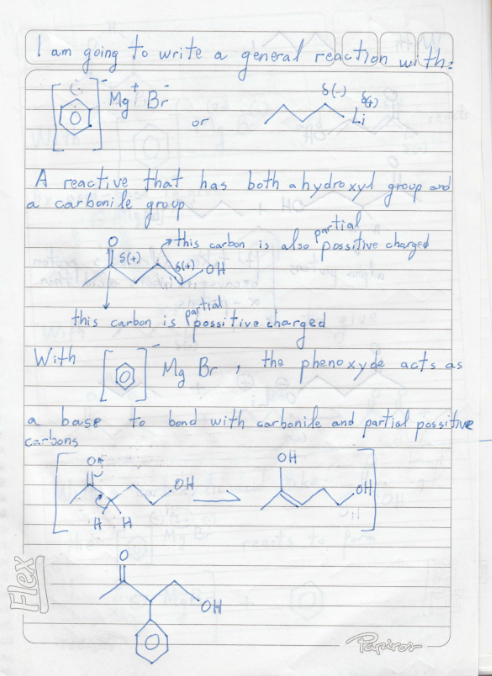
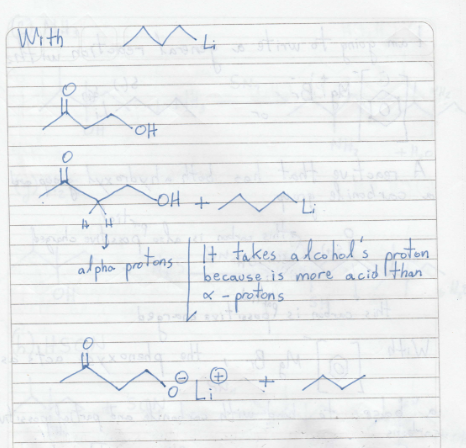
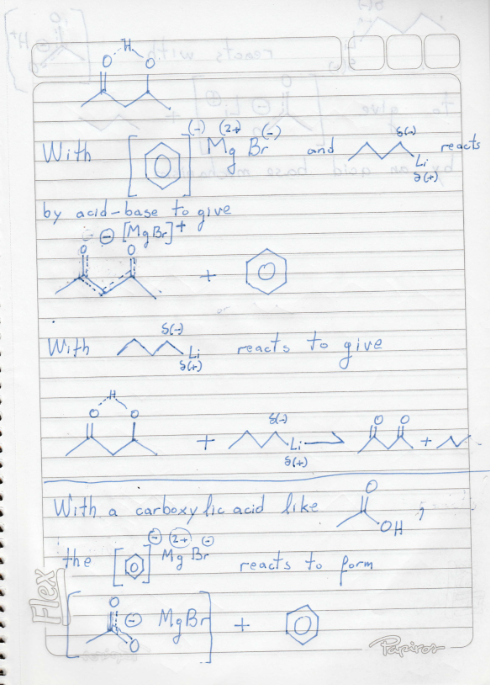
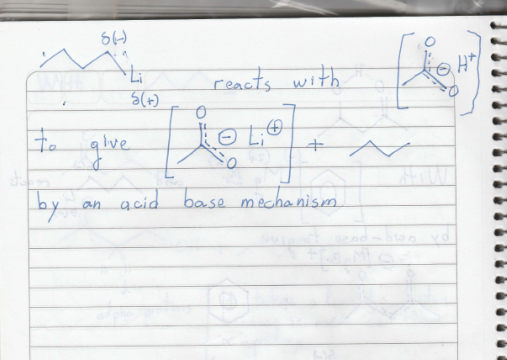
Grignard and organolithium reagents are powerful bases. Because of this, they cannot be used as nucleophiles on compound...
Grignard and organolithium reagents are powerful bases. Because of this, they cannot be used as
nucleophiles on compounds which contain acidic hydrogens. If they are use, they will act as a base and
deprotonate the acidic hydrogen rather than act as a nucleophile and attack the carbonyl. A partial list of
functional groups which cannot be used are: alcohols, amides, 1o amines, 2o amines, carboxylic acids, and
terminal alkynes.
Determine the product of a reaction in which one of the reactant contains both a hydroxyl group and a
carbonyl group.
Homework Answers
Add Answer to:
Grignard and organolithium reagents are powerful bases. Because of this, they cannot be used as nucleophiles on compound...
8. Grignard and or ganolithium reagents are powerful bases. Because of this, they cannot be used as nucleophiles on...
 8. Grignard and or ganolithium reagents are powerful bases. Because of this, they cannot be used as nucleophiles on compounds which contain acidic hydrogens. If they are use, they will act as a base and deprotonate the acidic hydrogen rather than act as a nucleophile and attack the carbonyl. A partial list of functional groups which cannot be used are: alcohols, amides, 1 amines, 2 amines, carboxylic acids, and terminal alkynes. Determine the product of a reaction in which one...
Organometallic reagents such as Grignard reagents, organolithium reagents and acetylides have two primary behaviors: 1) they...
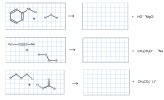 Organometallic reagents such as Grignard reagents, organolithium
reagents and acetylides have two primary behaviors: 1) they act as
strong bases, and 2) they act as strong nucleophiles. When they
come into contact with any OH group they always act as a base and
deprotonate the OH proton. Draw in curved arrows to show this
deprotonation in the reactions below. Then, draw the missing
organic products in each reaction.
C-Na HOO- MgCl CH3CH20 'Na CH3co2 Li
Organometallic reagents such as Grignard reagents, organolithium
reagents and acetylides have two primary behaviors: 1) they act as
strong bases, and 2) they act as strong nucleophiles. When they
come into contact with any OH group they always act as a base and
deprotonate the OH proton. Draw in curved arrows to show this
deprotonation in the reactions below. Then, draw the missing
organic products in each reaction.
C-Na HOO- MgCl CH3CH20 'Na CH3co2 Li
Grignard reagent THE GRIGNARD REAGENT-PREPARATION AND REACTION In this experiment, you will prepa...
 i need help with the prelab questions please
Grignard reagent THE GRIGNARD REAGENT-PREPARATION AND REACTION In this experiment, you will prepare a Grignard reagent, phenyl magnesium bromide, from bromobenzene and magnesium metal. The Grignard reagent will then react with methyl benzoate to form triphenylmethanol. Introduction Grignard reagents, such as organomagnesium halides, were discovered in 1910 by French chemist Victor Grignard. The Grignard reaction is one of the most general methods for carbon- carbon bond formation in all of organic chemistry....
i need help with the prelab questions please
Grignard reagent THE GRIGNARD REAGENT-PREPARATION AND REACTION In this experiment, you will prepare a Grignard reagent, phenyl magnesium bromide, from bromobenzene and magnesium metal. The Grignard reagent will then react with methyl benzoate to form triphenylmethanol. Introduction Grignard reagents, such as organomagnesium halides, were discovered in 1910 by French chemist Victor Grignard. The Grignard reaction is one of the most general methods for carbon- carbon bond formation in all of organic chemistry....
Can you help me identify reagent (i), Compound 8 and Compound 12 in the reaction scheme?...
 Can you help me identify reagent (i), Compound 8 and
Compound 12 in the reaction scheme?
You have laboratory data on all the compounds in the
synthesis, however the amount of data available to you varies. Some
have the entirety of the spectral data, others have as little as
the elemental analysis. Use the laboratory data to help you
discover which reaction has been performed.
The lab data for Compound 8 and 12 is as
follows:
You can use any...
Can you help me identify reagent (i), Compound 8 and
Compound 12 in the reaction scheme?
You have laboratory data on all the compounds in the
synthesis, however the amount of data available to you varies. Some
have the entirety of the spectral data, others have as little as
the elemental analysis. Use the laboratory data to help you
discover which reaction has been performed.
The lab data for Compound 8 and 12 is as
follows:
You can use any...
Can you help me determine if I am correct and help me find the ither answers...
 Can
you help me determine if I am correct and help me find the ither
answers to this functional group lab worksheet?
18 w paper 1 we by addin trecome char Discussion of Properties and Test Ora general undergo dition reactions, whereas by substitution reactions. These two types of d e beds and womate compounds we characterized described in equation form as follows: action Addition Reaction Substitution Reaction (Note: numbers in boxes to the left refer to w in the...
Can
you help me determine if I am correct and help me find the ither
answers to this functional group lab worksheet?
18 w paper 1 we by addin trecome char Discussion of Properties and Test Ora general undergo dition reactions, whereas by substitution reactions. These two types of d e beds and womate compounds we characterized described in equation form as follows: action Addition Reaction Substitution Reaction (Note: numbers in boxes to the left refer to w in the...
Grignard reagent THE GRIGNARD REAGENT-PREPARATION AND REACTION In this experiment, you will prepa...
 i need help with the postlab questions please
Grignard reagent THE GRIGNARD REAGENT-PREPARATION AND REACTION In this experiment, you will prepare a Grignard reagent, phenyl magnesium bromide, from bromobenzene and magnesium metal. The Grignard reagent will then react with methyl benzoate to form triphenylmethanol. Introduction Grignard reagents, such as organomagnesium halides, were discovered in 1910 by French chemist Victor Grignard. The Grignard reaction is one of the most general methods for carbon- carbon bond formation in all of organic chemistry....
i need help with the postlab questions please
Grignard reagent THE GRIGNARD REAGENT-PREPARATION AND REACTION In this experiment, you will prepare a Grignard reagent, phenyl magnesium bromide, from bromobenzene and magnesium metal. The Grignard reagent will then react with methyl benzoate to form triphenylmethanol. Introduction Grignard reagents, such as organomagnesium halides, were discovered in 1910 by French chemist Victor Grignard. The Grignard reaction is one of the most general methods for carbon- carbon bond formation in all of organic chemistry....
 8. Grignard and or ganolithium reagents are powerful bases. Because of this, they cannot be used as nucleophiles on compounds which contain acidic hydrogens. If they are use, they will act as a base and deprotonate the acidic hydrogen rather than act as a nucleophile and attack the carbonyl. A partial list of functional groups which cannot be used are: alcohols, amides, 1 amines, 2 amines, carboxylic acids, and terminal alkynes. Determine the product of a reaction in which one...
 Organometallic reagents such as Grignard reagents, organolithium
reagents and acetylides have two primary behaviors: 1) they act as
strong bases, and 2) they act as strong nucleophiles. When they
come into contact with any OH group they always act as a base and
deprotonate the OH proton. Draw in curved arrows to show this
deprotonation in the reactions below. Then, draw the missing
organic products in each reaction.
C-Na HOO- MgCl CH3CH20 'Na CH3co2 Li
Organometallic reagents such as Grignard reagents, organolithium
reagents and acetylides have two primary behaviors: 1) they act as
strong bases, and 2) they act as strong nucleophiles. When they
come into contact with any OH group they always act as a base and
deprotonate the OH proton. Draw in curved arrows to show this
deprotonation in the reactions below. Then, draw the missing
organic products in each reaction.
C-Na HOO- MgCl CH3CH20 'Na CH3co2 Li
 i need help with the prelab questions please
Grignard reagent THE GRIGNARD REAGENT-PREPARATION AND REACTION In this experiment, you will prepare a Grignard reagent, phenyl magnesium bromide, from bromobenzene and magnesium metal. The Grignard reagent will then react with methyl benzoate to form triphenylmethanol. Introduction Grignard reagents, such as organomagnesium halides, were discovered in 1910 by French chemist Victor Grignard. The Grignard reaction is one of the most general methods for carbon- carbon bond formation in all of organic chemistry....
i need help with the prelab questions please
Grignard reagent THE GRIGNARD REAGENT-PREPARATION AND REACTION In this experiment, you will prepare a Grignard reagent, phenyl magnesium bromide, from bromobenzene and magnesium metal. The Grignard reagent will then react with methyl benzoate to form triphenylmethanol. Introduction Grignard reagents, such as organomagnesium halides, were discovered in 1910 by French chemist Victor Grignard. The Grignard reaction is one of the most general methods for carbon- carbon bond formation in all of organic chemistry....
 Can you help me identify reagent (i), Compound 8 and
Compound 12 in the reaction scheme?
You have laboratory data on all the compounds in the
synthesis, however the amount of data available to you varies. Some
have the entirety of the spectral data, others have as little as
the elemental analysis. Use the laboratory data to help you
discover which reaction has been performed.
The lab data for Compound 8 and 12 is as
follows:
You can use any...
Can you help me identify reagent (i), Compound 8 and
Compound 12 in the reaction scheme?
You have laboratory data on all the compounds in the
synthesis, however the amount of data available to you varies. Some
have the entirety of the spectral data, others have as little as
the elemental analysis. Use the laboratory data to help you
discover which reaction has been performed.
The lab data for Compound 8 and 12 is as
follows:
You can use any...
 Can
you help me determine if I am correct and help me find the ither
answers to this functional group lab worksheet?
18 w paper 1 we by addin trecome char Discussion of Properties and Test Ora general undergo dition reactions, whereas by substitution reactions. These two types of d e beds and womate compounds we characterized described in equation form as follows: action Addition Reaction Substitution Reaction (Note: numbers in boxes to the left refer to w in the...
Can
you help me determine if I am correct and help me find the ither
answers to this functional group lab worksheet?
18 w paper 1 we by addin trecome char Discussion of Properties and Test Ora general undergo dition reactions, whereas by substitution reactions. These two types of d e beds and womate compounds we characterized described in equation form as follows: action Addition Reaction Substitution Reaction (Note: numbers in boxes to the left refer to w in the...
 i need help with the postlab questions please
Grignard reagent THE GRIGNARD REAGENT-PREPARATION AND REACTION In this experiment, you will prepare a Grignard reagent, phenyl magnesium bromide, from bromobenzene and magnesium metal. The Grignard reagent will then react with methyl benzoate to form triphenylmethanol. Introduction Grignard reagents, such as organomagnesium halides, were discovered in 1910 by French chemist Victor Grignard. The Grignard reaction is one of the most general methods for carbon- carbon bond formation in all of organic chemistry....
i need help with the postlab questions please
Grignard reagent THE GRIGNARD REAGENT-PREPARATION AND REACTION In this experiment, you will prepare a Grignard reagent, phenyl magnesium bromide, from bromobenzene and magnesium metal. The Grignard reagent will then react with methyl benzoate to form triphenylmethanol. Introduction Grignard reagents, such as organomagnesium halides, were discovered in 1910 by French chemist Victor Grignard. The Grignard reaction is one of the most general methods for carbon- carbon bond formation in all of organic chemistry....
Most questions answered within 3 hours.
-
Where is the error in this code sequence?
String s1 = "Hello";
String s2 = "ello";...
asked 10 months ago -
Financial data for Joel de Paris, Inc., for last year
follow:
Joel de Paris, Inc.
Balance...
asked 10 months ago -
Consider this reaction:
Al2(SO4)3 (aq)+ BaCl3
(aq) Al2Cl6 (aq)- +
3BaSO4(s) . What is the...
asked 10 months ago -
Suppose that Savneet is considering increasing her
recent random sample from 20 car rentals to 40...
asked 10 months ago -
Trucks arrive at an unloading terminal at an average rate of 120
per hour.
Trucks arrive...
asked 10 months ago -
Why are methanol and ethanol completely soluble in water while
octanol is not very little soluble....
asked 10 months ago -
A facilities manager at a university reads in a research report
that the mean amount of...
asked 10 months ago -
When the CuSO4 is rehydrated by adding water to the anhydrous
compound, is this an endothermic...
asked 10 months ago -
A ray of sunlight is passing from diamond into crown glass; the
angle of incidence is...
asked 10 months ago -
A block of mass 0.249 kg is placed on top of a light, vertical
spring of...
asked 10 months ago -
how do the kidneys compensate in the presences of acidosis
a) trigger hyperventilate
b) reserve acid...
asked 10 months ago -
Question 501 pts
The rental rate of capital to the firm increases. Which of the
following...
asked 10 months ago