
Homework Answers
Add Answer to:
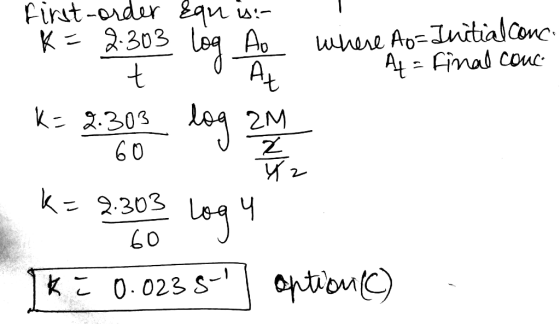
d. MS : Ms 13. The decay of 2M Seaborgium-266 (26Sg) takes 60 seconds to become a 4 of its original amount. What is...
12. Which set of units of A: the rate constant of first-order reactions, B: the rate...
 12. Which set of units of A: the rate constant of first-order reactions, B: the rate constant of second-order reactions, and C: the velocity of second-order reactions is CORRECT? a. s? M -1 b. st M's : M's-1 : Ms :M -1 : Ms M's d. M's? 13. The decay of 2M Seaborgium-266 (Sg) takes 60 seconds to become a 4 of its original amount. What is the rate constant of this isotope? a. 0.006 b. 0.012 c. 0.023 d....
QUESTION 13 What is radioactive iodine-131 used for medically? A Vitamin B12 abnormalities B Bone imaging...
QUESTION 13 What is radioactive iodine-131 used for medically? A Vitamin B12 abnormalities B Bone imaging C Blood volume determination D None of the above QUESTION 16 The natural decay of uranium produces what radioactive, gaseous element? A Radon. B Krypton. C Xenon. D Argon. QUESTION 19 To what does the ionizing power of a radioactive particle refer? A Its ability to be ionized B Its tendency to ionize spontaneously C Its ability to ionize another molecule D Its tendency...
For a certain first-order reaction, is takes 2880 seconds for the concentration of the reactant to...
 For a certain first-order reaction, is takes 2880 seconds for the concentration of the reactant to decrease to 25% of its initial value. What is the value for the rate constant (in s^-1) for the reaction? a) 2.9 times 10^-2 s^-1 b) 6.0 times 10^-3 s^-1 c) 4.8 times 10^-4 s^-1 d) 1.0 times 10^-4 s^-1
Please answer 2 3 and 4. thanks . 1. In this activity, we will be exploring...
 Please answer 2 3 and 4. thanks .
1. In this activity, we will be exploring the relationship between the amount of a radioactive substance and the rate of decay. There are many forms of radioactive decay. For this activity we will be using beta (8) decay, when a neutron decays into an electron and proton, and gamma (7) decay, when an atom emits energy through a gamma photon. B- Decay y Decay High Energy+ Unstable Atom Neutron Low Energy+...
Please answer 2 3 and 4. thanks .
1. In this activity, we will be exploring the relationship between the amount of a radioactive substance and the rate of decay. There are many forms of radioactive decay. For this activity we will be using beta (8) decay, when a neutron decays into an electron and proton, and gamma (7) decay, when an atom emits energy through a gamma photon. B- Decay y Decay High Energy+ Unstable Atom Neutron Low Energy+...
The integrated rate law allows chemists to predict the reactant concentration after a certain amount of...
The integrated rate law allows chemists to predict the reactant concentration after a certain amount of time, or the time it would take for a certain concentration to be reached. The integrated rate law for a first-order reaction is: [A]=[A]0e−kt Now say we are particularly interested in the time it would take for the concentration to become one-half of its initial value. Then we could substitute [A]02 for [A] and rearrange the equation to: t1/2=0.693k This equation calculates the time...
The integrated rate law allows chemists to predict the reactant concentration after a certain amount of...
The integrated rate law allows chemists to predict the reactant concentration after a certain amount of time, or the time it would take for a certain concentration to be reached. The integrated rate law for a first-order reaction is: [A]=[A]0e−kt[A]=[A]0e−kt Now say we are particularly interested in the time it would take for the concentration to become one-half of its initial value. Then we could substitute [A]02[A]02 for [A][A] and rearrange the equation to: t1/2=0.693k t1/2=0.693k This equation calculates the...
The integrated rate law allows chemists to predict the reactant concentration after a certain amount of...
 The integrated rate law allows
chemists to predict the reactant concentration after a certain
amount of time, or the time it would take for a certain
concentration to be reached. The integrated rate law for a
first-order reaction is: [A]=[A]0e−kt Now say we are particularly
interested in the time it would take for the concentration to
become one-half of its initial value. Then we could substitute
[A]02 for [A] and rearrange the equation to: t1/2=0.693k This
equation calculates the time...
The integrated rate law allows
chemists to predict the reactant concentration after a certain
amount of time, or the time it would take for a certain
concentration to be reached. The integrated rate law for a
first-order reaction is: [A]=[A]0e−kt Now say we are particularly
interested in the time it would take for the concentration to
become one-half of its initial value. Then we could substitute
[A]02 for [A] and rearrange the equation to: t1/2=0.693k This
equation calculates the time...
13 A 1.0 m radius grinding wheel takes 55 s to speed up from 20 rad/sto...
 13 A 1.0 m radius grinding wheel takes 55 s to speed up from 20 rad/sto 11.0 rad/s. What is the wheels average angular acceleration? a 9 6 radis b. 4 8 radis c 16 radis d 0.33 rad's fit 14. A bowing ball has a mass of 80 kg a moment of inertia of 28 x 107 kg*mand a radius of 0.10 m rolls down the lane without slipping at a linear speed of 40 m/s, what is its...
1. A car, travelling at 30m/s slows to 10m/s in 5 seconds. What was the acceleration?...
 1. A car, travelling at 30m/s slows to 10m/s in 5 seconds. What was the acceleration? A). -6 m/s B) 4m/s C).-2 m/s D). -9.8m/s 2. A ball thrown straight up takes 3 seconds to reach its maximum height. The height is most nearly B). 45m C). 60m D), 90 m A). 30m 3. A driver of a car wishes to pass a truck on the highway. Her car can accelerate at a constant 5m/s'. How long does it take...
d listing r. (Individ For a particular first-order reaction, it takes 24 minutes for the concentration...
 d listing r. (Individ For a particular first-order reaction, it takes 24 minutes for the concentration of the reactant to decrease to 25% of its initial value, what is the value for rate constant (in S-1) for the reaction? A) 2.0-104 s-1 B)9.6 x 10⁻⁴ s-1 C) 1.2 × 10⁻² s-1 D)5.8 102s-1 12. In the first order reaction A → products, [A1-0.400 M initially and 0250 M after 15.0 mun, what willl after 175 min? e A) 1.67-10-3 M...
 12. Which set of units of A: the rate constant of first-order reactions, B: the rate constant of second-order reactions, and C: the velocity of second-order reactions is CORRECT? a. s? M -1 b. st M's : M's-1 : Ms :M -1 : Ms M's d. M's? 13. The decay of 2M Seaborgium-266 (Sg) takes 60 seconds to become a 4 of its original amount. What is the rate constant of this isotope? a. 0.006 b. 0.012 c. 0.023 d....
 For a certain first-order reaction, is takes 2880 seconds for the concentration of the reactant to decrease to 25% of its initial value. What is the value for the rate constant (in s^-1) for the reaction? a) 2.9 times 10^-2 s^-1 b) 6.0 times 10^-3 s^-1 c) 4.8 times 10^-4 s^-1 d) 1.0 times 10^-4 s^-1
 Please answer 2 3 and 4. thanks .
1. In this activity, we will be exploring the relationship between the amount of a radioactive substance and the rate of decay. There are many forms of radioactive decay. For this activity we will be using beta (8) decay, when a neutron decays into an electron and proton, and gamma (7) decay, when an atom emits energy through a gamma photon. B- Decay y Decay High Energy+ Unstable Atom Neutron Low Energy+...
Please answer 2 3 and 4. thanks .
1. In this activity, we will be exploring the relationship between the amount of a radioactive substance and the rate of decay. There are many forms of radioactive decay. For this activity we will be using beta (8) decay, when a neutron decays into an electron and proton, and gamma (7) decay, when an atom emits energy through a gamma photon. B- Decay y Decay High Energy+ Unstable Atom Neutron Low Energy+...
 The integrated rate law allows
chemists to predict the reactant concentration after a certain
amount of time, or the time it would take for a certain
concentration to be reached. The integrated rate law for a
first-order reaction is: [A]=[A]0e−kt Now say we are particularly
interested in the time it would take for the concentration to
become one-half of its initial value. Then we could substitute
[A]02 for [A] and rearrange the equation to: t1/2=0.693k This
equation calculates the time...
The integrated rate law allows
chemists to predict the reactant concentration after a certain
amount of time, or the time it would take for a certain
concentration to be reached. The integrated rate law for a
first-order reaction is: [A]=[A]0e−kt Now say we are particularly
interested in the time it would take for the concentration to
become one-half of its initial value. Then we could substitute
[A]02 for [A] and rearrange the equation to: t1/2=0.693k This
equation calculates the time...
 13 A 1.0 m radius grinding wheel takes 55 s to speed up from 20 rad/sto 11.0 rad/s. What is the wheels average angular acceleration? a 9 6 radis b. 4 8 radis c 16 radis d 0.33 rad's fit 14. A bowing ball has a mass of 80 kg a moment of inertia of 28 x 107 kg*mand a radius of 0.10 m rolls down the lane without slipping at a linear speed of 40 m/s, what is its...
 1. A car, travelling at 30m/s slows to 10m/s in 5 seconds. What was the acceleration? A). -6 m/s B) 4m/s C).-2 m/s D). -9.8m/s 2. A ball thrown straight up takes 3 seconds to reach its maximum height. The height is most nearly B). 45m C). 60m D), 90 m A). 30m 3. A driver of a car wishes to pass a truck on the highway. Her car can accelerate at a constant 5m/s'. How long does it take...
 d listing r. (Individ For a particular first-order reaction, it takes 24 minutes for the concentration of the reactant to decrease to 25% of its initial value, what is the value for rate constant (in S-1) for the reaction? A) 2.0-104 s-1 B)9.6 x 10⁻⁴ s-1 C) 1.2 × 10⁻² s-1 D)5.8 102s-1 12. In the first order reaction A → products, [A1-0.400 M initially and 0250 M after 15.0 mun, what willl after 175 min? e A) 1.67-10-3 M...
Most questions answered within 3 hours.
-
Where is the error in this code sequence?
String s1 = "Hello";
String s2 = "ello";...
asked 11 months ago -
Financial data for Joel de Paris, Inc., for last year
follow:
Joel de Paris, Inc.
Balance...
asked 11 months ago -
Consider this reaction:
Al2(SO4)3 (aq)+ BaCl3
(aq) Al2Cl6 (aq)- +
3BaSO4(s) . What is the...
asked 11 months ago -
Suppose that Savneet is considering increasing her
recent random sample from 20 car rentals to 40...
asked 11 months ago -
Trucks arrive at an unloading terminal at an average rate of 120
per hour.
Trucks arrive...
asked 11 months ago -
Why are methanol and ethanol completely soluble in water while
octanol is not very little soluble....
asked 11 months ago -
A facilities manager at a university reads in a research report
that the mean amount of...
asked 11 months ago -
When the CuSO4 is rehydrated by adding water to the anhydrous
compound, is this an endothermic...
asked 11 months ago -
A ray of sunlight is passing from diamond into crown glass; the
angle of incidence is...
asked 11 months ago -
A block of mass 0.249 kg is placed on top of a light, vertical
spring of...
asked 11 months ago -
how do the kidneys compensate in the presences of acidosis
a) trigger hyperventilate
b) reserve acid...
asked 11 months ago -
Question 501 pts
The rental rate of capital to the firm increases. Which of the
following...
asked 11 months ago