
Homework Answers
Please thumbs up
Add Answer to:
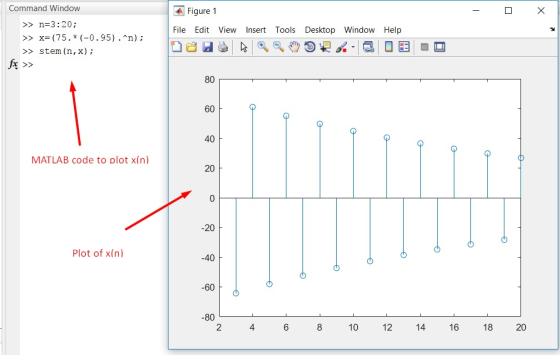
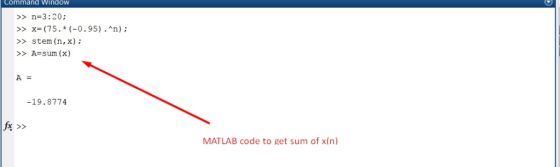
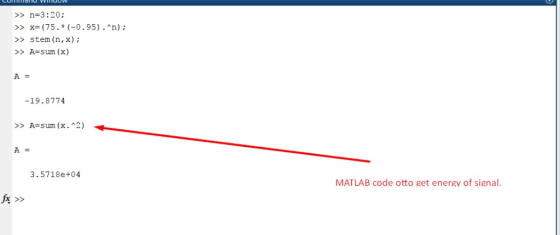
MATLAB PLEASE MATLAB PLEASE 9. Consider the following discrete-time exponential signal r(n) 75(-0.95)"u(n-3) (a)...
Consider the continous time signal x(t) - u(t) where u(t) is the unit step, sampled at a sampling period Ts- 1/4 to produce a discrete time signal rn] (a) Plot the signal r[n] over an appropriate int...
 Consider the continous time signal x(t) - u(t) where u(t) is the unit step, sampled at a sampling period Ts- 1/4 to produce a discrete time signal rn] (a) Plot the signal r[n] over an appropriate interval (b) Compute and plot the short term energy for 10 successive blocks using a rectangular window of width 4 (c) Compute and plot the Zero Crossing Rate for 10 successive blocks using a rectangular window of width 4
Consider the continous time signal...
Consider the continous time signal x(t) - u(t) where u(t) is the unit step, sampled at a sampling period Ts- 1/4 to produce a discrete time signal rn] (a) Plot the signal r[n] over an appropriate interval (b) Compute and plot the short term energy for 10 successive blocks using a rectangular window of width 4 (c) Compute and plot the Zero Crossing Rate for 10 successive blocks using a rectangular window of width 4
Consider the continous time signal...
BC:9.4 A LTI discrete time system has an impulse response h[n] = (−0.6)nu[n] + (0.95)nu[n −...
 BC:9.4 A LTI discrete time system has an impulse response h[n] =
(−0.6)nu[n] + (0.95)nu[n − 1] Find the transfer function, Hˆ (e jωˆ
), in the normalized frequency domain. Use Matlab to plot the
magnitude and phase (in degrees) of Hˆ (e jωˆ ) in the range of −π
≤ ωˆ ≤ π. Attach your Matlab source code with the plots.
BC:9.4 A LTI discrete time system has an impulse response h[n] = (-0.6)"u[n] + (0.95)"u[n-1] Find the transfer...
BC:9.4 A LTI discrete time system has an impulse response h[n] =
(−0.6)nu[n] + (0.95)nu[n − 1] Find the transfer function, Hˆ (e jωˆ
), in the normalized frequency domain. Use Matlab to plot the
magnitude and phase (in degrees) of Hˆ (e jωˆ ) in the range of −π
≤ ωˆ ≤ π. Attach your Matlab source code with the plots.
BC:9.4 A LTI discrete time system has an impulse response h[n] = (-0.6)"u[n] + (0.95)"u[n-1] Find the transfer...
4. Consider the discrete time signal x[n] = u[n-2] - u[n – 6] a. Plot the...
 4. Consider the discrete time signal x[n] = u[n-2] - u[n – 6] a. Plot the signal b. Find the Fourier Transform of x[n]
please, provide answer along with its matlab code. 10. Consider the continuous- time signal kite a1ua(-t) + kze-a2t...
 please, provide answer along with its matlab code.
10. Consider the continuous- time signal kite a1ua(-t) + kze-a2t cos (2mfi t) ua (t), Ta(t) where ki =-400, k2 2, a1 = -57.5364, a2 21.0721, and fi=300 Hz. (a) Plot ra(t). Identify the non-causal part of Ta (t) as Tal(t) and the causal part as Ta2(t). (b) Assuming that aa(t) is sampled using the sampling frequency fsamp 200 Hz, determine the discrete-time counter-parts corresponding to aal (t) and ra2(t), named a1(n)...
please, provide answer along with its matlab code.
10. Consider the continuous- time signal kite a1ua(-t) + kze-a2t cos (2mfi t) ua (t), Ta(t) where ki =-400, k2 2, a1 = -57.5364, a2 21.0721, and fi=300 Hz. (a) Plot ra(t). Identify the non-causal part of Ta (t) as Tal(t) and the causal part as Ta2(t). (b) Assuming that aa(t) is sampled using the sampling frequency fsamp 200 Hz, determine the discrete-time counter-parts corresponding to aal (t) and ra2(t), named a1(n)...
1. Consider the following sequence (The bold large size element is at n = 0) x(n)...
 1. Consider the following sequence (The bold large size element is at n = 0) x(n) = { ----- 0,0,01, 1, 1, 1, 1, 0, 0, 0------}. It has the period of N=8. a. Find (in closed form) and sketch the complex exponential Fourier series coefficients (Magnitude and Phase). Verify using Matlab. Include code and graphics. b. Find the energy in this sequence first using the sequence in the time domain, and then using the DTFS coefficients. Verify using Matlab....
(1) Consider the following continuous-time signal: (1) 2ua(-t+t)ua(t), where its energy is 20 milli Joules (2...
 (1) Consider the following continuous-time signal: (1) 2ua(-t+t)ua(t), where its energy is 20 milli Joules (2 x 10³Joules). The signal ra(t) is sampled at a rate of 500 samples/sec to yield its discrete-time counter part (n) (a) Find ti, and hence sketch ra(t). (b) From part (a), plot r(n) and finds its energy (c) Derive an expression for the Fourier transform of a(n), namely X(ew). (d) Plot the magnitude spectrum (1X(e)) and phase spectrum 2(X(e). (e) Consider the signal y(n)...
matlab please matlab please (4) Consider the system described by the following difference equation y(n)1.77y(n-1)-0.81y(n 2)a(n)-...
 matlab please
(4) Consider the system described by the following difference equation y(n)1.77y(n-1)-0.81y(n 2)a(n)- 0.5(n -1) (a) Assuming a unit-step input, and using a long enough section of the input constant output y(n) is observed for large n, hence plot the output and determine the value of this constant called G so that a Note: G, y(n) for n0o. (b) Determine and plot the transient response given by: n(n) = y(n)- Go (c) Find the energy of the...
matlab please
matlab please
(4) Consider the system described by the following difference equation y(n)1.77y(n-1)-0.81y(n 2)a(n)- 0.5(n -1) (a) Assuming a unit-step input, and using a long enough section of the input constant output y(n) is observed for large n, hence plot the output and determine the value of this constant called G so that a Note: G, y(n) for n0o. (b) Determine and plot the transient response given by: n(n) = y(n)- Go (c) Find the energy of the...
Please show all your works. Thanks. 2) Let r(t) be the continuous-time signal x(t) t(0.97)' [a(t)-u(t-100)|...
 Please show all your works.
Thanks.
2) Let r(t) be the continuous-time signal x(t) t(0.97)' [a(t)-u(t-100)| where u(t) is the unit step function. We sample r(t) with a sampling period of T 0.4 over ootoo to obtain r/n]. Assume that the sample for n 0 is taken at t 0. We then use sinc interpolation to generate Tr(t) from xml a) Plot r(t) using MATLAB over the smallest range that includes all nonzero values of r(t) b) Find r[n] c)...
Please show all your works.
Thanks.
2) Let r(t) be the continuous-time signal x(t) t(0.97)' [a(t)-u(t-100)| where u(t) is the unit step function. We sample r(t) with a sampling period of T 0.4 over ootoo to obtain r/n]. Assume that the sample for n 0 is taken at t 0. We then use sinc interpolation to generate Tr(t) from xml a) Plot r(t) using MATLAB over the smallest range that includes all nonzero values of r(t) b) Find r[n] c)...
(5) Consider the following discrete time signal zln-S[n] + δ[n-1] + a[n-2] + δ n-3] a)...
 (5) Consider the following discrete time signal zln-S[n] + δ[n-1] + a[n-2] + δ n-3] a) Compute the DTFT of n b) Compute the DFT4 (DFT with N 4) coefficients for zn], i.e., Xk for k 0,1,2,3. c) Compute the DFTs (DFT with N-8) coefficients for r[n], i.e., Xk for k 0,1,...,7.
(2) Consider the causal discrete-time LTI system with an input r (n) and an output y(n)...
 (2) Consider the causal discrete-time LTI system with an input r (n) and an output y(n) as shown in Figure 1, where K 6 (constant), system #1 is described by its impulse response: h(n) = -36(n) + 0.48(n- 1)+8.26(n-2), and system # 2 has the difference equation given by: y(n)+0.1y(n-1)+0.3y(n-2)- 2a(n). (a) Determine the corresponding difference equation of the system #1. Hence, write its fre- quency response. (b) Find the frequency response of system #2. 1 system #1 system #2...
 Consider the continous time signal x(t) - u(t) where u(t) is the unit step, sampled at a sampling period Ts- 1/4 to produce a discrete time signal rn] (a) Plot the signal r[n] over an appropriate interval (b) Compute and plot the short term energy for 10 successive blocks using a rectangular window of width 4 (c) Compute and plot the Zero Crossing Rate for 10 successive blocks using a rectangular window of width 4
Consider the continous time signal...
Consider the continous time signal x(t) - u(t) where u(t) is the unit step, sampled at a sampling period Ts- 1/4 to produce a discrete time signal rn] (a) Plot the signal r[n] over an appropriate interval (b) Compute and plot the short term energy for 10 successive blocks using a rectangular window of width 4 (c) Compute and plot the Zero Crossing Rate for 10 successive blocks using a rectangular window of width 4
Consider the continous time signal...
 BC:9.4 A LTI discrete time system has an impulse response h[n] =
(−0.6)nu[n] + (0.95)nu[n − 1] Find the transfer function, Hˆ (e jωˆ
), in the normalized frequency domain. Use Matlab to plot the
magnitude and phase (in degrees) of Hˆ (e jωˆ ) in the range of −π
≤ ωˆ ≤ π. Attach your Matlab source code with the plots.
BC:9.4 A LTI discrete time system has an impulse response h[n] = (-0.6)"u[n] + (0.95)"u[n-1] Find the transfer...
BC:9.4 A LTI discrete time system has an impulse response h[n] =
(−0.6)nu[n] + (0.95)nu[n − 1] Find the transfer function, Hˆ (e jωˆ
), in the normalized frequency domain. Use Matlab to plot the
magnitude and phase (in degrees) of Hˆ (e jωˆ ) in the range of −π
≤ ωˆ ≤ π. Attach your Matlab source code with the plots.
BC:9.4 A LTI discrete time system has an impulse response h[n] = (-0.6)"u[n] + (0.95)"u[n-1] Find the transfer...
 4. Consider the discrete time signal x[n] = u[n-2] - u[n – 6] a. Plot the signal b. Find the Fourier Transform of x[n]
 please, provide answer along with its matlab code.
10. Consider the continuous- time signal kite a1ua(-t) + kze-a2t cos (2mfi t) ua (t), Ta(t) where ki =-400, k2 2, a1 = -57.5364, a2 21.0721, and fi=300 Hz. (a) Plot ra(t). Identify the non-causal part of Ta (t) as Tal(t) and the causal part as Ta2(t). (b) Assuming that aa(t) is sampled using the sampling frequency fsamp 200 Hz, determine the discrete-time counter-parts corresponding to aal (t) and ra2(t), named a1(n)...
please, provide answer along with its matlab code.
10. Consider the continuous- time signal kite a1ua(-t) + kze-a2t cos (2mfi t) ua (t), Ta(t) where ki =-400, k2 2, a1 = -57.5364, a2 21.0721, and fi=300 Hz. (a) Plot ra(t). Identify the non-causal part of Ta (t) as Tal(t) and the causal part as Ta2(t). (b) Assuming that aa(t) is sampled using the sampling frequency fsamp 200 Hz, determine the discrete-time counter-parts corresponding to aal (t) and ra2(t), named a1(n)...
 1. Consider the following sequence (The bold large size element is at n = 0) x(n) = { ----- 0,0,01, 1, 1, 1, 1, 0, 0, 0------}. It has the period of N=8. a. Find (in closed form) and sketch the complex exponential Fourier series coefficients (Magnitude and Phase). Verify using Matlab. Include code and graphics. b. Find the energy in this sequence first using the sequence in the time domain, and then using the DTFS coefficients. Verify using Matlab....
 (1) Consider the following continuous-time signal: (1) 2ua(-t+t)ua(t), where its energy is 20 milli Joules (2 x 10³Joules). The signal ra(t) is sampled at a rate of 500 samples/sec to yield its discrete-time counter part (n) (a) Find ti, and hence sketch ra(t). (b) From part (a), plot r(n) and finds its energy (c) Derive an expression for the Fourier transform of a(n), namely X(ew). (d) Plot the magnitude spectrum (1X(e)) and phase spectrum 2(X(e). (e) Consider the signal y(n)...
 matlab please
(4) Consider the system described by the following difference equation y(n)1.77y(n-1)-0.81y(n 2)a(n)- 0.5(n -1) (a) Assuming a unit-step input, and using a long enough section of the input constant output y(n) is observed for large n, hence plot the output and determine the value of this constant called G so that a Note: G, y(n) for n0o. (b) Determine and plot the transient response given by: n(n) = y(n)- Go (c) Find the energy of the...
matlab please
matlab please
(4) Consider the system described by the following difference equation y(n)1.77y(n-1)-0.81y(n 2)a(n)- 0.5(n -1) (a) Assuming a unit-step input, and using a long enough section of the input constant output y(n) is observed for large n, hence plot the output and determine the value of this constant called G so that a Note: G, y(n) for n0o. (b) Determine and plot the transient response given by: n(n) = y(n)- Go (c) Find the energy of the...
 Please show all your works.
Thanks.
2) Let r(t) be the continuous-time signal x(t) t(0.97)' [a(t)-u(t-100)| where u(t) is the unit step function. We sample r(t) with a sampling period of T 0.4 over ootoo to obtain r/n]. Assume that the sample for n 0 is taken at t 0. We then use sinc interpolation to generate Tr(t) from xml a) Plot r(t) using MATLAB over the smallest range that includes all nonzero values of r(t) b) Find r[n] c)...
Please show all your works.
Thanks.
2) Let r(t) be the continuous-time signal x(t) t(0.97)' [a(t)-u(t-100)| where u(t) is the unit step function. We sample r(t) with a sampling period of T 0.4 over ootoo to obtain r/n]. Assume that the sample for n 0 is taken at t 0. We then use sinc interpolation to generate Tr(t) from xml a) Plot r(t) using MATLAB over the smallest range that includes all nonzero values of r(t) b) Find r[n] c)...
 (5) Consider the following discrete time signal zln-S[n] + δ[n-1] + a[n-2] + δ n-3] a) Compute the DTFT of n b) Compute the DFT4 (DFT with N 4) coefficients for zn], i.e., Xk for k 0,1,2,3. c) Compute the DFTs (DFT with N-8) coefficients for r[n], i.e., Xk for k 0,1,...,7.
 (2) Consider the causal discrete-time LTI system with an input r (n) and an output y(n) as shown in Figure 1, where K 6 (constant), system #1 is described by its impulse response: h(n) = -36(n) + 0.48(n- 1)+8.26(n-2), and system # 2 has the difference equation given by: y(n)+0.1y(n-1)+0.3y(n-2)- 2a(n). (a) Determine the corresponding difference equation of the system #1. Hence, write its fre- quency response. (b) Find the frequency response of system #2. 1 system #1 system #2...
Most questions answered within 3 hours.
-
Where is the error in this code sequence?
String s1 = "Hello";
String s2 = "ello";...
asked 11 months ago -
Financial data for Joel de Paris, Inc., for last year
follow:
Joel de Paris, Inc.
Balance...
asked 11 months ago -
Consider this reaction:
Al2(SO4)3 (aq)+ BaCl3
(aq) Al2Cl6 (aq)- +
3BaSO4(s) . What is the...
asked 11 months ago -
Suppose that Savneet is considering increasing her
recent random sample from 20 car rentals to 40...
asked 11 months ago -
Trucks arrive at an unloading terminal at an average rate of 120
per hour.
Trucks arrive...
asked 11 months ago -
Why are methanol and ethanol completely soluble in water while
octanol is not very little soluble....
asked 11 months ago -
A facilities manager at a university reads in a research report
that the mean amount of...
asked 11 months ago -
When the CuSO4 is rehydrated by adding water to the anhydrous
compound, is this an endothermic...
asked 11 months ago -
A ray of sunlight is passing from diamond into crown glass; the
angle of incidence is...
asked 11 months ago -
A block of mass 0.249 kg is placed on top of a light, vertical
spring of...
asked 11 months ago -
how do the kidneys compensate in the presences of acidosis
a) trigger hyperventilate
b) reserve acid...
asked 11 months ago -
Question 501 pts
The rental rate of capital to the firm increases. Which of the
following...
asked 11 months ago