
Homework Answers
Add Answer to:
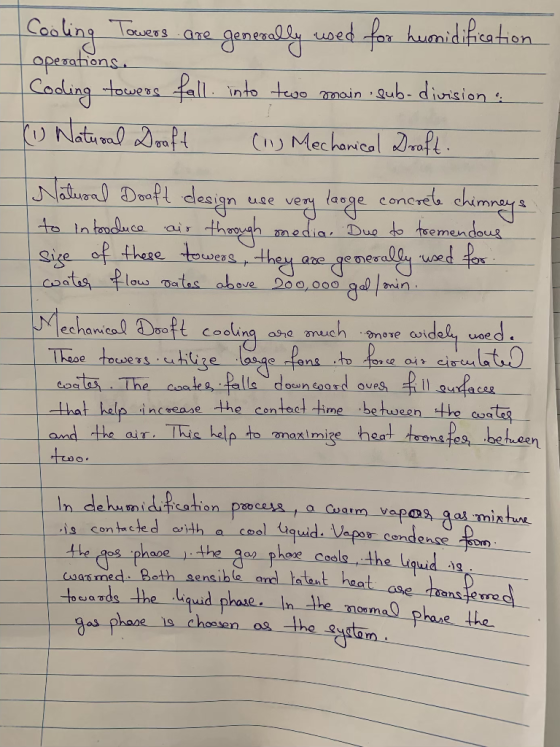
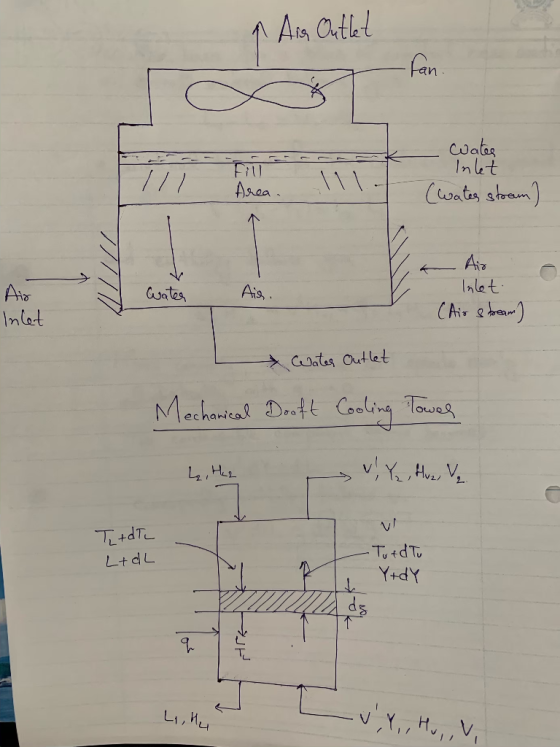
Consider a cooling tower designed to remove 5MW of waste energy. Draw a flow diagram of such a cooling tower including...
need an answer for this question, please. thanks. An existing packed countercurrent water-cooling tower was designed...
 need an answer for this question, please. thanks.
An existing packed countercurrent water-cooling tower was designed to cool water from 107.6 degree F to 82.4 degree F. The air enters at 82.4 degree F with a wet bulb temperature of 72.5 degree F. The water flow rate is 1900 lb_m water/h.ft^2 and the gas flowrate is 1450 lb_m dry air/h.ft^2. The tower operates at a pressure of 1 atm. Given the overall mass-transfer coefficient (K_ca) is 6.75 lb mol/h.ft^3. Determine...
need an answer for this question, please. thanks.
An existing packed countercurrent water-cooling tower was designed to cool water from 107.6 degree F to 82.4 degree F. The air enters at 82.4 degree F with a wet bulb temperature of 72.5 degree F. The water flow rate is 1900 lb_m water/h.ft^2 and the gas flowrate is 1450 lb_m dry air/h.ft^2. The tower operates at a pressure of 1 atm. Given the overall mass-transfer coefficient (K_ca) is 6.75 lb mol/h.ft^3. Determine...
4. Liquid water at 100°F and 200 gal/min volumetric flow rate enters a cooling tower operating...
 4. Liquid water at 100°F and 200 gal/min volumetric flow rate enters a cooling tower operating at steady state. Atmospheric air enters with a dry-bulb temperature of 80°F and a wet-bulb temperature of 60°F. Moist air exits the cooling tower at 90° and 90% relative humidity. Makeup water is provided at 80°F. Calculate the mass flow rates of the dry air and makeup water, each in lb/min, versus return water temperature at 80, 90, and 100°F. Ignore kinetic and potential...
Water entering a wet cooling tower at 35°C at a rate of 100 kg/s is cooled to 22°C in the cooling tower by air that enters the tower at 1 atm, 20°C, and 60% relative humidity and leaves saturated at 3...
 Water entering a wet cooling tower at 35°C at a rate of 100 kg/s
is cooled to 22°C in the cooling tower by air that enters the tower
at 1 atm, 20°C, and 60% relative humidity and leaves saturated at
30°C. The makeup water of 22°C is supplied to the outlet to make
the mass flow rate of the cool water the same as that at the inlet,
see Figure Q5.
Q.5Water entering a wet cooling tower at 35°C at...
Water entering a wet cooling tower at 35°C at a rate of 100 kg/s
is cooled to 22°C in the cooling tower by air that enters the tower
at 1 atm, 20°C, and 60% relative humidity and leaves saturated at
30°C. The makeup water of 22°C is supplied to the outlet to make
the mass flow rate of the cool water the same as that at the inlet,
see Figure Q5.
Q.5Water entering a wet cooling tower at 35°C at...
Cooling tower is a special recycling device which applies the heat rejection process. Figure Q4 (a)...
 Cooling tower is a special recycling device which applies the heat rejection process. Figure Q4 (a) shows the cooling tower system that extracts waste heat to the atmosphere through the cooling of a water stream to a lower temperature. Sketch the water recycle in the cooling tower Q4 (a) (5 marks) High leaving water temperature will cause a drop in process cooling efficiency, increasing system power consumption, creating physical discomfort to people within an air-conditioned area, and have a detrimental...
The figure below shows a condenser/cooling tower pipe system needed to remove heat from a water...
 The figure below shows a condenser/cooling tower pipe system needed to remove heat from a water cooled refrigeration condenser and reject the heat to the atmosphere. The amount of heat to be rejected to the atmosphere is 480,000 Btu/hr. The water enters the condenser at 85"F, and the temperature rise of the water through the condenser is 10°F. The total length of the piping in the system is 60 ft. Fittings are as shown. Assume bends to be as shown...
Draw a detailed and clearly labeled process flow diagram for water use and disposal on UConn’s...
Draw a detailed and clearly labeled process flow diagram for water use and disposal on UConn’s campus: include only the following components (as boxes on your PFD): Campus buildings Wastewater treatment plant Well fields (where our drinking water comes from) Water tower/storage for drinking water Reclaimed Water Facility (RWF) Central Utilities Plant (CUP) Irrigation Willimantic River Between these components you will have the following water streams that need to be included: Potable water Wastewater Reclaimed water Steam (for heating) Steam...
Problem -4 (200) In the condenser of a power plant, energy is discharged by heat transfer...
 Problem -4 (200) In the condenser of a power plant, energy is discharged by heat transfer at a rate of 853035 Btu/s to cooling water that exits the condenser at 110°F into a cooling tower. Cooled water at 64°F is returned to the condenser. Atmospheric air enters the tower at 80°F, 1 atm, 30% relative humidity. Moist air exits at 98°F, 1 atm, 95% relative humidity. Makeup water is supplied at 64°F. For operation at steady state, determine (a) Draw...
A tray tower is designed to absorb acetone from air stream using pure water at 293...
 A tray tower is designed to absorb acetone from air stream using pure water at 293 K and 101.3 kPa. The inlet air flow rate is 483.33 kg/min (MW air = 29) and it contains 5 mol % of acetone. It is desired to remove 95 % of the acetone from air stream. The equilibrium relationship for this dilute stream is given by the equation of y= 1.186 x. * All the solutions should be presented in the unit of...
A stirred tank flow reactor is operating in continuous mode (shown below), and an exothermic (heat...
 A stirred tank flow reactor is operating in continuous mode
(shown below), and an exothermic (heat generating) chemical
reaction is taking place inside the reactor. The control objective
is to maintain the concentration of product at a desired value (set
point). The conversion of chemical reaction is highly dependent on
the reaction temperature. To maintain the reaction temperature at
the desired value, a cooling water jacket is used for the reactor.
The major input disturbance is fluctuation in the temperature...
A stirred tank flow reactor is operating in continuous mode
(shown below), and an exothermic (heat generating) chemical
reaction is taking place inside the reactor. The control objective
is to maintain the concentration of product at a desired value (set
point). The conversion of chemical reaction is highly dependent on
the reaction temperature. To maintain the reaction temperature at
the desired value, a cooling water jacket is used for the reactor.
The major input disturbance is fluctuation in the temperature...
H1- COOLING TOWER [10 p] 1. What is the wet bulb temperature? How can you measure...
 H1- COOLING TOWER [10 p] 1. What is the wet bulb temperature? How can you measure it? Is the wet-bulb temperature greater than dry-bulb temperature? Why? [10 p] 2. A cooling tower is to be designed to cool 8 kg/s of water from 37°C to 29 °C. Entering air is 25 °C and at 30 % relative humidity. Leaving air is 22 °C and at 90% relative humidity. a) Calculate the air flow rate, G. b) Determine the possible lowest...
 need an answer for this question, please. thanks.
An existing packed countercurrent water-cooling tower was designed to cool water from 107.6 degree F to 82.4 degree F. The air enters at 82.4 degree F with a wet bulb temperature of 72.5 degree F. The water flow rate is 1900 lb_m water/h.ft^2 and the gas flowrate is 1450 lb_m dry air/h.ft^2. The tower operates at a pressure of 1 atm. Given the overall mass-transfer coefficient (K_ca) is 6.75 lb mol/h.ft^3. Determine...
need an answer for this question, please. thanks.
An existing packed countercurrent water-cooling tower was designed to cool water from 107.6 degree F to 82.4 degree F. The air enters at 82.4 degree F with a wet bulb temperature of 72.5 degree F. The water flow rate is 1900 lb_m water/h.ft^2 and the gas flowrate is 1450 lb_m dry air/h.ft^2. The tower operates at a pressure of 1 atm. Given the overall mass-transfer coefficient (K_ca) is 6.75 lb mol/h.ft^3. Determine...
 4. Liquid water at 100°F and 200 gal/min volumetric flow rate enters a cooling tower operating at steady state. Atmospheric air enters with a dry-bulb temperature of 80°F and a wet-bulb temperature of 60°F. Moist air exits the cooling tower at 90° and 90% relative humidity. Makeup water is provided at 80°F. Calculate the mass flow rates of the dry air and makeup water, each in lb/min, versus return water temperature at 80, 90, and 100°F. Ignore kinetic and potential...
 Water entering a wet cooling tower at 35°C at a rate of 100 kg/s
is cooled to 22°C in the cooling tower by air that enters the tower
at 1 atm, 20°C, and 60% relative humidity and leaves saturated at
30°C. The makeup water of 22°C is supplied to the outlet to make
the mass flow rate of the cool water the same as that at the inlet,
see Figure Q5.
Q.5Water entering a wet cooling tower at 35°C at...
Water entering a wet cooling tower at 35°C at a rate of 100 kg/s
is cooled to 22°C in the cooling tower by air that enters the tower
at 1 atm, 20°C, and 60% relative humidity and leaves saturated at
30°C. The makeup water of 22°C is supplied to the outlet to make
the mass flow rate of the cool water the same as that at the inlet,
see Figure Q5.
Q.5Water entering a wet cooling tower at 35°C at...
 Cooling tower is a special recycling device which applies the heat rejection process. Figure Q4 (a) shows the cooling tower system that extracts waste heat to the atmosphere through the cooling of a water stream to a lower temperature. Sketch the water recycle in the cooling tower Q4 (a) (5 marks) High leaving water temperature will cause a drop in process cooling efficiency, increasing system power consumption, creating physical discomfort to people within an air-conditioned area, and have a detrimental...
 The figure below shows a condenser/cooling tower pipe system needed to remove heat from a water cooled refrigeration condenser and reject the heat to the atmosphere. The amount of heat to be rejected to the atmosphere is 480,000 Btu/hr. The water enters the condenser at 85"F, and the temperature rise of the water through the condenser is 10°F. The total length of the piping in the system is 60 ft. Fittings are as shown. Assume bends to be as shown...
 Problem -4 (200) In the condenser of a power plant, energy is discharged by heat transfer at a rate of 853035 Btu/s to cooling water that exits the condenser at 110°F into a cooling tower. Cooled water at 64°F is returned to the condenser. Atmospheric air enters the tower at 80°F, 1 atm, 30% relative humidity. Moist air exits at 98°F, 1 atm, 95% relative humidity. Makeup water is supplied at 64°F. For operation at steady state, determine (a) Draw...
 A tray tower is designed to absorb acetone from air stream using pure water at 293 K and 101.3 kPa. The inlet air flow rate is 483.33 kg/min (MW air = 29) and it contains 5 mol % of acetone. It is desired to remove 95 % of the acetone from air stream. The equilibrium relationship for this dilute stream is given by the equation of y= 1.186 x. * All the solutions should be presented in the unit of...
 A stirred tank flow reactor is operating in continuous mode
(shown below), and an exothermic (heat generating) chemical
reaction is taking place inside the reactor. The control objective
is to maintain the concentration of product at a desired value (set
point). The conversion of chemical reaction is highly dependent on
the reaction temperature. To maintain the reaction temperature at
the desired value, a cooling water jacket is used for the reactor.
The major input disturbance is fluctuation in the temperature...
A stirred tank flow reactor is operating in continuous mode
(shown below), and an exothermic (heat generating) chemical
reaction is taking place inside the reactor. The control objective
is to maintain the concentration of product at a desired value (set
point). The conversion of chemical reaction is highly dependent on
the reaction temperature. To maintain the reaction temperature at
the desired value, a cooling water jacket is used for the reactor.
The major input disturbance is fluctuation in the temperature...
 H1- COOLING TOWER [10 p] 1. What is the wet bulb temperature? How can you measure it? Is the wet-bulb temperature greater than dry-bulb temperature? Why? [10 p] 2. A cooling tower is to be designed to cool 8 kg/s of water from 37°C to 29 °C. Entering air is 25 °C and at 30 % relative humidity. Leaving air is 22 °C and at 90% relative humidity. a) Calculate the air flow rate, G. b) Determine the possible lowest...
Most questions answered within 3 hours.
-
Where is the error in this code sequence?
String s1 = "Hello";
String s2 = "ello";...
asked 10 months ago -
Financial data for Joel de Paris, Inc., for last year
follow:
Joel de Paris, Inc.
Balance...
asked 10 months ago -
Consider this reaction:
Al2(SO4)3 (aq)+ BaCl3
(aq) Al2Cl6 (aq)- +
3BaSO4(s) . What is the...
asked 10 months ago -
Suppose that Savneet is considering increasing her
recent random sample from 20 car rentals to 40...
asked 10 months ago -
Trucks arrive at an unloading terminal at an average rate of 120
per hour.
Trucks arrive...
asked 10 months ago -
Why are methanol and ethanol completely soluble in water while
octanol is not very little soluble....
asked 10 months ago -
A facilities manager at a university reads in a research report
that the mean amount of...
asked 10 months ago -
When the CuSO4 is rehydrated by adding water to the anhydrous
compound, is this an endothermic...
asked 10 months ago -
A ray of sunlight is passing from diamond into crown glass; the
angle of incidence is...
asked 10 months ago -
A block of mass 0.249 kg is placed on top of a light, vertical
spring of...
asked 10 months ago -
how do the kidneys compensate in the presences of acidosis
a) trigger hyperventilate
b) reserve acid...
asked 10 months ago -
Question 501 pts
The rental rate of capital to the firm increases. Which of the
following...
asked 10 months ago