
Homework Answers
The discount rate as per CAPM is given by:-
Re= Rf + beta*(Rm-Rf)
Re= 2.62% + 1.23*(6.35%-2.62%)
Re= 2.62%+1.23*3.73%
Re= 2.62%+4.59%
Re= 7.21%
Add Answer to:
3) Calculation of Discount Rate r with CAPM. Equity Beta: 1.23 U.K. Government Bond Yield: 2.62% Market Risk Premiu...
The cost of equity using the CAPM approach The current risk-free rate of return (rRF) is...
 The cost of equity using the CAPM approach The current risk-free rate of return (rRF) is 3.86%, while the market risk premium is 5.75%. The Jefferson Company has a beta of 0.92. Using the Capital Asset Pricing Model (CAPM) approach, Jefferson's cost of equity is 9.15% 9.61% 10.98% 10.07% The cost of equity using the bond yield plus risk premium approach | The Adams Company is closely held and, therefore, cannot generate reliable inputs with which to use the CAPM...
The cost of equity using the CAPM approach The current risk-free rate of return (TRF) is...
 The cost of equity using the CAPM approach The current risk-free rate of return (TRF) is 4.67% while the market risk premium is 6.63%. The Jefferson Company has a beta of 0.92. Using the capital asset pricing model (CAPM) approach, Jefferson's cost of equity is 11.3085% The cost of equity using the bond yield plus risk premium approad 10.779 11.847% The Harrison Company is dosely held and, therefore, cannot generate relis cost of internal equity. Harrison's bonds yield 11.52%, and...
Barton Industries estimates its cost of common equity by using three approaches: the CAPM, the bond-yield-plus-risk-premium...
Barton Industries estimates its cost of common equity by using three approaches: the CAPM, the bond-yield-plus-risk-premium approach, and the DCF model. Barton expects next year's annual dividend, D1, to be $2.20 and it expects dividends to grow at a constant rate g = 4.4%. The firm's current common stock price, P0, is $20.00. The current risk-free rate, rRF, = 4.7%; the market risk premium, RPM, = 6.2%, and the firm's stock has a current beta, b, = 1.35. Assume that...
The cost of equity using the CAPM approach The current risk-free rate of return (RF) is...
 The cost of equity using the CAPM approach The current risk-free rate of return (RF) is 4.23%, while the market risk premium is 6.63%, the Burris Company has a beta of 0.92. Using the Capital Asset Pricing Model (CAPM) approach, Burris's cost of equity is The cost of equity using the bond yield plus risk premium approach The Lincoln Company is closely held and, therefore, cannot generate reliable inputs with which to use the CAPM method for estimating a company's...
Barton Industries estimates its cost of common equity by using three approaches: the CAPM, the bond-yield-plus-risk-premium...
Barton Industries estimates its cost of common equity by using three approaches: the CAPM, the bond-yield-plus-risk-premium approach, and the DCF model. Barton expects next year's annual dividend, D1, to be $2.50 and it expects dividends to grow at a constant rate gL = 3.7%. The firm's current common stock price, P0, is $22.00. The current risk-free rate, rRF, = 4.7%; the market risk premium, RPM, = 6%, and the firm's stock has a current beta, b, = 1.2. Assume that...
1. According to CAPM, cost of common equity can reduce if: I. risk-free rate is lower...
1. According to CAPM, cost of common equity can reduce if: I. risk-free rate is lower II. beta is lower III market risk premium is higher IV. market return is higher a) I and II only b) III and IV only c) I only d) II and IV only e) III only 2. Which of the following will have a higher yield to maturity? a) Not enough information given to determine the answer. b) A discount bond c) A premium...
9. Given this information: • Beta: 1.6 • Market risk premium 8% • Risk free rate:...
9. Given this information: • Beta: 1.6 • Market risk premium 8% • Risk free rate: 3% • Dividends expected to grow 4% per year • Last dividend: 2 EUR • Equity selling at 17.5 a) What is the expected cost of equity using the CAPM? b) What is the expected cost of equity using the dividend growth model? c) Is there any difference between them? And if risk free rate decrease by 1%?
10-5a CAPM Appronch Calculate the cost of equity financing given the following Risk-free ratc 1% Market...
 10-5a CAPM Appronch Calculate the cost of equity financing given the following Risk-free ratc 1% Market risk premium: 7% 1.25 Beta: 10-5b Bond-Yield-Plus-Risk-Premium Approsch The return on a bond is 4% while the return on common is 5%. What is the risk premium? 10-5e DCE Approach Solve for required return given the following The dividend paid at the beginning of the first time period (Du) was fa/share. The dividend grows in perpetuity at 3.5% (growth rate g). The price of...
Explain each letter in the questions above. b) If the terminal growth rate is projected to...
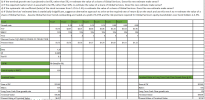 Explain each letter in the questions
above.
b) If the terminal growth rate is projected to be 6%, rather than 5%, re-estimate the value of a share of Global Services. Does this new estimate make sense? c) If the expected market return is assumed to be 9%, rather than 10%, re-estimate the value of a share of Global Services. Does this new estimate make sense? d) If the systematic risk coefficient (beta) of the stock increases from 1.25 to 1.40,...
Explain each letter in the questions
above.
b) If the terminal growth rate is projected to be 6%, rather than 5%, re-estimate the value of a share of Global Services. Does this new estimate make sense? c) If the expected market return is assumed to be 9%, rather than 10%, re-estimate the value of a share of Global Services. Does this new estimate make sense? d) If the systematic risk coefficient (beta) of the stock increases from 1.25 to 1.40,...
1) A project has a market beta of 1.7. The risk-free rate is 3%, and the...
1) A project has a market beta of 1.7. The risk-free rate is 3%, and the equity premium is 5%. Your firm should undertake this project only if it returns greater or equal to 8% greater or equal to 35% greater or equal to 8.3333% greater or equal to 11.5% 2) A zero-coupon bond has a beta of 0.3 and promises to pay $1000 next year with a probability of 95%. If the bond defaults, it will pay nothing. One...
 The cost of equity using the CAPM approach The current risk-free rate of return (rRF) is 3.86%, while the market risk premium is 5.75%. The Jefferson Company has a beta of 0.92. Using the Capital Asset Pricing Model (CAPM) approach, Jefferson's cost of equity is 9.15% 9.61% 10.98% 10.07% The cost of equity using the bond yield plus risk premium approach | The Adams Company is closely held and, therefore, cannot generate reliable inputs with which to use the CAPM...
 The cost of equity using the CAPM approach The current risk-free rate of return (TRF) is 4.67% while the market risk premium is 6.63%. The Jefferson Company has a beta of 0.92. Using the capital asset pricing model (CAPM) approach, Jefferson's cost of equity is 11.3085% The cost of equity using the bond yield plus risk premium approad 10.779 11.847% The Harrison Company is dosely held and, therefore, cannot generate relis cost of internal equity. Harrison's bonds yield 11.52%, and...
 The cost of equity using the CAPM approach The current risk-free rate of return (RF) is 4.23%, while the market risk premium is 6.63%, the Burris Company has a beta of 0.92. Using the Capital Asset Pricing Model (CAPM) approach, Burris's cost of equity is The cost of equity using the bond yield plus risk premium approach The Lincoln Company is closely held and, therefore, cannot generate reliable inputs with which to use the CAPM method for estimating a company's...
 10-5a CAPM Appronch Calculate the cost of equity financing given the following Risk-free ratc 1% Market risk premium: 7% 1.25 Beta: 10-5b Bond-Yield-Plus-Risk-Premium Approsch The return on a bond is 4% while the return on common is 5%. What is the risk premium? 10-5e DCE Approach Solve for required return given the following The dividend paid at the beginning of the first time period (Du) was fa/share. The dividend grows in perpetuity at 3.5% (growth rate g). The price of...
 Explain each letter in the questions
above.
b) If the terminal growth rate is projected to be 6%, rather than 5%, re-estimate the value of a share of Global Services. Does this new estimate make sense? c) If the expected market return is assumed to be 9%, rather than 10%, re-estimate the value of a share of Global Services. Does this new estimate make sense? d) If the systematic risk coefficient (beta) of the stock increases from 1.25 to 1.40,...
Explain each letter in the questions
above.
b) If the terminal growth rate is projected to be 6%, rather than 5%, re-estimate the value of a share of Global Services. Does this new estimate make sense? c) If the expected market return is assumed to be 9%, rather than 10%, re-estimate the value of a share of Global Services. Does this new estimate make sense? d) If the systematic risk coefficient (beta) of the stock increases from 1.25 to 1.40,...
Most questions answered within 3 hours.
-
Where is the error in this code sequence?
String s1 = "Hello";
String s2 = "ello";...
asked 10 months ago -
Financial data for Joel de Paris, Inc., for last year
follow:
Joel de Paris, Inc.
Balance...
asked 10 months ago -
Consider this reaction:
Al2(SO4)3 (aq)+ BaCl3
(aq) Al2Cl6 (aq)- +
3BaSO4(s) . What is the...
asked 10 months ago -
Suppose that Savneet is considering increasing her
recent random sample from 20 car rentals to 40...
asked 10 months ago -
Trucks arrive at an unloading terminal at an average rate of 120
per hour.
Trucks arrive...
asked 10 months ago -
Why are methanol and ethanol completely soluble in water while
octanol is not very little soluble....
asked 10 months ago -
A facilities manager at a university reads in a research report
that the mean amount of...
asked 10 months ago -
When the CuSO4 is rehydrated by adding water to the anhydrous
compound, is this an endothermic...
asked 10 months ago -
A ray of sunlight is passing from diamond into crown glass; the
angle of incidence is...
asked 10 months ago -
A block of mass 0.249 kg is placed on top of a light, vertical
spring of...
asked 10 months ago -
how do the kidneys compensate in the presences of acidosis
a) trigger hyperventilate
b) reserve acid...
asked 10 months ago -
Question 501 pts
The rental rate of capital to the firm increases. Which of the
following...
asked 10 months ago