
Homework Answers
Add Answer to:
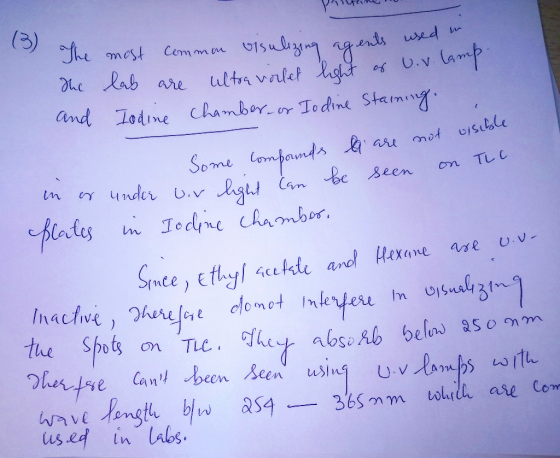
3) What two methods of visualizing spots on the TLC plate will you use in this lab? Why would you predict that the...
Possible Quiz Questions 1 What two methods of visualizing spots on a TLC plate will you...
 Possible Quiz Questions 1 What two methods of visualizing spots on a TLC plate will you use in this Give two reasons why would you predict that the elution solvents (hexanes or acetate) would not be visible under UV visualization? week's lab? ethyl 2. Define R 3. Calculate the R of the spot on the following TLC plate. 4. Which compound in each pair is predicted to have the higher Ri? a. CH3CH2CH2CH2OH and CH3CH2CH2CH28r b. CH3CH2CH2CH2OH and CH3CH2CH2CH2CH2CH2CH3 c....
5. Two unknown samples are spotted next to each other on a TLC plate. Development of...
 5. Two unknown samples are spotted next to each other on a TLC plate. Development of the plate with ethyl acetate and visualization using UV light gives the following data: Spot 1: Rp = 0.65 Spot 2: Rp = 0.63 These two Rf values are so close that the difference might be due to experimental error (you're still learning TLC and not yet an expert in the technique). Describe an experiment that can be run using the same developing solvent...
4. Consider the following silica gel TLC plac or compounds A, B, and hexines: developed in...
 4. Consider the following silica gel TLC plac or compounds A, B, and hexines: developed in Fo-o- og a) Determine the Rr values of compounds A, B, and C run on a silica gel TLC plate using hexanes as the solvent b) Which compound, A, B, or C. is the most polar? values if you used acetone instead c) What would you expect to happen to the of hexanes as the eluting solvent? 5) Consider a sample that is a...
2. What are the phases involved in TLC? 3. What is coated on the TLC plate?...
 2. What are the phases involved in TLC? 3. What is coated on the TLC plate? 4. What is the purpose of lining the wall of the TLC chamber with paper? 5. Why is it important to use a small amount of the mobile phase? 6. Why should you remove the TLC plate before the mobile phase reaches the top? 7. What type of compounds are visible with UV light? 8. With a polar stationary phase and non-polar mobile phase,...
Common solvents used in TLC analysis are hexane and ethyl acetate, the latter being more polar. A TLC has been performed...
Common solvents used in TLC analysis are hexane and ethyl acetate, the latter being more polar. A TLC has been performed on a mixture of two compounds. The solvent ran for 3 cm(plate length is 6cm) with 5% ethyl acetate in hexane. The two spots were not resolved, meaning they showed up too close to each other. What can you suggest to possible improve the results of the separation?
2. A solution containing a mixture of naphthalene, benzoic acid, and benzaldehyde is analyzed via TLC...
 2. A solution containing a mixture of naphthalene, benzoic acid, and benzaldehyde is analyzed via TLC and GC. Use the structures and properties of the compounds to aid in answering the following questions. A. In the TLC experiment, the mixture is spotted on a silica TLC plate and eluted with a 1:1 mixture of hexanes and ethyl acetate. Three spots are observed on the plate, with Re values of 0.25, 0.58, and 0.74. Indicate which spot corresponds to which compound....
7. (4 pt.) What two methods were used to visualize the spots on the developed TLC...
 7. (4 pt.) What two methods were used to visualize the spots on the developed TLC plate?
During the TLC plate you notice all of the spots remain on the baseline. What is...
During the TLC plate you notice all of the spots remain on the baseline. What is the problem and how would you fix it?
can you please answer all 1. When you run a TLC of the reaction in ethyl...
 can
you please answer all
1. When you run a TLC of the reaction in ethyl acetate : hexanes 1:1, the plate below is produced. Give a solvent system that would be expected to produce greater separation and a BRIEF (8 words) justification about your choice. (5 points) 7 6 5 4 3 b. Calculate the R for the bottom spot. (5 points) c. Which compound on the TLC plate is the most polar? (5 points) 2. Why is it...
can
you please answer all
1. When you run a TLC of the reaction in ethyl acetate : hexanes 1:1, the plate below is produced. Give a solvent system that would be expected to produce greater separation and a BRIEF (8 words) justification about your choice. (5 points) 7 6 5 4 3 b. Calculate the R for the bottom spot. (5 points) c. Which compound on the TLC plate is the most polar? (5 points) 2. Why is it...
1) Why do we use a mixture of ethyl acetate and hexanes as solvents in the...
1) Why do we use a mixture of ethyl acetate and hexanes as solvents in the synthesis of 5,6-endo-dicarboxylic anhydride? 2) What do the terms exo and endo refer to? 3) Why do we not do any TLC on the product in the synthesis of 5,6-endo-dicarboxylic anhydride?
 Possible Quiz Questions 1 What two methods of visualizing spots on a TLC plate will you use in this Give two reasons why would you predict that the elution solvents (hexanes or acetate) would not be visible under UV visualization? week's lab? ethyl 2. Define R 3. Calculate the R of the spot on the following TLC plate. 4. Which compound in each pair is predicted to have the higher Ri? a. CH3CH2CH2CH2OH and CH3CH2CH2CH28r b. CH3CH2CH2CH2OH and CH3CH2CH2CH2CH2CH2CH3 c....
 5. Two unknown samples are spotted next to each other on a TLC plate. Development of the plate with ethyl acetate and visualization using UV light gives the following data: Spot 1: Rp = 0.65 Spot 2: Rp = 0.63 These two Rf values are so close that the difference might be due to experimental error (you're still learning TLC and not yet an expert in the technique). Describe an experiment that can be run using the same developing solvent...
 4. Consider the following silica gel TLC plac or compounds A, B, and hexines: developed in Fo-o- og a) Determine the Rr values of compounds A, B, and C run on a silica gel TLC plate using hexanes as the solvent b) Which compound, A, B, or C. is the most polar? values if you used acetone instead c) What would you expect to happen to the of hexanes as the eluting solvent? 5) Consider a sample that is a...
 2. What are the phases involved in TLC? 3. What is coated on the TLC plate? 4. What is the purpose of lining the wall of the TLC chamber with paper? 5. Why is it important to use a small amount of the mobile phase? 6. Why should you remove the TLC plate before the mobile phase reaches the top? 7. What type of compounds are visible with UV light? 8. With a polar stationary phase and non-polar mobile phase,...
 2. A solution containing a mixture of naphthalene, benzoic acid, and benzaldehyde is analyzed via TLC and GC. Use the structures and properties of the compounds to aid in answering the following questions. A. In the TLC experiment, the mixture is spotted on a silica TLC plate and eluted with a 1:1 mixture of hexanes and ethyl acetate. Three spots are observed on the plate, with Re values of 0.25, 0.58, and 0.74. Indicate which spot corresponds to which compound....
 7. (4 pt.) What two methods were used to visualize the spots on the developed TLC plate?
 can
you please answer all
1. When you run a TLC of the reaction in ethyl acetate : hexanes 1:1, the plate below is produced. Give a solvent system that would be expected to produce greater separation and a BRIEF (8 words) justification about your choice. (5 points) 7 6 5 4 3 b. Calculate the R for the bottom spot. (5 points) c. Which compound on the TLC plate is the most polar? (5 points) 2. Why is it...
can
you please answer all
1. When you run a TLC of the reaction in ethyl acetate : hexanes 1:1, the plate below is produced. Give a solvent system that would be expected to produce greater separation and a BRIEF (8 words) justification about your choice. (5 points) 7 6 5 4 3 b. Calculate the R for the bottom spot. (5 points) c. Which compound on the TLC plate is the most polar? (5 points) 2. Why is it...
Most questions answered within 3 hours.
-
Where is the error in this code sequence?
String s1 = "Hello";
String s2 = "ello";...
asked 10 months ago -
Financial data for Joel de Paris, Inc., for last year
follow:
Joel de Paris, Inc.
Balance...
asked 10 months ago -
Consider this reaction:
Al2(SO4)3 (aq)+ BaCl3
(aq) Al2Cl6 (aq)- +
3BaSO4(s) . What is the...
asked 10 months ago -
Suppose that Savneet is considering increasing her
recent random sample from 20 car rentals to 40...
asked 10 months ago -
Trucks arrive at an unloading terminal at an average rate of 120
per hour.
Trucks arrive...
asked 10 months ago -
Why are methanol and ethanol completely soluble in water while
octanol is not very little soluble....
asked 10 months ago -
A facilities manager at a university reads in a research report
that the mean amount of...
asked 10 months ago -
When the CuSO4 is rehydrated by adding water to the anhydrous
compound, is this an endothermic...
asked 10 months ago -
A ray of sunlight is passing from diamond into crown glass; the
angle of incidence is...
asked 10 months ago -
A block of mass 0.249 kg is placed on top of a light, vertical
spring of...
asked 10 months ago -
how do the kidneys compensate in the presences of acidosis
a) trigger hyperventilate
b) reserve acid...
asked 10 months ago -
Question 501 pts
The rental rate of capital to the firm increases. Which of the
following...
asked 10 months ago