
Homework Answers
Geometric Modeling
The computer compatible mathematical description of the geometry of the object is called as geometric modeling.
Steps for Creating the Geometric Model
There are three steps in which the designer can create geometric models by using CAD software, these are:
1) Creation of basic geometric objects: In the first step the designer creates basic geometric elements by using commands like points, lines, and circles.
2) Transformations of the elements: In the second step the designer uses commands like achieve scaling, rotation and other related transformations of the geometric elements.
3) Creation of the geometric model: During the final step the designer uses various commands to that cause integration of the objects or elements of the geometric model to form the desired shape. During the process of geometric modeling the computer converts various commands given from within the CAD software into mathematical models, stores them as the files and finally displays them as the image. The geometric models created by the designer can open at any time for reviewing, editing or analysis.
Representation of the Geometric Models
There are three types of wire frame geometric modeling, these are: 2D, 2.1/2D and 3D. They have been described below:
1) 2D: It stands of two dimensional view and is useful for flat objects.
2) 2.1/2D: It gives views beyond the 2D view and permits viewing of 3D object that has no sidewall details.
3) 3D: The three dimension representation allows complete three-dimensional viewing of the model with highly complex geometry. Solid modeling is the most advanced method of geometric modeling in three dimensions
Computer aided engineering analysis
Computer aided engineering analysis comprises of three steps.
1. Pre-processing:
2.Solving
3.Post processing
Preprocessing: In this phase, engineers model the geometry (or a system representation) and the physical properties of the design, as well as the environment in the form of applied loads or constraints.
Solving:the model is solved using an appropriate mathematical formulation of the underlying physics.
Post-processing: In the post-processing phase, the results are presented to the engineer for review.
Add Answer to:
CATIA or INVENTOR Steps for geometrical modeling and analysis of simple components. CATIA or INVENTOR Steps for...
Modeling with Autodesk Inventor 6-26 Parametric Review Questions: (Time: 25 minutes) . What are the two...
 Modeling with Autodesk Inventor 6-26 Parametric Review Questions: (Time: 25 minutes) . What are the two types of wireframe geometry available in A 2 Can we create a profile with extra 2D geometry entities? do we access the Autodesk Inventor's Edit Sketch option? 3. How How do we create a profile in Autodesk Inventor? Can we build a profile that consists of self-intersecting curves? 5. a sketched 2D wireframe geometry 7. Can we create additional entities in a 2D sketch,...
One of the components of behavior modeling is: a. cross-training. b. programmed instructions. c. learning points....
One of the components of behavior modeling is: a. cross-training. b. programmed instructions. c. learning points. d. a person analysis.
Shapes of Simple Molecules Choose the geometrical shapes that VSEPR theory pred icts for the following...
 Shapes of Simple Molecules Choose the geometrical shapes that VSEPR theory pred icts for the following molecules or ions. (i.e. Predict the approximate geometrical arrangement of the bonds about the central atom.) NH3 PO33- CN22 CS2 Tries 0/5 Submit Answer Post Discussion Send Feedback
nomework points) Shapes of Simple Molecules Choose the geometrical shapes that VSEPR theory predicts for the...
 nomework points) Shapes of Simple Molecules Choose the geometrical shapes that VSEPR theory predicts for the following molecules or ions. (i.e. Predict the approximate geometrical arrangement of the bonds about the central atom.) Cl20 DOCCI2 NH2 H3CCI Submit Answer Tries 0/5 e Post Discussion tai
Parametric Modeling with Autodesk Inventor 11-36 Review Questions: (Time: 25 minutes) 1. List the different symmetrical features created in the Pulley design What are the advantages of using a dr...
 Parametric Modeling with Autodesk Inventor 11-36 Review Questions: (Time: 25 minutes) 1. List the different symmetrical features created in the Pulley design What are the advantages of using a drawing template? 2. Describe the steps required in using the Mirror Feature command. 3. 4. Why is it important to identify symmetrical features in designs? When and why should we use the Pattern option? 5. What are the required elements in order to generate a sectional view? 6. 7. How do...
Explain the textual analysis technique to identify the objects and classes for structural modeling?
Explain the textual analysis technique to identify the objects and classes for structural modeling?
Principle components analysis analyzes covariance. T F Principal components analysis is usually the preferred method of...
Principle components analysis analyzes covariance. T F Principal components analysis is usually the preferred method of factor extraction, especially when the focus of an analysis searching for an underlying structure is explanatory. T F Kaiser’s rule states that only those components in principal components analysis whose eigenvalues are greater than 1 should be retained. T F An eigenvalue is defined as the amount of total variance explained by each factor, with the total amount of variability in the analysis equal...
what is d pointing to on the simple mask Identify the following components of a Simple...
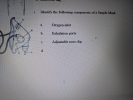 what is d pointing to on the simple mask
Identify the following components of a Simple Mask Oxygen inlet a. Exhalation ports ь clip Adjustable nose С. d
what is d pointing to on the simple mask
Identify the following components of a Simple Mask Oxygen inlet a. Exhalation ports ь clip Adjustable nose С. d
In statistical modeling, regression analysis helps you to: a. None of them b. estimate the relationships...
In statistical modeling, regression analysis helps you to: a. None of them b. estimate the relationships between two dependent variables and one independent variable. c. estimate the relationships between a dependent variable and one or more independent variables. d. calculate the exact values for the dependent and independent variables.
Question 1) Explain agent-based modeling, its purpose, its primary attributes, and where as an analysis and...
 Question 1) Explain agent-based modeling, its purpose, its primary attributes, and where as an analysis and simulation tool it is best suited for application to problem solving and research within the fields of engineering, business and the sciences.
 Modeling with Autodesk Inventor 6-26 Parametric Review Questions: (Time: 25 minutes) . What are the two types of wireframe geometry available in A 2 Can we create a profile with extra 2D geometry entities? do we access the Autodesk Inventor's Edit Sketch option? 3. How How do we create a profile in Autodesk Inventor? Can we build a profile that consists of self-intersecting curves? 5. a sketched 2D wireframe geometry 7. Can we create additional entities in a 2D sketch,...
 Shapes of Simple Molecules Choose the geometrical shapes that VSEPR theory pred icts for the following molecules or ions. (i.e. Predict the approximate geometrical arrangement of the bonds about the central atom.) NH3 PO33- CN22 CS2 Tries 0/5 Submit Answer Post Discussion Send Feedback
 nomework points) Shapes of Simple Molecules Choose the geometrical shapes that VSEPR theory predicts for the following molecules or ions. (i.e. Predict the approximate geometrical arrangement of the bonds about the central atom.) Cl20 DOCCI2 NH2 H3CCI Submit Answer Tries 0/5 e Post Discussion tai
 Parametric Modeling with Autodesk Inventor 11-36 Review Questions: (Time: 25 minutes) 1. List the different symmetrical features created in the Pulley design What are the advantages of using a drawing template? 2. Describe the steps required in using the Mirror Feature command. 3. 4. Why is it important to identify symmetrical features in designs? When and why should we use the Pattern option? 5. What are the required elements in order to generate a sectional view? 6. 7. How do...
 what is d pointing to on the simple mask
Identify the following components of a Simple Mask Oxygen inlet a. Exhalation ports ь clip Adjustable nose С. d
what is d pointing to on the simple mask
Identify the following components of a Simple Mask Oxygen inlet a. Exhalation ports ь clip Adjustable nose С. d
 Question 1) Explain agent-based modeling, its purpose, its primary attributes, and where as an analysis and simulation tool it is best suited for application to problem solving and research within the fields of engineering, business and the sciences.
Most questions answered within 3 hours.
-
Where is the error in this code sequence?
String s1 = "Hello";
String s2 = "ello";...
asked 11 months ago -
Financial data for Joel de Paris, Inc., for last year
follow:
Joel de Paris, Inc.
Balance...
asked 11 months ago -
Consider this reaction:
Al2(SO4)3 (aq)+ BaCl3
(aq) Al2Cl6 (aq)- +
3BaSO4(s) . What is the...
asked 11 months ago -
Suppose that Savneet is considering increasing her
recent random sample from 20 car rentals to 40...
asked 11 months ago -
Trucks arrive at an unloading terminal at an average rate of 120
per hour.
Trucks arrive...
asked 11 months ago -
Why are methanol and ethanol completely soluble in water while
octanol is not very little soluble....
asked 11 months ago -
A facilities manager at a university reads in a research report
that the mean amount of...
asked 11 months ago -
When the CuSO4 is rehydrated by adding water to the anhydrous
compound, is this an endothermic...
asked 11 months ago -
A ray of sunlight is passing from diamond into crown glass; the
angle of incidence is...
asked 11 months ago -
A block of mass 0.249 kg is placed on top of a light, vertical
spring of...
asked 11 months ago -
how do the kidneys compensate in the presences of acidosis
a) trigger hyperventilate
b) reserve acid...
asked 11 months ago -
Question 501 pts
The rental rate of capital to the firm increases. Which of the
following...
asked 11 months ago