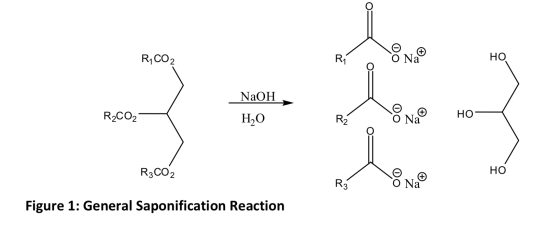
saponification of coconut oil with NaOH
1. What is the nucleophile in this reaction?
hydroxide???
2. Why doesn’t sodium acetate act as soap?
Sodium acetate cannot be used as soap because there is no non-polar hydrocarbon side component long enough to bind nonpolar dirt fats or oils. Without this organic component it cannot be used as soap.???
3. Detergents contain compounds that have a sulfonate group instead of a carboxylate. Why do detergents work better than soaps at all pH ranges?
4. Why wouldn’t you want to put ‘banana oil’ (isopentyl acetate) into this reaction before the solution begins to thicken?
-Banana oil is for scent and I have to wait to add it till it begins to thicken or else it will decompose.
Homework Answers
Part 1. Yes, the nucleophile in the saponification reaction is hydroxide (OH- = NaOH).
Part 2. Yes, sodium acetate can't be used as soap because it doesn't contain a nonpolar tail.
Part 3. Because the sulfonic acid moiety (SO3H) is more polar (polar head) than the carboxylic acid moiety (CO2H).
Part 4. Yes, you are correct!
Add Answer to:
saponification of coconut oil with NaOH 1. What is the nucleophile in this reaction? hydroxide??? 2. Why doesn’t sodium...
lab report on the preparation of soap (Saponification) 1. Write the reaction for the saponification of...
 lab report on the preparation of soap
(Saponification)
1. Write the reaction for the saponification of glyceryl tripalmitate with sodium 2. 3. 4. hydroxide. Why is the product of saponification called a salt? Why was ethanol added to the reaction mixture of fat and base? Do you think the solid soap that you made contains glycerol? Why or why not? Explain. 5. Describe the appearance of your soap. 6. Explain how soaps emulsify oils and fats. 7. Explain why soaps...
lab report on the preparation of soap
(Saponification)
1. Write the reaction for the saponification of glyceryl tripalmitate with sodium 2. 3. 4. hydroxide. Why is the product of saponification called a salt? Why was ethanol added to the reaction mixture of fat and base? Do you think the solid soap that you made contains glycerol? Why or why not? Explain. 5. Describe the appearance of your soap. 6. Explain how soaps emulsify oils and fats. 7. Explain why soaps...
Lab 12: Saponification – Making Soap Objective: To make soap using the process call saponification, an...
Lab 12: Saponification – Making Soap Objective: To make soap using the process call saponification, an organic form of the neutralization reaction that an acid reacts with a base to form a salt. Introduction: A soap is the sodium or potassium salt of a long chained carbohydrate called a fatty acid. A fatty acid usually contains between 12 – 18 carbon atoms. Fatty acids are esters of either animal or vegetable fats. They are called triglycerides if they are solids at room...
What would be my percent yield if i retrieved 3.1020 grams of soap? thank you, please show all work.
 what would be my percent yield if i retrieved 3.1020 grams of
soap? thank you, please show all work.
SAPONIFICATION (HYDROLYSIS OF A FAD Fats and edible oils consitute a special class of esters called riglycerides in which alcohol part of the molecule, the trihydroxy compound glycerol, forms with three molecules of various long-chain carboxylic acids (called fatty acids). Ty reactions of simple esters can also be carried out on fats and oils,i acid-or-base-catalyzed hydrolysis. three ester linkages carboxylic acids...
what would be my percent yield if i retrieved 3.1020 grams of
soap? thank you, please show all work.
SAPONIFICATION (HYDROLYSIS OF A FAD Fats and edible oils consitute a special class of esters called riglycerides in which alcohol part of the molecule, the trihydroxy compound glycerol, forms with three molecules of various long-chain carboxylic acids (called fatty acids). Ty reactions of simple esters can also be carried out on fats and oils,i acid-or-base-catalyzed hydrolysis. three ester linkages carboxylic acids...
Question 1 The following reaction between 2-methylbut-2-ene and hydrogen bromide (HBr) is best described as what...
 Question 1 The following reaction between 2-methylbut-2-ene and hydrogen bromide (HBr) is best described as what type of reaction? Refer to the Figure A) Addition B) Substitution C) Elimination D) Rearrangement Question 2 For the reaction in question 1, two products are possible- a major product, and a minor product. For the minor product, what is the splitting pattern for the added hydrogen (highlighted in red) that would be observed in the molecules HINMR spectrum? Refer to the Figure HBr...
 lab report on the preparation of soap
(Saponification)
1. Write the reaction for the saponification of glyceryl tripalmitate with sodium 2. 3. 4. hydroxide. Why is the product of saponification called a salt? Why was ethanol added to the reaction mixture of fat and base? Do you think the solid soap that you made contains glycerol? Why or why not? Explain. 5. Describe the appearance of your soap. 6. Explain how soaps emulsify oils and fats. 7. Explain why soaps...
lab report on the preparation of soap
(Saponification)
1. Write the reaction for the saponification of glyceryl tripalmitate with sodium 2. 3. 4. hydroxide. Why is the product of saponification called a salt? Why was ethanol added to the reaction mixture of fat and base? Do you think the solid soap that you made contains glycerol? Why or why not? Explain. 5. Describe the appearance of your soap. 6. Explain how soaps emulsify oils and fats. 7. Explain why soaps...
 what would be my percent yield if i retrieved 3.1020 grams of
soap? thank you, please show all work.
SAPONIFICATION (HYDROLYSIS OF A FAD Fats and edible oils consitute a special class of esters called riglycerides in which alcohol part of the molecule, the trihydroxy compound glycerol, forms with three molecules of various long-chain carboxylic acids (called fatty acids). Ty reactions of simple esters can also be carried out on fats and oils,i acid-or-base-catalyzed hydrolysis. three ester linkages carboxylic acids...
what would be my percent yield if i retrieved 3.1020 grams of
soap? thank you, please show all work.
SAPONIFICATION (HYDROLYSIS OF A FAD Fats and edible oils consitute a special class of esters called riglycerides in which alcohol part of the molecule, the trihydroxy compound glycerol, forms with three molecules of various long-chain carboxylic acids (called fatty acids). Ty reactions of simple esters can also be carried out on fats and oils,i acid-or-base-catalyzed hydrolysis. three ester linkages carboxylic acids...
 Question 1 The following reaction between 2-methylbut-2-ene and hydrogen bromide (HBr) is best described as what type of reaction? Refer to the Figure A) Addition B) Substitution C) Elimination D) Rearrangement Question 2 For the reaction in question 1, two products are possible- a major product, and a minor product. For the minor product, what is the splitting pattern for the added hydrogen (highlighted in red) that would be observed in the molecules HINMR spectrum? Refer to the Figure HBr...
Most questions answered within 3 hours.
-
Where is the error in this code sequence?
String s1 = "Hello";
String s2 = "ello";...
asked 11 months ago -
Financial data for Joel de Paris, Inc., for last year
follow:
Joel de Paris, Inc.
Balance...
asked 11 months ago -
Consider this reaction:
Al2(SO4)3 (aq)+ BaCl3
(aq) Al2Cl6 (aq)- +
3BaSO4(s) . What is the...
asked 11 months ago -
Suppose that Savneet is considering increasing her
recent random sample from 20 car rentals to 40...
asked 11 months ago -
Trucks arrive at an unloading terminal at an average rate of 120
per hour.
Trucks arrive...
asked 11 months ago -
Why are methanol and ethanol completely soluble in water while
octanol is not very little soluble....
asked 11 months ago -
A facilities manager at a university reads in a research report
that the mean amount of...
asked 11 months ago -
When the CuSO4 is rehydrated by adding water to the anhydrous
compound, is this an endothermic...
asked 11 months ago -
A ray of sunlight is passing from diamond into crown glass; the
angle of incidence is...
asked 11 months ago -
A block of mass 0.249 kg is placed on top of a light, vertical
spring of...
asked 11 months ago -
how do the kidneys compensate in the presences of acidosis
a) trigger hyperventilate
b) reserve acid...
asked 11 months ago -
Question 501 pts
The rental rate of capital to the firm increases. Which of the
following...
asked 11 months ago