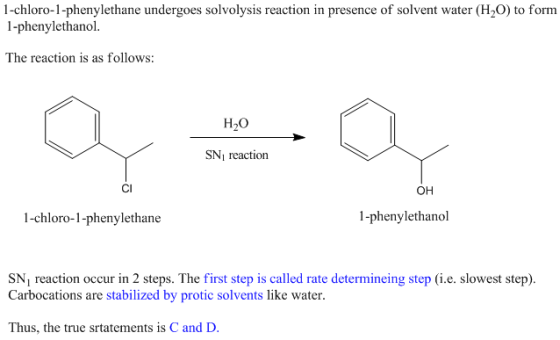
1-chloro-1-phenylethane undergoes solvolysis in water by an SN1 mechanism to make 1-phenylethanol. The reaction is follo...
1-chloro-1-phenylethane undergoes solvolysis in water by an SN1 mechanism to make 1-phenylethanol.
The reaction is followed with bromothymol blue indicator and an aliquot of sodium hydroxide base. Which of the following statements about the reaction are true? (more than one can apply)
A.Carbocations are destabilized by protic solvents like alcohols
B. The reaction can be followed because base is generated as a product.
C. The first step is the slowest because a bond is being broken.
D. Carbocations are stabilized by protic solvents like water.
Homework Answers
Add Answer to:
1-chloro-1-phenylethane undergoes solvolysis in water by an SN1 mechanism to make 1-phenylethanol. The reaction is follo...
The solvolysis of 1-chloro-1-phenylethane in water under Sn1 conditions produces 1-phenylethanol. Mapo The structure of 1-chloro-1-phenylethane...
 The solvolysis of 1-chloro-1-phenylethane in water under Sn1 conditions produces 1-phenylethanol. Mapo The structure of 1-chloro-1-phenylethane is shown as a 2D image and as a rotatable 3D image. Identify the chirality center by clicking on the chiral atom in the 3D image, then determine the absolute configuration at the chirality center. Click in the box to rotate the molecule in 3D. Click on any individual atom to highlight it in blue Note. Some hydrogens have been omitted from this structure...
Complete the mechanism for the solvolysis of 1-chloro-1-phenylethane in water under SN1 conditions by drawing in the...
 Complete the mechanism for the solvolysis of 1-chloro-1-phenylethane in water under SN1 conditions by drawing in the curved arrows where needed.
 The solvolysis of 1-chloro-1-phenylethane in water under Sn1 conditions produces 1-phenylethanol. Mapo The structure of 1-chloro-1-phenylethane is shown as a 2D image and as a rotatable 3D image. Identify the chirality center by clicking on the chiral atom in the 3D image, then determine the absolute configuration at the chirality center. Click in the box to rotate the molecule in 3D. Click on any individual atom to highlight it in blue Note. Some hydrogens have been omitted from this structure...
 Complete the mechanism for the solvolysis of 1-chloro-1-phenylethane in water under SN1 conditions by drawing in the curved arrows where needed.
Most questions answered within 3 hours.
-
Where is the error in this code sequence?
String s1 = "Hello";
String s2 = "ello";...
asked 10 months ago -
Financial data for Joel de Paris, Inc., for last year
follow:
Joel de Paris, Inc.
Balance...
asked 10 months ago -
Consider this reaction:
Al2(SO4)3 (aq)+ BaCl3
(aq) Al2Cl6 (aq)- +
3BaSO4(s) . What is the...
asked 10 months ago -
Suppose that Savneet is considering increasing her
recent random sample from 20 car rentals to 40...
asked 10 months ago -
Trucks arrive at an unloading terminal at an average rate of 120
per hour.
Trucks arrive...
asked 10 months ago -
Why are methanol and ethanol completely soluble in water while
octanol is not very little soluble....
asked 10 months ago -
A facilities manager at a university reads in a research report
that the mean amount of...
asked 10 months ago -
When the CuSO4 is rehydrated by adding water to the anhydrous
compound, is this an endothermic...
asked 10 months ago -
A ray of sunlight is passing from diamond into crown glass; the
angle of incidence is...
asked 10 months ago -
A block of mass 0.249 kg is placed on top of a light, vertical
spring of...
asked 10 months ago -
how do the kidneys compensate in the presences of acidosis
a) trigger hyperventilate
b) reserve acid...
asked 10 months ago -
Question 501 pts
The rental rate of capital to the firm increases. Which of the
following...
asked 10 months ago