If you had stearic acid in a hexane solution and some of the hexane evaporated, what would happen to the Avogadro’s numb...
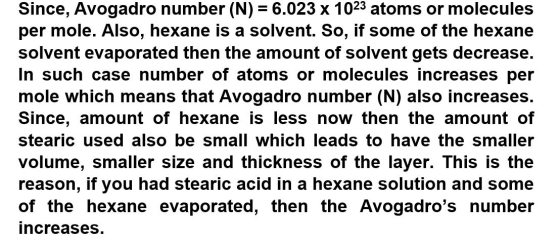
If you had stearic acid in a hexane solution and some of the hexane evaporated, what would happen to the Avogadro’s number and why?
Thank you.
Homework Answers
Add Answer to:
If you had stearic acid in a hexane solution and some of the hexane evaporated, what would happen to the Avogadro’s numb...
1. The stearic acid/hexane solution contains 0.1 g of stearic acid per 1 mL of solution....
1. The stearic acid/hexane solution contains 0.1 g of stearic acid per 1 mL of solution. What is the molarity of this solution?
What would happen if you had used a 1:1 mixture of ethyl acetate instead of hexane...
What would happen if you had used a 1:1 mixture of ethyl acetate instead of hexane to elute your column? Would the product (DEET) have come out faster or slower? Would this have improved your separation, or made it worse?
If you added too much acetic acid to the milk solution , what would happen to...
If you added too much acetic acid to the milk solution , what would happen to the lactose? Please, draw the products of the reaction that would occur. Thank you!
what problems do you see in assuming that the stearic molecules exist as rectangular prisms. based...
what problems do you see in assuming that the stearic molecules exist as rectangular prisms. based on molecular structure? comment on the role. of counting drops of stearic acid solution in the accuracy of determining avogadros number? the assumption. is made that the stearic acid molecules line up perfectly to cover. the surface. what issues do you see with that assumption and how might. those cause discrepancy in the calculated value for avogrados number
You determined the molar mass of an unknown fatty acid 3 dissolved into stearic acid to...
You determined the molar mass of an unknown fatty acid 3 dissolved into stearic acid to be 219.4 g/mol. Unknown fatty acid 3 was myristic acid, which has a molar mass of 228.37 g/mol. What was your percent error to the correct number of significant figures?
If you failed to dry the ether solution before evaporating it, what would you see in...
If you failed to dry the ether solution before evaporating it, what would you see in the flask after the ether had evaporated, how would this affect your yield, your melting point?
Question 16 (1 point) Suppose some blood cells were in a hypertonic solution. What would happen...
 Question 16 (1 point) Suppose some blood cells were in a hypertonic solution. What would happen to them? They would shrink. They would remain the same size. They would expand. The outcome is not predictable.
6.90. Benzene and hexane are being considered as solvents to extract acetic acid from aqueous mixtures At 30°C, dis...
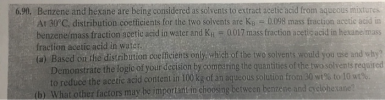 6.90. Benzene and hexane are being considered as solvents to extract acetic acid from aqueous mixtures At 30°C, distribution coefficients for the two solvents are KB-0.098 mass fraction acetic acid in benzene/mass traction acetic acid in water and KH 0017 mass fraction acetic acid in hexane mass fraction acetic acid in water (a) Based on the distribution coefficients only, which of the two solvents would you use and why? Demonstrate the logic of your decision by comparing the quantities of...
Name: Date: Instructor's Initials: Lab Section: Enthalpy PreLab What would happen if you used a wet...
 Name: Date: Instructor's Initials: Lab Section: Enthalpy PreLab What would happen if you used a wet beaker to obtain your acid solution? How might this affect your results? 2. What is the difference between heat capacity and specific heat? 3. What is the purpose of using volumetric glassware for this experiment? 4. Why rinse the pipet three times with the solution to be used? How many ml of solution should be used to rinse the 100.00 mL pipet-5 mL, 10...
POST-LAB QUESTIONS 1. What would happen if you added more than 5 mL of yeast solution...
POST-LAB QUESTIONS 1. What would happen if you added more than 5 mL of yeast solution to the H2O2? 2. What would happen if you added more than 5 mL of H2O2 to the 5 mL of yeast solution?
 Question 16 (1 point) Suppose some blood cells were in a hypertonic solution. What would happen to them? They would shrink. They would remain the same size. They would expand. The outcome is not predictable.
 6.90. Benzene and hexane are being considered as solvents to extract acetic acid from aqueous mixtures At 30°C, distribution coefficients for the two solvents are KB-0.098 mass fraction acetic acid in benzene/mass traction acetic acid in water and KH 0017 mass fraction acetic acid in hexane mass fraction acetic acid in water (a) Based on the distribution coefficients only, which of the two solvents would you use and why? Demonstrate the logic of your decision by comparing the quantities of...
 Name: Date: Instructor's Initials: Lab Section: Enthalpy PreLab What would happen if you used a wet beaker to obtain your acid solution? How might this affect your results? 2. What is the difference between heat capacity and specific heat? 3. What is the purpose of using volumetric glassware for this experiment? 4. Why rinse the pipet three times with the solution to be used? How many ml of solution should be used to rinse the 100.00 mL pipet-5 mL, 10...
Most questions answered within 3 hours.
-
Where is the error in this code sequence?
String s1 = "Hello";
String s2 = "ello";...
asked 10 months ago -
Financial data for Joel de Paris, Inc., for last year
follow:
Joel de Paris, Inc.
Balance...
asked 10 months ago -
Consider this reaction:
Al2(SO4)3 (aq)+ BaCl3
(aq) Al2Cl6 (aq)- +
3BaSO4(s) . What is the...
asked 10 months ago -
Suppose that Savneet is considering increasing her
recent random sample from 20 car rentals to 40...
asked 10 months ago -
Trucks arrive at an unloading terminal at an average rate of 120
per hour.
Trucks arrive...
asked 10 months ago -
Why are methanol and ethanol completely soluble in water while
octanol is not very little soluble....
asked 10 months ago -
A facilities manager at a university reads in a research report
that the mean amount of...
asked 10 months ago -
When the CuSO4 is rehydrated by adding water to the anhydrous
compound, is this an endothermic...
asked 10 months ago -
A ray of sunlight is passing from diamond into crown glass; the
angle of incidence is...
asked 10 months ago -
A block of mass 0.249 kg is placed on top of a light, vertical
spring of...
asked 10 months ago -
how do the kidneys compensate in the presences of acidosis
a) trigger hyperventilate
b) reserve acid...
asked 10 months ago -
Question 501 pts
The rental rate of capital to the firm increases. Which of the
following...
asked 10 months ago