
Homework Answers
![F1om continuiy equohion we ave V.j0 Noto probability denaiy f= af at Nouo since sahisfie Schroedi nge en. Vi]t = the complex](http://img.homeworklib.com/images/9157391e-8fe0-4d17-a932-7dcea58ffbe9.png?x-oss-process=image/resize,w_560)
Add Answer to:
9. From the continuity eq.. derive J 2m i (.A#-A,4) 9. From the continuity eq.. derive J 2m i (.A#-A,4)
6. In the context of Bohr's theory, derive the quantization of energy [Eq. (4)] from the...
 6. In the context of Bohr's theory, derive the quantization of energy [Eq. (4)] from the quantization of angular momentum [Eq. (3)].
Q3:-Derive the discretization equations for the following differential eq.:- a con +S=0 (roman + dy A):-...
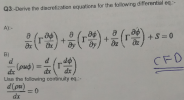 Q3:-Derive the discretization equations for the following differential eq.:- a con +S=0 (roman + dy A):- ad a + ax ax Oy B) d d do I dx dx Use the following continuity eq.:- d(pu) 0 CFD di (oud)
Exercises 81.1 Derive the recurrence relations from the Euler integral (Eq. (8.5),
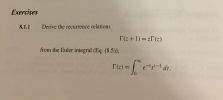 Exercises 81.1 Derive the recurrence relations from the Euler integral (Eq. (8.5),
using an equation like eq 3, derive the expression for k given in eq 4 Equation...
 using an equation like eq 3, derive the expression for k given
in eq 4
Equation 3 Co2 2.303 log [R-CIDO [R-Cl]o - 0.5[R-CN) kt1/2 = 2.303 log 2 = k = 0.693 / 112 Similarly, we can also solve fork in terms of t1/10, the time required for one-tenth of the starting material to react. Equation 4 k = 0.1054 /t 1/10
using an equation like eq 3, derive the expression for k given
in eq 4
Equation 3 Co2 2.303 log [R-CIDO [R-Cl]o - 0.5[R-CN) kt1/2 = 2.303 log 2 = k = 0.693 / 112 Similarly, we can also solve fork in terms of t1/10, the time required for one-tenth of the starting material to react. Equation 4 k = 0.1054 /t 1/10
1. Use Eq. 1 to derive an expression for the expected output waveform from an ideal...
 1. Use Eq. 1 to derive an expression for the expected output waveform from an ideal differentiator circuit having input waveform Vin=lsin[(21)1000t] V. Let RF1.5 k12 and C=10 nF. 2. Use Eq. 3 to find the peak-peak output amplitude of the ideal differentiator of question 1 for a 2 Vpp sine wave input at 1 kHz and 2 kHz. Put the results in the Calculated Output column of Table 1 in Appendix A. 3. Use the indefinite integral version of...
I NEED HELP WITH QUESTION #9 QUESTION #9: From Eq. 9-9, which plot in Fig. 9-2...
 I NEED HELP WITH QUESTION #9
QUESTION #9: From Eq. 9-9, which plot in Fig. 9-2 describes the
impedance for an inductor?
II IV N N z N f f f Figure 9-2. Possible impedance vs frequency plots. PREPARATION The impedance of an inductor also varies with frequency. Inductive reactance (XL) is given by the following: X = 2nfl (9-8) For a circuit with a resistor, and inductor in series with each other, the total impedance is then given by:...
I NEED HELP WITH QUESTION #9
QUESTION #9: From Eq. 9-9, which plot in Fig. 9-2 describes the
impedance for an inductor?
II IV N N z N f f f Figure 9-2. Possible impedance vs frequency plots. PREPARATION The impedance of an inductor also varies with frequency. Inductive reactance (XL) is given by the following: X = 2nfl (9-8) For a circuit with a resistor, and inductor in series with each other, the total impedance is then given by:...
From the conservation law aplat+0, (a) derive the expression of j, where p = \012 (b)...
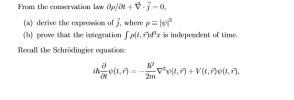 From the conservation law aplat+0, (a) derive the expression of j, where p = \012 (b) prove that the integration Solt,r)dx is independent of time. Recall the Schrödingier equation: 12 in mult, 7) vy(t,r) + V (1,7) (t,r), 2m
In addition, derive the "wave equation" for an incompressible fluid. Use the continuity equation and the...
 In addition, derive the "wave equation" for an incompressible
fluid. Use the continuity equation and the linearized euler
equation.
Linearized Euler:
A flow is incompressible if a fluid element does not change its density as the element moves. From Problem 54.1, this means (7p/dt) u . ρ-0. (a) Show that for an incompressible fluid the equation of continuity reduces to V -u -0. (b) Write Euler's equation for the flow of an incompressible fluid. (c) What is c for an...
In addition, derive the "wave equation" for an incompressible
fluid. Use the continuity equation and the linearized euler
equation.
Linearized Euler:
A flow is incompressible if a fluid element does not change its density as the element moves. From Problem 54.1, this means (7p/dt) u . ρ-0. (a) Show that for an incompressible fluid the equation of continuity reduces to V -u -0. (b) Write Euler's equation for the flow of an incompressible fluid. (c) What is c for an...
a) Derive from the definition of the clectric current I = [s df - j through...
 a) Derive from the definition of the clectric current I = [s df - j through the arca S the dwhere dQ is the charge formula for the electric current inside a conducting wire I which flows through the cross section of the wire in the time dt stationary charge distribution, 2n wire have to be equal and independent of the cross sections of the wire both ends of the b) Show that for a 0, the currents on OSS...
at .2M and 10 mL pH= 2.78 at .02M and 1mL pH=3.32 a) Determine the [H3O+]eq...
at .2M and 10 mL pH= 2.78 at .02M and 1mL pH=3.32 a) Determine the [H3O+]eq from the pH values for each solution. b) Construct ICE tables and use the initial molarity of [HC2H3O2] for each diluted solution, the equilibrium concentration for [H3O+]eq and the equation below to determine [C2H3O2–]eq and [HC2H3O2]eq. HC2H3O2(aq) + H2O (l)--> H3O+(aq) + C2H3O2–(aq) c. Write the Ka expression for the acid dissociation reaction and substitute the calculated equilibrium concentrations in to determine the Ka...
 6. In the context of Bohr's theory, derive the quantization of energy [Eq. (4)] from the quantization of angular momentum [Eq. (3)].
 Q3:-Derive the discretization equations for the following differential eq.:- a con +S=0 (roman + dy A):- ad a + ax ax Oy B) d d do I dx dx Use the following continuity eq.:- d(pu) 0 CFD di (oud)
 Exercises 81.1 Derive the recurrence relations from the Euler integral (Eq. (8.5),
 using an equation like eq 3, derive the expression for k given
in eq 4
Equation 3 Co2 2.303 log [R-CIDO [R-Cl]o - 0.5[R-CN) kt1/2 = 2.303 log 2 = k = 0.693 / 112 Similarly, we can also solve fork in terms of t1/10, the time required for one-tenth of the starting material to react. Equation 4 k = 0.1054 /t 1/10
using an equation like eq 3, derive the expression for k given
in eq 4
Equation 3 Co2 2.303 log [R-CIDO [R-Cl]o - 0.5[R-CN) kt1/2 = 2.303 log 2 = k = 0.693 / 112 Similarly, we can also solve fork in terms of t1/10, the time required for one-tenth of the starting material to react. Equation 4 k = 0.1054 /t 1/10
 1. Use Eq. 1 to derive an expression for the expected output waveform from an ideal differentiator circuit having input waveform Vin=lsin[(21)1000t] V. Let RF1.5 k12 and C=10 nF. 2. Use Eq. 3 to find the peak-peak output amplitude of the ideal differentiator of question 1 for a 2 Vpp sine wave input at 1 kHz and 2 kHz. Put the results in the Calculated Output column of Table 1 in Appendix A. 3. Use the indefinite integral version of...
 I NEED HELP WITH QUESTION #9
QUESTION #9: From Eq. 9-9, which plot in Fig. 9-2 describes the
impedance for an inductor?
II IV N N z N f f f Figure 9-2. Possible impedance vs frequency plots. PREPARATION The impedance of an inductor also varies with frequency. Inductive reactance (XL) is given by the following: X = 2nfl (9-8) For a circuit with a resistor, and inductor in series with each other, the total impedance is then given by:...
I NEED HELP WITH QUESTION #9
QUESTION #9: From Eq. 9-9, which plot in Fig. 9-2 describes the
impedance for an inductor?
II IV N N z N f f f Figure 9-2. Possible impedance vs frequency plots. PREPARATION The impedance of an inductor also varies with frequency. Inductive reactance (XL) is given by the following: X = 2nfl (9-8) For a circuit with a resistor, and inductor in series with each other, the total impedance is then given by:...
 From the conservation law aplat+0, (a) derive the expression of j, where p = \012 (b) prove that the integration Solt,r)dx is independent of time. Recall the Schrödingier equation: 12 in mult, 7) vy(t,r) + V (1,7) (t,r), 2m
 In addition, derive the "wave equation" for an incompressible
fluid. Use the continuity equation and the linearized euler
equation.
Linearized Euler:
A flow is incompressible if a fluid element does not change its density as the element moves. From Problem 54.1, this means (7p/dt) u . ρ-0. (a) Show that for an incompressible fluid the equation of continuity reduces to V -u -0. (b) Write Euler's equation for the flow of an incompressible fluid. (c) What is c for an...
In addition, derive the "wave equation" for an incompressible
fluid. Use the continuity equation and the linearized euler
equation.
Linearized Euler:
A flow is incompressible if a fluid element does not change its density as the element moves. From Problem 54.1, this means (7p/dt) u . ρ-0. (a) Show that for an incompressible fluid the equation of continuity reduces to V -u -0. (b) Write Euler's equation for the flow of an incompressible fluid. (c) What is c for an...
 a) Derive from the definition of the clectric current I = [s df - j through the arca S the dwhere dQ is the charge formula for the electric current inside a conducting wire I which flows through the cross section of the wire in the time dt stationary charge distribution, 2n wire have to be equal and independent of the cross sections of the wire both ends of the b) Show that for a 0, the currents on OSS...
Most questions answered within 3 hours.
-
Where is the error in this code sequence?
String s1 = "Hello";
String s2 = "ello";...
asked 10 months ago -
Financial data for Joel de Paris, Inc., for last year
follow:
Joel de Paris, Inc.
Balance...
asked 10 months ago -
Consider this reaction:
Al2(SO4)3 (aq)+ BaCl3
(aq) Al2Cl6 (aq)- +
3BaSO4(s) . What is the...
asked 10 months ago -
Suppose that Savneet is considering increasing her
recent random sample from 20 car rentals to 40...
asked 10 months ago -
Trucks arrive at an unloading terminal at an average rate of 120
per hour.
Trucks arrive...
asked 10 months ago -
Why are methanol and ethanol completely soluble in water while
octanol is not very little soluble....
asked 10 months ago -
A facilities manager at a university reads in a research report
that the mean amount of...
asked 10 months ago -
When the CuSO4 is rehydrated by adding water to the anhydrous
compound, is this an endothermic...
asked 10 months ago -
A ray of sunlight is passing from diamond into crown glass; the
angle of incidence is...
asked 10 months ago -
A block of mass 0.249 kg is placed on top of a light, vertical
spring of...
asked 10 months ago -
how do the kidneys compensate in the presences of acidosis
a) trigger hyperventilate
b) reserve acid...
asked 10 months ago -
Question 501 pts
The rental rate of capital to the firm increases. Which of the
following...
asked 10 months ago