
Homework Answers
Add Answer to:
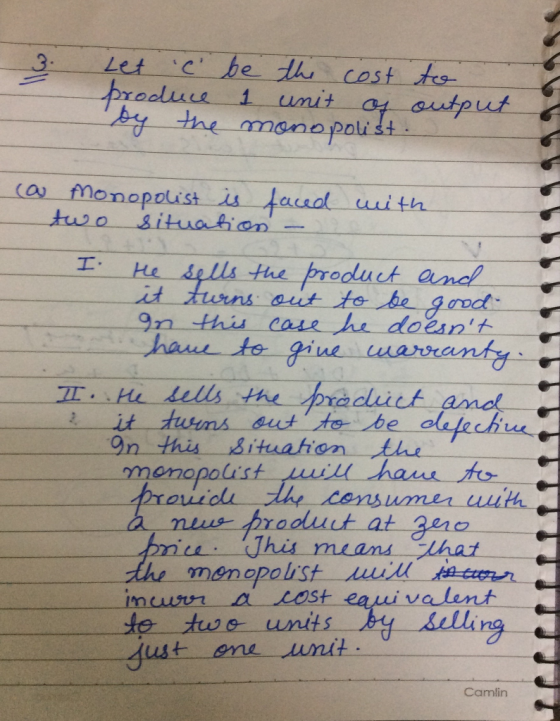
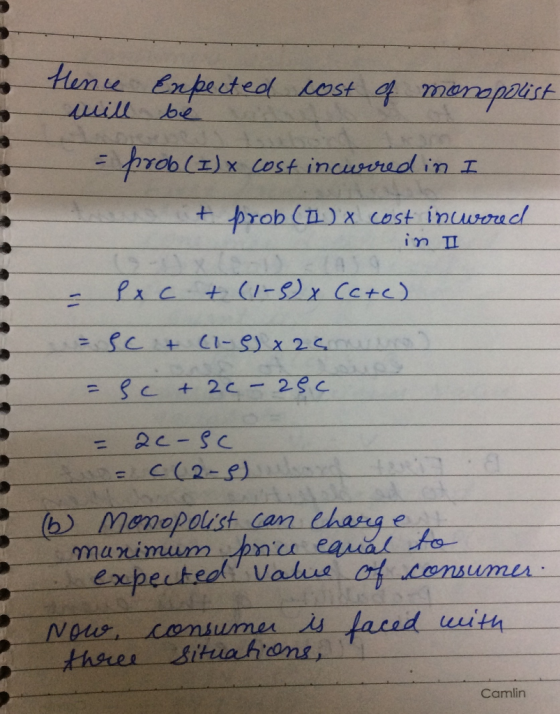
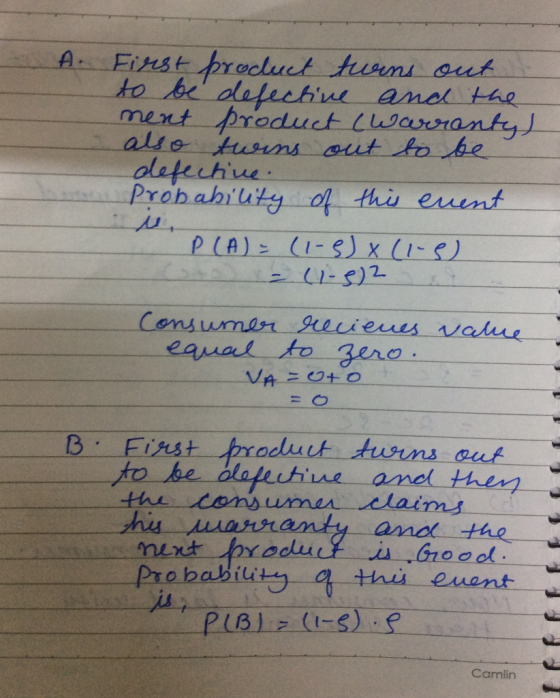
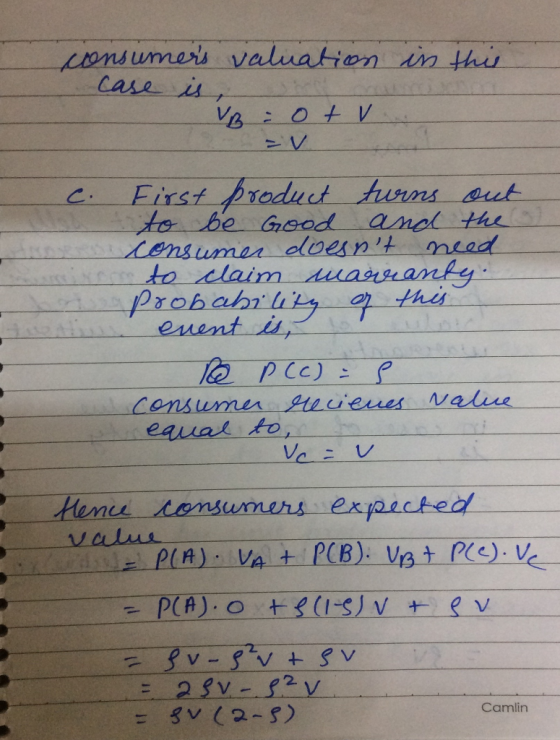
3. Consider the monopoly's warranty problem under symmetric information analyzed in the lecture. The value of a...
2. Consider a world in which a risk-neutral monopolist offers a product for sale. The product costs c = $60. In each pe...
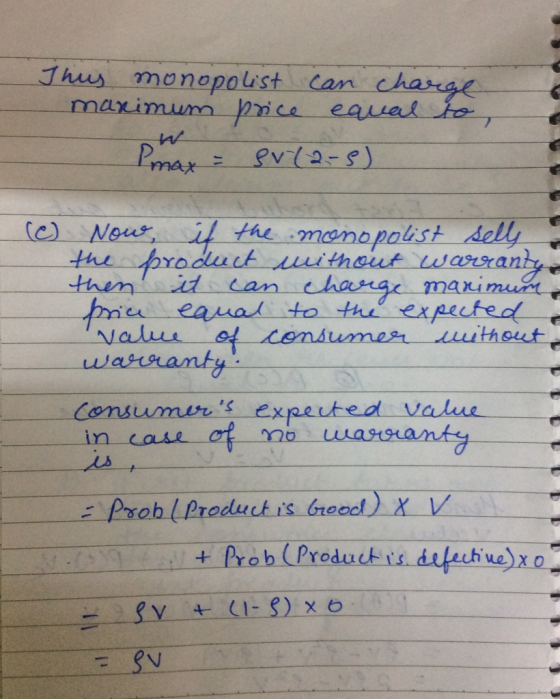
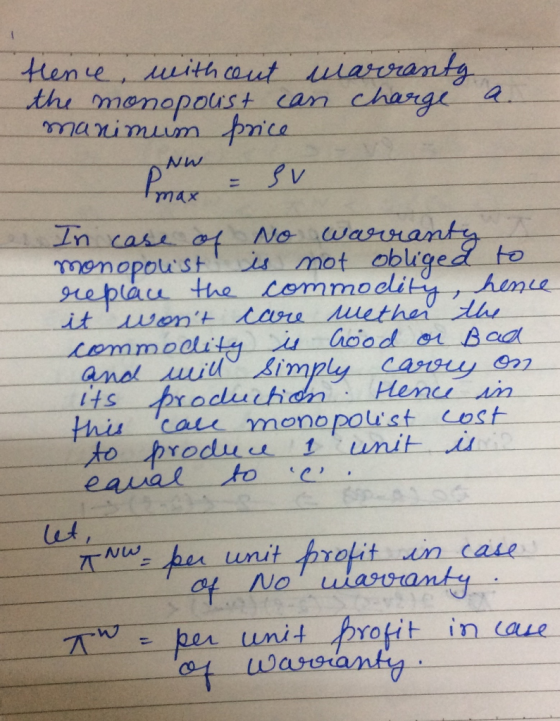
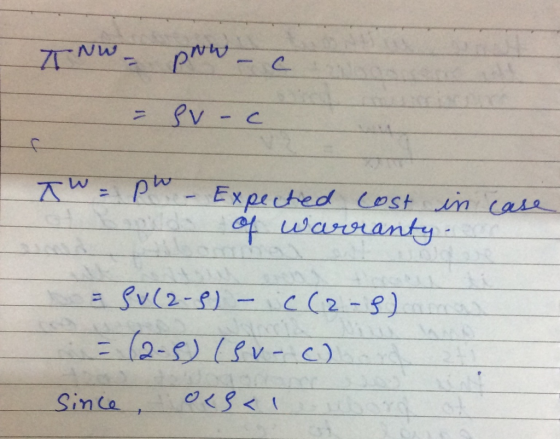
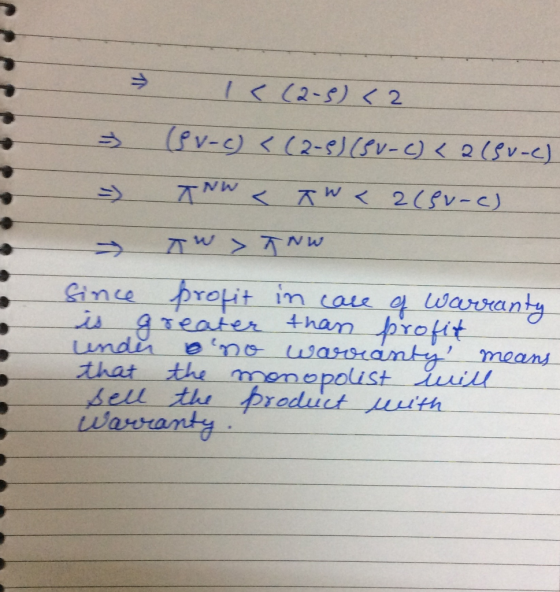
 2. Consider a world in which a risk-neutral monopolist offers a product for sale. The product costs c = $60. In each period, the product can either be fully functional or totally defective. It is totally defective with probability 0.2 and is thus fully operative with probability p = 0.8. These events are independent across periods. Consumers, who are all risk-neutral, have valuation of V = $120 for a fully-functional product and zero for a totally defective product. In any...
explain each step please 2. Consider a world in which a risk-neutral monopolist offers a product...
 explain each step please
2. Consider a world in which a risk-neutral monopolist offers a product for sale. The product costs c = $60. In each period, the product can either be fully functional or totally defective. It is totally defective with probability 0.2 and is thus fully operative with probability p = 0.8. These events are independent across periods. Consumers, who are all risk-neutral, have valuation of V = $120 for a fully-functional product and zero for a totally...
explain each step please
2. Consider a world in which a risk-neutral monopolist offers a product for sale. The product costs c = $60. In each period, the product can either be fully functional or totally defective. It is totally defective with probability 0.2 and is thus fully operative with probability p = 0.8. These events are independent across periods. Consumers, who are all risk-neutral, have valuation of V = $120 for a fully-functional product and zero for a totally...
solve problem #1 depending on the given information Consider the following 1D second order elliptic equation with Dirichlet boundary conditions du(x) (c(x)du ) = f(x) (a $15 b), u(a) = ga, u(b) = gb...
 solve problem #1 depending on the given information
Consider the following 1D second order elliptic equation with Dirichlet boundary conditions du(x) (c(x)du ) = f(x) (a $15 b), u(a) = ga, u(b) = gb dr: where u(x) is the unknown function, ga and gb are the Dirichlet boundary values, c(x) is a given coefficient function and f(x) is a given source function. See the theorem 10.1 in the textbook for the existence and uniqueness of the solution. 1.1 Weak Formulation...
solve problem #1 depending on the given information
Consider the following 1D second order elliptic equation with Dirichlet boundary conditions du(x) (c(x)du ) = f(x) (a $15 b), u(a) = ga, u(b) = gb dr: where u(x) is the unknown function, ga and gb are the Dirichlet boundary values, c(x) is a given coefficient function and f(x) is a given source function. See the theorem 10.1 in the textbook for the existence and uniqueness of the solution. 1.1 Weak Formulation...
Problem 1: Drawing from an Urn (no posted data set) We will be comparing empirical probabilities...
Problem 1: Drawing from an Urn (no posted data set) We will be comparing empirical probabilities (relative frequencies based on an observation of a real-life process) to theoretical probabilities (long-run relative frequency). We will use StatCrunch to simulate this process of drawing colored balls from an urn without replacement. Imagine this urn has 50 total balls, 18 of which are red and 32 of which are green. You draw 6 balls from the urn and we are interested in the...
1/ Consider the following table. Defects in batch Probability 2 0.18 3 0.29 4 0.18 5...
1/ Consider the following table. Defects in batch Probability 2 0.18 3 0.29 4 0.18 5 0.14 6 0.11 7 0.10 Find the standard deviation of this variable. 1.52 4.01 1.58 2.49 2/ The standard deviation of samples from supplier A is 0.0841, while the standard deviation of samples from supplier B is 0.0926. Which supplier would you be likely to choose based on these data and why? Supplier B, as their standard deviation is higher and, thus, easier to...
1. We reject the null hypothesis only when: a. our sample mean is larger than the population mean. b. the p value asso...
1. We reject the null hypothesis only when: a. our sample mean is larger than the population mean. b. the p value associated with our test statistic is greater than the significance level of the test we have chosen. c. our sample mean is smaller than the population mean. d. the p value associated with our test statistic is smaller than the significance level of the test we have chosen. 2. In a study of simulated juror decision making, researchers...
could you please help me with this problem, also I need a little text so I...
 could you please help me with this problem, also I
need a little text so I can understand how you solved the
problem?
import java.io.File; import java.util.Scanner; /** *
This program lists the files in a directory specified by * the
user. The user is asked to type in a directory name. * If the name
entered by the user is not a directory, a * message is printed and
the program ends. */ public class DirectoryList { public static...
could you please help me with this problem, also I
need a little text so I can understand how you solved the
problem?
import java.io.File; import java.util.Scanner; /** *
This program lists the files in a directory specified by * the
user. The user is asked to type in a directory name. * If the name
entered by the user is not a directory, a * message is printed and
the program ends. */ public class DirectoryList { public static...
Consider a cylindrical capacitor like that shown in Fig. 24.6. Let d = rb − ra...
 Consider a cylindrical capacitor like that shown in Fig. 24.6. Let d = rb − ra be the spacing between the inner and outer conductors. (a) Let the radii of the two conductors be only slightly different, so that d << ra. Show that the result derived in Example 24.4 (Section 24.1) for the capacitance of a cylindrical capacitor then reduces to Eq. (24.2), the equation for the capacitance of a parallel-plate capacitor, with A being the surface area of...
JOHNSON & JOHNSON AND SUBSIDIARIES CONSOLIDATED STATEMENTS OF EARNINGS (Dollars and Shares in Millions Except Per...
 JOHNSON & JOHNSON AND SUBSIDIARIES CONSOLIDATED STATEMENTS OF EARNINGS (Dollars and Shares in Millions Except Per Share Amounts) (Note 1)* 2016 71,890 21,789 50.101 20,067 9.143 29 Sales to customers Cost of products sold Gross profit Selling, marketing and administrative expenses Research and development expense In-process research and development Interest income Interest expense, net of portion capitalized (Note 4) Other (income) expense, net Restructuring (Note 22) Eamings before provision for taxes on income Provision for taxes on income (Note 8)...
JOHNSON & JOHNSON AND SUBSIDIARIES CONSOLIDATED STATEMENTS OF EARNINGS (Dollars and Shares in Millions Except Per...
 JOHNSON & JOHNSON AND SUBSIDIARIES CONSOLIDATED STATEMENTS OF EARNINGS (Dollars and Shares in Millions Except Per Share Amounts) (Note 1)* 2016 71,890 21,789 50.101 20,067 9.143 29 Sales to customers Cost of products sold Gross profit Selling, marketing and administrative expenses Research and development expense In-process research and development Interest income Interest expense, net of portion capitalized (Note 4) Other (income) expense, net Restructuring (Note 22) Eamings before provision for taxes on income Provision for taxes on income (Note 8)...
 2. Consider a world in which a risk-neutral monopolist offers a product for sale. The product costs c = $60. In each period, the product can either be fully functional or totally defective. It is totally defective with probability 0.2 and is thus fully operative with probability p = 0.8. These events are independent across periods. Consumers, who are all risk-neutral, have valuation of V = $120 for a fully-functional product and zero for a totally defective product. In any...
 explain each step please
2. Consider a world in which a risk-neutral monopolist offers a product for sale. The product costs c = $60. In each period, the product can either be fully functional or totally defective. It is totally defective with probability 0.2 and is thus fully operative with probability p = 0.8. These events are independent across periods. Consumers, who are all risk-neutral, have valuation of V = $120 for a fully-functional product and zero for a totally...
explain each step please
2. Consider a world in which a risk-neutral monopolist offers a product for sale. The product costs c = $60. In each period, the product can either be fully functional or totally defective. It is totally defective with probability 0.2 and is thus fully operative with probability p = 0.8. These events are independent across periods. Consumers, who are all risk-neutral, have valuation of V = $120 for a fully-functional product and zero for a totally...
 solve problem #1 depending on the given information
Consider the following 1D second order elliptic equation with Dirichlet boundary conditions du(x) (c(x)du ) = f(x) (a $15 b), u(a) = ga, u(b) = gb dr: where u(x) is the unknown function, ga and gb are the Dirichlet boundary values, c(x) is a given coefficient function and f(x) is a given source function. See the theorem 10.1 in the textbook for the existence and uniqueness of the solution. 1.1 Weak Formulation...
solve problem #1 depending on the given information
Consider the following 1D second order elliptic equation with Dirichlet boundary conditions du(x) (c(x)du ) = f(x) (a $15 b), u(a) = ga, u(b) = gb dr: where u(x) is the unknown function, ga and gb are the Dirichlet boundary values, c(x) is a given coefficient function and f(x) is a given source function. See the theorem 10.1 in the textbook for the existence and uniqueness of the solution. 1.1 Weak Formulation...
 could you please help me with this problem, also I
need a little text so I can understand how you solved the
problem?
import java.io.File; import java.util.Scanner; /** *
This program lists the files in a directory specified by * the
user. The user is asked to type in a directory name. * If the name
entered by the user is not a directory, a * message is printed and
the program ends. */ public class DirectoryList { public static...
could you please help me with this problem, also I
need a little text so I can understand how you solved the
problem?
import java.io.File; import java.util.Scanner; /** *
This program lists the files in a directory specified by * the
user. The user is asked to type in a directory name. * If the name
entered by the user is not a directory, a * message is printed and
the program ends. */ public class DirectoryList { public static...
 Consider a cylindrical capacitor like that shown in Fig. 24.6. Let d = rb − ra be the spacing between the inner and outer conductors. (a) Let the radii of the two conductors be only slightly different, so that d << ra. Show that the result derived in Example 24.4 (Section 24.1) for the capacitance of a cylindrical capacitor then reduces to Eq. (24.2), the equation for the capacitance of a parallel-plate capacitor, with A being the surface area of...
 JOHNSON & JOHNSON AND SUBSIDIARIES CONSOLIDATED STATEMENTS OF EARNINGS (Dollars and Shares in Millions Except Per Share Amounts) (Note 1)* 2016 71,890 21,789 50.101 20,067 9.143 29 Sales to customers Cost of products sold Gross profit Selling, marketing and administrative expenses Research and development expense In-process research and development Interest income Interest expense, net of portion capitalized (Note 4) Other (income) expense, net Restructuring (Note 22) Eamings before provision for taxes on income Provision for taxes on income (Note 8)...
 JOHNSON & JOHNSON AND SUBSIDIARIES CONSOLIDATED STATEMENTS OF EARNINGS (Dollars and Shares in Millions Except Per Share Amounts) (Note 1)* 2016 71,890 21,789 50.101 20,067 9.143 29 Sales to customers Cost of products sold Gross profit Selling, marketing and administrative expenses Research and development expense In-process research and development Interest income Interest expense, net of portion capitalized (Note 4) Other (income) expense, net Restructuring (Note 22) Eamings before provision for taxes on income Provision for taxes on income (Note 8)...
Most questions answered within 3 hours.
-
Where is the error in this code sequence?
String s1 = "Hello";
String s2 = "ello";...
asked 10 months ago -
Financial data for Joel de Paris, Inc., for last year
follow:
Joel de Paris, Inc.
Balance...
asked 10 months ago -
Consider this reaction:
Al2(SO4)3 (aq)+ BaCl3
(aq) Al2Cl6 (aq)- +
3BaSO4(s) . What is the...
asked 10 months ago -
Suppose that Savneet is considering increasing her
recent random sample from 20 car rentals to 40...
asked 10 months ago -
Trucks arrive at an unloading terminal at an average rate of 120
per hour.
Trucks arrive...
asked 10 months ago -
Why are methanol and ethanol completely soluble in water while
octanol is not very little soluble....
asked 10 months ago -
A facilities manager at a university reads in a research report
that the mean amount of...
asked 10 months ago -
When the CuSO4 is rehydrated by adding water to the anhydrous
compound, is this an endothermic...
asked 10 months ago -
A ray of sunlight is passing from diamond into crown glass; the
angle of incidence is...
asked 10 months ago -
A block of mass 0.249 kg is placed on top of a light, vertical
spring of...
asked 10 months ago -
how do the kidneys compensate in the presences of acidosis
a) trigger hyperventilate
b) reserve acid...
asked 10 months ago -
Question 501 pts
The rental rate of capital to the firm increases. Which of the
following...
asked 10 months ago