a) Compare a firm's informational needs to engage in 1st, 2nd and 3rd degree price discrimination. b) In second degree...
Homework Answers
A) Price discrimination is a strategy that consists of a business or seller charging a different price to various customers for the same product or service. It is one of the competitive practices used by larger, established businesses in an attempt to profit from differences in supply and demand from consumers.
A company can enhance its profits by charging each customer the maximum amount he is willing to pay, eliminating consumer surplus, but it is often a challenge to determine what that exact price is for every buyer. The most common types of price discrimination are first, second, and third-degree discrimination.
First degree
First-degree price discrimination, alternatively known as perfect price discrimination, occurs when a firm charges a different price for every unit consumed. The firm is able to charge the maximum possible price for each unit which enables the firm to capture all available consumer surplus for itself. In practice, first-degree discrimination is rare.
Second degree
Second-degree price discrimination means charging a different price for different quantities, such as quantity discounts for bulk purchases.
Third-degree
Third-degree price discrimination means charging a different price to different consumer groups. For example, rail and tube travelers can be subdivided into a commuter and casual travelers, and cinema goers can be subdivided into adults and children. Splitting the market into peak and off-peak use is very common and occurs with gas, electricity, and telephone supply, as well as gym membership and parking charges. Third-degree discrimination is the commonest type. Conditions for successful discrimination:
-
The firm must be able to identify different market segments, such as domestic users and industrial users.
-
Different segments must have different price elasticities (PEDs).
-
Markets must be kept separate, either by time, physical distance and nature of use. Time-based pricing - also called dynamic pricing - is increasingly common in goods and services sold online. In this case, prices can vary by the second, based on real-time demand related to consumers' online activity.
-
There must be no seepage between the two markets, which means that a consumer cannot purchase at the low price in the elastic sub-market, and then re-sell to other consumers in the inelastic sub-market, at a higher price.
-
The firm must have some degree of monopoly power.
B) Second-degree price discrimination, or nonlinear pricing, involves setting prices subject to the amount bought, in an attempt to capture part of the consumer surplus. Revenues collected by the firm in this matter will be a nonlinear function. A bulk sale strategy, such as quantity discounts, will be applied and consumers will choose the block that better suits them.
In second-degree price discrimination, high-end demand consumers are more benefitted because they buy goods in bulk. a monopoly will be able to implement this type of price discrimination to a certain consumer by offering discounts for buying a higher quantity. By offering a lower price, for some quantity, the monopoly is able to extract part of the consumer surplus. This price discrimination works similarly to two-part tariffs. However, in this case, the monopoly won’t charge an entrance fee but will hide this entrance fee into part of the discounted price offered to the consumer.
Add Answer to:
a) Compare a firm's informational needs to engage in 1st, 2nd and 3rd degree price discrimination. b) In second degree...
4. a) Discuss a firm's informational needs to engage in 3"d, and 2nd degree price discrimination....
 4. a) Discuss a firm's informational needs to engage in 3"d, and 2nd degree price discrimination. In third degree price discrimination what is the relationship between price set for a specific group and price elasticity of demand for that group? b) In second price discrimination, suppose who benefits from the presence of the other group, high demand consumers or low demand consumers? Explain
Compare and list a firm'a informational needs for first, second and third degree price discrimination. Note:...
Compare and list a firm'a informational needs for first, second and third degree price discrimination. Note: Don't give definitions of them. Just compare and list informational needs.
Question 2 (35 points): (3rd Degree Price Discrimination) Let there be a monopolist firm and two ...
 Please answer clearly and explain.
Question 2 (35 points): (3rd Degree Price Discrimination) Let there be a monopolist firm and two groups of consumers. Suppose that marginal cost is defined by MC- 2. T'he demand that each consumer receives is given by Q,-50-pl 202 200-P 1) ( 4 points) Consider the monopolist engages in first degree price discrimina- tion only in market 2. Compute the monopoly profit in this market. ii) (4 points) Which group has a mhore inelastic demand...
Please answer clearly and explain.
Question 2 (35 points): (3rd Degree Price Discrimination) Let there be a monopolist firm and two groups of consumers. Suppose that marginal cost is defined by MC- 2. T'he demand that each consumer receives is given by Q,-50-pl 202 200-P 1) ( 4 points) Consider the monopolist engages in first degree price discrimina- tion only in market 2. Compute the monopoly profit in this market. ii) (4 points) Which group has a mhore inelastic demand...
Question 2 (35 points): (3rd Degree Price Discrimination) Let there be a monopolist firm and two ...
 Please answer clearly and explain. Thank you!
Question 2 (35 points): (3rd Degree Price Discrimination) Let there be a monopolist firm and two groups of consumers. Suppose that marginal cost is defined by MC- 2. The demand that each consumer receives is given by 1 50- P 2Q2- 200 - P2 i) (4 points) Consider the monopolist engages in first degree price discrimina- tion only in market 2. Compute the monopoly profit in this market. ii) (4 points) Which group...
Please answer clearly and explain. Thank you!
Question 2 (35 points): (3rd Degree Price Discrimination) Let there be a monopolist firm and two groups of consumers. Suppose that marginal cost is defined by MC- 2. The demand that each consumer receives is given by 1 50- P 2Q2- 200 - P2 i) (4 points) Consider the monopolist engages in first degree price discrimina- tion only in market 2. Compute the monopoly profit in this market. ii) (4 points) Which group...
In 1st and 3rd degree price discrimination (PD), when profit maximizing, firms choose quantities across seqments...
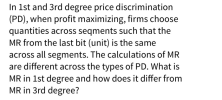 In 1st and 3rd degree price discrimination (PD), when profit maximizing, firms choose quantities across seqments such that the MR from the last bit (unit) is the same across all segments. The calculations of MR are different across the types of PD. What is MR in 1st degree and how does it differ from MR in 3rd degree?
Problem 1. Second Degree price discrimination Suppose all consumers are identical and market demand given by...
 Problem 1. Second Degree price discrimination Suppose all consumers are identical and market demand given by p = 100-q. The monopoly's cost function is C(q) q2. (a) Suppose the monopolist cannot discriminate prices and must set a uniform price. Compute price and quantity set by the monopolist. Compute the profit of the monopoly. b) Suppose now that the monopoly can set a two-part tariff. Find the optimal two-part tariff. Compute the profit of the monopolist Problem 2. Third Degree price...
please help solve. Is this also 3rd degree price discrimination? A price-discriminating monopolist faces the following...
 please help solve. Is this also
3rd degree price discrimination?
A price-discriminating monopolist faces the following inverse demand functions: In Market One it is P1- 80-Q1 and in Market Two it is P2 60-Q2 Marginal cost is constant at $10. Consumers in market two can resell the good to consumers in market one at a cost of $4 per unit. Find the profit-maximizing quantity and price charged in each market subject to the resale constraint.
please help solve. Is this also
3rd degree price discrimination?
A price-discriminating monopolist faces the following inverse demand functions: In Market One it is P1- 80-Q1 and in Market Two it is P2 60-Q2 Marginal cost is constant at $10. Consumers in market two can resell the good to consumers in market one at a cost of $4 per unit. Find the profit-maximizing quantity and price charged in each market subject to the resale constraint.
QUESTION 5: THIRD DEGREE PRICE DISCRIMINATION (20pt) A monopolist engages in third degree price discrimination.There are...
 QUESTION 5: THIRD DEGREE PRICE DISCRIMINATION (20pt) A monopolist engages in third degree price discrimination.There are 2 types of consumers, and the monopolist wants to sell to both groups. The monopolist is allowed to charge different prices and hence engages in third degree price discrimination. The demand curve for each group (the entire group) is as follows 01 500 10P Q2 200-5P2 The total cost function is TC 2000+10Q (a) What price does this firm charge to each group? (b)...
Second Degree Price Discrimination Q2. HP sells printers to two types of customers with different demands...
 Second Degree Price Discrimination Q2. HP sells printers to two types of customers with different demands for printer speed. HIGH-type 40 2q where q is the speed (quality) of the printer and users have inverse demand for speed of P(g) 30 3q. There are two LOW-type LOW-type users have inverse demand for speed of P(q) users for every HIGH-type user. The marginal cost of a printer of any speed is zero. HP plans to sell two types type of speed...
Cereal manufacturers' use of coupons can be partially explained by: a. first-degree price discrimination. b. second-degree...
Cereal manufacturers' use of coupons can be partially explained by: a. first-degree price discrimination. b. second-degree price discrimination. c. third-degree price discrimination. d. markup pricing. e. tying.
 4. a) Discuss a firm's informational needs to engage in 3"d, and 2nd degree price discrimination. In third degree price discrimination what is the relationship between price set for a specific group and price elasticity of demand for that group? b) In second price discrimination, suppose who benefits from the presence of the other group, high demand consumers or low demand consumers? Explain
 Please answer clearly and explain.
Question 2 (35 points): (3rd Degree Price Discrimination) Let there be a monopolist firm and two groups of consumers. Suppose that marginal cost is defined by MC- 2. T'he demand that each consumer receives is given by Q,-50-pl 202 200-P 1) ( 4 points) Consider the monopolist engages in first degree price discrimina- tion only in market 2. Compute the monopoly profit in this market. ii) (4 points) Which group has a mhore inelastic demand...
Please answer clearly and explain.
Question 2 (35 points): (3rd Degree Price Discrimination) Let there be a monopolist firm and two groups of consumers. Suppose that marginal cost is defined by MC- 2. T'he demand that each consumer receives is given by Q,-50-pl 202 200-P 1) ( 4 points) Consider the monopolist engages in first degree price discrimina- tion only in market 2. Compute the monopoly profit in this market. ii) (4 points) Which group has a mhore inelastic demand...
 Please answer clearly and explain. Thank you!
Question 2 (35 points): (3rd Degree Price Discrimination) Let there be a monopolist firm and two groups of consumers. Suppose that marginal cost is defined by MC- 2. The demand that each consumer receives is given by 1 50- P 2Q2- 200 - P2 i) (4 points) Consider the monopolist engages in first degree price discrimina- tion only in market 2. Compute the monopoly profit in this market. ii) (4 points) Which group...
Please answer clearly and explain. Thank you!
Question 2 (35 points): (3rd Degree Price Discrimination) Let there be a monopolist firm and two groups of consumers. Suppose that marginal cost is defined by MC- 2. The demand that each consumer receives is given by 1 50- P 2Q2- 200 - P2 i) (4 points) Consider the monopolist engages in first degree price discrimina- tion only in market 2. Compute the monopoly profit in this market. ii) (4 points) Which group...
 In 1st and 3rd degree price discrimination (PD), when profit maximizing, firms choose quantities across seqments such that the MR from the last bit (unit) is the same across all segments. The calculations of MR are different across the types of PD. What is MR in 1st degree and how does it differ from MR in 3rd degree?
 Problem 1. Second Degree price discrimination Suppose all consumers are identical and market demand given by p = 100-q. The monopoly's cost function is C(q) q2. (a) Suppose the monopolist cannot discriminate prices and must set a uniform price. Compute price and quantity set by the monopolist. Compute the profit of the monopoly. b) Suppose now that the monopoly can set a two-part tariff. Find the optimal two-part tariff. Compute the profit of the monopolist Problem 2. Third Degree price...
 please help solve. Is this also
3rd degree price discrimination?
A price-discriminating monopolist faces the following inverse demand functions: In Market One it is P1- 80-Q1 and in Market Two it is P2 60-Q2 Marginal cost is constant at $10. Consumers in market two can resell the good to consumers in market one at a cost of $4 per unit. Find the profit-maximizing quantity and price charged in each market subject to the resale constraint.
please help solve. Is this also
3rd degree price discrimination?
A price-discriminating monopolist faces the following inverse demand functions: In Market One it is P1- 80-Q1 and in Market Two it is P2 60-Q2 Marginal cost is constant at $10. Consumers in market two can resell the good to consumers in market one at a cost of $4 per unit. Find the profit-maximizing quantity and price charged in each market subject to the resale constraint.
 QUESTION 5: THIRD DEGREE PRICE DISCRIMINATION (20pt) A monopolist engages in third degree price discrimination.There are 2 types of consumers, and the monopolist wants to sell to both groups. The monopolist is allowed to charge different prices and hence engages in third degree price discrimination. The demand curve for each group (the entire group) is as follows 01 500 10P Q2 200-5P2 The total cost function is TC 2000+10Q (a) What price does this firm charge to each group? (b)...
 Second Degree Price Discrimination Q2. HP sells printers to two types of customers with different demands for printer speed. HIGH-type 40 2q where q is the speed (quality) of the printer and users have inverse demand for speed of P(g) 30 3q. There are two LOW-type LOW-type users have inverse demand for speed of P(q) users for every HIGH-type user. The marginal cost of a printer of any speed is zero. HP plans to sell two types type of speed...
Most questions answered within 3 hours.
-
Where is the error in this code sequence?
String s1 = "Hello";
String s2 = "ello";...
asked 10 months ago -
Financial data for Joel de Paris, Inc., for last year
follow:
Joel de Paris, Inc.
Balance...
asked 10 months ago -
Consider this reaction:
Al2(SO4)3 (aq)+ BaCl3
(aq) Al2Cl6 (aq)- +
3BaSO4(s) . What is the...
asked 10 months ago -
Suppose that Savneet is considering increasing her
recent random sample from 20 car rentals to 40...
asked 10 months ago -
Trucks arrive at an unloading terminal at an average rate of 120
per hour.
Trucks arrive...
asked 10 months ago -
Why are methanol and ethanol completely soluble in water while
octanol is not very little soluble....
asked 10 months ago -
A facilities manager at a university reads in a research report
that the mean amount of...
asked 10 months ago -
When the CuSO4 is rehydrated by adding water to the anhydrous
compound, is this an endothermic...
asked 10 months ago -
A ray of sunlight is passing from diamond into crown glass; the
angle of incidence is...
asked 10 months ago -
A block of mass 0.249 kg is placed on top of a light, vertical
spring of...
asked 10 months ago -
how do the kidneys compensate in the presences of acidosis
a) trigger hyperventilate
b) reserve acid...
asked 10 months ago -
Question 501 pts
The rental rate of capital to the firm increases. Which of the
following...
asked 10 months ago