Hi,
I am solving this problem right now.
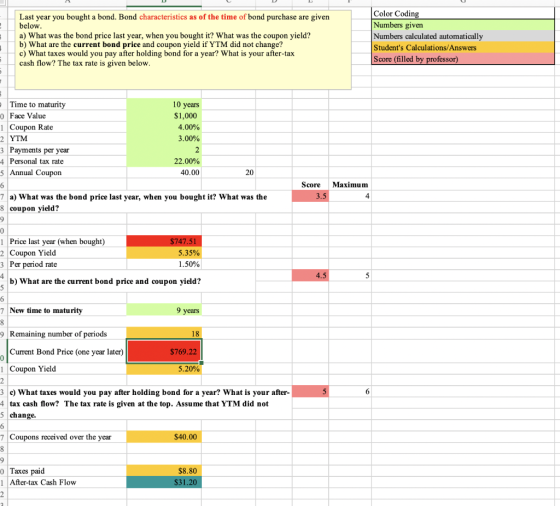
I assume that the red colored fields are wrong, and the orange ones are probably correct. Green is given by the professor.
I would appreciate some help.
Thank you very much. I RATE in return.
Homework Answers
Calculation of Bond Price for Last year (when purchased) and current (after 1 year)
Bond Price = 
C = Coupon payment = 40 / 2 = 20
R = yield = YTM / 2 = 3% / 2 = 1.5%
n = number of periods = 10 years* 2 coupons every year = 20
F = Face Value
Bond Price When purchased = [20 * {(1-(1+1.5%)^-20)/1.5%}] + [1000 / ((1+1.5%)^20)]
= [20 * {0.257529581776227/1.5%}] + [1000 / 1.34685500655005]
= [20 * 17.1686387850818] + 742.470418223773
= 343.372775701636 + 742.470418223773
= 1085.84
Current Bond Price (1 year later) = [20 * {(1-(1+1.5%)^-18)/1.5%}] + [1000 / ((1+1.5%)^18)]
= [20 * {0.235088413385414/1.5%}] + [1000 / 1.30734063583203]
= [20 * 15.6725608923609] + 764.911586614586
= 313.451217847218 + 764.911586614586
= 1078.36
Note: Always remember when Yield is less than coupon rate, bond price is more than face value. Reason being you are getting more return than expected.
Good Luck.
Add Answer to:
Hi, I am solving this problem right now. I assume that the red colored fields are wrong, and the orange ones are probabl...
I need #4 4. Assuming the same coupon payment as listed in question 3 but now...
 I need #4
4. Assuming the same coupon payment as listed in question 3 but now the price you pay for the bond increases to $101.00, what is the current yield, did it rise or fall? 5. Presume you purchased a 10 year year bond for $1,000, which has a face value of $1000.00. The bond pays an annual coupon of $60.00 and has an interest rate (Yeild to maturity) of of 6%. Presume you decide to sell the bond...
I need #4
4. Assuming the same coupon payment as listed in question 3 but now the price you pay for the bond increases to $101.00, what is the current yield, did it rise or fall? 5. Presume you purchased a 10 year year bond for $1,000, which has a face value of $1000.00. The bond pays an annual coupon of $60.00 and has an interest rate (Yeild to maturity) of of 6%. Presume you decide to sell the bond...
The 10-year Coupon Bond has a face value of $1,000, the annual coupon rate is 5...
The 10-year Coupon Bond has a face value of $1,000, the annual coupon rate is 5 percent (out of its face value), the yield to maturity is 10 percent. (2.a) show me the cash flows of this coupon bond, you can use words or a timeline graph you created. (2.b) compute the price (present value) of this bond (2.c) suppose the yield to maturity increases to 20 percent after one year, computes the new price. (remember that as time passed...
2. You just bought a newly issued bond which has a face value of S1,000 and pays its coupon once annually. Its coup...
 2. You just bought a newly issued bond which has a face value of S1,000 and pays its coupon once annually. Its coupon rate is 5%, maturity is 20 years and the yield to maturity for the bond is currently 8%. a. Do you expect the bond price to change in the future when the yield stays at 8%? Why or why not? Explain. (No calculation is necessary.) (2 marks) b. Calculate what the bond price would be in one...
A bond with a coupon rate of 6% makes semiannual coupon payments on January 15 and...
 A bond with a coupon rate of 6% makes semiannual coupon payments on January 15 and July 15 of each year The Wall Street Journal reports the ask price for the bond on January 30 at 100 250, What is the invoice price of the bond? The coupon period has 182 days. (Do not round intelmediate calculations. Round your answer to 2 decimal places.) Invoice price A newly issued bond pays its coupons once a year. Its coupon rate is...
I am very confused about how to work this problem. I don't have a lot of...
I am very confused about how to work this problem. I don't have a lot of experience using formulas in Excel. This bond is a 20-year, 8% semiannual coupon bond with a par value of $1,000 may be called in 5 years at a call price of $1,040. The bond sells for $1,100. (Assume that the bond has been issued.) She needs you to complete the partial model for her. She needs the following to be answered. What is the...
5. Eleven years from now the bond will have 1 year until maturity. Assume market interest...
 5. Eleven years from now the bond will have 1 year until maturity. Assume market interest rates are at 7 percent, the same place they were when the bond was issued. Given this: k. What will be the bond's price 11 years from now? 1. What will be the current yield eleven years from now? m. What is the expected capital gains yield eleven years from now? n. How does you answers to part (1) and (m) compare with your...
Problem 14-10 Assume you have a 1-year investment horizon and are trying to choose among three...
 Problem 14-10 Assume you have a 1-year investment horizon and are trying to choose among three bonds. All have the same degree of default risk and mature in 10 years. The first is a zero-coupon bond that pays $1,000 at maturity. The second has an 9.2% coupon rate and pays the $92 coupon once per year. The third has a 11.2% coupon rate and pays the $112 coupon once per year. a. If all three bonds are now priced to...
Hi ! I am solving this problem right now, but I am not sure if b)...
 Hi ! I am solving this problem right now, but I am not sure if
b) and c) are correct.
I would appreciate some help!
Thank you very much.
You need a fixed-rate mortgage to buy a new home. Your mortgage bank will lend you the money with parameters of the loan shown below. a. What are your regular (periodic) payments? b. You can afford only a limited regular payment (see below), and you offer to pay off the remaining...
Hi ! I am solving this problem right now, but I am not sure if
b) and c) are correct.
I would appreciate some help!
Thank you very much.
You need a fixed-rate mortgage to buy a new home. Your mortgage bank will lend you the money with parameters of the loan shown below. a. What are your regular (periodic) payments? b. You can afford only a limited regular payment (see below), and you offer to pay off the remaining...
1. Consider a bond paying a coupon rate of 12.25% per year semiannually when the market...
1. Consider a bond paying a coupon rate of 12.25% per year semiannually when the market interest rate is only 4.9% per half-year. The bond has six years until maturity. a. Find the bond's price today and twelve months from now after the next coupon is paid. (Do not round intermediate calculations. Round your answers to 2 decimal places.) b. What is the total rate of return on the bond? (Do not round intermediate calculations. Round your answer to 2...
Bond Valuation Assume that you are considering the purchase of a 20-year, non- callable bond with...
 Bond Valuation Assume that you are considering the purchase of a 20-year, non- callable bond with an annual coupon rate of 9.5%. The bond has a face value of $1,000, and it makes semiannual interest payments. If you require an 8.4% nominal yield to maturity on this investment, what is the maximum price you should be willing to pay for the bond? Yield to Maturity Radoski Corporation's bonds make an annual coupon interest payment of 7.35%. The bonds have a...
 I need #4
4. Assuming the same coupon payment as listed in question 3 but now the price you pay for the bond increases to $101.00, what is the current yield, did it rise or fall? 5. Presume you purchased a 10 year year bond for $1,000, which has a face value of $1000.00. The bond pays an annual coupon of $60.00 and has an interest rate (Yeild to maturity) of of 6%. Presume you decide to sell the bond...
I need #4
4. Assuming the same coupon payment as listed in question 3 but now the price you pay for the bond increases to $101.00, what is the current yield, did it rise or fall? 5. Presume you purchased a 10 year year bond for $1,000, which has a face value of $1000.00. The bond pays an annual coupon of $60.00 and has an interest rate (Yeild to maturity) of of 6%. Presume you decide to sell the bond...
 2. You just bought a newly issued bond which has a face value of S1,000 and pays its coupon once annually. Its coupon rate is 5%, maturity is 20 years and the yield to maturity for the bond is currently 8%. a. Do you expect the bond price to change in the future when the yield stays at 8%? Why or why not? Explain. (No calculation is necessary.) (2 marks) b. Calculate what the bond price would be in one...
 A bond with a coupon rate of 6% makes semiannual coupon payments on January 15 and July 15 of each year The Wall Street Journal reports the ask price for the bond on January 30 at 100 250, What is the invoice price of the bond? The coupon period has 182 days. (Do not round intelmediate calculations. Round your answer to 2 decimal places.) Invoice price A newly issued bond pays its coupons once a year. Its coupon rate is...
 5. Eleven years from now the bond will have 1 year until maturity. Assume market interest rates are at 7 percent, the same place they were when the bond was issued. Given this: k. What will be the bond's price 11 years from now? 1. What will be the current yield eleven years from now? m. What is the expected capital gains yield eleven years from now? n. How does you answers to part (1) and (m) compare with your...
 Problem 14-10 Assume you have a 1-year investment horizon and are trying to choose among three bonds. All have the same degree of default risk and mature in 10 years. The first is a zero-coupon bond that pays $1,000 at maturity. The second has an 9.2% coupon rate and pays the $92 coupon once per year. The third has a 11.2% coupon rate and pays the $112 coupon once per year. a. If all three bonds are now priced to...
 Hi ! I am solving this problem right now, but I am not sure if
b) and c) are correct.
I would appreciate some help!
Thank you very much.
You need a fixed-rate mortgage to buy a new home. Your mortgage bank will lend you the money with parameters of the loan shown below. a. What are your regular (periodic) payments? b. You can afford only a limited regular payment (see below), and you offer to pay off the remaining...
Hi ! I am solving this problem right now, but I am not sure if
b) and c) are correct.
I would appreciate some help!
Thank you very much.
You need a fixed-rate mortgage to buy a new home. Your mortgage bank will lend you the money with parameters of the loan shown below. a. What are your regular (periodic) payments? b. You can afford only a limited regular payment (see below), and you offer to pay off the remaining...
 Bond Valuation Assume that you are considering the purchase of a 20-year, non- callable bond with an annual coupon rate of 9.5%. The bond has a face value of $1,000, and it makes semiannual interest payments. If you require an 8.4% nominal yield to maturity on this investment, what is the maximum price you should be willing to pay for the bond? Yield to Maturity Radoski Corporation's bonds make an annual coupon interest payment of 7.35%. The bonds have a...
Most questions answered within 3 hours.
-
Where is the error in this code sequence?
String s1 = "Hello";
String s2 = "ello";...
asked 10 months ago -
Financial data for Joel de Paris, Inc., for last year
follow:
Joel de Paris, Inc.
Balance...
asked 10 months ago -
Consider this reaction:
Al2(SO4)3 (aq)+ BaCl3
(aq) Al2Cl6 (aq)- +
3BaSO4(s) . What is the...
asked 10 months ago -
Suppose that Savneet is considering increasing her
recent random sample from 20 car rentals to 40...
asked 10 months ago -
Trucks arrive at an unloading terminal at an average rate of 120
per hour.
Trucks arrive...
asked 10 months ago -
Why are methanol and ethanol completely soluble in water while
octanol is not very little soluble....
asked 10 months ago -
A facilities manager at a university reads in a research report
that the mean amount of...
asked 10 months ago -
When the CuSO4 is rehydrated by adding water to the anhydrous
compound, is this an endothermic...
asked 10 months ago -
A ray of sunlight is passing from diamond into crown glass; the
angle of incidence is...
asked 10 months ago -
A block of mass 0.249 kg is placed on top of a light, vertical
spring of...
asked 10 months ago -
how do the kidneys compensate in the presences of acidosis
a) trigger hyperventilate
b) reserve acid...
asked 10 months ago -
Question 501 pts
The rental rate of capital to the firm increases. Which of the
following...
asked 10 months ago