How can you tell what is a weak/strong nucleophile and a weak/strong base to determine what mechanism you use (SN1, SN2, E1, E2)?
Homework Answers
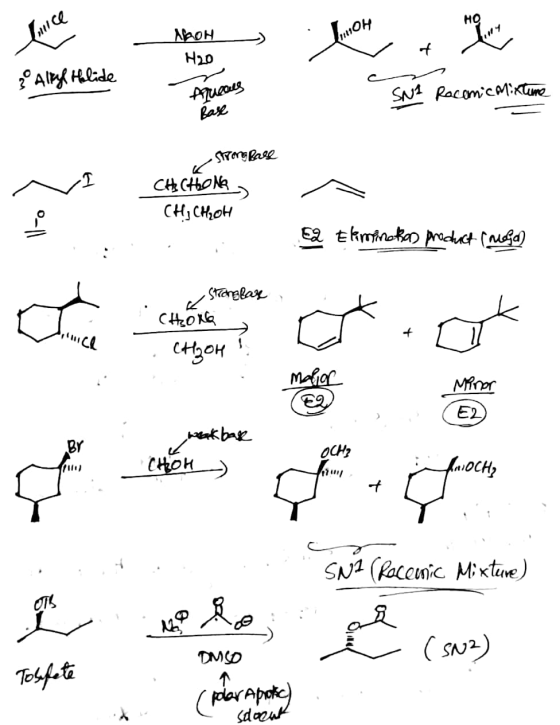
if strong base then it favours elimination and if weak base it favours the substitution in polar aprotic solvents it undergoes the SN2 reaction and in presence of polar protic solvents it favours the SN1 reaction
Add Answer to:
How can you tell what is a weak/strong nucleophile and a weak/strong base to determine what mechanism you use (SN1, SN2,...
How can you tell if a reactant, like the NaOH, is a strong/weak nucleophile or base...
 How can you tell if a reactant, like the NaOH, is a
strong/weak nucleophile or base to determine what mechanism you
use? The picture provided has the correct answers. I just don't
understand how to get to them.
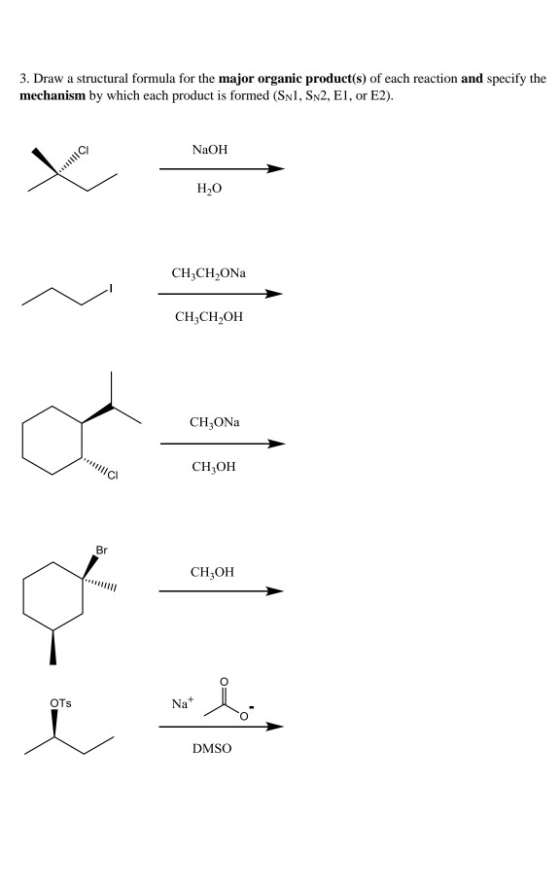
3. Draw a structural formula for the major organic product(s) of each reaction and specify the mechanism by which each product is formed (SN1, S2, E, or E2). E2 NaOH Н,0 CH3CH2ONa CH3CH2OH E2 CH2ONa иис CH3OH OCH3 Br CH3OH ИИ E1...
How can you tell if a reactant, like the NaOH, is a
strong/weak nucleophile or base to determine what mechanism you
use? The picture provided has the correct answers. I just don't
understand how to get to them.
3. Draw a structural formula for the major organic product(s) of each reaction and specify the mechanism by which each product is formed (SN1, S2, E, or E2). E2 NaOH Н,0 CH3CH2ONa CH3CH2OH E2 CH2ONa иис CH3OH OCH3 Br CH3OH ИИ E1...
please explain why and how they are E2/SN2/SN1/E1 3. Draw a structural formula for the major organic product(s) of e...
 please explain why and how they are E2/SN2/SN1/E1
3. Draw a structural formula for the major organic product(s) of each reaction and specify the mechanism by which each product is formed (SNI, S2, El, or E2). • NaOH H20 CH,CH ON CH,CH OH CH ON CH,OH CH OH Na DMSO
please explain why and how they are E2/SN2/SN1/E1
3. Draw a structural formula for the major organic product(s) of each reaction and specify the mechanism by which each product is formed (SNI, S2, El, or E2). • NaOH H20 CH,CH ON CH,CH OH CH ON CH,OH CH OH Na DMSO
strong nucleophile weak base strong bulky base strong nucleophile strong base Promote SN2/E2 weak nucleophile weak...
 strong nucleophile weak base strong bulky base strong nucleophile strong base Promote SN2/E2 weak nucleophile weak base Promote SN1/E1 Promote SN2 Promote E2 CH Br HS NCT HO CHO CHÚCHO NaNO NaOH NOME Noe HOORS Conjugate acids have pka 16-18 Conjugate acids Recall, you make hydroxide have pka 11 or alkoxide ons from the corresponding alcohol or water and Nat CH,OH (MOH) HO CH,CH,OH (EXOH) | HC-Ć-o to CH tert-BUOK NOCH KOHBU NEOBU The structures above are all ways of...
3. Draw a structural formula for the major organic product(s) of each reaction and specify the...
 3. Draw a structural formula for the major organic product(s) of each reaction and specify the mechanism by which each product is formed (Syl, SN2, E1, or E2). NaOH HO CH3CH2ON CH3CH2OH CH ON CH OH Br CH,OH Na DMSO
can someone please explain to me how to tell whether substitution (sn1/sn2) or Elimination (E1/E2) im...
can someone please explain to me how to tell whether substitution (sn1/sn2) or Elimination (E1/E2) im mostly confused on nucleophile or base strong or weak like is there a step by step that you know thats great for knowing what mechanisms to use ? please please be descriptive . write steps to finish mechanism. and explain nucleophile/base/strong/weak and what goes with what mech.
2. (1.5 pts) Label the following reagents as Good or Poor Nucleophiles AND as Strong or Weak Base...
 2. (1.5 pts) Label the following reagents as Good or Poor Nucleophiles AND as Strong or Weak Bases. OK Na SH 3. (1.5 pt) Predict the productts) of the following reactions, if there are multiple products indicate which, if any, is the major product. Be sure to clearly mark the stereochemistry of chiral carbon atoms and draw multiple products if there is more than one stereoisomer that forms. HCI MeOH H2SO H2 Pd/BaSO4 quinoline 4. (3 pt) For the following...
please explain in detail. Thank you in advance . 1. Circle the mechanism (SN2, SN1, E2,...
 please explain in detail. Thank you in advance .
1. Circle the mechanism (SN2, SN1, E2, or E1) responsible for the formation of each product in this reaction. If the product cannot be formed in the reaction, circle "not a product". (2 pts) CI CHE CH3 CHE CH3 осна SN2 SN1 E2 E1 S2 SN1 E2 E1 SN2 Sn1 E2 E1 SN2 SN1 E2 E1 not a product not a product not a product not a product 2. These reactions...
please explain in detail. Thank you in advance .
1. Circle the mechanism (SN2, SN1, E2, or E1) responsible for the formation of each product in this reaction. If the product cannot be formed in the reaction, circle "not a product". (2 pts) CI CHE CH3 CHE CH3 осна SN2 SN1 E2 E1 S2 SN1 E2 E1 SN2 Sn1 E2 E1 SN2 SN1 E2 E1 not a product not a product not a product not a product 2. These reactions...
1. Determine whether the following reactions will go through SN1, SN2, E1, or E2 mechanism a....
 1. Determine whether the following reactions will go through SN1, SN2, E1, or E2 mechanism a. 1-bromobutane + sodium hydroxide b. 2-chloro-2-methylpentane + sodium hydroxide + heat C. 2,3-dimethyl-3-bromopentane + water d. 2-bromobutane + methanol 2. Draw the major product for the following reactions (draw both products if racemic): NaSH DMSO TsO CHA Nal CH, acetone CH,CH,ONa+ ethanol CH,OH/H-0 Solite Nal (1 equiv.) acetone F CH2CH OH 25°C
Circle the mechanism (SN2, SN1, E2, or E1) responsible for the formation of each product in...
 Circle the mechanism (SN2, SN1, E2, or E1) responsible for the formation of each product in this reaction. If the product cannot be formed in the reaction, circle "not a product". (2 pts) ГОН SN2 SN1 E2 E1 S N2 SN1 E2 E1 SN2 SN1 E2 E1 S2 Sn1 E2 E1 not a product not a product not a product not a product
30. Late papers not accepted. Work Independently. 1. Predict the most likely reaction mechanism (SN1, SN2,...
 30. Late papers not accepted. Work Independently. 1. Predict the most likely reaction mechanism (SN1, SN2, E1, E2) and draw all products. CH₂ Na O=CH₂ Hic Br 2 Draw complete mechanism with arrows for the SNI/E1 mechanism. Check for carbocation rearrangements CH3 + H2O 3. Which is the major product for the following reaction? Y CH + NaOH CH HO HO H₃ CH₂ H₃ HOCH CH₂ H₃ CHE CH₂ CH₂ CH3 CH 4. Name the following including the R/S, E/Z...
 How can you tell if a reactant, like the NaOH, is a
strong/weak nucleophile or base to determine what mechanism you
use? The picture provided has the correct answers. I just don't
understand how to get to them.
3. Draw a structural formula for the major organic product(s) of each reaction and specify the mechanism by which each product is formed (SN1, S2, E, or E2). E2 NaOH Н,0 CH3CH2ONa CH3CH2OH E2 CH2ONa иис CH3OH OCH3 Br CH3OH ИИ E1...
How can you tell if a reactant, like the NaOH, is a
strong/weak nucleophile or base to determine what mechanism you
use? The picture provided has the correct answers. I just don't
understand how to get to them.
3. Draw a structural formula for the major organic product(s) of each reaction and specify the mechanism by which each product is formed (SN1, S2, E, or E2). E2 NaOH Н,0 CH3CH2ONa CH3CH2OH E2 CH2ONa иис CH3OH OCH3 Br CH3OH ИИ E1...
 please explain why and how they are E2/SN2/SN1/E1
3. Draw a structural formula for the major organic product(s) of each reaction and specify the mechanism by which each product is formed (SNI, S2, El, or E2). • NaOH H20 CH,CH ON CH,CH OH CH ON CH,OH CH OH Na DMSO
please explain why and how they are E2/SN2/SN1/E1
3. Draw a structural formula for the major organic product(s) of each reaction and specify the mechanism by which each product is formed (SNI, S2, El, or E2). • NaOH H20 CH,CH ON CH,CH OH CH ON CH,OH CH OH Na DMSO
 strong nucleophile weak base strong bulky base strong nucleophile strong base Promote SN2/E2 weak nucleophile weak base Promote SN1/E1 Promote SN2 Promote E2 CH Br HS NCT HO CHO CHÚCHO NaNO NaOH NOME Noe HOORS Conjugate acids have pka 16-18 Conjugate acids Recall, you make hydroxide have pka 11 or alkoxide ons from the corresponding alcohol or water and Nat CH,OH (MOH) HO CH,CH,OH (EXOH) | HC-Ć-o to CH tert-BUOK NOCH KOHBU NEOBU The structures above are all ways of...
 3. Draw a structural formula for the major organic product(s) of each reaction and specify the mechanism by which each product is formed (Syl, SN2, E1, or E2). NaOH HO CH3CH2ON CH3CH2OH CH ON CH OH Br CH,OH Na DMSO
 2. (1.5 pts) Label the following reagents as Good or Poor Nucleophiles AND as Strong or Weak Bases. OK Na SH 3. (1.5 pt) Predict the productts) of the following reactions, if there are multiple products indicate which, if any, is the major product. Be sure to clearly mark the stereochemistry of chiral carbon atoms and draw multiple products if there is more than one stereoisomer that forms. HCI MeOH H2SO H2 Pd/BaSO4 quinoline 4. (3 pt) For the following...
 please explain in detail. Thank you in advance .
1. Circle the mechanism (SN2, SN1, E2, or E1) responsible for the formation of each product in this reaction. If the product cannot be formed in the reaction, circle "not a product". (2 pts) CI CHE CH3 CHE CH3 осна SN2 SN1 E2 E1 S2 SN1 E2 E1 SN2 Sn1 E2 E1 SN2 SN1 E2 E1 not a product not a product not a product not a product 2. These reactions...
please explain in detail. Thank you in advance .
1. Circle the mechanism (SN2, SN1, E2, or E1) responsible for the formation of each product in this reaction. If the product cannot be formed in the reaction, circle "not a product". (2 pts) CI CHE CH3 CHE CH3 осна SN2 SN1 E2 E1 S2 SN1 E2 E1 SN2 Sn1 E2 E1 SN2 SN1 E2 E1 not a product not a product not a product not a product 2. These reactions...
 1. Determine whether the following reactions will go through SN1, SN2, E1, or E2 mechanism a. 1-bromobutane + sodium hydroxide b. 2-chloro-2-methylpentane + sodium hydroxide + heat C. 2,3-dimethyl-3-bromopentane + water d. 2-bromobutane + methanol 2. Draw the major product for the following reactions (draw both products if racemic): NaSH DMSO TsO CHA Nal CH, acetone CH,CH,ONa+ ethanol CH,OH/H-0 Solite Nal (1 equiv.) acetone F CH2CH OH 25°C
 Circle the mechanism (SN2, SN1, E2, or E1) responsible for the formation of each product in this reaction. If the product cannot be formed in the reaction, circle "not a product". (2 pts) ГОН SN2 SN1 E2 E1 S N2 SN1 E2 E1 SN2 SN1 E2 E1 S2 Sn1 E2 E1 not a product not a product not a product not a product
 30. Late papers not accepted. Work Independently. 1. Predict the most likely reaction mechanism (SN1, SN2, E1, E2) and draw all products. CH₂ Na O=CH₂ Hic Br 2 Draw complete mechanism with arrows for the SNI/E1 mechanism. Check for carbocation rearrangements CH3 + H2O 3. Which is the major product for the following reaction? Y CH + NaOH CH HO HO H₃ CH₂ H₃ HOCH CH₂ H₃ CHE CH₂ CH₂ CH3 CH 4. Name the following including the R/S, E/Z...
Most questions answered within 3 hours.
-
Where is the error in this code sequence?
String s1 = "Hello";
String s2 = "ello";...
asked 11 months ago -
Financial data for Joel de Paris, Inc., for last year
follow:
Joel de Paris, Inc.
Balance...
asked 11 months ago -
Consider this reaction:
Al2(SO4)3 (aq)+ BaCl3
(aq) Al2Cl6 (aq)- +
3BaSO4(s) . What is the...
asked 11 months ago -
Suppose that Savneet is considering increasing her
recent random sample from 20 car rentals to 40...
asked 11 months ago -
Trucks arrive at an unloading terminal at an average rate of 120
per hour.
Trucks arrive...
asked 11 months ago -
Why are methanol and ethanol completely soluble in water while
octanol is not very little soluble....
asked 11 months ago -
A facilities manager at a university reads in a research report
that the mean amount of...
asked 11 months ago -
When the CuSO4 is rehydrated by adding water to the anhydrous
compound, is this an endothermic...
asked 11 months ago -
A ray of sunlight is passing from diamond into crown glass; the
angle of incidence is...
asked 11 months ago -
A block of mass 0.249 kg is placed on top of a light, vertical
spring of...
asked 11 months ago -
how do the kidneys compensate in the presences of acidosis
a) trigger hyperventilate
b) reserve acid...
asked 11 months ago -
Question 501 pts
The rental rate of capital to the firm increases. Which of the
following...
asked 11 months ago