
Homework Answers
The answer is attached herewith
Add Answer to:
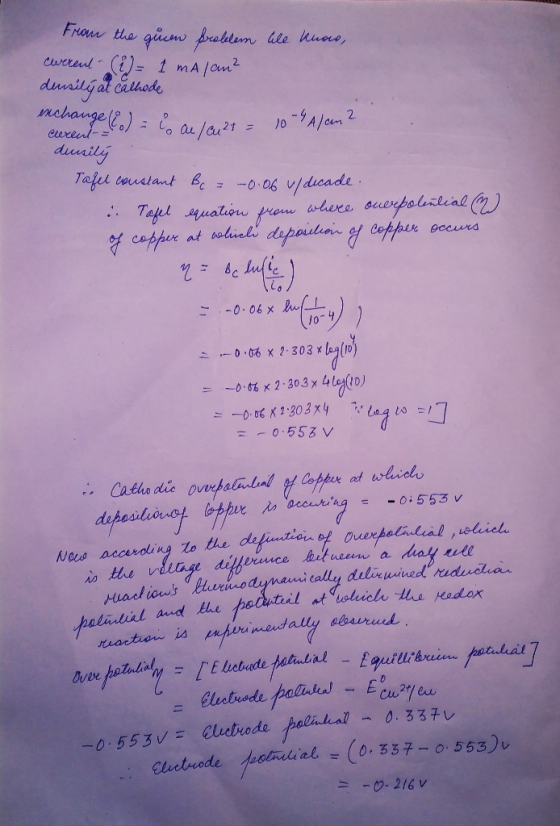
5. Electrodeposition of copper is carried out at a current density of 1 mA/cm² in an aqueous copper sulfate solution...
40. Concentrated aqueous ammonia is added to a solution of copper(II) sulfate. A white precipitate forms....
 40. Concentrated aqueous ammonia is added to a solution of copper(II) sulfate. A white precipitate forms. The precipitate dissolves as more ammonia is added, generating an intensely blue solution. Which combination of net ionic equations, in the appropriate order, describes this chemistry?! I Cu?* (aq) + 2OH(aq) Cu(OH)2 (19) II Cu?" (aq) + 2OH(aq) = Cu(OH)2 (8) III Cu(OH)(aq) + 4 NH, (aq) Cu(NH3),?* () + 2OH(aq) IV Cu(OH)2 (8) + 4NH, (aq) Cu(NH3)*(14) + 2OH(aq) V NH3(aq) + H20...
5. What was the purpose of the NaNO3 solution in this experiment? 6. Could a solution...
 5. What was the purpose of the NaNO3 solution in this experiment? 6. Could a solution of NaCl be used instead of NaNO3? 7. What was the purpose of FeSO4 solution in this experiment? 8. Could a solution of FeCl, be used instead of FeSO4? 9. Could a solution of NaSO4 be used instead of FeSO4? 10. Calculate the standard cell potential for the spontaneous redox reaction between a Pb(s)/Pb(NO3)2(aq) half-cell and a Ag(s)/AgNO3(aq) half-cell. Which metal would be oxidized?...
 40. Concentrated aqueous ammonia is added to a solution of copper(II) sulfate. A white precipitate forms. The precipitate dissolves as more ammonia is added, generating an intensely blue solution. Which combination of net ionic equations, in the appropriate order, describes this chemistry?! I Cu?* (aq) + 2OH(aq) Cu(OH)2 (19) II Cu?" (aq) + 2OH(aq) = Cu(OH)2 (8) III Cu(OH)(aq) + 4 NH, (aq) Cu(NH3),?* () + 2OH(aq) IV Cu(OH)2 (8) + 4NH, (aq) Cu(NH3)*(14) + 2OH(aq) V NH3(aq) + H20...
 5. What was the purpose of the NaNO3 solution in this experiment? 6. Could a solution of NaCl be used instead of NaNO3? 7. What was the purpose of FeSO4 solution in this experiment? 8. Could a solution of FeCl, be used instead of FeSO4? 9. Could a solution of NaSO4 be used instead of FeSO4? 10. Calculate the standard cell potential for the spontaneous redox reaction between a Pb(s)/Pb(NO3)2(aq) half-cell and a Ag(s)/AgNO3(aq) half-cell. Which metal would be oxidized?...
Most questions answered within 3 hours.
-
Where is the error in this code sequence?
String s1 = "Hello";
String s2 = "ello";...
asked 11 months ago -
Financial data for Joel de Paris, Inc., for last year
follow:
Joel de Paris, Inc.
Balance...
asked 11 months ago -
Consider this reaction:
Al2(SO4)3 (aq)+ BaCl3
(aq) Al2Cl6 (aq)- +
3BaSO4(s) . What is the...
asked 11 months ago -
Suppose that Savneet is considering increasing her
recent random sample from 20 car rentals to 40...
asked 11 months ago -
Trucks arrive at an unloading terminal at an average rate of 120
per hour.
Trucks arrive...
asked 11 months ago -
Why are methanol and ethanol completely soluble in water while
octanol is not very little soluble....
asked 11 months ago -
A facilities manager at a university reads in a research report
that the mean amount of...
asked 11 months ago -
When the CuSO4 is rehydrated by adding water to the anhydrous
compound, is this an endothermic...
asked 11 months ago -
A ray of sunlight is passing from diamond into crown glass; the
angle of incidence is...
asked 11 months ago -
A block of mass 0.249 kg is placed on top of a light, vertical
spring of...
asked 11 months ago -
how do the kidneys compensate in the presences of acidosis
a) trigger hyperventilate
b) reserve acid...
asked 11 months ago -
Question 501 pts
The rental rate of capital to the firm increases. Which of the
following...
asked 11 months ago