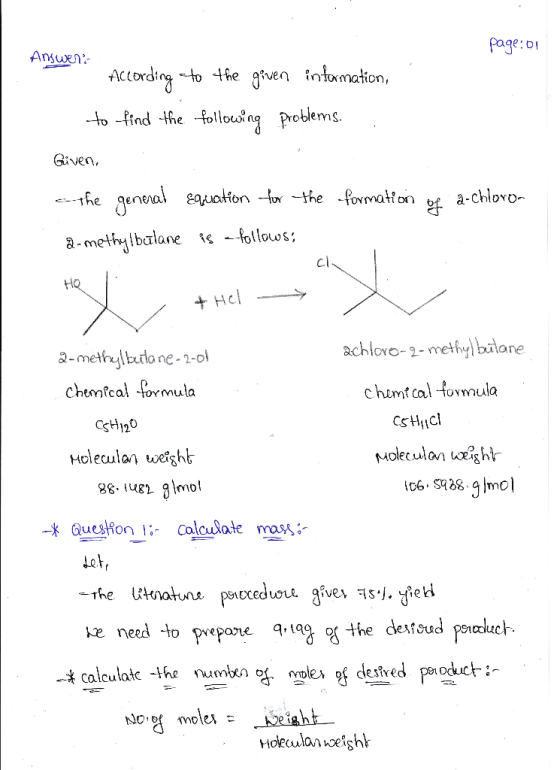
You are working in a synthetic organic chemistry lab and you need to prepare 9.19 g of 2-chloro-2-methylbutane. The give...
You are working in a synthetic organic chemistry lab and you need to prepare 9.19 g of 2-chloro-2-methylbutane. The given literature procedure typically results in a 75% experimental (isolated) yield for the preparation of the desired compound
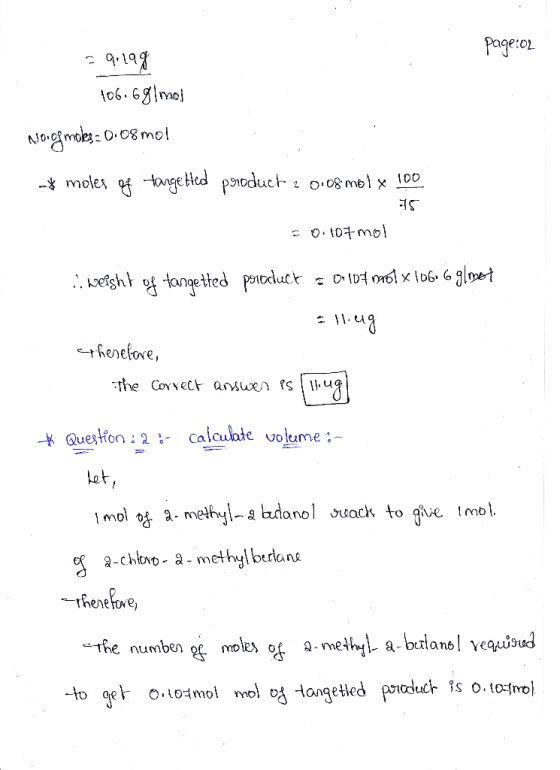
Question 1: To ensure that you isolate the correct amount of material, what mass of product should you aim to prepare in this experiment? Enter a mass in grams, accurate to one decimal place.
____________ g
Question 2: What volume of 2-methyl-2-butanol should be used? Enter a volume in mL, accurate to one decimal place. Note: 2-methyl-2-butanol is purchased from Sigma-Aldrich.
____________ mL
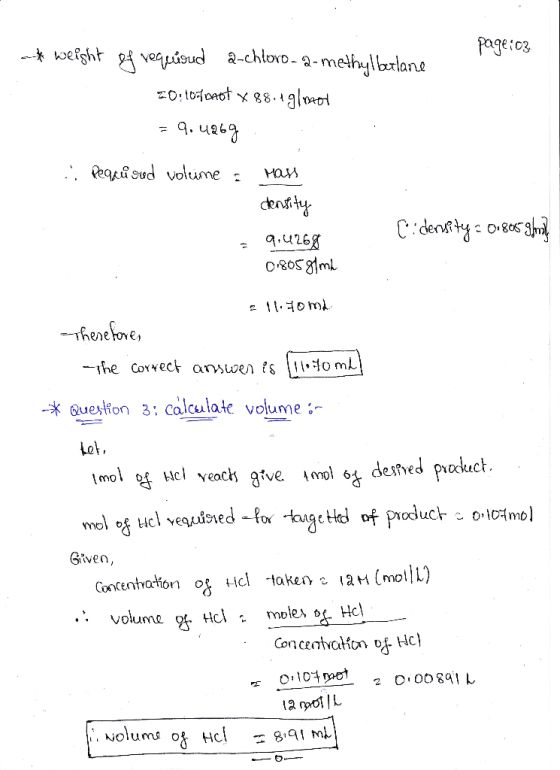
Question 3: What volume of concentrated HCl (aq) should be used? Enter a volume in mL, accurate to one decimal place.
____________ mL
Homework Answers
Add Answer to:
You are working in a synthetic organic chemistry lab and you need to prepare 9.19 g of 2-chloro-2-methylbutane. The give...
Just Answer Question 5 Synthesis of 2-chloro-2-methylbutane (literature version) Concentrated aqueous hydrochloric acid (HCI, 3.3 equivalents)...
 Just Answer Question 5
Synthesis of 2-chloro-2-methylbutane (literature version) Concentrated aqueous hydrochloric acid (HCI, 3.3 equivalents) was slowly added to 2-methyl-2-butanol (1.0 equivalents) in a 100 mL round bottom flask with stirring. The reaction was stirred for 15 minutes at room temperature. Upon completion, the reaction mixture was transferred to a 60 mL separatory funnel and the aqueous layer was removed. The organic layer (i.e. the product) was successively washed with: (1) saturated aqueous NaCl (brine), (2) saturated aqueous NaHCO,...
Just Answer Question 5
Synthesis of 2-chloro-2-methylbutane (literature version) Concentrated aqueous hydrochloric acid (HCI, 3.3 equivalents) was slowly added to 2-methyl-2-butanol (1.0 equivalents) in a 100 mL round bottom flask with stirring. The reaction was stirred for 15 minutes at room temperature. Upon completion, the reaction mixture was transferred to a 60 mL separatory funnel and the aqueous layer was removed. The organic layer (i.e. the product) was successively washed with: (1) saturated aqueous NaCl (brine), (2) saturated aqueous NaHCO,...
Compound G is a common contaminant in synthetic 2-chloro-2-methylbutane prepared from a tertiary alcohol. Using an...
Compound G is a common contaminant in synthetic 2-chloro-2-methylbutane prepared from a tertiary alcohol. Using an appropriate purification technique learnt in Organic Chemistry I, recover the pure product. You should also write a short essay or draw a separation scheme on the exercise.
(If you need any more information just let me know) Determine the limiting reagent for the...
(If you need any more information just let me know) Determine the limiting reagent for the preparation of 2-bromo-2-methylbutane and calculate the theoretical yield of product. 1 CHEM-2223 Organic Chemistry Laboratory I Exp. 7: Synthesis of 2-chloro-2-methylbutane In this reaction a tertiary alcohol, 2-methyl-2-butanol, is converted to a tertiary halide, 2-chloro- 2-methylbutane through a SN1 reaction. 1) Chemicals 2-Methyl-2-butanol Hydrochloric acid, HCl (12 M) Saturated sodium bicarbonate Saturated sodium chloride (380 g/L) Anhydrous sodium sulfate...
Hello, I need help understanding a lab we are doing in class tomorrow. I need to...
Hello, I need help understanding a lab we are doing in class tomorrow. I need to know which is the "ORGANIC LAYER" ... we are using a separatory funnel, and I would like to know whether the organic layer will be on top or on the bottom. This is in order for me to correctly carry out the experiment. The lab is similar to this one I found online, and its very vague for me as to what is the...
Volume of 2-methyl-2-butanol used 2.25 mL (measured to 2 decimal places) Density of 2-methyl-2-butanol_0.806_ (at 25°C)...
 Volume of 2-methyl-2-butanol used 2.25 mL (measured to 2 decimal places) Density of 2-methyl-2-butanol_0.806_ (at 25°C) Mol. Wt. of 2-methyl-2-butanol_$8.15 21 Volume of Hydrochloric Acid used 5.05 mL_(measured to 2 decimal places) Molarity of Hydrochloric acid used 12.1 l) (Usually 12.1 M but double check.) Mol. Wt. of 2-chloro-2-methyl-butane 106.59 Mass of product produced ОН + 1 HCI - H20 1. Using complete dimensional analysis, with all units and identifiers, starting with your volume of 2-methyl-2-butanol, show the maximum amount...
Volume of 2-methyl-2-butanol used 2.25 mL (measured to 2 decimal places) Density of 2-methyl-2-butanol_0.806_ (at 25°C)...
 Volume of 2-methyl-2-butanol used 2.25 mL (measured to 2 decimal places) Density of 2-methyl-2-butanol_0.806_ (at 25°C) Mol. Wt. of 2-methyl-2-butanol_$8.15 21 Volume of Hydrochloric Acid used 5.05 mL_(measured to 2 decimal places) Molarity of Hydrochloric acid used 12.1 l) (Usually 12.1 M but double check.) Mol. Wt. of 2-chloro-2-methyl-butane 106.59 Mass of product produced ОН + 1 HCI - H20 1. Using complete dimensional analysis, with all units and identifiers, starting with your volume of 2-methyl-2-butanol, show the maximum amount...
Use retrosynthetic analysis to design a synthesis on paper for the transformation of 2-chloro-3-methylbutane into 3-methylbutanal as shown below. You'll need six of the following reagents. Order the correct ones in order 1-6. The one you don't use will b
 Use retrosynthetic analysis to design a synthesis on paper for the transformation of 2-chloro-3-methylbutane into 3-methylbutanal as shown below. You'll need six of the following reagents. Order the correct ones in order 1-6.The one you don't use will be number 7 through 10. But order the 7+ ones in analagous order to the synthesis. For instance, if your first step is a zaistev elimination, and you have a bulky base and a nonbulky base, then reagent number 7 should be the bulky base. If your...
NEED MAJOR HELP PLS! work shown would be greatly appreciated Question 4 2 pts If you...
 NEED MAJOR HELP PLS! work shown would be
greatly appreciated
Question 4 2 pts If you add 126.45 mL of water to 18.99 mL of 3.36 M sodium hydroxide, what is the molarity (M) of the resulting solution? Use the dilution equation Mconc *V conc=Mdii * Vdil, where Mconc and Vconc are the molarity and volume of the stock (more concentrated) solution, respectively, and Mdil and Vdil are the molarity and final volume of the diluted solution. In this case...
NEED MAJOR HELP PLS! work shown would be
greatly appreciated
Question 4 2 pts If you add 126.45 mL of water to 18.99 mL of 3.36 M sodium hydroxide, what is the molarity (M) of the resulting solution? Use the dilution equation Mconc *V conc=Mdii * Vdil, where Mconc and Vconc are the molarity and volume of the stock (more concentrated) solution, respectively, and Mdil and Vdil are the molarity and final volume of the diluted solution. In this case...
how do i calculate the number of moles, theoretical yield, and limiting reagent on the READ...
 how do i calculate the number of moles, theoretical yield, and
limiting reagent on the READ ABOUT part? thank you
i need help on READ ABOUT: Calculate the number of moles of
2-methyl-2-butanol and hydrochloric acid (concentrated HCl is 12
M). Based on the balanced equation, determine the limiting reagent
and the theoretical yield of 2-chloride-2-methylbutane.
PREPARATION AND ANALYSIS OF T-AMYL CHLORIDE ОН HCI (conc.) + H2O DISCUSSION: Compounds with good leaving groups often participate in substitution reactions. Two limiting...
how do i calculate the number of moles, theoretical yield, and
limiting reagent on the READ ABOUT part? thank you
i need help on READ ABOUT: Calculate the number of moles of
2-methyl-2-butanol and hydrochloric acid (concentrated HCl is 12
M). Based on the balanced equation, determine the limiting reagent
and the theoretical yield of 2-chloride-2-methylbutane.
PREPARATION AND ANALYSIS OF T-AMYL CHLORIDE ОН HCI (conc.) + H2O DISCUSSION: Compounds with good leaving groups often participate in substitution reactions. Two limiting...
I need help calculating the mass percent and with the post lab question #2. Part 1...
 I need help calculating the mass percent and with the post lab
question #2.
Part 1 Mass Initial | Final Vol Nall Moles concen. KPHCG (ML) I (m2) Used (m2) KHP (mol)/NaOH(M) 0.28470.00 13.60r 13.600 10.00- 0.1025 2 UZ + ZANT 13.600 24.45 1 10.85 0.001128 10.40 Aug NaOH Concentration (M):0.1032 Part2 Vinegar identification # 4 Vinegar sample date: (011/ Vol Vinegat Initial Final Yol NaOH Mol Acotic Mass Acctic Mass % Titr ULST I OML Used (ml) Acid (mol)...
I need help calculating the mass percent and with the post lab
question #2.
Part 1 Mass Initial | Final Vol Nall Moles concen. KPHCG (ML) I (m2) Used (m2) KHP (mol)/NaOH(M) 0.28470.00 13.60r 13.600 10.00- 0.1025 2 UZ + ZANT 13.600 24.45 1 10.85 0.001128 10.40 Aug NaOH Concentration (M):0.1032 Part2 Vinegar identification # 4 Vinegar sample date: (011/ Vol Vinegat Initial Final Yol NaOH Mol Acotic Mass Acctic Mass % Titr ULST I OML Used (ml) Acid (mol)...
 Just Answer Question 5
Synthesis of 2-chloro-2-methylbutane (literature version) Concentrated aqueous hydrochloric acid (HCI, 3.3 equivalents) was slowly added to 2-methyl-2-butanol (1.0 equivalents) in a 100 mL round bottom flask with stirring. The reaction was stirred for 15 minutes at room temperature. Upon completion, the reaction mixture was transferred to a 60 mL separatory funnel and the aqueous layer was removed. The organic layer (i.e. the product) was successively washed with: (1) saturated aqueous NaCl (brine), (2) saturated aqueous NaHCO,...
Just Answer Question 5
Synthesis of 2-chloro-2-methylbutane (literature version) Concentrated aqueous hydrochloric acid (HCI, 3.3 equivalents) was slowly added to 2-methyl-2-butanol (1.0 equivalents) in a 100 mL round bottom flask with stirring. The reaction was stirred for 15 minutes at room temperature. Upon completion, the reaction mixture was transferred to a 60 mL separatory funnel and the aqueous layer was removed. The organic layer (i.e. the product) was successively washed with: (1) saturated aqueous NaCl (brine), (2) saturated aqueous NaHCO,...
 Volume of 2-methyl-2-butanol used 2.25 mL (measured to 2 decimal places) Density of 2-methyl-2-butanol_0.806_ (at 25°C) Mol. Wt. of 2-methyl-2-butanol_$8.15 21 Volume of Hydrochloric Acid used 5.05 mL_(measured to 2 decimal places) Molarity of Hydrochloric acid used 12.1 l) (Usually 12.1 M but double check.) Mol. Wt. of 2-chloro-2-methyl-butane 106.59 Mass of product produced ОН + 1 HCI - H20 1. Using complete dimensional analysis, with all units and identifiers, starting with your volume of 2-methyl-2-butanol, show the maximum amount...
 Volume of 2-methyl-2-butanol used 2.25 mL (measured to 2 decimal places) Density of 2-methyl-2-butanol_0.806_ (at 25°C) Mol. Wt. of 2-methyl-2-butanol_$8.15 21 Volume of Hydrochloric Acid used 5.05 mL_(measured to 2 decimal places) Molarity of Hydrochloric acid used 12.1 l) (Usually 12.1 M but double check.) Mol. Wt. of 2-chloro-2-methyl-butane 106.59 Mass of product produced ОН + 1 HCI - H20 1. Using complete dimensional analysis, with all units and identifiers, starting with your volume of 2-methyl-2-butanol, show the maximum amount...
 NEED MAJOR HELP PLS! work shown would be
greatly appreciated
Question 4 2 pts If you add 126.45 mL of water to 18.99 mL of 3.36 M sodium hydroxide, what is the molarity (M) of the resulting solution? Use the dilution equation Mconc *V conc=Mdii * Vdil, where Mconc and Vconc are the molarity and volume of the stock (more concentrated) solution, respectively, and Mdil and Vdil are the molarity and final volume of the diluted solution. In this case...
NEED MAJOR HELP PLS! work shown would be
greatly appreciated
Question 4 2 pts If you add 126.45 mL of water to 18.99 mL of 3.36 M sodium hydroxide, what is the molarity (M) of the resulting solution? Use the dilution equation Mconc *V conc=Mdii * Vdil, where Mconc and Vconc are the molarity and volume of the stock (more concentrated) solution, respectively, and Mdil and Vdil are the molarity and final volume of the diluted solution. In this case...
 how do i calculate the number of moles, theoretical yield, and
limiting reagent on the READ ABOUT part? thank you
i need help on READ ABOUT: Calculate the number of moles of
2-methyl-2-butanol and hydrochloric acid (concentrated HCl is 12
M). Based on the balanced equation, determine the limiting reagent
and the theoretical yield of 2-chloride-2-methylbutane.
PREPARATION AND ANALYSIS OF T-AMYL CHLORIDE ОН HCI (conc.) + H2O DISCUSSION: Compounds with good leaving groups often participate in substitution reactions. Two limiting...
how do i calculate the number of moles, theoretical yield, and
limiting reagent on the READ ABOUT part? thank you
i need help on READ ABOUT: Calculate the number of moles of
2-methyl-2-butanol and hydrochloric acid (concentrated HCl is 12
M). Based on the balanced equation, determine the limiting reagent
and the theoretical yield of 2-chloride-2-methylbutane.
PREPARATION AND ANALYSIS OF T-AMYL CHLORIDE ОН HCI (conc.) + H2O DISCUSSION: Compounds with good leaving groups often participate in substitution reactions. Two limiting...
 I need help calculating the mass percent and with the post lab
question #2.
Part 1 Mass Initial | Final Vol Nall Moles concen. KPHCG (ML) I (m2) Used (m2) KHP (mol)/NaOH(M) 0.28470.00 13.60r 13.600 10.00- 0.1025 2 UZ + ZANT 13.600 24.45 1 10.85 0.001128 10.40 Aug NaOH Concentration (M):0.1032 Part2 Vinegar identification # 4 Vinegar sample date: (011/ Vol Vinegat Initial Final Yol NaOH Mol Acotic Mass Acctic Mass % Titr ULST I OML Used (ml) Acid (mol)...
I need help calculating the mass percent and with the post lab
question #2.
Part 1 Mass Initial | Final Vol Nall Moles concen. KPHCG (ML) I (m2) Used (m2) KHP (mol)/NaOH(M) 0.28470.00 13.60r 13.600 10.00- 0.1025 2 UZ + ZANT 13.600 24.45 1 10.85 0.001128 10.40 Aug NaOH Concentration (M):0.1032 Part2 Vinegar identification # 4 Vinegar sample date: (011/ Vol Vinegat Initial Final Yol NaOH Mol Acotic Mass Acctic Mass % Titr ULST I OML Used (ml) Acid (mol)...
Most questions answered within 3 hours.
-
Where is the error in this code sequence?
String s1 = "Hello";
String s2 = "ello";...
asked 11 months ago -
Financial data for Joel de Paris, Inc., for last year
follow:
Joel de Paris, Inc.
Balance...
asked 11 months ago -
Consider this reaction:
Al2(SO4)3 (aq)+ BaCl3
(aq) Al2Cl6 (aq)- +
3BaSO4(s) . What is the...
asked 11 months ago -
Suppose that Savneet is considering increasing her
recent random sample from 20 car rentals to 40...
asked 11 months ago -
Trucks arrive at an unloading terminal at an average rate of 120
per hour.
Trucks arrive...
asked 11 months ago -
Why are methanol and ethanol completely soluble in water while
octanol is not very little soluble....
asked 11 months ago -
A facilities manager at a university reads in a research report
that the mean amount of...
asked 11 months ago -
When the CuSO4 is rehydrated by adding water to the anhydrous
compound, is this an endothermic...
asked 11 months ago -
A ray of sunlight is passing from diamond into crown glass; the
angle of incidence is...
asked 11 months ago -
A block of mass 0.249 kg is placed on top of a light, vertical
spring of...
asked 11 months ago -
how do the kidneys compensate in the presences of acidosis
a) trigger hyperventilate
b) reserve acid...
asked 11 months ago -
Question 501 pts
The rental rate of capital to the firm increases. Which of the
following...
asked 11 months ago