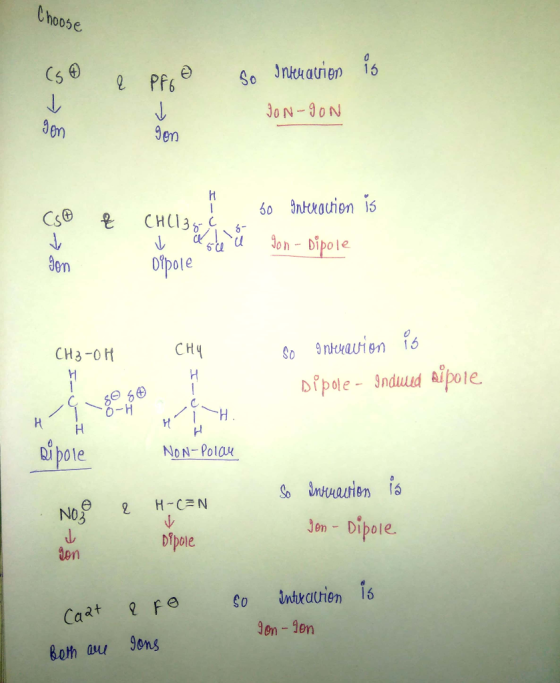
Choose the strongest non-covalent interaction that exists between the following pairs of compounds. Ion-Ion Ion-Dipole...
Choose the strongest non-covalent interaction that exists
between the following pairs of compounds.
Ion-Ion Ion-Dipole Dipole-Dipole Dipole-Induced Dipole Induced
Dipole-Induced Dipole Cs+ and
PF6-
| Tries 0/5 |
Ion-Ion Ion-Dipole Dipole-Dipole Dipole-Induced Dipole Induced
Dipole-Induced Dipole Cs+ and
CHCl3
| Tries 0/5 |
Ion-Ion Ion-Dipole Dipole-Dipole Dipole-Induced Dipole Induced
Dipole-Induced Dipole CH3OH and
CH4
| Tries 0/5 |
Ion-Ion Ion-Dipole Dipole-Dipole Dipole-Induced Dipole Induced
Dipole-Induced Dipole NO3- and
HCN
| Tries 0/1 |
Ion-Ion Ion-Dipole Dipole-Dipole Dipole-Induced Dipole Induced
Dipole-Induced Dipole Ca2+ and
F-
Homework Answers
Add Answer to:
Choose the strongest non-covalent interaction that exists between the following pairs of compounds. Ion-Ion Ion-Dipole...
Ion-dipole interactions can occur between any ion and any molecule with a dipole. Identify all of...
Ion-dipole interactions can occur between any ion and any molecule with a dipole. Identify all of the following pairs of species that can interact via ion-dipole forces. 1. Ca2+ and H2O 2. H2O and CH3OH 3. CH3OH and ClO2- 4. Ca2+ and F- 5. SO42- and CH4 6. Be2+ and CH3Cl
Ion-dipole interactions can occur between any ion and any molecule with a dipole. Identify all of...
Ion-dipole interactions can occur between any ion and any molecule with a dipole. Identify all of the following pairs of species that can interact via ion-dipole forces. a. ClO2- and CH4 b. Be2+ and CH3Cl c. H2O and CH3OH d. Ca2+ and ClO2- e. CH3OH and Mg2+ f. Li+ and H2O
In each of the pairs below, identify the type of intermolecular interaction that would exist between...
In each of the pairs below, identify the type of intermolecular interaction that would exist between the pair; if that pair were mixed together. Also in that pair, circle the molecule/ion which contributes the strongest to that pair's intermolecular interaction. (please explain each step and why) HF O2 CH4 NH2CH3 NCL3 Na+ CH3CH3 CH3CH2CH3 Cl2 I2 Li+ C2- NH2CH3 HF Ca2+ N2 need to identify each element as dipole, london, ion and if theres a hydrogen bond. lastly need to...
Math the pair of polymer chains with the STRONGEST intermolecular force interaction possible between the two...
 Math the pair of polymer chains with the STRONGEST
intermolecular force interaction possible between the two
chains
Match each material with the appropriate position is would be
isolated from in a fractional distillation tower
Question 8 4 pts Match the pair of polymer chains with the STRONGEST intermolecular force interaction possible between the two chains... nanciar A= tol.00+ B= to do Сн, H tot Loan, 107. 110. chy-ch,-ot. D= Match each material with the appropriate position it would be isolated...
Math the pair of polymer chains with the STRONGEST
intermolecular force interaction possible between the two
chains
Match each material with the appropriate position is would be
isolated from in a fractional distillation tower
Question 8 4 pts Match the pair of polymer chains with the STRONGEST intermolecular force interaction possible between the two chains... nanciar A= tol.00+ B= to do Сн, H tot Loan, 107. 110. chy-ch,-ot. D= Match each material with the appropriate position it would be isolated...
Predict the largest intermolecular force between the two molecules (or atoms) in each of the following...
 Predict the largest intermolecular force between the two
molecules (or atoms) in each of the following cases:(Choose
between: Ion-Dipole, Dipole-Dipole, H Bond, Ion-Induced Dipole,
Dipole-Induced Dipole, or Dispersion Forces)
a) (CH3)2CO -
(CH3)2CO (two molecules of acetone)
b)
H2 - Ne
c) H2O - H2
d) H2O - (CH3)2CO
e) HF - CH4
f) HF - (CH3)2CO
g) O2 - CH4
h) CH3OH - CH3CH2OH
Predict the largest intermolecular force between the two
molecules (or atoms) in each of the following cases:(Choose
between: Ion-Dipole, Dipole-Dipole, H Bond, Ion-Induced Dipole,
Dipole-Induced Dipole, or Dispersion Forces)
a) (CH3)2CO -
(CH3)2CO (two molecules of acetone)
b)
H2 - Ne
c) H2O - H2
d) H2O - (CH3)2CO
e) HF - CH4
f) HF - (CH3)2CO
g) O2 - CH4
h) CH3OH - CH3CH2OH
Bond Types Select the best descriptions for bonds between the listed atom pairs. non-polh covalent polar...
 Bond Types Select the best descriptions for bonds between the listed atom pairs. non-polh covalent polar covalent ionic oxygen-fluorine bromine-bromine potassium-chlorine nitrogen-nitrogen Submit Answer Tries 0/5 e Post Discussion Send Feedback
1. Select the two compounds that are more likely to be a gas at room temperature...
1. Select the two compounds that are more likely to be a gas at room temperature (as opposed to a liquid). CH4 CH3OH C2H6 H2O 2. The separation of charges within a polar molecule is called a(n) ________. polar bond strong attraction dipole ionic bond dipole-dipole 3. Which of the following intermolecular forces best describes why nonpolar molecules like gasoline (C8H18) have only limited solubility in water? dipole-dipole ion-dipole Both dipole-dipole and induced dipole-induced dipole induced dipole-induced dipole dipole-induced dipole...
Which of the following compounds exhibits dipole-dipole forces as its strongest attraction between molecules? He BrCH2CH2OH...
 Which of the following compounds exhibits dipole-dipole forces as its strongest attraction between molecules? He BrCH2CH2OH OCC14 CHzBr 02 Calculate the AGºrxn using the following information. 2HNO3(aq) + NO(g) + 3NO2(g) + H20 (1) AG rxn = ? AG°f(kJ/mol)= -110.9 87.6 51.3 -237.1 O +162.5 kJ O +51.0 kJ O-74.9 kJ O +54.5 kJ -87.6 kJ What is the pH of 0.626 Manilinium hydrochloride (C6H5NH3Cl) solution in water, given that Kb for aniline is 3.83 10-4? 8.61 1.81 O 5.39...
What type(s) of intermolecular forces are expected between SO2Cl2 molecules? ball & stick V - labels...
 What type(s) of intermolecular forces are expected between SO2Cl2 molecules? ball & stick V - labels Indicate with a Y (yes) or an N (no) which apply. dipole forces induced dipole forces hydrogen bonding What type(s) of intermolecular forces are expected between PC13 molecules? Choose all that apply dispersion hydrogen bonding dipole-dipole ion-ion What type(s) of intermolecular forces are expected between H20 molecules? ball & stick v + labels Indicate with a Y (yes) or an N (no) which apply....
QUESTION 1 Which of the following chemical species exhibits both ionic and covalent bonding? B205 0...
 QUESTION 1 Which of the following chemical species exhibits both ionic and covalent bonding? B205 0 0 u B. 02- C2H5NO2 OP. 504² E. NH4C2H302 QUESTION 2 Match the electron configurations to the appropriate transition metal species. Some choices may be selected more than once. - Cu *[Kr]4d10552 RXej4f145d10 - Cult U - Ni2+ [Ar]4513010 [Kr]4d10 - Zn2+ E. [Ar]3d8 - . . Agt cd cd2+ * [Ar]3d10 - Aut QUESTION 3 Which of the following chemical species has non-polar...
 Math the pair of polymer chains with the STRONGEST
intermolecular force interaction possible between the two
chains
Match each material with the appropriate position is would be
isolated from in a fractional distillation tower
Question 8 4 pts Match the pair of polymer chains with the STRONGEST intermolecular force interaction possible between the two chains... nanciar A= tol.00+ B= to do Сн, H tot Loan, 107. 110. chy-ch,-ot. D= Match each material with the appropriate position it would be isolated...
Math the pair of polymer chains with the STRONGEST
intermolecular force interaction possible between the two
chains
Match each material with the appropriate position is would be
isolated from in a fractional distillation tower
Question 8 4 pts Match the pair of polymer chains with the STRONGEST intermolecular force interaction possible between the two chains... nanciar A= tol.00+ B= to do Сн, H tot Loan, 107. 110. chy-ch,-ot. D= Match each material with the appropriate position it would be isolated...
 Predict the largest intermolecular force between the two
molecules (or atoms) in each of the following cases:(Choose
between: Ion-Dipole, Dipole-Dipole, H Bond, Ion-Induced Dipole,
Dipole-Induced Dipole, or Dispersion Forces)
a) (CH3)2CO -
(CH3)2CO (two molecules of acetone)
b)
H2 - Ne
c) H2O - H2
d) H2O - (CH3)2CO
e) HF - CH4
f) HF - (CH3)2CO
g) O2 - CH4
h) CH3OH - CH3CH2OH
Predict the largest intermolecular force between the two
molecules (or atoms) in each of the following cases:(Choose
between: Ion-Dipole, Dipole-Dipole, H Bond, Ion-Induced Dipole,
Dipole-Induced Dipole, or Dispersion Forces)
a) (CH3)2CO -
(CH3)2CO (two molecules of acetone)
b)
H2 - Ne
c) H2O - H2
d) H2O - (CH3)2CO
e) HF - CH4
f) HF - (CH3)2CO
g) O2 - CH4
h) CH3OH - CH3CH2OH
 Bond Types Select the best descriptions for bonds between the listed atom pairs. non-polh covalent polar covalent ionic oxygen-fluorine bromine-bromine potassium-chlorine nitrogen-nitrogen Submit Answer Tries 0/5 e Post Discussion Send Feedback
 Which of the following compounds exhibits dipole-dipole forces as its strongest attraction between molecules? He BrCH2CH2OH OCC14 CHzBr 02 Calculate the AGºrxn using the following information. 2HNO3(aq) + NO(g) + 3NO2(g) + H20 (1) AG rxn = ? AG°f(kJ/mol)= -110.9 87.6 51.3 -237.1 O +162.5 kJ O +51.0 kJ O-74.9 kJ O +54.5 kJ -87.6 kJ What is the pH of 0.626 Manilinium hydrochloride (C6H5NH3Cl) solution in water, given that Kb for aniline is 3.83 10-4? 8.61 1.81 O 5.39...
 What type(s) of intermolecular forces are expected between SO2Cl2 molecules? ball & stick V - labels Indicate with a Y (yes) or an N (no) which apply. dipole forces induced dipole forces hydrogen bonding What type(s) of intermolecular forces are expected between PC13 molecules? Choose all that apply dispersion hydrogen bonding dipole-dipole ion-ion What type(s) of intermolecular forces are expected between H20 molecules? ball & stick v + labels Indicate with a Y (yes) or an N (no) which apply....
 QUESTION 1 Which of the following chemical species exhibits both ionic and covalent bonding? B205 0 0 u B. 02- C2H5NO2 OP. 504² E. NH4C2H302 QUESTION 2 Match the electron configurations to the appropriate transition metal species. Some choices may be selected more than once. - Cu *[Kr]4d10552 RXej4f145d10 - Cult U - Ni2+ [Ar]4513010 [Kr]4d10 - Zn2+ E. [Ar]3d8 - . . Agt cd cd2+ * [Ar]3d10 - Aut QUESTION 3 Which of the following chemical species has non-polar...
Most questions answered within 3 hours.
-
Where is the error in this code sequence?
String s1 = "Hello";
String s2 = "ello";...
asked 10 months ago -
Financial data for Joel de Paris, Inc., for last year
follow:
Joel de Paris, Inc.
Balance...
asked 10 months ago -
Consider this reaction:
Al2(SO4)3 (aq)+ BaCl3
(aq) Al2Cl6 (aq)- +
3BaSO4(s) . What is the...
asked 10 months ago -
Suppose that Savneet is considering increasing her
recent random sample from 20 car rentals to 40...
asked 10 months ago -
Trucks arrive at an unloading terminal at an average rate of 120
per hour.
Trucks arrive...
asked 10 months ago -
Why are methanol and ethanol completely soluble in water while
octanol is not very little soluble....
asked 10 months ago -
A facilities manager at a university reads in a research report
that the mean amount of...
asked 10 months ago -
When the CuSO4 is rehydrated by adding water to the anhydrous
compound, is this an endothermic...
asked 10 months ago -
A ray of sunlight is passing from diamond into crown glass; the
angle of incidence is...
asked 10 months ago -
A block of mass 0.249 kg is placed on top of a light, vertical
spring of...
asked 10 months ago -
how do the kidneys compensate in the presences of acidosis
a) trigger hyperventilate
b) reserve acid...
asked 10 months ago -
Question 501 pts
The rental rate of capital to the firm increases. Which of the
following...
asked 10 months ago