Select the statements explaining how one can limit a radical chlorination reaction to produce mainly the monochlorinat...
 Select the statements explaining how one
can limit a radical chlorination reaction to produce mainly the
monochlorinated alkane.
Select the statements explaining how one
can limit a radical chlorination reaction to produce mainly the
monochlorinated alkane.
Homework Answers
3 answer is rightWrite the complete, detailed mechanism for the chlorination of methane, specifying the three stages of the reaction.
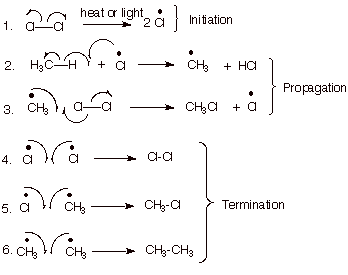
C. Transition State ModelsWrite the complete, detailed mechanism for the chlorination of methane, specifying the three stages of the reaction.
Add Answer to:
Select the statements explaining how one
can limit a radical chlorination reaction to produce mainly the
monochlorinat...
How many distinct monochlorinated products can result when 2-methylpropane is subjected to free radical chlorination? A)...
How many distinct monochlorinated products can result when 2-methylpropane is subjected to free radical chlorination? A) 1 B) 2 C) 3 D) 4 E) 5 Please explain
Chlorination of alkanes can produce a multitude of products. Determine the number of monochlorinated and dichlorinated...
 Chlorination of alkanes can produce a multitude of products. Determine the number of monochlorinated and dichlorinated products that can be obtained by chlorination of 3-methylpentane. (Consider constitutional isomers only. Do not count stereoisomers.) Cl2 rightarrow hv Number of monochlorinated products (C6H-13Cl) Number of dichlorinated products (C6H12Cl2)
Chlorination of alkanes can produce a multitude of products. Determine the number of monochlorinated and dichlorinate...
 Chlorination of alkanes can produce a multitude of products.
Determine the number of monochlorinated and dichlorinated products
that can be obtained by chlorination of 3-methylpentane. (Consider
constitutional isomers only. Do not count stereoisomers.)
Chlorination of alkanes can produce a multitude of products.
Determine the number of monochlorinated and dichlorinated products
that can be obtained by chlorination of 3-methylpentane. (Consider
constitutional isomers only. Do not count stereoisomers.)
Chlorination of alkanes can produce a multitude of products. Determine the number of monochlorinated and dichlorinated p...
Chlorination of alkanes can produce a multitude of products. Determine the number of monochlorinated and dichlorinated products that can be obtained by chlorination of 3-methylpentane. (Consider constitutional isomers only. Do not count stereoisomers.)
5. How many different monochlorinated products will result from the radical chlorination of methylcyclohexane? c) 3...
 5. How many different monochlorinated products will result from the radical chlorination of methylcyclohexane? c) 3 d) 2 b) 4 e) 5 a) 1 Which of the following could act as an electrophile? (5 pts) 6. c. NH CN а. b. H0 d. NH 7. Which of the following radicals is the least stable? a) CH2CH2CH(CHa) 2 ) снсH:C(сн) b) снiснсH(сH)» d) All have the same energy
please answer all questions the chlorination How many monochlorinated products would be obtained from the chlorin...
 please answer all questions
the chlorination How many monochlorinated products would be obtained from the chlorin Methane? Give the structure of all the products (6) ve the complete first two stes of the mechanism for the radical chlorination of propane to give any one of the two organic products. Use curved arrows. 8 points 12. The structures below show the step-wise bond making and bond breaking in this reaction. Draw curved arrows to show the electron flow that has occurred...
please answer all questions
the chlorination How many monochlorinated products would be obtained from the chlorin Methane? Give the structure of all the products (6) ve the complete first two stes of the mechanism for the radical chlorination of propane to give any one of the two organic products. Use curved arrows. 8 points 12. The structures below show the step-wise bond making and bond breaking in this reaction. Draw curved arrows to show the electron flow that has occurred...
0112012 WCF4 | 19) When 2,2-dimethylbutane is subjected to free radical chlorination distinct monochlorinated products are...
 0112012 WCF4 | 19) When 2,2-dimethylbutane is subjected to free radical chlorination distinct monochlorinated products are possible and_ _of these contain asymmetric carbon atoms. A) 4,2 B) 5,0 (13,0 D) 5,2 €) 4,0 c 20) Arrange the - cr. ILUULELO 1. Was the major product of this reaction the cis or the trans isomer? Explain. 2. Determine the percent yield of each isomer. (The weight of the other isomer is the difference between the mass of the product and the...
Give the complete mechanism for the radical chlorination the reaction potential energy diagram below for the...
 Give the complete mechanism for the radical chlorination the reaction potential energy diagram below for the reaction from A to X, Answer the following questions: 7 points Reaction 3) Wichstponis a) Indicate the intermediate(s) on the diagram with letters. b) How many transition states are there? c) Clearly show the free energy of activation for each step. d) What is the slowest step of the reaction? e) Which reaction is fastest and exergonic? 1) Which step is fastest and endergonic?...
What is the name of following substituent Select one tert-Butyl Isopropyl Butyl Isobutyl sec-Butyl How many...
 What is the name of following substituent Select one tert-Butyl Isopropyl Butyl Isobutyl sec-Butyl How many monochlorinated products are obtained from chlorination of the following compound ? Select one: 4 2 3 5 Spre Edit
help with page 23. How is the following step in the free radical chlorination mechanism described...
 help with page
23. How is the following step in the free radical chlorination mechanism described *CH3 + 'Cl → CHCI a. initiation step b . termination step c. propagation step d. electrophilic step 24. Which compound would give the following alkene as the major product in an elimination reaction with CH3CH2ONat? ? CHỊCHONa. Br Br 1 3 a. 1 b. 2 c. 3 d. 1 and 3 25. What is the product of the following reaction? OH H2SO4 он...
help with page
23. How is the following step in the free radical chlorination mechanism described *CH3 + 'Cl → CHCI a. initiation step b . termination step c. propagation step d. electrophilic step 24. Which compound would give the following alkene as the major product in an elimination reaction with CH3CH2ONat? ? CHỊCHONa. Br Br 1 3 a. 1 b. 2 c. 3 d. 1 and 3 25. What is the product of the following reaction? OH H2SO4 он...
 Chlorination of alkanes can produce a multitude of products. Determine the number of monochlorinated and dichlorinated products that can be obtained by chlorination of 3-methylpentane. (Consider constitutional isomers only. Do not count stereoisomers.) Cl2 rightarrow hv Number of monochlorinated products (C6H-13Cl) Number of dichlorinated products (C6H12Cl2)
 Chlorination of alkanes can produce a multitude of products.
Determine the number of monochlorinated and dichlorinated products
that can be obtained by chlorination of 3-methylpentane. (Consider
constitutional isomers only. Do not count stereoisomers.)
Chlorination of alkanes can produce a multitude of products.
Determine the number of monochlorinated and dichlorinated products
that can be obtained by chlorination of 3-methylpentane. (Consider
constitutional isomers only. Do not count stereoisomers.)
 5. How many different monochlorinated products will result from the radical chlorination of methylcyclohexane? c) 3 d) 2 b) 4 e) 5 a) 1 Which of the following could act as an electrophile? (5 pts) 6. c. NH CN а. b. H0 d. NH 7. Which of the following radicals is the least stable? a) CH2CH2CH(CHa) 2 ) снсH:C(сн) b) снiснсH(сH)» d) All have the same energy
 please answer all questions
the chlorination How many monochlorinated products would be obtained from the chlorin Methane? Give the structure of all the products (6) ve the complete first two stes of the mechanism for the radical chlorination of propane to give any one of the two organic products. Use curved arrows. 8 points 12. The structures below show the step-wise bond making and bond breaking in this reaction. Draw curved arrows to show the electron flow that has occurred...
please answer all questions
the chlorination How many monochlorinated products would be obtained from the chlorin Methane? Give the structure of all the products (6) ve the complete first two stes of the mechanism for the radical chlorination of propane to give any one of the two organic products. Use curved arrows. 8 points 12. The structures below show the step-wise bond making and bond breaking in this reaction. Draw curved arrows to show the electron flow that has occurred...
 0112012 WCF4 | 19) When 2,2-dimethylbutane is subjected to free radical chlorination distinct monochlorinated products are possible and_ _of these contain asymmetric carbon atoms. A) 4,2 B) 5,0 (13,0 D) 5,2 €) 4,0 c 20) Arrange the - cr. ILUULELO 1. Was the major product of this reaction the cis or the trans isomer? Explain. 2. Determine the percent yield of each isomer. (The weight of the other isomer is the difference between the mass of the product and the...
 Give the complete mechanism for the radical chlorination the reaction potential energy diagram below for the reaction from A to X, Answer the following questions: 7 points Reaction 3) Wichstponis a) Indicate the intermediate(s) on the diagram with letters. b) How many transition states are there? c) Clearly show the free energy of activation for each step. d) What is the slowest step of the reaction? e) Which reaction is fastest and exergonic? 1) Which step is fastest and endergonic?...
 What is the name of following substituent Select one tert-Butyl Isopropyl Butyl Isobutyl sec-Butyl How many monochlorinated products are obtained from chlorination of the following compound ? Select one: 4 2 3 5 Spre Edit
 help with page
23. How is the following step in the free radical chlorination mechanism described *CH3 + 'Cl → CHCI a. initiation step b . termination step c. propagation step d. electrophilic step 24. Which compound would give the following alkene as the major product in an elimination reaction with CH3CH2ONat? ? CHỊCHONa. Br Br 1 3 a. 1 b. 2 c. 3 d. 1 and 3 25. What is the product of the following reaction? OH H2SO4 он...
help with page
23. How is the following step in the free radical chlorination mechanism described *CH3 + 'Cl → CHCI a. initiation step b . termination step c. propagation step d. electrophilic step 24. Which compound would give the following alkene as the major product in an elimination reaction with CH3CH2ONat? ? CHỊCHONa. Br Br 1 3 a. 1 b. 2 c. 3 d. 1 and 3 25. What is the product of the following reaction? OH H2SO4 он...
Most questions answered within 3 hours.
-
Where is the error in this code sequence?
String s1 = "Hello";
String s2 = "ello";...
asked 10 months ago -
Financial data for Joel de Paris, Inc., for last year
follow:
Joel de Paris, Inc.
Balance...
asked 10 months ago -
Consider this reaction:
Al2(SO4)3 (aq)+ BaCl3
(aq) Al2Cl6 (aq)- +
3BaSO4(s) . What is the...
asked 10 months ago -
Suppose that Savneet is considering increasing her
recent random sample from 20 car rentals to 40...
asked 10 months ago -
Trucks arrive at an unloading terminal at an average rate of 120
per hour.
Trucks arrive...
asked 10 months ago -
Why are methanol and ethanol completely soluble in water while
octanol is not very little soluble....
asked 10 months ago -
A facilities manager at a university reads in a research report
that the mean amount of...
asked 10 months ago -
When the CuSO4 is rehydrated by adding water to the anhydrous
compound, is this an endothermic...
asked 10 months ago -
A ray of sunlight is passing from diamond into crown glass; the
angle of incidence is...
asked 10 months ago -
A block of mass 0.249 kg is placed on top of a light, vertical
spring of...
asked 10 months ago -
how do the kidneys compensate in the presences of acidosis
a) trigger hyperventilate
b) reserve acid...
asked 10 months ago -
Question 501 pts
The rental rate of capital to the firm increases. Which of the
following...
asked 10 months ago